Thank you for visiting SNEWPapers!
Sign up free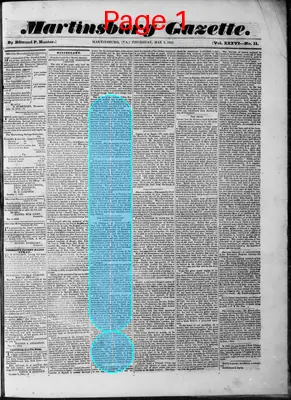
Editorial
May 7, 1835
Martinsburg Gazette
Martinsburg, Berkeley County, West Virginia
What is this article about?
Editorial from the National Intelligencer praises a pamphlet 'A Congress of Nations' by J. McFarlane of Richmond, advocating for an international tribunal to amicably resolve national disputes, promoting peace over war through Christian principles and impartial arbitration.
Clipping

OCR Quality
98%
Excellent
Full Text
From the National Intelligencer.
A VOICE FOR PEACE.
"A Congress of Nations." We have read with much pleasure a small well written Pamphlet with this title, from the press of J. McFarlane, of Richmond. Its object is the amicable adjustment of National Differences, and the important subject is treated in a fine spirit, and in a good plain style; and well calculated to recommend a practical Christian spirit in the settlement of all differences, in preference to the vice and folly of resorting to violence and war. where peaceful means would better accomplish the end.
As a specimen of the contents of this little tract, we give our readers the following extracts, in the hope that they may induce them to procure the pamphlet, and enjoy the satisfaction which we have had in reading it.
"National differences may be amicably adjusted by a Congress of Nations or Supreme Court of the civilized World. Every nation should be equally represented. The tribunal being the most important and honorable one in the world, would consist of the most accomplished civilians, who look to no higher office, and whose characters would give weight to their decisions. Its jurisdiction should extend to all the nations represented ; and it should be the final arbiter in all cases. where national disputes are not amicably adjusted between the parties.
A tribunal thus constituted, would be impartial. Every nation, in deciding the question of peace or war for itself, decides on its own case, and is an interested and consequently a partial judge. Both parties profess to be governed by the principles of justice; and both attempt to justify their conduct by the laws of nations. In the proposed Congress of Nations, this absurdity of uniting the party and the judge would be avoided. This court would consist of the representatives of so many nations that a large majority would be disinterested in any controversy that might arise, and not likely to unite in any bias for, or against, either of the parties.
Such a tribunal would need no armed force to compel obedience to its decisions. It would be competent to a right decision of national controversies. It would be to the community of nations what the Supreme Court is to any one nation. Composed of the most learned and distinguished civilians in the world, it would combine all the advantages for a right decision which it is possible for men to possess. The weakest nation would come to this court on an equality with the most powerful. The absurdity of measuring justice by power, which now decides so many national differences, would be avoided; and justice would be obtained much more frequently than by the present mode.
This mode of terminating national disputes, would be economical. The expense of our representation would not exceed the amount of the whiskey consumed in our army in time of peace, which in 1830 was twenty thousand dollars. It would save us the annual expenditure of one hundred thousand dollars to pay an army. and nine hundred thousand dollars to arm and equip them; and it would save the employment of an unproductive capital of 12 millions in their service; besides an immense expenditure for fortifications and other preparations of defence, and the inconceivable destruction of life and property in actual war, If the whole amount thus expended in violating the plain commands of Jehovah, and bringing down his displeasure upon the nations, we re devoted to the literary, moral, and religious improvement of the people, the earth would be converted into a paradise.
This Congress could examine and decide upon any case at once without waiting for instructions from a distance. Much time is now wasted in fruitless negociations, during which the people are held in suspense, their business deranged, and the worst feelings of the human heart excited. The amicable and speedy adjustment of national differences by a tribunal commanding the confidence of all parties, would greatly allay that spirit of jealousy and illwill which so extensively prevails between the people of different countries. and promote in its place a feeling of love and friendship, more favorable to intellectual and moral improvement and the diffusion of christianity in the world."
A VOICE FOR PEACE.
"A Congress of Nations." We have read with much pleasure a small well written Pamphlet with this title, from the press of J. McFarlane, of Richmond. Its object is the amicable adjustment of National Differences, and the important subject is treated in a fine spirit, and in a good plain style; and well calculated to recommend a practical Christian spirit in the settlement of all differences, in preference to the vice and folly of resorting to violence and war. where peaceful means would better accomplish the end.
As a specimen of the contents of this little tract, we give our readers the following extracts, in the hope that they may induce them to procure the pamphlet, and enjoy the satisfaction which we have had in reading it.
"National differences may be amicably adjusted by a Congress of Nations or Supreme Court of the civilized World. Every nation should be equally represented. The tribunal being the most important and honorable one in the world, would consist of the most accomplished civilians, who look to no higher office, and whose characters would give weight to their decisions. Its jurisdiction should extend to all the nations represented ; and it should be the final arbiter in all cases. where national disputes are not amicably adjusted between the parties.
A tribunal thus constituted, would be impartial. Every nation, in deciding the question of peace or war for itself, decides on its own case, and is an interested and consequently a partial judge. Both parties profess to be governed by the principles of justice; and both attempt to justify their conduct by the laws of nations. In the proposed Congress of Nations, this absurdity of uniting the party and the judge would be avoided. This court would consist of the representatives of so many nations that a large majority would be disinterested in any controversy that might arise, and not likely to unite in any bias for, or against, either of the parties.
Such a tribunal would need no armed force to compel obedience to its decisions. It would be competent to a right decision of national controversies. It would be to the community of nations what the Supreme Court is to any one nation. Composed of the most learned and distinguished civilians in the world, it would combine all the advantages for a right decision which it is possible for men to possess. The weakest nation would come to this court on an equality with the most powerful. The absurdity of measuring justice by power, which now decides so many national differences, would be avoided; and justice would be obtained much more frequently than by the present mode.
This mode of terminating national disputes, would be economical. The expense of our representation would not exceed the amount of the whiskey consumed in our army in time of peace, which in 1830 was twenty thousand dollars. It would save us the annual expenditure of one hundred thousand dollars to pay an army. and nine hundred thousand dollars to arm and equip them; and it would save the employment of an unproductive capital of 12 millions in their service; besides an immense expenditure for fortifications and other preparations of defence, and the inconceivable destruction of life and property in actual war, If the whole amount thus expended in violating the plain commands of Jehovah, and bringing down his displeasure upon the nations, we re devoted to the literary, moral, and religious improvement of the people, the earth would be converted into a paradise.
This Congress could examine and decide upon any case at once without waiting for instructions from a distance. Much time is now wasted in fruitless negociations, during which the people are held in suspense, their business deranged, and the worst feelings of the human heart excited. The amicable and speedy adjustment of national differences by a tribunal commanding the confidence of all parties, would greatly allay that spirit of jealousy and illwill which so extensively prevails between the people of different countries. and promote in its place a feeling of love and friendship, more favorable to intellectual and moral improvement and the diffusion of christianity in the world."
What sub-type of article is it?
War Or Peace
Foreign Affairs
Moral Or Religious
What keywords are associated?
Congress Of Nations
Peaceful Arbitration
International Disputes
Christian Peace
Anti War
Supreme Court Of Nations
What entities or persons were involved?
Congress Of Nations
J. Mcfarlane
National Intelligencer
Editorial Details
Primary Topic
Advocacy For A Congress Of Nations To Resolve International Disputes Peacefully
Stance / Tone
Supportive Of Peaceful Arbitration And Christian Principles Over War
Key Figures
Congress Of Nations
J. Mcfarlane
National Intelligencer
Key Arguments
National Differences Can Be Adjusted By A Congress Of Nations Or Supreme Court Of The Civilized World With Equal Representation.
The Tribunal Would Be Impartial, Avoiding The Bias Of Nations Judging Their Own Cases.
No Armed Force Needed; Composed Of Accomplished Civilians For Right Decisions.
Weakest Nation Equals The Powerful; Avoids Measuring Justice By Power.
Economical: Saves Military Expenses, Which Could Fund Moral And Religious Improvements.
Speedy Decisions Without Fruitless Negotiations, Reducing Jealousy And Promoting Friendship And Christianity.