Thank you for visiting SNEWPapers!
Sign up free
Editorial
March 19, 1829
Litchfield Enquirer
Litchfield, Litchfield County, Connecticut
What is this article about?
This editorial, 'The Public cross-examined: No. III.', argues for electing talented Connecticut representatives to Congress to protect small states' rights against larger states' dominance, critiques declining influence, and condemns past members for supporting slavery extension in Missouri.
Clipping
OCR Quality
98%
Excellent
Full Text
FOR THE LITCHFIELD ENQUIRER.
The Public cross-examined: No. III.
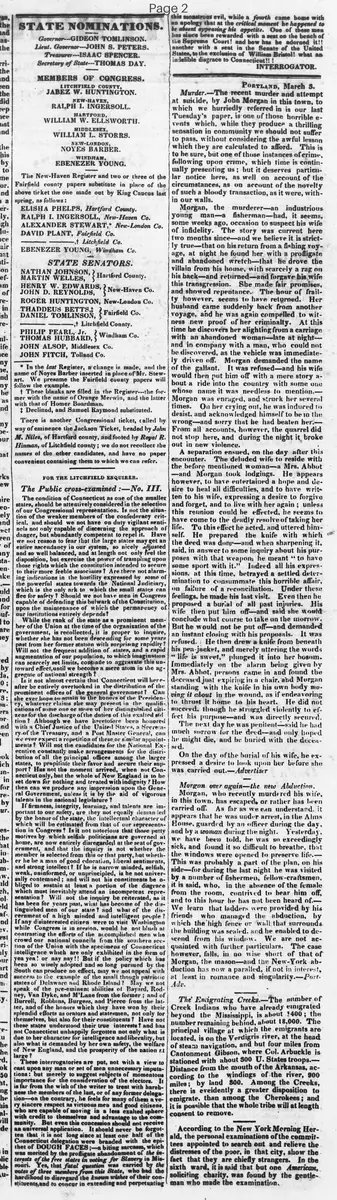
The condition of Connecticut as one of the smaller states, should be attentively considered in the selection of our Congressional representation. Is not the situation of the weaker members of the confederacy critical, and should we not have on duty vigilant sentinels not only capable of discerning the approach of danger, but abundantly competent to repel it. Have we not reason to fear that the large states may get an entire ascendancy in our system, so nicely adjusted and so well balanced, and at length not only feel the disposition, but exercise the power of trampling upon those rights which the constitution intended to secure to their more feeble associates? Are there not alarming indications in the hostility expressed by some of the powerful states towards the National Judiciary, which is the only ark to which the small states can flee for safety? Should we not have men in Congress capable of defending this bulwark of the Constitution, upon the maintenance of which the permanency of our institutions entirely depends?
While the rank of the state as a prominent member of the Union at the time of the organization of the government, is recollected, it is proper to inquire, whether she has not been descending for some years past from her former station with surprising rapidity? Will not the frequent addition of states, and a rapid augmentation of our population, to which imagination can scarcely set limits, continue to aggravate this untoward effect, until we become a mere atom in the aggregate of national strength?
Is it not almost certain that Connecticut will hereafter be entirely overlooked in the distribution of the prominent offices of the general government? Can she ever hope to attain to the honors of the Presidency, whatever claims she may present in the qualifications of some one or more of her distinguished citizens for the discharge of the duties of this exalted station? Although we have heretofore been honored with a Chief Justice of the United States, a Secretary of the Treasury, and a Post Master General, can we ever expect a repetition of these or similar appointments? Will not the candidates for the National Executive constantly make arrangements for the distribution of all the principal offices among the larger states, to propitiate their favor and secure their support? Has not the moment arrived, when not Connecticut only, but the whole of New England is to be set down for nothing and treated with indignity? How then can we produce any impression upon the General Government, unless it is by the aid of vigorous talents in the national legislature?
If firmness, integrity, learning, and talents are important to our safety, are they not equally demanded by the honor of the state, the intellectual character of which will be estimated from that of our representation in Congress? Is it not notorious that those petty motives by which selfish politicians are governed at home, are now entirely disregarded at the seat of government, and that the inquiry is not whether the member is selected from this or that party, but whether he be a man of good education, liberal sentiments, and strong intellect? If he is narrow minded, selfish, weak, uninformed, or unprincipled, is he not universally contemned; and will not his constituents be obliged to sustain at least a portion of the disgrace which must inevitably attend an incompetent representation? Will not the inquiry be reiterated, as it has been for years past, what has become of the distinguished men of our state? and what of the discernment of a high minded and intelligent people?
If any disinterested citizen were to visit Washington while Congress is in session, would he not blush at contrasting the efforts of the accomplished men who crowd our national councils from the southern section of the Union with the specimens of Connecticut intelligence which are only exhibited in the form of yea yea! or nay nay!! But if the policy which has been so wisely adopted and so long pursued by the South can produce no effect, may we not appeal with success to the example of the small though patriotic states of Delaware and Rhode Island? May we not speak of the pre-eminent abilities of Bayard, Rodney, Van Dyke, and M'Lane from the former; and of Burrell, Robbins, Burgess, and Pierce—from the latter, and of the honors which they have won by their splendid efforts as orators and statesmen, not only for themselves, but also for their constituents? Have not these states understood their true interests? and has not Connecticut unhappily forgotten not only what is due to her character for intelligence and liberality, but also what is demanded by her own safety, the welfare of New England, and the prosperity of the nation at large?
These interrogatories are put, not with a view to cast upon any man or set of men unnecessary imputations: but merely to suggest subjects of momentous importance for the consideration of the electors. It is far from the wish of the writer to treat with harshness the members of the last, or of any former delegation—on the contrary, he feels for many of them a very sincere respect as virtuous men and good citizens, who are capable of moving in a less exalted sphere with credit to themselves and advantage to the community. But even this concession should not receive an universal application.
It should never be forgotten that it is not long since at least one half of the Connecticut delegation were branded with the epithet of DOUGH FACES;—a biting sarcasm, which was merited by the profligate abandonment of the interests of the free states in voting for Slavery in Missouri. Yes, that fatal question was carried by the votes of three members from this State, who had the hardihood to disregard the known wishes of their constituents, and to concur in extending and perpetuating this monstrous evil, while a fourth came home with an apology that at the critical moment he happened to be absent appeasing his appetite. One of these men has since been rewarded with a seat on the bench of the Supreme Court! and how has he adorned it!! another with a seat in the Senate of the United States, to the exclusion of William Bristol! what an indelible disgrace to Connecticut!!!
INTERROGATOR.
The Public cross-examined: No. III.
The condition of Connecticut as one of the smaller states, should be attentively considered in the selection of our Congressional representation. Is not the situation of the weaker members of the confederacy critical, and should we not have on duty vigilant sentinels not only capable of discerning the approach of danger, but abundantly competent to repel it. Have we not reason to fear that the large states may get an entire ascendancy in our system, so nicely adjusted and so well balanced, and at length not only feel the disposition, but exercise the power of trampling upon those rights which the constitution intended to secure to their more feeble associates? Are there not alarming indications in the hostility expressed by some of the powerful states towards the National Judiciary, which is the only ark to which the small states can flee for safety? Should we not have men in Congress capable of defending this bulwark of the Constitution, upon the maintenance of which the permanency of our institutions entirely depends?
While the rank of the state as a prominent member of the Union at the time of the organization of the government, is recollected, it is proper to inquire, whether she has not been descending for some years past from her former station with surprising rapidity? Will not the frequent addition of states, and a rapid augmentation of our population, to which imagination can scarcely set limits, continue to aggravate this untoward effect, until we become a mere atom in the aggregate of national strength?
Is it not almost certain that Connecticut will hereafter be entirely overlooked in the distribution of the prominent offices of the general government? Can she ever hope to attain to the honors of the Presidency, whatever claims she may present in the qualifications of some one or more of her distinguished citizens for the discharge of the duties of this exalted station? Although we have heretofore been honored with a Chief Justice of the United States, a Secretary of the Treasury, and a Post Master General, can we ever expect a repetition of these or similar appointments? Will not the candidates for the National Executive constantly make arrangements for the distribution of all the principal offices among the larger states, to propitiate their favor and secure their support? Has not the moment arrived, when not Connecticut only, but the whole of New England is to be set down for nothing and treated with indignity? How then can we produce any impression upon the General Government, unless it is by the aid of vigorous talents in the national legislature?
If firmness, integrity, learning, and talents are important to our safety, are they not equally demanded by the honor of the state, the intellectual character of which will be estimated from that of our representation in Congress? Is it not notorious that those petty motives by which selfish politicians are governed at home, are now entirely disregarded at the seat of government, and that the inquiry is not whether the member is selected from this or that party, but whether he be a man of good education, liberal sentiments, and strong intellect? If he is narrow minded, selfish, weak, uninformed, or unprincipled, is he not universally contemned; and will not his constituents be obliged to sustain at least a portion of the disgrace which must inevitably attend an incompetent representation? Will not the inquiry be reiterated, as it has been for years past, what has become of the distinguished men of our state? and what of the discernment of a high minded and intelligent people?
If any disinterested citizen were to visit Washington while Congress is in session, would he not blush at contrasting the efforts of the accomplished men who crowd our national councils from the southern section of the Union with the specimens of Connecticut intelligence which are only exhibited in the form of yea yea! or nay nay!! But if the policy which has been so wisely adopted and so long pursued by the South can produce no effect, may we not appeal with success to the example of the small though patriotic states of Delaware and Rhode Island? May we not speak of the pre-eminent abilities of Bayard, Rodney, Van Dyke, and M'Lane from the former; and of Burrell, Robbins, Burgess, and Pierce—from the latter, and of the honors which they have won by their splendid efforts as orators and statesmen, not only for themselves, but also for their constituents? Have not these states understood their true interests? and has not Connecticut unhappily forgotten not only what is due to her character for intelligence and liberality, but also what is demanded by her own safety, the welfare of New England, and the prosperity of the nation at large?
These interrogatories are put, not with a view to cast upon any man or set of men unnecessary imputations: but merely to suggest subjects of momentous importance for the consideration of the electors. It is far from the wish of the writer to treat with harshness the members of the last, or of any former delegation—on the contrary, he feels for many of them a very sincere respect as virtuous men and good citizens, who are capable of moving in a less exalted sphere with credit to themselves and advantage to the community. But even this concession should not receive an universal application.
It should never be forgotten that it is not long since at least one half of the Connecticut delegation were branded with the epithet of DOUGH FACES;—a biting sarcasm, which was merited by the profligate abandonment of the interests of the free states in voting for Slavery in Missouri. Yes, that fatal question was carried by the votes of three members from this State, who had the hardihood to disregard the known wishes of their constituents, and to concur in extending and perpetuating this monstrous evil, while a fourth came home with an apology that at the critical moment he happened to be absent appeasing his appetite. One of these men has since been rewarded with a seat on the bench of the Supreme Court! and how has he adorned it!! another with a seat in the Senate of the United States, to the exclusion of William Bristol! what an indelible disgrace to Connecticut!!!
INTERROGATOR.
What sub-type of article is it?
Constitutional
Partisan Politics
Slavery Abolition
What keywords are associated?
Connecticut Representation
Small States Rights
Congressional Talents
Missouri Slavery
Dough Faces
National Judiciary
New England Interests
What entities or persons were involved?
Connecticut
Large States
National Judiciary
New England
Delaware
Rhode Island
Bayard
Rodney
Van Dyke
M'lane
Burrell
Robbins
Burgess
Pierce
Dough Faces
William Bristol
Editorial Details
Primary Topic
Selection Of Talented Congressional Representatives For Connecticut To Protect Small States' Rights
Stance / Tone
Urgent Exhortation For Vigilant, Capable Representation Against Large States' Dominance And Past Failures On Slavery
Key Figures
Connecticut
Large States
National Judiciary
New England
Delaware
Rhode Island
Bayard
Rodney
Van Dyke
M'lane
Burrell
Robbins
Burgess
Pierce
Dough Faces
William Bristol
Key Arguments
Small States Like Connecticut Need Vigilant, Talented Representatives To Counter Large States' Potential Dominance
Connecticut's Influence In National Government Is Declining Rapidly Due To Population Growth And New States
Past Connecticut Delegation Failed By Supporting Extension Of Slavery In Missouri Against Constituents' Wishes
National Success Depends On Intellect And Firmness, Not Party Loyalty
Examples From Delaware And Rhode Island Show Benefits Of Electing Able Representatives
Criticism Of 'Dough Faces' For Betraying Free States' Interests