Thank you for visiting SNEWPapers!
Sign up free
Literary
November 10, 1794
Gazette Of The United States And Daily Evening Advertiser
Philadelphia, Philadelphia County, Pennsylvania
What is this article about?
Section III of 'The Level of Europe and America' outlines six principal axioms of political economy by Laroque, covering specie's role in power, population growth via cultivation, the need for rapid population increase in new societies, corruption's sources, wartime prosperity means, and morality's guarantee of empire duration.
Clipping
OCR Quality
95%
Excellent
Full Text
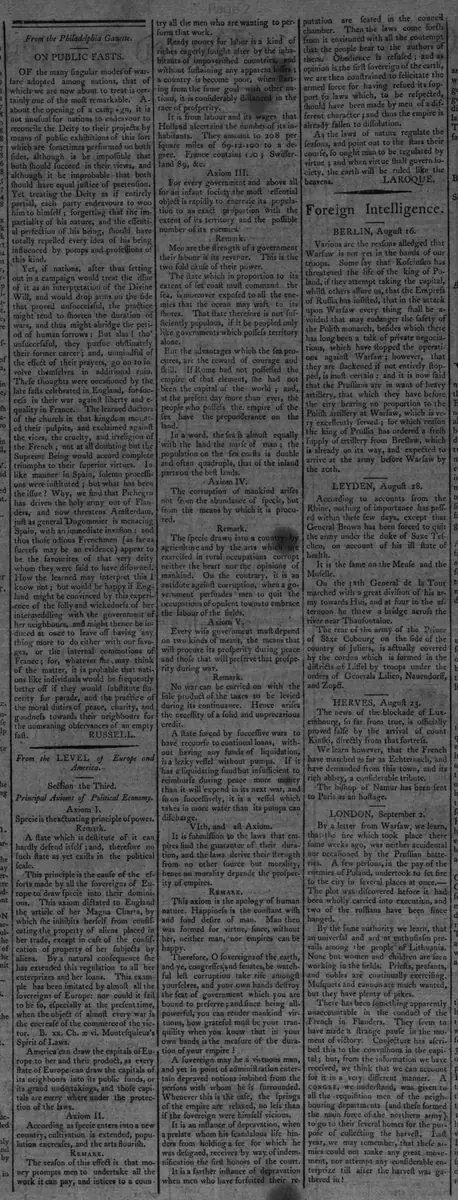
From the LEVEL of Europe and America.
Section the Third.
Principal Axioms of Political Economy.
Axiom I.
Specie is the actuating principle of power.
Remark.
A state which is destitute of it can hardly defend itself; and, therefore no such state as yet exists in the political scale.
This principle is the cause of the efforts made by all the sovereigns of Europe to draw specie into their dominions. This axiom dictated to England the article of her Magna Charta, by which she inhibits herself from confiscating the property of aliens placed in her trade, except in case of the confiscation of property of her subjects by aliens. By a natural consequence she has extended this regulation to all her enterprises and her loans. This example has been imitated by almost all the sovereigns of Europe: nor could it fail to be so, especially at the present time, when the object of almost every war is the increase of the commerce of the victor. B. xx. Ch. vi. Montesquieu's Spirit of Laws.
America can draw the capitals of Europe to her and their product, as every state of Europe can draw the capitals of its neighbours into its public funds, or its grand undertakings, and those capitals are every where under the protection of the laws.
Axiom II.
According as specie enters into a new country, cultivation is extended, population increases, and the arts flourish.
Remark.
The reason of this effect is that money prompts men to undertake all the work it can pay, and entices to a country all the men who are wanting to perform that work.
Ready money for labor is a kind of riches eagerly sought after by the inhabitants of impoverished countries, and without sustaining any apparent losses; a country is become poor, when starting from the same goal with other nations, it is considerably distanced in the race of prosperity.
It is from labour and its wages that Holland ascertains the number of its inhabitants. They amount to 208 per square miles of 69-12-100 to a degree. France contains 120; Switzerland 89, &c.
Axiom III.
For every government and above all for an infant society the most essential object is rapidly to increase its population to an exact proportion with the extent of its territory and the possible number of its enemies.
Remark.
Men are the strength of a government their labour is its revenue. This is the two fold cause of their power.
The state which in proportion to its extent of sea coast must command the sea, is moreover exposed to all the enemies that the ocean may waft to its shores. That state therefore is not sufficiently populous, if it be peopled only like governments which possess territory alone.
But the advantages which the sea procures, are the reward of courage and skill. If Rome had not possessed the empire of that element, she had not been the capital of the world; and, at the present day more than ever, the people who possess the empire of the sea have the preponderance on the land.
In a word, the sea is almost equally with the land the nurse of man; the population on the sea coasts is double and often quadruple, that of the inland parts on the best lands.
Axiom IV.
The corruption of mankind arises not from the abundance of specie, but from the means by which it is procured.
Remark.
The specie drawn into a country by agriculture and by the arts which are exercised in rural occupations corrupt neither the heart nor the opinions of mankind. On the contrary, it is an antidote against corruption, when a government persuades men to quit the occupations of opulent towns to embrace the labour of the fields.
Axiom V.
Every wise government must depend on two kinds of means, the means that will procure its prosperity during peace and those that will preserve that prosperity during war.
Remark.
No war can be carried on with the sole product of the taxes to be levied during its continuance. Hence arises the necessity of a solid and unprecarious credit.
A state forced by successive wars to have recourse to continual loans, without having any funds of liquidation, is a leaky vessel without pumps. If it has a liquidating fund but insufficient to reimburse during peace more money than it will expend in its next war, and so on successively, it is a vessel which takes in more water than its pumps can discharge.
VIth, and last Axiom.
It is submission to the laws that empires find the guarantee of their duration, and the laws derive their strength from no other source but morality, hence on morality depends the prosperity of empires.
REMARK.
This axiom is the apology of human nature. Happiness is the constant wish and fond desire of man. Man then was formed for virtue, since, without her, neither man, nor empires can be happy.
Therefore, O sovereigns of the earth, and ye, congresses and senates, be watchful lest corruption take rise amongst yourselves, and your own hands destroy the seat of government which you are bound to preserve; and since being all-powerful, you can render mankind virtuous, how grateful must be your tranquility when you know that in your own hands is the measure of the duration of your empire!
A sovereign may be a virtuous man. and yet in point of administration entertain depraved notions imbibed from the persons with whom he is surrounded.
Whenever this is the case, the springs of the empire are relaxed, no less than if the sovereign were himself vicious.
It is an instance of depravation, when a prelate whom his scandalous life hinders from holding a see for which he was designed, receives by way of indemnification the first honors of the court.
It is a farther instance of depravation when men who have forfeited their reputation are seated in the council chamber. Then the laws come forth from it environed with all the contempt that the people bear to the authors of them: Obedience is refused; and as opinion is the first sovereign of the earth, we are then constrained to felicitate the armed force for having refused its support to laws which, to be respected, should have been made by men of a different character; and thus the empire is already fallen to dissolution.
As the laws of nature regulate the seasons, and point out to the stars their course, so ought man to be regulated by virtue; and when virtue shall govern society, the earth will be ruled like the heavens.
LAROQUE.
Section the Third.
Principal Axioms of Political Economy.
Axiom I.
Specie is the actuating principle of power.
Remark.
A state which is destitute of it can hardly defend itself; and, therefore no such state as yet exists in the political scale.
This principle is the cause of the efforts made by all the sovereigns of Europe to draw specie into their dominions. This axiom dictated to England the article of her Magna Charta, by which she inhibits herself from confiscating the property of aliens placed in her trade, except in case of the confiscation of property of her subjects by aliens. By a natural consequence she has extended this regulation to all her enterprises and her loans. This example has been imitated by almost all the sovereigns of Europe: nor could it fail to be so, especially at the present time, when the object of almost every war is the increase of the commerce of the victor. B. xx. Ch. vi. Montesquieu's Spirit of Laws.
America can draw the capitals of Europe to her and their product, as every state of Europe can draw the capitals of its neighbours into its public funds, or its grand undertakings, and those capitals are every where under the protection of the laws.
Axiom II.
According as specie enters into a new country, cultivation is extended, population increases, and the arts flourish.
Remark.
The reason of this effect is that money prompts men to undertake all the work it can pay, and entices to a country all the men who are wanting to perform that work.
Ready money for labor is a kind of riches eagerly sought after by the inhabitants of impoverished countries, and without sustaining any apparent losses; a country is become poor, when starting from the same goal with other nations, it is considerably distanced in the race of prosperity.
It is from labour and its wages that Holland ascertains the number of its inhabitants. They amount to 208 per square miles of 69-12-100 to a degree. France contains 120; Switzerland 89, &c.
Axiom III.
For every government and above all for an infant society the most essential object is rapidly to increase its population to an exact proportion with the extent of its territory and the possible number of its enemies.
Remark.
Men are the strength of a government their labour is its revenue. This is the two fold cause of their power.
The state which in proportion to its extent of sea coast must command the sea, is moreover exposed to all the enemies that the ocean may waft to its shores. That state therefore is not sufficiently populous, if it be peopled only like governments which possess territory alone.
But the advantages which the sea procures, are the reward of courage and skill. If Rome had not possessed the empire of that element, she had not been the capital of the world; and, at the present day more than ever, the people who possess the empire of the sea have the preponderance on the land.
In a word, the sea is almost equally with the land the nurse of man; the population on the sea coasts is double and often quadruple, that of the inland parts on the best lands.
Axiom IV.
The corruption of mankind arises not from the abundance of specie, but from the means by which it is procured.
Remark.
The specie drawn into a country by agriculture and by the arts which are exercised in rural occupations corrupt neither the heart nor the opinions of mankind. On the contrary, it is an antidote against corruption, when a government persuades men to quit the occupations of opulent towns to embrace the labour of the fields.
Axiom V.
Every wise government must depend on two kinds of means, the means that will procure its prosperity during peace and those that will preserve that prosperity during war.
Remark.
No war can be carried on with the sole product of the taxes to be levied during its continuance. Hence arises the necessity of a solid and unprecarious credit.
A state forced by successive wars to have recourse to continual loans, without having any funds of liquidation, is a leaky vessel without pumps. If it has a liquidating fund but insufficient to reimburse during peace more money than it will expend in its next war, and so on successively, it is a vessel which takes in more water than its pumps can discharge.
VIth, and last Axiom.
It is submission to the laws that empires find the guarantee of their duration, and the laws derive their strength from no other source but morality, hence on morality depends the prosperity of empires.
REMARK.
This axiom is the apology of human nature. Happiness is the constant wish and fond desire of man. Man then was formed for virtue, since, without her, neither man, nor empires can be happy.
Therefore, O sovereigns of the earth, and ye, congresses and senates, be watchful lest corruption take rise amongst yourselves, and your own hands destroy the seat of government which you are bound to preserve; and since being all-powerful, you can render mankind virtuous, how grateful must be your tranquility when you know that in your own hands is the measure of the duration of your empire!
A sovereign may be a virtuous man. and yet in point of administration entertain depraved notions imbibed from the persons with whom he is surrounded.
Whenever this is the case, the springs of the empire are relaxed, no less than if the sovereign were himself vicious.
It is an instance of depravation, when a prelate whom his scandalous life hinders from holding a see for which he was designed, receives by way of indemnification the first honors of the court.
It is a farther instance of depravation when men who have forfeited their reputation are seated in the council chamber. Then the laws come forth from it environed with all the contempt that the people bear to the authors of them: Obedience is refused; and as opinion is the first sovereign of the earth, we are then constrained to felicitate the armed force for having refused its support to laws which, to be respected, should have been made by men of a different character; and thus the empire is already fallen to dissolution.
As the laws of nature regulate the seasons, and point out to the stars their course, so ought man to be regulated by virtue; and when virtue shall govern society, the earth will be ruled like the heavens.
LAROQUE.
What sub-type of article is it?
Essay
What themes does it cover?
Political
Commerce Trade
Moral Virtue
What keywords are associated?
Political Economy
Specie
Population Growth
Corruption
Morality Governance
Commerce
Sovereigns
Empires
What entities or persons were involved?
Laroque
Literary Details
Title
Section The Third. Principal Axioms Of Political Economy
Author
Laroque
Key Lines
Specie Is The Actuating Principle Of Power.
According As Specie Enters Into A New Country, Cultivation Is Extended, Population Increases, And The Arts Flourish.
For Every Government And Above All For An Infant Society The Most Essential Object Is Rapidly To Increase Its Population To An Exact Proportion With The Extent Of Its Territory And The Possible Number Of Its Enemies.
The Corruption Of Mankind Arises Not From The Abundance Of Specie, But From The Means By Which It Is Procured.
It Is Submission To The Laws That Empires Find The Guarantee Of Their Duration, And The Laws Derive Their Strength From No Other Source But Morality, Hence On Morality Depends The Prosperity Of Empires.