Thank you for visiting SNEWPapers!
Sign up free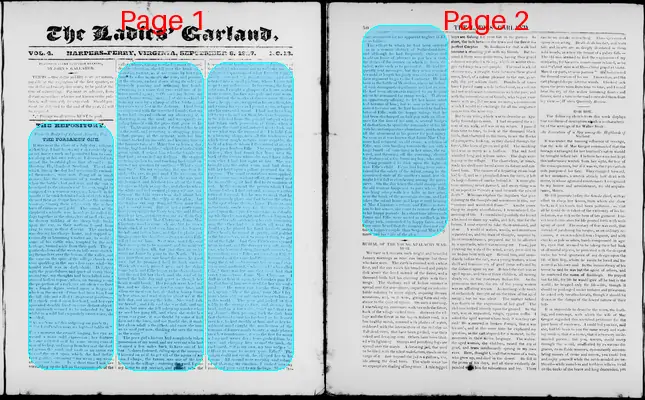
Literary
September 8, 1827
The Ladies' Garland
Harpers Ferry, Jefferson County, West Virginia
What is this article about?
In the Scottish Highlands, a traveler encounters mad Effie Ochs, forsaken by her soldier lover Jamie Mac Claymore after he leaves for duty. She searches desperately for her lost child. Jamie returns wounded from Waterloo, reunites with her, and their hidden child is restored, leading to their happy marriage.
Merged-components note: This is a single continuous literary story 'The Forsaken One' that spans across pages 1 and 2, ending abruptly on page 1 and continuing directly on page 2.
Clippings
1 of 2
OCR Quality
95%
Excellent
Full Text
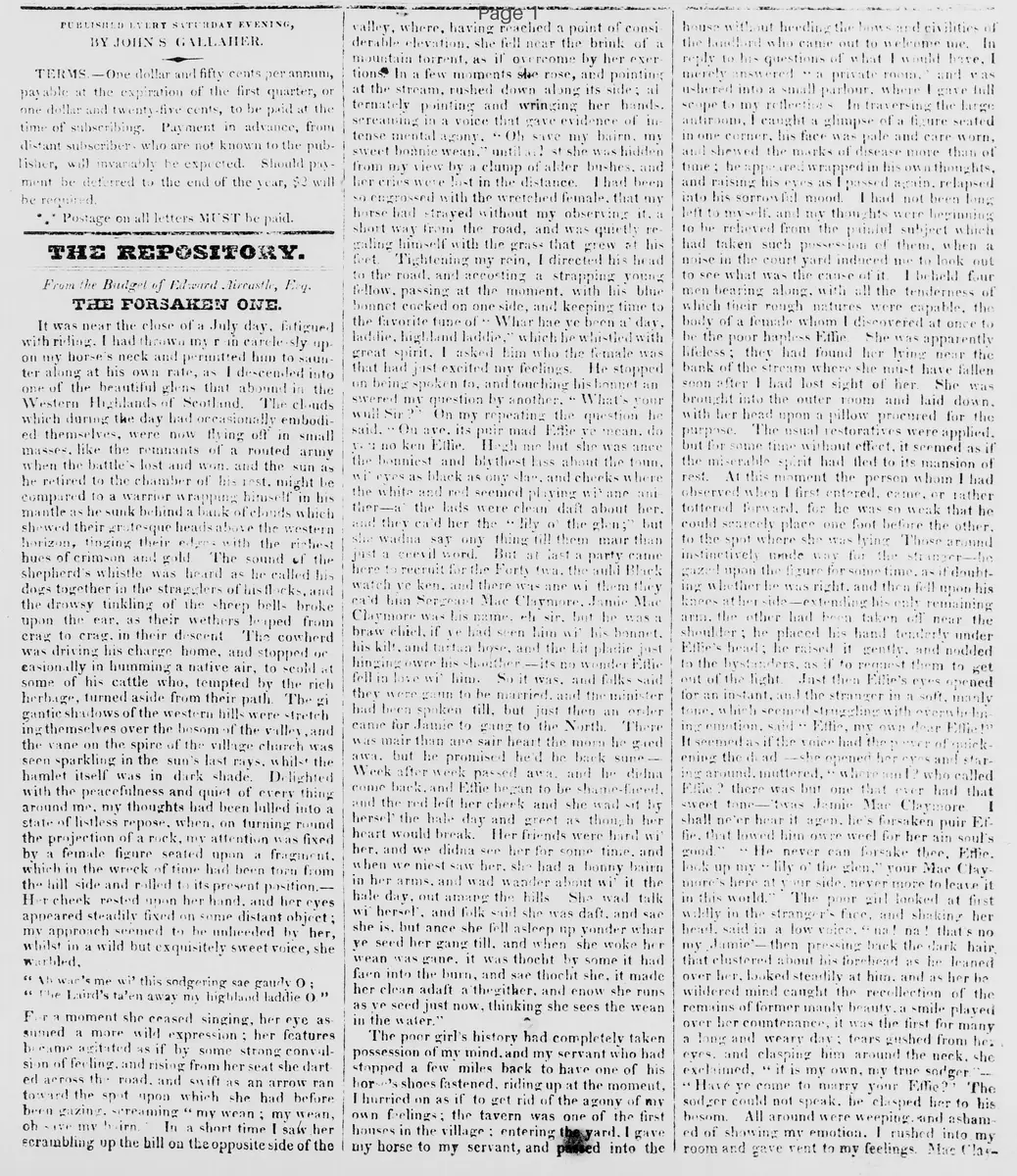
THE REPOSITORY.
From the Budget of Edward Riccastle, Esq.
THE FORSAKEN ONE.
It was near the close of a July day, fatigued with riding, I had thrown my rein carelessly upon my horse's neck and permitted him to saunter along at his own rate, as I descended into one of the beautiful glens that abound in the Western Highlands of Scotland. The clouds which during the day had occasionally embodied themselves, were now flying off in small masses, like the remnants of a routed army when the battle's lost and won, and the sun as he retired to the chamber of his rest, might be compared to a warrior wrapping himself in his mantle as he sunk behind a bank of clouds which showed their grotesque heads above the western horizon, tinging their edges with the richest hues of crimson and gold. The sound of the shepherd's whistle was heard as he called his dogs together in the stragglers of his flocks, and the drowsy tinkling of the sheep bell broke upon the ear, as their wethers loiped from crag to crag, in their descent. The cowherd was driving his charge home, and stopped occasionally in humming a native air, to scold at some of his cattle who, tempted by the rich herbage, turned aside from their path. The gigantic shadows of the western hills were stretching themselves over the bosom of the valley, and the vane on the spire of the village church was seen sparkling in the sun's last rays, while the hamlet itself was in dark shade. Delighted with the peacefulness and quiet of everything around me, my thoughts had been lulled into a state of listless repose, when, on turning round the projection of a rock, my attention was fixed by a female figure seated upon a fragment, which in the wreck of time had been torn from the hill side and rolled to its present position.—Her cheek rested upon her hand, and her eyes appeared steadily fixed on some distant object: my approach seemed to be unheeded by her, whilst in a wild but exquisitely sweet voice, she warbled,
"Ah war's me wi' this sodgering sae gaudy O:
"The Laird's ta'en away my highland laddie O."
For a moment she ceased singing, her eye assumed a more wild expression; her features became agitated as if by some strong convulsion of feeling, and rising from her seat she darted across the road, and swift as an arrow ran toward the spot upon which she had before been gazing, screaming "my wean; my wean, oh save my wean!" In a short time I saw her scrambling up the hill on the opposite side of the valley, where, having reached a point of considerable elevation, she fell near the brink of a mountain torrent, as if overcome by her exertions. In a few moments she rose, and pointing at the stream, rushed down along its side; alternately pointing and wringing her hands, screaming in a voice that gave evidence of intense mental agony, "Oh save my bairn, my sweet bonnie wean," until at last she was hidden from my view by a clump of alder bushes, and her cries were lost in the distance. I had been so engrossed with the wretched female, that my horse had strayed without my observing it, a short way from the road, and was quietly regaling himself with the grass that grew at his feet. Tightening my rein, I directed his head to the road, and accosting a strapping young fellow, passing at the moment, with his blue bonnet cocked on one side, and keeping time to the favorite tune of "Whar hae ye been a' day, laddie, highland laddie," which he whistled with great spirit, I asked him who the female was that had just excited my feelings. He stopped on being spoken to, and touching his bonnet answered my question by another. "What's your wull Sir?" On my repeating the question he said,—"Ou aye, its puir mad Effie Ochs, do ye no ken Effie? Hegh mo but she was ance the bonniest and blithest lass about the toun, wi' e'en as black as ony slae, and cheeks where the white and red seemed playing wi' ane anither—a' the lads were clean daft about her, and they ca'd her the lily o' the glen" but she wadna say ony thing till them mair than just a ceevil word. But at last a party came here to recruit for the Forty twa, the auld Black Watch ye ken, and there was ane wi' them they ca'd him Sergeant Mac Claymore. Jamie Mac Claymore was his name, eh sir, but he was a braw chiel, if ye had seen him wi' his bonnet, his kilt, and tartan hose, and the bit pladie just hingin' owre his shoulder—its no wonder Effie fell in love wi' him. So it was, and folks said they were gann to be married, and the minister had been spoken till, but just then an order came for Jamie to gang to the North. There was mair than ae sair heart the morn he gaed awa, but he promised he'd be back sune— Week after week passed awa, and he didna come back, and Effie began to be shame-faced, and the red left her cheek and she wad sit by hersel' the hale day and greet as tho' her heart would break. Her friends were hard wi' her, and we didna see her for some time, and when we niest saw her, she had a bonny bairn in her arms, and wad wander about wi' it the hale day, out amang the hills. She wad talk wi' hersel', and folk said she was daft, and sae she is, but ance she fell asleep up yonder whar ye seed her gang till, and when she woke her wean was gane. It was thocht by some it had fa'en into the burn, and sae thocht she. It made her clean daft athegither, and enow she runs as ye seed just now, thinking she sees the wean in the water."
The poor girl's history had completely taken possession of my mind, and my servant who had stopped a few miles back to have one of his horse's shoes fastened, riding up at the moment, I hurried on as if to get rid of the agony of my own feelings: the tavern was one of the first houses in the village: entering the yard, I gave my horse to my servant, and paced into the house without heeding the bows and civilities of the landlady who came out to welcome me. In reply to his questions of what I would have, I merely answered "a private room," and was ushered into a small parlour, where I gave full scope to my reflections. In traversing the large antiroom, I caught a glimpse of a figure seated in one corner, his face was pale and care worn, and showed the marks of disease more than of time; he appeared wrapped in his own thoughts, and raising his eyes as I passed again, relapsed into his sorrowful mood. I had not been long left to myself, and my thoughts were beginning to be relieved from the painful subject which had taken such possession of them, when a noise in the court yard induced me to look out to see what was the cause of it. I beheld four men bearing along, with all the tenderness of which their rough natures were capable, the body of a female whom I discovered at once to be the poor hapless Effie. She was apparently lifeless; they had found her lying near the bank of the stream where she must have fallen soon after I had lost sight of her. She was brought into the outer room and laid down, with her head upon a pillow procured for the purpose. The usual restoratives were applied, but for some time without effect. It seemed as if the miserable spirit had fled to its mansion of rest. At this moment the person whom I had observed when I first entered, came, or rather tottered forward, for he was so weak that he could scarcely place one foot before the other, to the spot where she was lying. Those around instinctively made way for the stranger—he gazed upon the figure for some time, as if doubting whether he was right, and then fell upon his knees beside her—extending his one remaining arm, the other had been taken off near the shoulder: he placed his hand tenderly under Effie's head; he raised it gently, and nodded to the bystanders, as if to request them to get out of the light. Just then Effie's eyes opened for an instant, and the stranger in a soft, inaudibly tone, which seemed struggling with overpowering emotion, said—Effie, my own dear Effie! It seemed as if the voice had the power of quickening the dead—she opened her eyes and staring around, muttered, "where am I? who called Effie? there was but one that e'er had that sweet tone—'twas Jamie Mac Claymore! I shall ne'er hear it agen. he's forsaken puir Effie, that lowed him owre weel for her ain soul's good." "He never can forsake thee, Effie. Look up my "lily o' the glen." your Mac Claymore's here at your side, never more to leave it in this world." The poor girl looked at first wildly in the stranger's face, and shaking her head, said in a low voice, "na! na! that's no my Jamie"—then pressing back the dark hair, that clustered about his forehead as he leaned over her, looked steadily at him, and as her bewildered mind caught the recollection of the remains of former manly beauty, a smile played over her countenance, it was the first for many a long and weary day; tears gushed from her eyes, and clasping him around the neck, she exclaimed, "it is my own, my true sodger!" "Have ye come to marry your Effie?" The soldier could not speak, he clasped her to his bosom. All around were weeping, and ashamed of showing my emotion, I rushed into my room and gave vent to my feelings. Mac Clay—
No more accounted for his apparent neglect of Effie as follows:
The village to which he had been ordered was in a remote district of Sutherlandshire, and although he had frequently endeavored to obtain leave of absence to pay her a visit, the duties of the service on which he been detailed, were such as to prevent it. He had frequently sent messages, but they never reached her until at length his party was ordered to join their regiment to go to the Continent. He had been in the battle of Waterloo, where he behaved with distinguished gallantry and lost an arm. He had been afterwards carried to a hospital where he remained for many weeks. Without an opportunity offering to let her know what had become of him; but as soon as he was permitted to come out, he had hastened to find his beloved Effie, with the happy tidings that he had been discharged on half pay with an allowance for the loss of his arm, & several badges of distinction, to spend the remainder of his life with her in comparative abundance, and to make all the atonement in his power for past injury.
So soon as it was known that Jamie Mac Claymore had returned, an old crone, a relation of Effie, was seen bustling towards the inn with a large bundle of something in her arms, she entered, and throwing off the covering, showed the features of a fine bouncing boy, who smiled at being permitted to look upon the light -- it was Effie's child. Fears had long been entertained for the safety of the infant, owing to the disordered state of the mother's mind, lest she might let it fall in clambering among the precipices. On the day when the child disappeared, the old woman happened to pass where Effie was lying asleep with her baby in her arms, near the brink of the mountain stream, and had taken the infant home and kept it until hearing of Mac Claymore's return, and Effie's restoration to her senses, she came to restore the child to its happy parents. In a short time afterwards Jamie and Effie were united in wedlock in the village kirk, surrounded by happy faces, and I have since heard that the country does not contain a happier couple than Sergeant Mac Claymore and his "lily of the glen."
From the Budget of Edward Riccastle, Esq.
THE FORSAKEN ONE.
It was near the close of a July day, fatigued with riding, I had thrown my rein carelessly upon my horse's neck and permitted him to saunter along at his own rate, as I descended into one of the beautiful glens that abound in the Western Highlands of Scotland. The clouds which during the day had occasionally embodied themselves, were now flying off in small masses, like the remnants of a routed army when the battle's lost and won, and the sun as he retired to the chamber of his rest, might be compared to a warrior wrapping himself in his mantle as he sunk behind a bank of clouds which showed their grotesque heads above the western horizon, tinging their edges with the richest hues of crimson and gold. The sound of the shepherd's whistle was heard as he called his dogs together in the stragglers of his flocks, and the drowsy tinkling of the sheep bell broke upon the ear, as their wethers loiped from crag to crag, in their descent. The cowherd was driving his charge home, and stopped occasionally in humming a native air, to scold at some of his cattle who, tempted by the rich herbage, turned aside from their path. The gigantic shadows of the western hills were stretching themselves over the bosom of the valley, and the vane on the spire of the village church was seen sparkling in the sun's last rays, while the hamlet itself was in dark shade. Delighted with the peacefulness and quiet of everything around me, my thoughts had been lulled into a state of listless repose, when, on turning round the projection of a rock, my attention was fixed by a female figure seated upon a fragment, which in the wreck of time had been torn from the hill side and rolled to its present position.—Her cheek rested upon her hand, and her eyes appeared steadily fixed on some distant object: my approach seemed to be unheeded by her, whilst in a wild but exquisitely sweet voice, she warbled,
"Ah war's me wi' this sodgering sae gaudy O:
"The Laird's ta'en away my highland laddie O."
For a moment she ceased singing, her eye assumed a more wild expression; her features became agitated as if by some strong convulsion of feeling, and rising from her seat she darted across the road, and swift as an arrow ran toward the spot upon which she had before been gazing, screaming "my wean; my wean, oh save my wean!" In a short time I saw her scrambling up the hill on the opposite side of the valley, where, having reached a point of considerable elevation, she fell near the brink of a mountain torrent, as if overcome by her exertions. In a few moments she rose, and pointing at the stream, rushed down along its side; alternately pointing and wringing her hands, screaming in a voice that gave evidence of intense mental agony, "Oh save my bairn, my sweet bonnie wean," until at last she was hidden from my view by a clump of alder bushes, and her cries were lost in the distance. I had been so engrossed with the wretched female, that my horse had strayed without my observing it, a short way from the road, and was quietly regaling himself with the grass that grew at his feet. Tightening my rein, I directed his head to the road, and accosting a strapping young fellow, passing at the moment, with his blue bonnet cocked on one side, and keeping time to the favorite tune of "Whar hae ye been a' day, laddie, highland laddie," which he whistled with great spirit, I asked him who the female was that had just excited my feelings. He stopped on being spoken to, and touching his bonnet answered my question by another. "What's your wull Sir?" On my repeating the question he said,—"Ou aye, its puir mad Effie Ochs, do ye no ken Effie? Hegh mo but she was ance the bonniest and blithest lass about the toun, wi' e'en as black as ony slae, and cheeks where the white and red seemed playing wi' ane anither—a' the lads were clean daft about her, and they ca'd her the lily o' the glen" but she wadna say ony thing till them mair than just a ceevil word. But at last a party came here to recruit for the Forty twa, the auld Black Watch ye ken, and there was ane wi' them they ca'd him Sergeant Mac Claymore. Jamie Mac Claymore was his name, eh sir, but he was a braw chiel, if ye had seen him wi' his bonnet, his kilt, and tartan hose, and the bit pladie just hingin' owre his shoulder—its no wonder Effie fell in love wi' him. So it was, and folks said they were gann to be married, and the minister had been spoken till, but just then an order came for Jamie to gang to the North. There was mair than ae sair heart the morn he gaed awa, but he promised he'd be back sune— Week after week passed awa, and he didna come back, and Effie began to be shame-faced, and the red left her cheek and she wad sit by hersel' the hale day and greet as tho' her heart would break. Her friends were hard wi' her, and we didna see her for some time, and when we niest saw her, she had a bonny bairn in her arms, and wad wander about wi' it the hale day, out amang the hills. She wad talk wi' hersel', and folk said she was daft, and sae she is, but ance she fell asleep up yonder whar ye seed her gang till, and when she woke her wean was gane. It was thocht by some it had fa'en into the burn, and sae thocht she. It made her clean daft athegither, and enow she runs as ye seed just now, thinking she sees the wean in the water."
The poor girl's history had completely taken possession of my mind, and my servant who had stopped a few miles back to have one of his horse's shoes fastened, riding up at the moment, I hurried on as if to get rid of the agony of my own feelings: the tavern was one of the first houses in the village: entering the yard, I gave my horse to my servant, and paced into the house without heeding the bows and civilities of the landlady who came out to welcome me. In reply to his questions of what I would have, I merely answered "a private room," and was ushered into a small parlour, where I gave full scope to my reflections. In traversing the large antiroom, I caught a glimpse of a figure seated in one corner, his face was pale and care worn, and showed the marks of disease more than of time; he appeared wrapped in his own thoughts, and raising his eyes as I passed again, relapsed into his sorrowful mood. I had not been long left to myself, and my thoughts were beginning to be relieved from the painful subject which had taken such possession of them, when a noise in the court yard induced me to look out to see what was the cause of it. I beheld four men bearing along, with all the tenderness of which their rough natures were capable, the body of a female whom I discovered at once to be the poor hapless Effie. She was apparently lifeless; they had found her lying near the bank of the stream where she must have fallen soon after I had lost sight of her. She was brought into the outer room and laid down, with her head upon a pillow procured for the purpose. The usual restoratives were applied, but for some time without effect. It seemed as if the miserable spirit had fled to its mansion of rest. At this moment the person whom I had observed when I first entered, came, or rather tottered forward, for he was so weak that he could scarcely place one foot before the other, to the spot where she was lying. Those around instinctively made way for the stranger—he gazed upon the figure for some time, as if doubting whether he was right, and then fell upon his knees beside her—extending his one remaining arm, the other had been taken off near the shoulder: he placed his hand tenderly under Effie's head; he raised it gently, and nodded to the bystanders, as if to request them to get out of the light. Just then Effie's eyes opened for an instant, and the stranger in a soft, inaudibly tone, which seemed struggling with overpowering emotion, said—Effie, my own dear Effie! It seemed as if the voice had the power of quickening the dead—she opened her eyes and staring around, muttered, "where am I? who called Effie? there was but one that e'er had that sweet tone—'twas Jamie Mac Claymore! I shall ne'er hear it agen. he's forsaken puir Effie, that lowed him owre weel for her ain soul's good." "He never can forsake thee, Effie. Look up my "lily o' the glen." your Mac Claymore's here at your side, never more to leave it in this world." The poor girl looked at first wildly in the stranger's face, and shaking her head, said in a low voice, "na! na! that's no my Jamie"—then pressing back the dark hair, that clustered about his forehead as he leaned over her, looked steadily at him, and as her bewildered mind caught the recollection of the remains of former manly beauty, a smile played over her countenance, it was the first for many a long and weary day; tears gushed from her eyes, and clasping him around the neck, she exclaimed, "it is my own, my true sodger!" "Have ye come to marry your Effie?" The soldier could not speak, he clasped her to his bosom. All around were weeping, and ashamed of showing my emotion, I rushed into my room and gave vent to my feelings. Mac Clay—
No more accounted for his apparent neglect of Effie as follows:
The village to which he had been ordered was in a remote district of Sutherlandshire, and although he had frequently endeavored to obtain leave of absence to pay her a visit, the duties of the service on which he been detailed, were such as to prevent it. He had frequently sent messages, but they never reached her until at length his party was ordered to join their regiment to go to the Continent. He had been in the battle of Waterloo, where he behaved with distinguished gallantry and lost an arm. He had been afterwards carried to a hospital where he remained for many weeks. Without an opportunity offering to let her know what had become of him; but as soon as he was permitted to come out, he had hastened to find his beloved Effie, with the happy tidings that he had been discharged on half pay with an allowance for the loss of his arm, & several badges of distinction, to spend the remainder of his life with her in comparative abundance, and to make all the atonement in his power for past injury.
So soon as it was known that Jamie Mac Claymore had returned, an old crone, a relation of Effie, was seen bustling towards the inn with a large bundle of something in her arms, she entered, and throwing off the covering, showed the features of a fine bouncing boy, who smiled at being permitted to look upon the light -- it was Effie's child. Fears had long been entertained for the safety of the infant, owing to the disordered state of the mother's mind, lest she might let it fall in clambering among the precipices. On the day when the child disappeared, the old woman happened to pass where Effie was lying asleep with her baby in her arms, near the brink of the mountain stream, and had taken the infant home and kept it until hearing of Mac Claymore's return, and Effie's restoration to her senses, she came to restore the child to its happy parents. In a short time afterwards Jamie and Effie were united in wedlock in the village kirk, surrounded by happy faces, and I have since heard that the country does not contain a happier couple than Sergeant Mac Claymore and his "lily of the glen."
What sub-type of article is it?
Prose Fiction
What themes does it cover?
Love Romance
War Peace
What keywords are associated?
Scottish Highlands
Forsaken Lover
Highland Soldier
Waterloo Veteran
Reunion
Madness
Child Restoration
What entities or persons were involved?
From The Budget Of Edward Riccastle, Esq.
Literary Details
Title
The Forsaken One.
Author
From The Budget Of Edward Riccastle, Esq.
Key Lines
"Ah War's Me Wi' This Sodgering Sae Gaudy O: "The Laird's Ta'en Away My Highland Laddie O."
"Effie, My Own Dear Effie!"
"It Is My Own, My True Sodger!" "Have Ye Come To Marry Your Effie?"