Thank you for visiting SNEWPapers!
Sign up free
The Herald
Big Stone City, Milbank, Grant County, South Dakota
What is this article about?
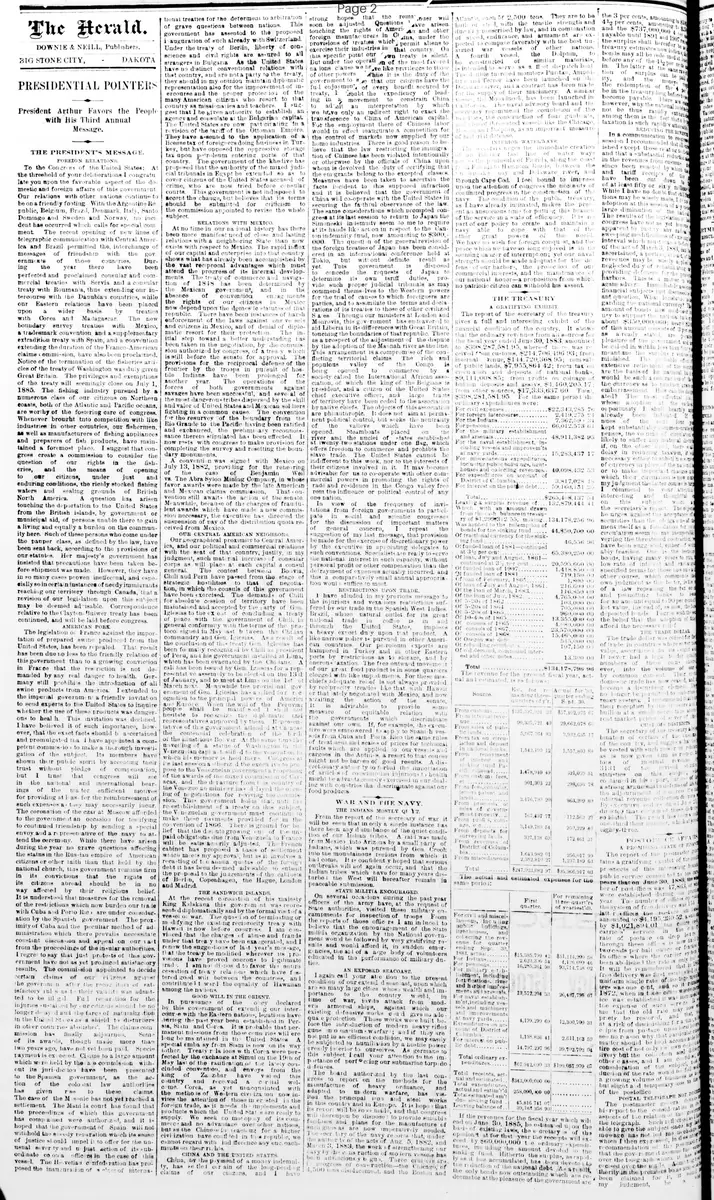
President Chester A. Arthur's 1883 annual message to Congress covers international diplomacy, trade disputes, military enhancements, financial surplus, and policy recommendations on immigration, navy, civil service, and more. (187 chars)
Merged-components note: Merged continuation of the President's annual message across pages 2 and 3, including related financial tables based on sequential content and topic coherence.
Clippings
1 of 2
OCR Quality
Full Text
President Arthur Favors the People with His Third Annual Message.
THE PRESIDENT'S MESSAGE.
FOREIGN RELATIONS.
To the Congress of the United States: At the threshold of your deliberations I congratulate you upon the favorable aspect of the domestic and foreign affairs of this government. Our relations with other nations continue to be on a friendly footing. With the Argentine Republic, Belgium, Brazil, Denmark, Italy, Santo Domingo and Sweden and Norway, no incident has occurred which calls for special comment.
The recent opening of new lines of telegraphic communication with Central America and Brazil permitted the interchange of messages of friendship with the governments of those countries.
During the year there have been perfected and proclaimed consular and commercial treaties with Servia and a consular treaty with Roumania, thus extending our intercourse with the Danubian countries, while our Eastern relations have been placed upon a wider basis by treaties with Corea and Madagascar.
The new boundary survey treaties with Mexico, a trademark convention and a supplementary extradition treaty with Spain, and a convention extending the duration of the Franco-American claims commission, have also been proclaimed.
Notice of the termination of the fisheries articles of the treaty of Washington was duly given Great Britain. The privileges and exemptions of the treaty will cease on July 1, 1885. The fishing industry pursued by a numerous class of our citizens on Northern coasts, both of the Atlantic and Pacific oceans, is worthy of the fostering care of Congress. Whenever brought into competition with like industries in other countries, our fishermen, as well as manufacturers of fishing appliances and preparers of fish products, have maintained a foremost place. I suggest that Congress create a commission to consider the question of our rights in the fisheries, and the means of opening to our citizens, under just and enduring conditions, the richly stocked fishing waters and sealing grounds of British North America.
A question has arisen touching the deportation to the United States from the British islands, by government or municipal aid, of persons unable there to gain a living and equally a burden on the community here. Such of these persons who come under the pauper class, as defined by the law, have been sent back, according to the provisions of our statutes. Her Majesty's government has insisted that precautions have been taken before shipment was made. However, they have in so many cases proven ineffectual, and especially so in certain instances of needy immigrants reaching our territory through Canada, that a revision of our legislation upon this subject may be deemed advisable. Correspondence relative to the Clayton-Bulwer treaty has been continued, and will be laid before Congress.
AMERICAN PORK
The legislation of France against the importation of prepared swine products from the United States has been repealed. That result has been due no less to the friendly relation of this government than to a growing conviction in France that the restriction is not demanded by any real danger to health. Germany still prohibits the introduction of all swine products from America. I extended to the imperial government a friendly invitation to send experts to the United States to inquire whether the use of these products was dangerous to health. This invitation was declined. I have believed it of such importance, however, that the exact facts should be ascertained and promulgated that I have appointed a competent commission to make a thorough investigation of the subject. Its members have shown their public spirit by accepting their trust without pledge of compensation, but I trust that Congress will see in the national and international bearings of the matter sufficient motives for providing at least for the reimbursement of such expenses as they may necessarily incur.
The coronation of the Czar at Moscow afforded to the government an occasion for testifying to continued friendship by sending a special envoy and a representative of the navy to attend the ceremony. While there have arisen during the year no grave questions affecting the status in the Russian empire of American citizens or other faith than that held by the national church, this government remains firm in its convictions that the rights of its citizens abroad should be in no way affected by their religious belief.
It is understood that measures for the removal of the restrictions which now burden our trade with Cuba and Porto Rico are under consideration by the Spanish government. The proximity of Cuba and the peculiar method of administration which there prevails necessitate constant discussion and appeal on our part from the proceedings of the insular authorities. I regret to say that just protests of this government have not as yet produced satisfactory results. The commission appointed to decide certain claims of our citizens against the government after the recognition of satisfactory rules as to their validity was admitted to be illegal. Full reparation for the injuries sustained by our citizens should no longer be delayed and the farce of naturalization in the United States as a shield to disturbers in other countries abolished. The claims commission has finally adjourned. Some of its awards, though made more than two years ago, have not yet been paid. Specie payment is expected. Claims to a large amount which were held by the late commission without its jurisdiction have been presented to the Spanish government, as the action of the colonial law authorities has given rise to these claims.
The case of the Masonic has not yet reached a settlement. The Manila court has found that the proceedings of which this government has complained were authorized, and it is hoped that the government of Spain will not withhold the speedy reparation which its sense of justice should impel it to offer for the unusual severity and unjust action of its subordinate colonial officers in the case of this vessel. The Helvetian Confederation has proposed the inauguration of a system of international treaties for the deferment to arbitration of grave questions between nations. This government has assented to the proposed inauguration of such already with Switzerland.
Under the treaty of Berlin, liberty of conscience and civil rights are assured to all strangers in Bulgaria. As the United States have no distinct conventional relations with that country, and are not a party to the treaty, they should in my opinion maintain diplomatic representation also for the improvement of intercourse and the proper protection of the many American citizens who resort to that country as missionaries and teachers. I suggest that I be given authority to establish an agency and consulate at the Bulgarian capital.
The United States are now participating in a revision of the tariff of the Ottoman Empire. They have assented to the application of a license tax of foreigners doing business in Turkey, but have opposed the oppressive storage tax upon petroleum entering ports of that country. The government of the Khedive has proposed that the authority of the mixed judicial tribunals in Egypt be extended so as to cover citizens of the United States accused of crime, who are now tried before consular courts. This government is not indisposed to accept the change, but believes that its terms should be submitted for criticism to the commission appointed to revise the whole subject.
RELATIONS WITH MEXICO.
At no time in our national history has there been more manifest need of close and lasting relations with a neighboring State than now exists with respect to Mexico. The rapid influx of our capital and enterprise into that country shows what has already been accomplished by the vast reciprocal advantages which must attend the progress of its internal developments. The treaty of commerce and navigation of 1848 has been determined by the Mexican government, and in the absence of conventional engagements the rights of our citizens in Mexico now depend upon the domestic statutes of that republic. There have been instances of harsh enforcement of the laws against our vessels and citizens in Mexico, and of denial of diplomatic resort for their protection. The initial step toward a better understanding has been taken in the negotiation, by the commission authorized by Congress, of a treaty which is still before the Senate for approval. The provisions for the reciprocal defense of the frontier by the troops in pursuit of hostile Indians have been prolonged for another year.
The operations of the forces of both governments against savages have been successful, and several of the most dangerous tribes dispersed by the skill and valor of United States and Mexican soldiers fighting in a common cause. The convention for the resurvey of the boundary from the Rio Grande to the Pacific having been ratified and exchanged, the preliminary reconnaissance therein stipulated has been effected. It now rests with Congress to make provision for completing the survey and resetting the boundary monuments.
A convention was signed with Mexico on July 13, 1882, providing for the rehearing of the case of Benjamin Weil vs. The Abra Silver Mining Company, in whose favor awards were made by the late American and Mexican claims commission. That convention still awaits the action of the Senate. Meanwhile, because of the charges of fraudulent awards which have made a new commission necessary, the executive has directed the suspension of payment of the distribution quota received from Mexico.
OUR CENTRAL AMERICAN NEIGHBORS
Our geographical proximity to Central America, and our political and commercial relations with the seat of that country, justify, in my judgment, such material increase of consular corps as will place at each capital a consul general.
The contest between Bolivia, Chili and Peru have passed from the stage of strategic hostilities to that of negotiation, in which the consuls of this government have been exercised. The demands of Chili for absolute cession of territory have been maintained and accepted by the party of Gen. Iglesias to the extent of concluding a treaty of peace with the government of Chili, in general conformity with the terms of the protocol signed in May last between the Chilean commander and Gen. Iglesias. As a result of the conclusion of this treaty Gen. Iglesias has been formally recognized by Chili as president of Peru, and his government installed at Lima, which has been evacuated by the Chileans. A call has been issued by Gen. Iglesias for a representative assembly to be elected on the 13th of January, and to meet at Lima on the 1st of March next. Meanwhile the provisional government of Gen. Iglesias has applied for recognition to the principal powers of America and Europe. When the will of the Peruvian people shall be manifested I shall not hesitate to recognize those diplomatic and representatives approved by them.
Representatives of this government attended the centennial celebration of the birth of the illustrious Bolivar. At the same time the unveiling of a statue of Washington in the Venezuelan capital testified to the veneration in which his memory is held there. Congress at its last session authorized the executive to propose to the Venezuelan government a reopening of the awards of the mixed commission of Caracas, and the departure from this country of the Venezuelan minister has delayed the opening of negotiations for reviving the commission. This government holds that, until the re-establishment of a treaty on this subject, the Venezuelan government must continue to make these payments provided for in the convention of 1866. There is ground for belief that the dispute growing out of the unpaid obligations due from Venezuela to France will be satisfactorily adjusted. The French cabinet has proposed a basis of settlement which meets my approval, but as it involves a recasting of the annual quotas of the foreign debt it has been deemed advisable to submit the proposal to the judgments of the cabinets of Berlin, Copenhagen, the Hague, London and Madrid.
THE SANDWICH ISLANDS.
At the recent coronation of his majesty King Kalakaua this government was represented diplomatically and by the formal visit of a vessel of war. The question of terminating or modifying the existing reciprocity treaty with Hawaii is now before Congress. I am convinced that the charges of abuse and frauds under that treaty have been exaggerated, and I renew the suggestions of last year's message, that the treaty be modified wherever its provisions have proved onerous to legitimate trade. I am not disposed to favor the entire cessation of treaty relations which have fostered good will between the countries, and contributed toward the equality of Hawaiian among the nations.
GOOD WILL IN THE ORIENT.
In pursuance of the policy declared by this government of extending our intercourse with the Eastern nations, legations have during the past year been established in Persia, Siam and Corea. It is probable that permanent missions from those countries will ere long be maintained in the United States. A special embassy from Siam is now on its way hither. Treaty relations with Corea were perfected by the exchange at Seoul on the 19th of May last of the ratification of the lately concluded convention, and envoys from the King of Zanzibar have visited this country and received a cordial welcome. Corea, as yet unacquainted with the methods of Western civilization now invites the attention of those interested in the foreign trade, as it needs the implements and products which the United States are ready to supply. We seek no monopoly of its commerce and no advantage over other nations, but as the Chinese immigrants for a higher civilization have confided in this republic, we cannot regard with indifference any encroachments on their rights.
CHINA AND THE UNITED STATES.
China, by the payment of a money indemnity, has settled certain of the long-pending claims of our citizens, and I have strong hopes that the remainder will soon be adjusted. Questions touching the rights of American and other foreign manufacturers have arisen from the provisions of treaties which permit aliens to exercise their industries in that country. On this specific point our own treaty is silent. But under the operation of the most favored nations clause we believe like privileges to those of other powers while it is the duty of the government to see that our citizens have the full enjoyment of every benefit secured by treaty, I doubt the expediency of leading in a movement to constrain China to admit an interpretation by which we have only an indirect right to exact the transference to China of American capital. For the employment there of Chinese labor would in effect inaugurate a competition for the control of markets now supplied by our home industries. There is good reason to believe that the law restricting the immigration of Chinese has been violated intentionally or otherwise by the officials of China upon whom is devolved the duty of certifying that the emigrants belong to the excepted classes. Measures have been taken to ascertain the facts incident to this supposed infraction and it is believed that the government of China will co-operate with the United States in securing the faithful observance of the law.
The same considerations which prompted Congress at its last session to return to Japan the Shimonoseki indemnity seem to me to require at its hands like act in respect to the Canton indemnity fund, now amounting to $300,000. The question of the general revision of the foreign treaties of Japan has been considered in an international conference held at Tokio, but without definite result as yet. This government is disposed to concede the requests of Japan to determine its own tariff duties, provide such proper judicial tribunals as may commend themselves to the Western powers for the trial of causes to which foreigners are parties, and to assimilate the terms and declarations of its treaties to those of other civilized states. Through our ministers at London and Monrovia, this government has endeavored to aid Liberia in its differences with Great Britain, touching the boundaries of that republic. There is a prospect of the adjustment of the dispute by the adoption of the Manoah river as the line. This arrangement is a compromise of the conflicting territorial claims. The rich and populous valley of the Congo is being opened to commerce by a society called the International African Association, of which the King of the Belgians is president, and a citizen of the United States chief executive officer, and large tracts of territory have been ceded to the association by native chiefs. The objects of this association are philanthropic. It does not aim at permanent political control, but seeks the neutrality of the valleys which have been opened. Steamboats placed on the river and the nuclei of states established at twenty-two stations under one flag, which offers freedom to commerce and prohibits the slave trade. The United States cannot be indifferent to this work, nor to the interests of their citizens involved in it. It may become advisable for us to co-operate with other commercial powers in promoting the rights of trade and residence in the Congo valley free from the influence or political control of any one nation.
In view of the frequency of invitations from foreign governments to participate in social and scientific congresses for the discussion of important matters of general concern, I repeat the suggestion of my last message, that provision be made for the exercise of discretionary power by the executive in appointing delegates to such conventions. Specialists are ready to serve the national interest in such capacity, without personal profit or other compensation than the defrayment of expenses actually incurred, and this a comparatively small annual appropriation would suffice to meet.
RESTRICTIONS UPON TRADE.
I have alluded in my previous message to the injurious and vexatious restrictions suffered by our trade in the Spanish West Indies. Brazil, whose natural outlet for its great national trade in coffee is in and through the United States, imposes a heavy export duty upon that product. A like narrow policy is pursued in other American countries. Our petroleum exports are hampered in Turkey and in other Eastern ports by restrictions as to storage, and by onerous taxation. The free outward movement of our great food product is in some quarters clogged with like impediments. For these mischiefs adequate relief is not always provided by reciprocity treaties like that with Hawaii or that lately negotiated with Mexico, and now awaiting the action of the Senate.
It is advisable to provide some measure of equitable relation with the governments which discriminate against our own. If, for example, the executive were empowered to apply to Spanish vessels from Cuba and Porto Rico the same rules of treatment and scales of prices for technical faults which are applied to our vessels and cargoes in the Antilles, a resort to that course might not be barren of good results. A discretionary authority to forbid the importation of articles of consumption injurious to health might be advantageously exercised in our dealing with countries that discriminate against our food products.
WAR AND THE NAVY.
THE INDIANS MOSTLY QUIET
From the report of the Secretary of War it will be seen that in only a single instance has there been any disturbance of the quiet condition of our Indian tribes. A raid was made from Mexico into Arizona by a small party of Indians, which was pursued by Gen. Crook into the mountainous regions from which it had come. It is confidently hoped that serious outbreaks will not again occur, and that the Indian tribes which have for many years disturbed the West will hereafter remain in peaceable submission.
STATE MILITIA ENCOURAGED.
On several occasions during the past year officers of the army have, at the request of State authorities, visited these military encampments for inspection of troops. From the reports of those officers I am induced to believe that the encouragement of the State militia organization by the National government would be followed by very gratifying results and would afford it, in sudden emergencies, the aid of a large body of volunteers educated in the performance of military duties.
AN EXPOSED SEACOAST.
I again call your attention to the present condition of our extended seacoast, upon which are so many large cities whose wealth and importance to the country would, in time of war, invite attack from modern armored ships, against which our existing defensive works could give no adequate protection. Those works were built before the introduction of modern heavy rifled guns in maritime warfare; and if they are not put in an efficient condition, we may easily be subjected to humiliation by a hostile power greatly inferior to ourselves. As germane to this subject, I call your attention to the importance of perfecting our submarine torpedo defenses.
The board authorized by the last Congress to report on the methods for the manufacture of heavy ordnance, adapted to modern warfare, has visited the principal iron and steel works in this country and in Europe. It is hoped that its report will be soon made, and that Congress will hereupon be disposed to provide suitable facilities and plans for the manufacture of such guns as are now imperatively needed.
The Secretary of the Navy reports that, under the authority of the acts of Aug. 5, 1882, and March 3, 1883, the work of strengthening our navy by the construction of modern vessels has been auspiciously begun. Three cruisers are in progress of construction—the Chicago, of 4,500 tons displacement, and the Boston and Atlanta, each of 2,500 tons. They are to be built of steel, with the tensile strength and ductility proscribed by law, and in combination of speed, endurance, and armament are expected to compare favorably with the best unarmored war vessels of other nations.
A fourth vessel, the Dolphin, to be constructed of similar materials, is intended to serve as a fleet dispatch boat. The double-turreted monitors Puritan, Amphitrite and Terror have been launched on the Delaware river, and a contract has been made for the supply of their machinery. A similar vessel, the Monadnock, has been launched in California. The naval advisory board and the Secretary recommend the completion of the four monitors, the construction of four gunboats, and four steel vessels like the Chicago, Boston, and Atlanta as an important measure of national defense.
INTERIOR WATERWAYS
The Secretary urges the immediate creation of a lateral system of inland waterways across the base of the Florida peninsula, along the coast in Florida to Hampton roads, between Chesapeake Bay and Delaware river, and through Cape Cod. I feel bound to impress upon the attention of Congress the necessity of continued progress in the construction of the navy. The condition of the public treasury, as I have already intimated, makes the present an auspicious time for putting this branch of the service in a state of efficiency. It is part of our policy to create and maintain a navy able to cope with that of the other great powers of the world. We have no wish for foreign conquest, and the peace which we have so long enjoyed is in no seeming danger of interruption; yet our naval strength should be made adequate, for the defense of our harbors the protection of our commercial interests, and the maintenance of our national honor—a proposition from which no patriotic citizen can withhold his assent.
THE TREASURY
A GRATIFYING EXHIBIT.
From their sources $173,336,37.60
$314,281,581.95.
For the same ordinary expenditures were:
For civil expenses
For foreign intercourse
For the Indians.
For pensions.
For the military establishment
and arsenals
For the naval establishment,
including vessels and improvements
at navy yards
For miscellaneous expenditures
including public buildings, light-houses and collecting revenues.
For expenditures on account of
District of Columbia
For interest on the public debt.
Total,
Leaving a surplus revenue of
Which, with an amount drawn
from this year's balance in treasury
Was applied to the redemption of
bonds for the sinking fund
Of fractional currency for the sinking
fund
Of funded loan of 1881
—continued
at 3½ per cent
Of loan, July and August, 1861
refunded at 3½ per cent
Of funded loan of 1881
Of funded loan of 1882
Of loan of February, 1865
Of loan of July and August, 1861.
Of the loan of March, 1863
Of the loans: July, 1861
of 5-20s
Of 5-20s of 1862
Of 5-20s of 1864
Of 5-20s of 1865
Of consols of 1865
of
consols of 1867
of
consols of 1868
Of Oregon war debt
Of refunding certificates.
Of our own bonds, compounded interest and other notes.
Total
same period:
the 3 per cent, amounting to $3:4
4½ per cent, amounting to $3
and the $737,000,00 4
Payable until July and Jan
the surplus shall hereafter be
treasury estimates now justify
tion
ity.
bonds may all be redeemed at
before any of the 4 per cent.
in.
The latter at the same manner
of annual loan can be p"
and
the
money: M
the redemption of the 4 p
be in the treasury long before they
become payable. There is no reason, however, why the national debt
should not be thus rapidly reduced.
Among them is the fact that only
taxation is such rapid reduction
REDUCING THE DEBT
In a communication to Congress
mention I recommended that the
internal revenue except those relating to tobacco
and that a substantial reduction
in the revenue from customs.
Since been enacted by which the
and
the
tariff receipts of the
been
cut down to
of at least fifty or sixty million
While I have no doubt that further
revision may be wisely made, I do
adopt at this period of a general
large diminution of the tariff
The results of the legislation of
Congress have not yet become
apparent to justify any revision
of the tariff, but it is worthy of
note that the yields from customs
are already showing millions of
revenue in excess of the estimates
of the act of March 3, 1883, as
ascertained, a further revision may be wise by a close
study of the statistics of production and consumption.
In the matter of the protection of our maritime interests and the provision of adequate harbor defenses, I beg to again call your attention to the subject.
Financial questions justly engross attention, but it is to be hoped that the national currency will not be left out of sight. The amount of money needed to support the business of the country is variously estimated, but I think no one will deny that $35,000,000 per
of this amount consists of $346,000,000 gold, $346,000,000 silver, and the paper currency of the government
be created within a year, and that the volume of currency
has not been diminished. The full legal tender money of the great
cities is the basis of the national banking system, and would be much more so if the banks were permitted to issue their own notes on the security of United States bonds.
The total circulation is now about $1,300,000,000, of which about $500,000,000 is gold, $300,000,000 silver, and $500,000,000 paper.
The question is, how much more is needed? The financial condition of the country is such that it can well afford to dispense with the $54,000,000 of fractional currency, and to that end I recommend the issue of silver coins to replace them.
The Secretary of the Treasury's
CUSTOMS DISTRICTS
as is now given him in respect
be vested with such power in regard
of the country, now suggests a bill
to:
of
Bill of
to revise statutes
At length
command in liberty, and
on
this subject,
A strong argument in favor of the
adjournment of earnest
Internal revenue relations dictate
direct that certain of the internal
revenues be diminished.
No internal revenue taxes
on the third the other, which at present
eighty-three.
The receipts from customs
take a gratifying exhibit of the
The report of the Postmaster
A PROMISING STATE OF
POSTOFFICE AFFAIRS
The prospects of this interesting branch
of the public service committed to his
charge are such that the Postmaster General is enabled to congratulate you upon the
continued growth of the postal service.
The number of post offices in existence on June 30, 1883, was 51,000, an increase of 3,000 during the year. The number of money order offices was 17,303, of which 3,000 were established during the past year of restriction. The amount of money order business transacted during the year was $101,195,230, an increase of $1,021,891 over the previous year.
The money order system has been extended to all the post offices in New York
through them of
railway post office service
—in
carriage
In other words the carrier system
It will be borne in mind that in
cities where the carrier system is established the rate is only
free delivery was first established
uniform single rate of postage was
1872, when in those cities where more than 80,000 population the rate was 3 cents, but now
that the expense of these services
is greater than the old rate may now
It
properly be resumed, and that
at a risk of diminishing revenue from
stamps on mail matter should be made necessary only by the growth of business.
There is no reason why that part of the
postal service which is now paid for out of the
public treasury should not be self-sustaining, and I am convinced that the
consideration of the subject,
a growing volume of business
reduction of the rate would not
be
of the population
POSTAL TELEGRAPH
The
postmaster
general
devotes
his report to the
consideration
of
It
aspects of the relation
between
the telegraph.
Such reflections as
those which
governs
last
message has not led me to change
able
give
the
subject
since
expressed
that the government assume the
communication of
this nature
over the telegraph which
it
exercised over the mail.
Although
thority in the premises but
been
claimed
for
it.
It
would
my
judgment,
he
DS
over the telegraph which it has exercised over the mail. Although authority in the premises has not been claimed for it, it would, in my judgment, be a serious mistake to relieve the telegraph companies from the obligations of the law of 1866. The policy of the government in that regard should be continued.
The trade dollar was coined
of trade in countries with which we
reciprocity treaties
val, near b
It now has a legal tender value
number of
the ports that
CAAr,
into the volume of our
by common consent. There
domestic trade has now ceased as
no longer legal tender except when
received for customs duties.
I recommend the repeal of the
provisions of the act authorizing its
coinage, and that the privilege of
free coinage of silver be confined to
the standard dollar.
The Secretary of the Treasury's
report upon the subject of the
department of the government
is
in
such condition that it is
impossible to make a more extended
reference to it in this message.
The total coinage of gold during the
fiscal year was $75,000,000, of silver
$50,000,000, and of minor coins
$5,000,000.
The receipts and disbursements of the
Post Office Department show a
surplus of $1,000,000.
| First quarter. | For remaining three-quarter's of year(est'd). | |
| For civil and miscellaneous, including buildings, buildings, and collecting the revenue for quarter ending Sept. 30, 1883, actual..... For Indians..... For pensions..... For military etabliement, including fortifications, river and harbor imp'vements and arseals. For naval establish-m'nt, including vessels and machinery and improvements at navy yards..... Expenditures on account of District of Columbia..... For interest on public debt..... | $15,385,799 422,623,336 5416,285,261 98 | $51,114,200 584,126,609 4693,714,738 02 |
| 13,572,204 33 | 25,487,795 67 | |
| 4,199,299 69 | 12,300,700 31 | |
| 1,138,836 41 | 2,611,163 59 | |
| 14,797,297 96 | 39,702,702 04 | |
| Total ordinary expenses..... | $67,942,090 33 | $190,057,909 67 |
| Total receipts, act-ual and estimated..... Total expenditures, actual and estim'd Total estimated am't due sinking fund..... Leaving balance of... | $343,000,000 00258,000,000 0045,816 741 0739,183,258 93 | ..... |
| Source. | Est. for remaining-quarter-of-y'r. | Actual for '83, quarter ending Sept. 30. |
| From customs | $137,597,024.33 | $57,402,975.67 |
| From internal revenue | 90,387,721.40 | 29,662,078.60 |
| From sales of public lands | 5,067,364.83 | 2,932,635.17 |
| From tax on circulation and deposit in national banks. | 1,542,100.12 | 1,557,800.88 |
| From repayment of interest | 1,478,940.49 | 521,059.51 |
| From curing and cificar railroad | 901,303.22 | 298,696.78 |
| From customs fees, et. | 2,476,790.20 | 863,209.80 |
| From fees, consular, letters patent and lands | 167,437.77 | 112,562.29 |
| From proceeds of sales of government property | 3,149,780.54 | 950,229.40 |
| From profits, coin-age, etc. | 327,138.69 | 172,461.31 |
| From deposits for surveying lands | 1,643,982.01 | 256,017.99 |
| From revenues of District of Columbia | 2,382,819.27 | 1,237,189.63 |
| From miscellaneous | $247,923,082.97 | $95,966,917.03 |
cannot purchase or assume the existing telegraph lines, or to construct new ones with a view of entering into general competition with private enterprise. The objections to such a course, which may be justly urged against the absorption of private enterprises by the government, do not, however, apply to the mere exercise of the right to employ the telegraph for its own uses, and I express the hope that some measure may be devised by which the government may enjoy the benefit of this most important invention. It is claimed, for example, that congress should authorize the postmaster general to contract with some private person or persons for the transmission of messages with the government at rates and under government supervision. Various such schemes, of the same general character, though differing in details, have been suggested in public prints, and the arguments in their favor, with their characteristic differences, have doubtless attracted your attention. At the present session the whole subject will be considered in all its aspects, but as it involves so many questions of a character which your deliberations would probably be assisted by further information, I submit the matter to your consideration. It is, however, that the government should be authorized by law to exercise supervision over interstate telegraph lines, and I express the hope that you will approve such a measure.
DEPARTMENT OF JUSTICE.
REGULATION OF FEES.
ERRORS TO BE REMEDIED.
UTAH.
The commission has submitted to the Interior its second annual report, the result of its labors supervising elections in that Territory, pursuant to the act of March 22, 1882. It appears that the laws have been executed by that act with the result of reducing the number of illegal votes to about 12,000 deducted from the polls. This fact, however little cause for congratulation, indicates that it is far from indicating any substantial progress toward the extinction of the great evils which exist there. All of the members of the commission are of the opinion that the Mormon leaders are in sympathy with the church that this government is seeking to suppress, and that their efforts in that respect are more likely to encounter their opposition than receive their encouragement. Even if this view should be erroneous, the law under which the commissioners have been acting would be made more effectual by the incorporation of some such measures as they recommend in bill No. 2238 introduced at the last session. I feel that polygamy is so strongly intrenched in the Territory of Utah that it is idle to attack it with the state weapons of national legislation provided. If, therefore, the part of the act upon which much depends, the assumption by the legislature of entire political control now and the establishment of a commission with such powers and duties as delegated to it by law.
DEPARTMENT OF AGRICULTURE.
The Department of Agriculture is bringing much in the direction of the development of the country, and the report of the commissioner giving a full account of his experiments will be found valuable. At his instance a convention of those interested in the cattle industry in the country was lately held. The prevalence of pleuro-pneumonia and other contagious diseases of animals was one of the chief topics of discussion. A committee of the convention asks your co-operation in investigations of these diseases, and proposes methods for their prevention and cure. Congress will not fail at its present session to consider the proposition to place Alaska under the protection of the laws of the United States. The people have repeatedly remonstrated against the neglect to afford them the protection expressly guaranteed by the treaty whereby that territory was ceded to the United States. They have pleaded in vain for that which they have received without asking. For sixteen years they have had no law for the administration of justice, or the enforcement of contracts or the collection of debts, the conveyance of property, the execution of laws, or the enforcement of contracts, or indeed for the punishment of crime, except such as are afforded by certain commerce and navigation acts. The resources of Alaska, especially in fur, lumber, are considerable in extent and capable of large development, while its geographical situation is one of political and commercial importance. The promptings of interest, as well as considerations of honor and good faith, demand the immediate establishment of a civil government in that Territory.
RAILWAYS.
The complaints which have lately been made by certain corporations controlling in part the facilities for the transportation of merchandise by the great railways of the country have resorted to the public to divers excessive in their character. In some instances the interstate traffic has been unjustly discriminated against. The State governments have attacked these evils, but have been unable to afford adequate relief because of the limitations which by the federal constitution are imposed upon the national government. The revision of control it ought to exercise which merits your careful consideration. While we cannot overestimate the importance of the vast railway systems of the country, on the other hand, remember that the power over the interstate traffic ought to be invested with wealth of any corporation. We cannot fail to recognize the beneficent influence upon the country, and their influence upon the legislation of the country.
Do not forget that the right of the people to reasonable freedom in their regulation must be recognized, but it seems only just that, as far as constitutional authority will permit, Congress should protect the people at large in their interstate traffic against any act of injustice when State governments fail to prevent. The inter-state commerce commission, established by the act of Congress, has already rendered valuable service, and its operations should be enlarged.
FOREST PRESERVES.
In my last annual message I called attention to the necessity of protecting by suitable legislation the forests situated upon the public domain. In many portions of the West the pursuit of general agriculture is only made practicable by resort to irrigation. While successful irrigation would be impossible without the aid afforded by forests in contributing to the regularity and constancy of the supply of water. During the past year severe suffering and great loss of property have been occasioned by profuse floods, followed by periods of unusually low water in many of the great rivers of the country; these irregularities were in great measure caused by the removal from about the sources of the streams in question of the timber by which the water supply had been nourished and protected. The preservation of such portions of the forests on the national domain as essentially contribute to the equable flow of important water courses is of the highest consequence. Important tributaries of the Missouri, the Columbia and the Saskatchewan rise in the mountains of Montana, now the northern boundary of the United States, between the Blackfeet and Flathead Indian reservations. These regions suitable for settlement, but upon the rivers which flow from them depends in the future the agricultural development of a vast tract of country. The attention of Congress is called to the necessity of withdrawing from the public sale this part of the public domain, and establishing there a forest preserve.
The industrial exhibitions which have been held in the United States during the present year attracted the attention of many foreign nations, where the announcement of those enterprises had been made public through the diplomatic representatives of this government. The Southern exhibition at Louisville were largely attended by the exhibitors of foreign countries, notwithstanding the absence of any professional character in those undertakings. The Cotton Centennial Exposition to be held next year at New Orleans, in commemoration of the century of the first shipment of cotton from a port of the United States, bids fair to meet with like gratifying success. Under the act of Congress of the 10th of February, 1883, declaring that exposition to be national and international in its character, the foreign governments with which the United States maintains relations have been invited to participate. The promoters of this important undertaking have already received assurances of the lively interest it has excited abroad.
The report of the commissioner of the District of Columbia is herewith transmitted. I ask for it your careful attention, especially for those portions which relate to assessments for taxes and water supply.
THE CIVIL SERVICE.
WORKINGS OF THE LAW.
The commissioners appointed under the act of Jan. 16, 1883, entitled 'An act to regulate and improve the civil service of the United States,' entered promptly upon the discharge of their duties. A series of rules framed in accordance with the spirit of the statute was approved and promulgated by the President. In some particulars where they seemed defective those rules were subsequently amended. It will be perceived that the system countenances no political or religious tests for admission to the offices of the public service to which the statute relates. The statute related in its original form to the classified clerkships in the several executive departments at Washington, numbering about 5,000, and to similar positions in the custom-houses and post-offices where as many as fifty persons are employed. A classification of these positions, and also of those existing in the Washington offices, was duly made before the law went into effect. Fifteen custom districts and twenty-three post-offices were brought under the immediate operation of the statute. The annual report of the civil service commission, which will be submitted to Congress, will doubtless detail the measures which have been taken to carry into effect the provisions of the law more fully than I am now prepared to describe. I am pleased that its operations far have been beneficial. Its practicable methods appear to be adequate for the ends proposed, and there has been no serious difficulty in carrying them into effect. Since the 16th of July last no less than 1,900 persons, so far as I am informed by the department to which they were appointed to the public service, have been appointed to the classified positions on the basis of the examination held in conformity to rules. The system is peaceful and adequate, and there has been no serious difficulty in carrying them into effect.
MISCELLANEOUS.
It is possible, of course, to have left the government without a constitutional ability to discharge its duties would tend to his office, his death, removal, resignation. At the time when the present executive entered upon the duties of his office, THE PRESIDENTIAL SUCCESSION. arose, unless the wisdom of Congress has a similar contingency may again arise at its next session, after full consideration, shall provide against its recurrence. These questions passed an act relating to this subject which will now, I trust, commend itself to the approval of both houses of Congress. The language of the Constitution upon which must depend any law regulating the presidential succession presents also for solution other questions of paramount importance. These questions relate to the proper interpretation of the phrase 'in case of the death, removal or resignation of the Vice President, or of any other officer.' Our law providing that when the President shall suffer from such inability the presidential office shall devolve under the circumstances upon the Vice President who must himself, unless as Congress may by law appoint to act as President in case of such inability. I need not here set forth numerous and interesting inquiries when are suggested by these words of the Constitution. They were fully stated in my first communication to Congress, and have since been the subject of free debate. It is to be hoped that these momentous questions will receive the deliberate consideration which their importance demands in that body. It is desirable that so important a subject should arise when longer delay will be impossible, and any determination, albeit the wisest, will find speedy solution, lest an emergency may furnish cause for anxiety and alarm.
For the reasons fully stated in my last annual message, I repeat my recommendation that Congress propose an amendment to that provision of the Constitution which prescribes that the formalities for the enactment of laws, whereby in respect to bills for the appropriation of public moneys, the executive may be enabled, while giving his approval to particular items, to interpose his veto as to such others as do not commend themselves to his judgment.
THE FOURTEENTH AMENDMENT.
The provision of the Constitution confers the limits of citizenship upon all persons born or naturalized in the United States, and subject to the jurisdiction thereof. It was the special purpose of this amendment to insure to members of the colored race the full enjoyment of civil and political rights. Certain statutory provisions intended to secure the enforcement of these rights have been declared unconstitutional by the Supreme Court. Any legislation whereby Congress may lawfully supplement the guarantees which the Constitution affords for the equal enjoyment by all the citizens of the United States of every right, privilege and immunity of citizenship will receive my unhesitating approval.
CHESTER A. ARTHUR.
What sub-type of article is it?
What themes does it cover?
What keywords are associated?
What entities or persons were involved?
Where did it happen?
Story Details
Key Persons
Location
United States
Event Date
1883
Story Details
President Arthur's third annual message to Congress reviews favorable domestic and foreign affairs, details diplomatic relations and treaties with various nations, discusses trade issues like American pork exports, naval strengthening, Indian affairs, treasury surplus and debt reduction, postal service growth, civil service reforms, and recommends legislation on multiple fronts including fisheries, immigration, navy construction, and civil rights.