Thank you for visiting SNEWPapers!
Sign up free
National Gazette
Philadelphia, Philadelphia County, Pennsylvania
What is this article about?
A correspondent notes the erection of a theater in Charleston after repeal of a prohibitory law and similar efforts in Boston. Argues theaters can be morally instructive in republics if managed well, but criticizes plays promoting monarchical themes and warns of their use by governments to distract from politics, citing English and French examples.
Clipping
OCR Quality
Full Text
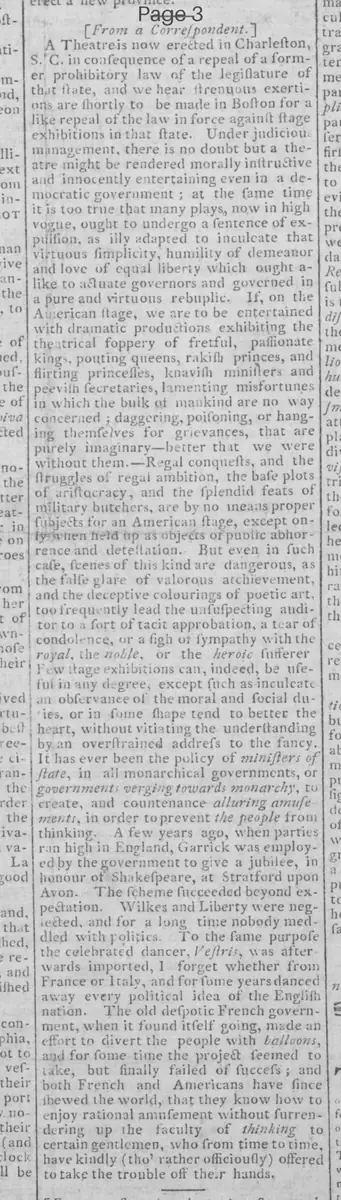
A Theatre is now erected in Charleston, S. C. in consequence of a repeal of a former prohibitory law of the legislature of that state, and we hear strenuous exertions are shortly to be made in Boston for a like repeal of the law in force against stage exhibitions in that state. Under judicious management, there is no doubt but a theatre might be rendered morally instructive and innocently entertaining even in a democratic government; at the same time it is too true that many plays, now in high vogue, ought to undergo a sentence of expulsion, as illy adapted to inculcate that virtuous simplicity, humility of demeanor and love of equal liberty which ought alike to animate governors and governed in a pure and virtuous republic. If, on the American stage, we are to be entertained with dramatic productions exhibiting the theatrical foppery of fretful, passionate king, pouting queens, rakish princes, and flirting princesses, knavish ministers and peevish secretaries, lamenting misfortunes in which the bulk of mankind are no way concerned; daggering, poisoning, or hanging themselves for grievances, that are purely imaginary—better that we were without them.—Regal conquests, and the struggles of regal ambition, the base plots of aristocracy, and the splendid feats of military butchers, are by no means proper subjects for an American stage, except only when held up as objects of public abhorrence and detestation. But even in such case, scenes of this kind are dangerous, as the false glare of valorous achievement, and the deceptive colourings of poetic art, too frequently lead the unsuspecting auditor to a sort of tacit approbation, a tear of condolence, or a sigh of sympathy with the royal, the noble, or the heroic sufferer. Few stage exhibitions can, indeed, be useful in any degree, except such as inculcate an observance of the moral and social duties, or in some shape tend to better the heart, without vitiating the understanding by an overstrained address to the fancy. It has ever been the policy of ministers of state, in all monarchical governments, or governments verging towards monarchy, to create, and countenance alluring amusements, in order to prevent the people from thinking. A few years ago, when parties ran high in England, Garrick was employed by the government to give a jubilee, in honour of Shakspeare, at Stratford upon Avon. The scheme succeeded beyond expectation. Wilkes and Liberty were neglected, and for a long time nobody meddled with politics. To the same purpose the celebrated dancer, Vestris, was afterwards imported, I forget whether from France or Italy, and for some years danced away every political idea of the English nation. The old despotic French government, when it found itself going, made an effort to divert the people with balloons and for some time the project seemed to take, but finally failed of success; and both French and Americans have since shewed the world, that they know how to enjoy rational amusement without surrendering up the faculty of thinking to certain gentlemen, who from time to time have kindly (tho' rather officiously) offered to take the trouble off their hands.
What sub-type of article is it?
What themes does it cover?
What keywords are associated?
What entities or persons were involved?
Letter to Editor Details
Author
A Correspondent
Main Argument
theaters can be morally instructive and entertaining in democratic governments under judicious management, but many popular plays promote unsuitable monarchical and aristocratic themes; governments historically use such amusements to distract people from political thinking.
Notable Details