Thank you for visiting SNEWPapers!
Sign up free
The New Hampshire Gazette
Portsmouth, Rockingham County, New Hampshire
What is this article about?
Summary of U.S. House of Representatives proceedings in late January, covering bills on land grants to refugees, canals and roads, intercourse with France, manufactures, seamen relief, land tax repeal, naturalization, state claims, treasury examination, foreign coins, bankrupt act, lighthouse rejection, and debates on the sedition law.
Clipping
OCR Quality
Full Text
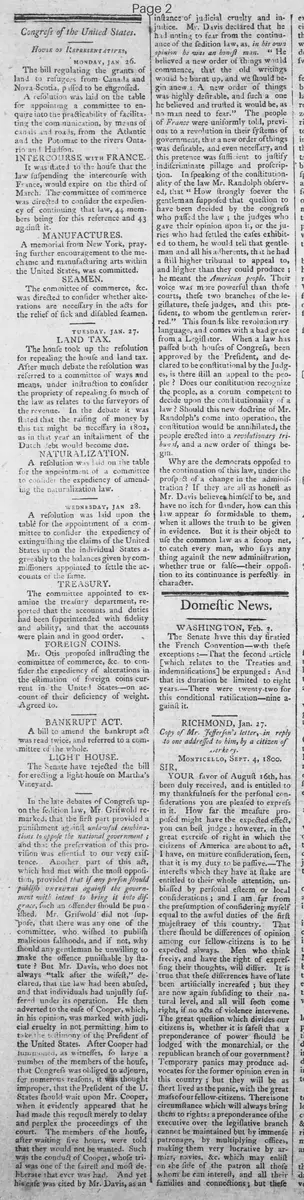
House of Representatives,
Monday, Jan. 20.
The bill regulating the grants of land to refugees from Canada and Nova-Scotia, passed to be engrossed.
A resolution was laid on the table for appointing a committee to enquire into the practicability of facilitating the communication, by means of canals and roads, from the Atlantic and the Potomac to the rivers Ontario and Hudson.
INTERCOURSE WITH FRANCE.
It was stated to the house that the law suspending the intercourse with France, would expire on the third of March. The committee of commerce was directed to consider the expediency of continuing that law, 44 members being for this reference and 43 against it.
MANUFACTURES
A memorial from New York, praying further encouragement to the mechanic and manufacturing arts within the United States, was committed.
SEAMEN.
The committee of commerce, &c. was directed to consider whether alterations are necessary in the acts for the relief of sick and disabled seamen.
TUESDAY, JAN. 27.
LAND TAX.
The house took up the resolution for repealing the house and land tax. After much debate the resolution was referred to a committee of ways and means, under instruction to consider the propriety of repealing so much of the law as relates to the surveyors of the revenue. In the debate it was stated that the raising of money by this tax might be necessary in 1802, as in that year an installment of the Dutch debt would become due.
NATURALIZATION.
A resolution was laid on the table for the appointment of a committee to consider the expediency of amending the naturalization law.
WEDNESDAY, JAN 28.
A resolution was laid upon the table for the appointment of a committee to consider the expediency of extinguishing the claims of the United States upon the individual States agreeably to the balances given by commissioners appointed to settle the accounts of the same.
TREASURY.
The committee appointed to examine the treasury department, reported that the accounts and duties had been superintended with fidelity and ability, and that the accounts were plain and in good order.
FOREIGN COINS.
Mr. Otis proposed instructing the committee of commerce, &c. to consider the expediency of alterations in the estimation of foreign coins current in the United States--on account of their deficiency of weight. Agreed to.
BANKRUPT ACT
A bill to amend the bankrupt act was read twice, and referred to a committee of the whole.
LIGHT HOUSE.
The Senate have rejected the bill for erecting a light house on Martha's Vineyard.
In the late debates of Congress upon the sedition law, Mr. Griswold remarked, that the first part provided a punishment against unlawful combinations to oppose the national government; and that the preservation of this provision was essential to our very existence. Another part of this act, which had met with the most opposition, provided that if any person should publish untruths against the government with intent to bring it into disgrace, such an offender should be punished. Mr. Griswold did not suppose, that there was any one of the committee, who wished to publish malicious falsehoods, and if not, why should any gentleman be unwilling to make the offence punishable by statute? But Mr. Davis, who does not always "talk after the wise," declared, that the law had been abused, and that individuals had unjustly suffered under its operation. He then adverted to the case of Cooper, which, in his opinion, was marked with judicial cruelty in not permitting him to take the testimony of the President of the United States. After Cooper had summoned, as witnesses, so large a number of the members of the house, that Congress was obliged to adjourn, for numerous reasons, it was thought improper, that the President of the U. States should wait upon Mr. Cooper, when it evidently appeared that he had made this request merely to delay and perplex the proceedings of the court. The members of the house, after waiting five hours, were told that they would not be wanted. Such was the conduct of Cooper, whose trial was one of the fairest and most deliberate that ever was had. And yet his case was cited by Mr. Davis, as an instance of judicial cruelty and injustice.
What sub-type of article is it?
What themes does it cover?
What keywords are associated?
What entities or persons were involved?
Where did it happen?
Story Details
Key Persons
Location
United States House Of Representatives
Event Date
January 20, 27, 28
Story Details
Proceedings include passage of land grants bill for Canadian and Nova Scotia refugees; resolution for canal and road communication; consideration of continuing intercourse suspension with France; memorial for manufacturing encouragement; review of seamen relief acts; debate and referral of land tax repeal; naturalization law amendment resolution; state claims extinguishment; positive treasury report; foreign coins estimation alterations; bankrupt act amendment; Senate rejection of Martha's Vineyard lighthouse; and sedition law debate highlighting Mr. Griswold's defense and Mr. Davis's criticism via Cooper's case.