Thank you for visiting SNEWPapers!
Sign up free
Story
January 25, 1822
The Portland Gazette
Portland, Cumberland County, Maine
What is this article about?
The Society for the Prevention of Pauperism in New York's fifth report critiques the pauper system as perpetuating poverty and vice, advocating its abolition to encourage self-reliance, sobriety, and industry among the poor, while noting liquor shops as a key cause.
Clipping
OCR Quality
95%
Excellent
Full Text
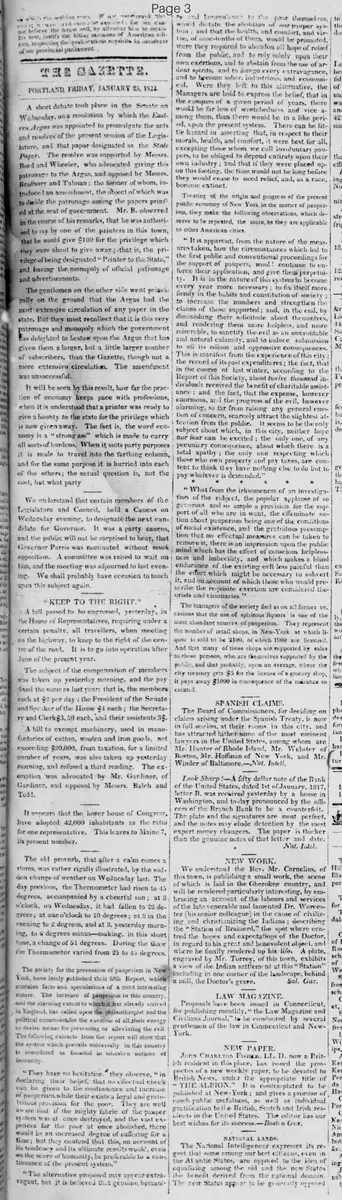
The society for the prevention of pauperism in New York, have lately published their fifth Report, which contains facts and speculations of a most interesting nature. The increase of pauperism in this country, and the alarming extent to which it has already arrived in England, has called upon the philanthropist and the political economist for the exertion of all their energy to devise means for preventing or alleviating the evil. The following extracts from the report will show that the system which prevails universally in this country is considered as founded in mistaken notions of humanity.
"They have no hesitation, they observe, "in declaring their belief, that no effectual check can be given to the continuance and increase of pauperism, while there exists a legal and gratuitous provision for the poor. They are well aware that if the mighty fabric of the pauper system was at once destroyed, and the vast expenses for the poor at once abolished, there would be an increased degree of suffering for a time; but they contend that this, on account of its tendency and its ultimate results would, even on the score of humanity, be preferable to a continuance of the present system."
"The alternative proposed may appear extravagant, but it is believed that genuine humanity and benevolence to the poor themselves, would dictate the abolition of our pauper system : and that the health, and comfort, and virtue, of nine-tenths of them, would be promoted, were they required to abandon all hope of relief from the public, and to rely solely upon their own exertions, and to abstain from the use of ardent spirits, and to forego every extravagance, and to become sober, industrious, and economical. Were they left to this alternative, the Managers are bold to express the belief, that in the compass of a given period of years, there would be far less of wretchedness and vice among them, than there would be in a like period, upon the present system. There can be little hazard in asserting that, in respect to their morals, health, and comfort, it were best for all, excepting those whom we call involuntary paupers, to be obliged to depend entirely upon their own industry ; and that if they were placed upon this footing, the time would not be long before they would cease to need relief, and, as a race, become extinct."
Treating of the origin and progress of the present public economy of New York in the matter of pauperism, they make the following observations, which deserve to be repeated, the more, as they are applicable to other American cities.
"It is apparent, from the nature of the measures taken, how the circumstances which led to the first public and conventional proceedings for the support of paupers, would continue to enforce their application, and give them perpetuity. It is in the nature of this system to become every year more necessary; to fix itself more firmly in the habits and constitution of society ; to increase the numbers and strengthen the claims of those supported; and, in the end, by diminishing their solicitude about themselves, and rendering them more helpless, and more miserable, to sanctify the evil as an unavoidable and natural calamity, and to induce submission to all its odious and oppressive consequences. This is manifest from the experience of this city ; the record of its past expenditures; the fact, that in the course of last winter, according to the Report of this Society, about twelve thousand individuals received the benefit of charitable assistance ; and the fact, that the expense, however enormous, and the progress of the evil, however alarming, so far from raising any general emotion of concern, scarcely attract the slightest attention from the public. It seems to be the only subject about which, in this city, neither hope nor fear can be excited ; the only one, of any pecuniary consequence, about which there is a total apathy ; the only one respecting which those who own property and pay taxes, are content to think they have nothing else to do but to pay whatever is demanded."
"What from the irksomeness of an investigation of the subject, the popular applause of so generous and so ample a provision for the support of all who are in want, the effeminate notion about pauperism being one of the conditions of social existence, and the gratuitous presumption that no effectual measures can be taken to remove it, there is an impression upon the public mind which has the effect of conscious helplessness and imbecility, and which makes a blind endurance of the existing evil less painful than the effort which might be necessary to subvert it, and on account of which those who would prescribe the requisite exertion are considered theorists and visionaries."
The managers of the society find as on all former occasions that the use of spirituous liquors is one of the most abundant sources of pauperism. They represent the number of retail shops. in New-York at which liquor is sold to be 2100, of which 1900 are licensed. And that many of those shops are supported by sales to those persons, who are themselves supported by the public, and that probably, upon an average, where the city treasury gets $5 for the license of a grocery shop. it pays away $1000 in consequence of the nuisance so created.
"They have no hesitation, they observe, "in declaring their belief, that no effectual check can be given to the continuance and increase of pauperism, while there exists a legal and gratuitous provision for the poor. They are well aware that if the mighty fabric of the pauper system was at once destroyed, and the vast expenses for the poor at once abolished, there would be an increased degree of suffering for a time; but they contend that this, on account of its tendency and its ultimate results would, even on the score of humanity, be preferable to a continuance of the present system."
"The alternative proposed may appear extravagant, but it is believed that genuine humanity and benevolence to the poor themselves, would dictate the abolition of our pauper system : and that the health, and comfort, and virtue, of nine-tenths of them, would be promoted, were they required to abandon all hope of relief from the public, and to rely solely upon their own exertions, and to abstain from the use of ardent spirits, and to forego every extravagance, and to become sober, industrious, and economical. Were they left to this alternative, the Managers are bold to express the belief, that in the compass of a given period of years, there would be far less of wretchedness and vice among them, than there would be in a like period, upon the present system. There can be little hazard in asserting that, in respect to their morals, health, and comfort, it were best for all, excepting those whom we call involuntary paupers, to be obliged to depend entirely upon their own industry ; and that if they were placed upon this footing, the time would not be long before they would cease to need relief, and, as a race, become extinct."
Treating of the origin and progress of the present public economy of New York in the matter of pauperism, they make the following observations, which deserve to be repeated, the more, as they are applicable to other American cities.
"It is apparent, from the nature of the measures taken, how the circumstances which led to the first public and conventional proceedings for the support of paupers, would continue to enforce their application, and give them perpetuity. It is in the nature of this system to become every year more necessary; to fix itself more firmly in the habits and constitution of society ; to increase the numbers and strengthen the claims of those supported; and, in the end, by diminishing their solicitude about themselves, and rendering them more helpless, and more miserable, to sanctify the evil as an unavoidable and natural calamity, and to induce submission to all its odious and oppressive consequences. This is manifest from the experience of this city ; the record of its past expenditures; the fact, that in the course of last winter, according to the Report of this Society, about twelve thousand individuals received the benefit of charitable assistance ; and the fact, that the expense, however enormous, and the progress of the evil, however alarming, so far from raising any general emotion of concern, scarcely attract the slightest attention from the public. It seems to be the only subject about which, in this city, neither hope nor fear can be excited ; the only one, of any pecuniary consequence, about which there is a total apathy ; the only one respecting which those who own property and pay taxes, are content to think they have nothing else to do but to pay whatever is demanded."
"What from the irksomeness of an investigation of the subject, the popular applause of so generous and so ample a provision for the support of all who are in want, the effeminate notion about pauperism being one of the conditions of social existence, and the gratuitous presumption that no effectual measures can be taken to remove it, there is an impression upon the public mind which has the effect of conscious helplessness and imbecility, and which makes a blind endurance of the existing evil less painful than the effort which might be necessary to subvert it, and on account of which those who would prescribe the requisite exertion are considered theorists and visionaries."
The managers of the society find as on all former occasions that the use of spirituous liquors is one of the most abundant sources of pauperism. They represent the number of retail shops. in New-York at which liquor is sold to be 2100, of which 1900 are licensed. And that many of those shops are supported by sales to those persons, who are themselves supported by the public, and that probably, upon an average, where the city treasury gets $5 for the license of a grocery shop. it pays away $1000 in consequence of the nuisance so created.
What sub-type of article is it?
Curiosity
Historical Event
What themes does it cover?
Misfortune
Moral Virtue
Social Manners
What keywords are associated?
Pauperism
Social Reform
New York
Liquor Shops
Self Reliance
Public Assistance
What entities or persons were involved?
Society For The Prevention Of Pauperism
Managers
Where did it happen?
New York
Story Details
Key Persons
Society For The Prevention Of Pauperism
Managers
Location
New York
Event Date
Last Winter
Story Details
The society's fifth report argues that the pauper system fosters dependency and vice, proposing its abolition to promote self-reliance and sobriety; notes 2100 liquor shops contribute to pauperism, with public costs far exceeding license fees.