Thank you for visiting SNEWPapers!
Sign up free
Alexandria Daily Advertiser
Alexandria, Virginia
What is this article about?
In a secret session of the French Tribunat on 2 Vendemiaire Year 14 (September 1805), orators from the Council of State read Emperor Napoleon's speech to the Senate and explained the outbreak of war on the continent. Blaming British intrigue, they noted Austria's unprovoked invasion of Bavaria, allying with Russia against France's efforts for peace and free seas.
Clipping
OCR Quality
Full Text
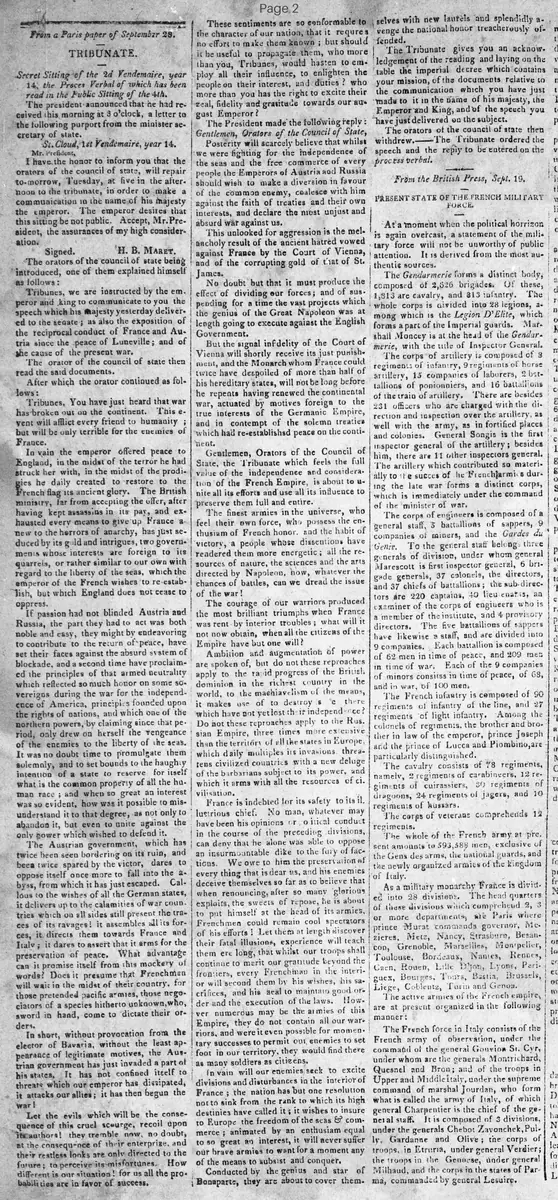
TRIBUNATE.
Secret Sitting of the 2d Vendemiaire, year 14. the Proces Verbal of which has been read in the Public Sitting of the 4th.
The president announced that he had received this morning at 3 o'clock, a letter to the following purport from the minister secretary of state.
St. Cloud, 1st Vendemiaire, year 14.
Mr. President,
I have the honor to inform you that the orators of the council of state, will repair to-morrow, Tuesday, at five in the afternoon to the tribunate, in order to make a communication in the name of his majesty the emperor. The emperor desires that this sitting be not public. Accept, Mr. President, the assurances of my high consideration.
Signed,
H. B. MARET.
The orators of the council of state being introduced, one of them explained himself as follows :
Tribunes, we are instructed by the emperor and king to communicate to you the speech which his majesty yesterday delivered to the senate ; as also the exposition of the reciprocal conduct of France and Austria since the peace of Luneville; and of the cause of the present war.
The orator of the council of state then read the said documents.
After which the orator continued as follows:
Tribunes. You have just heard that war has broken out on the continent. This event will afflict every friend to humanity ; but will be only terrible for the enemies of France.
In vain the emperor offered peace to England, in the midst of the terror he had struck her with, in the midst of the prodigies he daily created to restore to the French flag its ancient glory. The British ministry, far from accepting the offer, after having kept assassins in its pay, and exhausted every means to give up France anew to the horrors of anarchy, has just seduced by its gold and intrigues, two governments whose interests are foreign to its quarrels, or rather similar to our own with regard to the liberty of the seas, which the emperor of the French wishes to re-establish, but which England does not cease to oppress.
If passion had not blinded Austria and Russia, the part they had to act was both noble and easy, they might by endeavoring to contribute to the return of peace, have set their faces against the absurd system of blockade, and a second time have proclaimed the principles of that armed neutrality which reflected so much honor on some sovereigns during the war for the independence of America, principles founded upon the rights of nations, and which one of the northern powers, by claiming since that period, only drew on herself the vengeance of the enemies to the liberty of the seas.
It was no doubt time to promulgate them solemnly, and to set bounds to the haughty intention of a state to reserve for itself what is the common property of all the human race ; and when so great an interest was so evident, how was it possible to misunderstand it to that degree, as not only to abandon it, but even to unite against the only power which wished to defend it.
The Austrian government, which has twice been seen bordering on its ruin, and been twice spared by the victor, dares to oppose itself once more to fall into the abyss, from which it has just escaped. Callous to the wishes of all the German states, it delivers up to the calamities of war countries which on all sides still present the traces of its ravages! it assembles all its forces, it directs them towards France and Italy; it dares to assert that it arms for the preservation of peace. What advantage can it promise itself from this mockery of words? Does it presume that Frenchmen will wait in the midst of their country, for those pretended pacific armies, those negotiators of a species hitherto unknown, who, sword in hand, come to dictate their orders.
In short, without provocation from the elector of Bavaria, without the least appearance of legitimate motives, the Austrian government has just invaded a part of his states. It has not confined itself to threats which our emperor has dissipated, it attacks our allies: it has then begun the war!
Let the evils which will be the consequence of this cruel scourge, recoil upon its authors! they tremble now, no doubt, at the consequence of their enterprize, and their restless looks are only directed to the future: to perceive its misfortunes, How different is our situation! for us all the probabilities are in favor of success.
What sub-type of article is it?
What keywords are associated?
What entities or persons were involved?
Where did it happen?
Foreign News Details
Primary Location
Paris
Event Date
2d Vendemiaire, Year 14
Key Persons
Outcome
war has broken out on the continent; austrian government has invaded a part of the elector of bavaria's states, attacking french allies and beginning the conflict.
Event Details
In a secret sitting of the Tribunat, orators from the Council of State communicated the Emperor's speech to the Senate and an exposition of France-Austria relations since the Peace of Luneville, attributing the present war to British seduction of Austria and Russia. The Emperor had offered peace to England, but it persisted in blockades and anarchy plots. Austria, despite past sparing by France, mobilized forces against France and Italy, invading Bavaria without provocation.