Thank you for visiting SNEWPapers!
Sign up free
Story
March 8, 1854
Washington Telegraph
Washington, Hempstead County, Arkansas
What is this article about?
Two travelers in Lapland encounter a frozen man; one helps him, finding warmth and joy in the act, while the other stays in the sledge and freezes. The tale teaches that happiness comes from selfless benevolence toward others on life's journey.
Clipping
OCR Quality
95%
Excellent
Full Text
The Way to be Happy
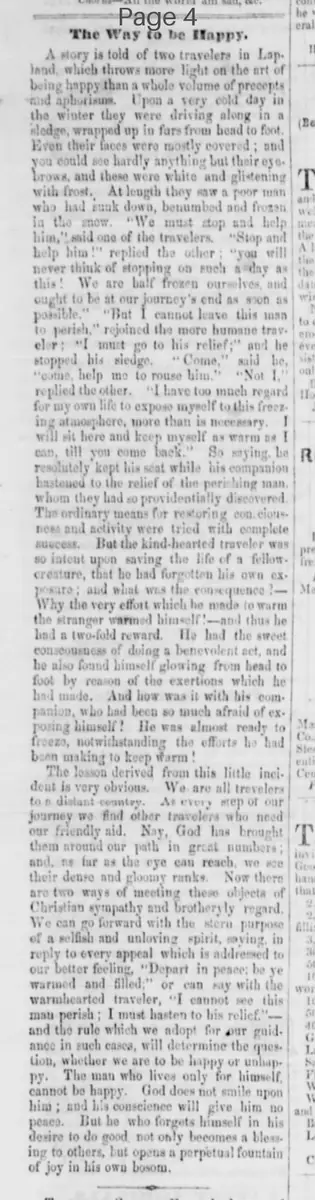
A story is told of two travelers in Lapland which throws more light on the art of being happy than a whole volume of precepts and aphorisms. Upon a very cold day in the winter they were driving along in a sledge, wrapped up in furs from head to foot. Even their faces were mostly covered; and you could see hardly anything but their eyebrows, and these were white and glistening with frost. At length they saw a poor man who had sunk down, benumbed and frozen in the snow. "We must stop and help him," said one of the travelers. "Stop and help him!" replied the other; "you will never think of stopping on such a day as this: We are half frozen ourselves and ought to be at our journey's end as soon as possible." "But I cannot leave this man to perish," rejoined the more humane traveler; "I must go to his relief;" and he stopped his sledge. "Come," said he, "come, help me to rouse him." "Not I," replied the other. "I have too much regard for my own life to expose myself to this freezing atmosphere, more than is necessary. I will sit here and keep myself as warm as I can, till you come back." So saying, he resolutely kept his seat while his companion hastened to the relief of the perishing man whom they had so providentially discovered. The ordinary means for restoring consciousness and activity were tried with complete success. But the kind-hearted traveler was so intent upon saving the life of a fellow creature, that he had forgotten his own exposure; and what was the consequence— Why the very effort which he made to warm the stranger warmed himself:—and thus he had a two-fold reward. He had the sweet consciousness of doing a benevolent act, and he also found himself glowing from head to foot by reason of the exertions which he had made. And how was it with his companion, who had been so much afraid of exposing himself! He was almost ready to freeze, notwithstanding the efforts he had been making to keep warm!
The lesson derived from this little incident is very obvious. We are all travelers to a distant country. As every step of our journey we find other travelers who need our friendly aid. Nay, God has brought them around our path in great numbers, and, as far as the eye can reach, we see their dense and gloomy ranks. Now there are two ways of meeting these objects of Christian sympathy and brotherly regard. We can go forward with the stern purpose of a selfish and unloving spirit, saying, in reply to every appeal which is addressed to our better feelings, "Depart in peace: be ye warmed and filled," or can say with the warm-hearted traveler, "I cannot see this man perish; I must hasten to his relief."— and the rule which we adopt for our guidance in such cases, will determine the question, whether we are to be happy or unhappy. The man who lives only for himself cannot be happy. God does not smile upon him; and his conscience will give him no peace. But he who forgets himself in his desire to do good not only becomes a blessing to others, but opens a perpetual fountain of joy in his own bosom.
A story is told of two travelers in Lapland which throws more light on the art of being happy than a whole volume of precepts and aphorisms. Upon a very cold day in the winter they were driving along in a sledge, wrapped up in furs from head to foot. Even their faces were mostly covered; and you could see hardly anything but their eyebrows, and these were white and glistening with frost. At length they saw a poor man who had sunk down, benumbed and frozen in the snow. "We must stop and help him," said one of the travelers. "Stop and help him!" replied the other; "you will never think of stopping on such a day as this: We are half frozen ourselves and ought to be at our journey's end as soon as possible." "But I cannot leave this man to perish," rejoined the more humane traveler; "I must go to his relief;" and he stopped his sledge. "Come," said he, "come, help me to rouse him." "Not I," replied the other. "I have too much regard for my own life to expose myself to this freezing atmosphere, more than is necessary. I will sit here and keep myself as warm as I can, till you come back." So saying, he resolutely kept his seat while his companion hastened to the relief of the perishing man whom they had so providentially discovered. The ordinary means for restoring consciousness and activity were tried with complete success. But the kind-hearted traveler was so intent upon saving the life of a fellow creature, that he had forgotten his own exposure; and what was the consequence— Why the very effort which he made to warm the stranger warmed himself:—and thus he had a two-fold reward. He had the sweet consciousness of doing a benevolent act, and he also found himself glowing from head to foot by reason of the exertions which he had made. And how was it with his companion, who had been so much afraid of exposing himself! He was almost ready to freeze, notwithstanding the efforts he had been making to keep warm!
The lesson derived from this little incident is very obvious. We are all travelers to a distant country. As every step of our journey we find other travelers who need our friendly aid. Nay, God has brought them around our path in great numbers, and, as far as the eye can reach, we see their dense and gloomy ranks. Now there are two ways of meeting these objects of Christian sympathy and brotherly regard. We can go forward with the stern purpose of a selfish and unloving spirit, saying, in reply to every appeal which is addressed to our better feelings, "Depart in peace: be ye warmed and filled," or can say with the warm-hearted traveler, "I cannot see this man perish; I must hasten to his relief."— and the rule which we adopt for our guidance in such cases, will determine the question, whether we are to be happy or unhappy. The man who lives only for himself cannot be happy. God does not smile upon him; and his conscience will give him no peace. But he who forgets himself in his desire to do good not only becomes a blessing to others, but opens a perpetual fountain of joy in his own bosom.
What sub-type of article is it?
Heroic Act
Journey
Personal Triumph
What themes does it cover?
Moral Virtue
Bravery Heroism
Providence Divine
What keywords are associated?
Lapland Travelers
Frozen Man Rescue
Benevolence Reward
Moral Lesson
Happiness Through Good Deeds
What entities or persons were involved?
Humane Traveler
Selfish Traveler
Poor Man
Where did it happen?
Lapland
Story Details
Key Persons
Humane Traveler
Selfish Traveler
Poor Man
Location
Lapland
Event Date
A Very Cold Day In The Winter
Story Details
Two travelers in Lapland find a frozen man; the humane one stops to help, warms himself through the effort, and saves the man, gaining joy; the selfish one freezes while waiting. The moral: Selfless aid brings happiness on life's journey.