Thank you for visiting SNEWPapers!
Sign up free
Gazette Of The United States
New York, New York County, New York
What is this article about?
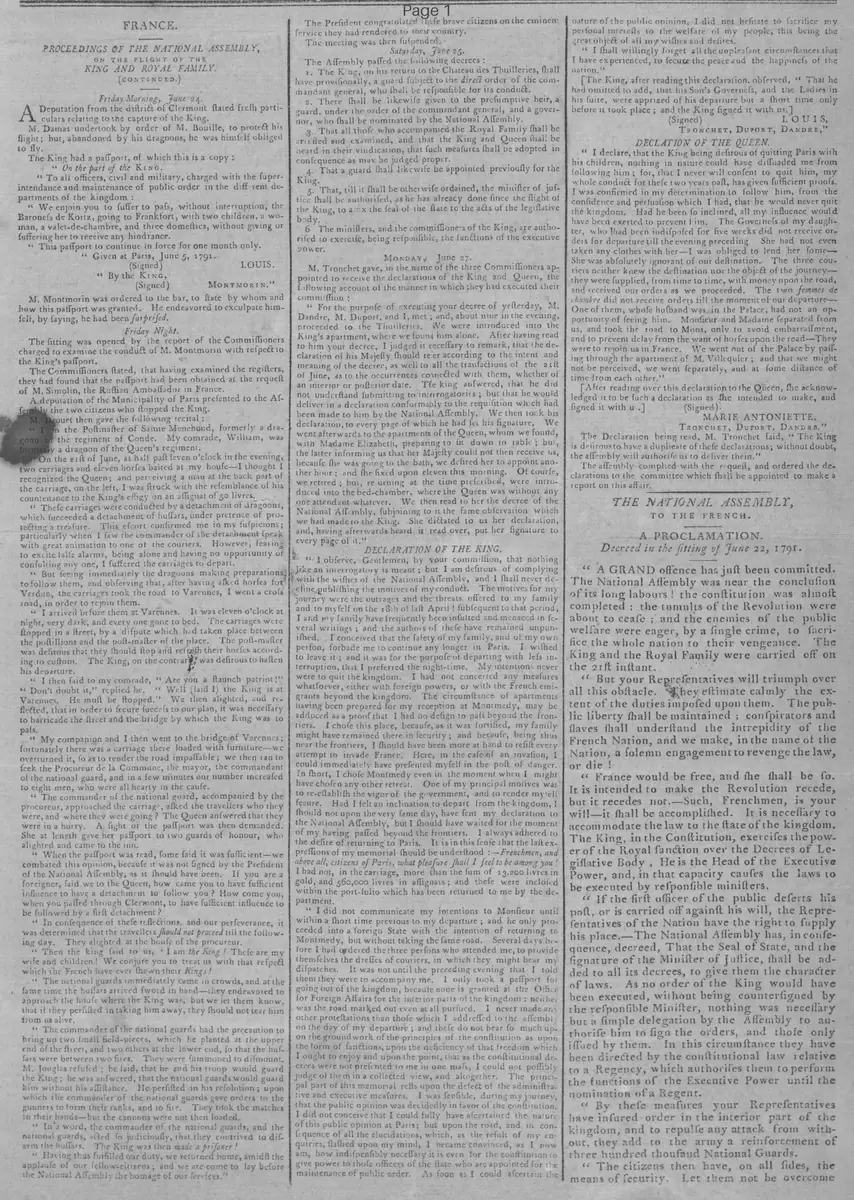
Proceedings of the French National Assembly following the King's flight to Varennes on June 21, 1791. Details include capture accounts by citizens Drouet and William, passports, declarations by Louis XVI and Marie Antoinette justifying the escape, decrees for royal guards, and a proclamation to the French affirming commitment to the Revolution and Constitution.
Merged-components note: Direct continuation of the detailed story on the flight of the King and proceedings of the National Assembly in France across pages 1 and 2.
Clippings
1 of 2
OCR Quality
Full Text
PROCEEDINGS OF THE NATIONAL ASSEMBLY,
ON THE FLIGHT OF THE
KING AND ROYAL FAMILY.
(Continued.)
Friday Morning, June 24.
Deputation from the district of Clermont stated fresh particulars relating to the capture of the King.
M. Damas undertook by order of M. Bouille, to protect his flight; but, abandoned by his dragoons, he was himself obliged to fly.
The King had a passport, of which this is a copy:
"On the part of the King.
"To all officers, civil and military, charged with the superintendence and maintenance of public order in the different departments of the kingdom:
"We enjoin you to suffer to pass, without interruption, the Baroness de Korff, going to Frankfort, with two children, a woman, a valet-de-chambre, and three domestics, without giving or suffering her to receive any hindrance.
"This passport to continue in force for one month only.
Given at Paris, June 5, 1791.
(Signed)
LOUIS.
"By the King,
(Signed)
MONTMORIN."
M. Montmorin was ordered to the bar, to state by whom and how this passport was granted. He endeavored to exculpate himself, by saying, he had been surprised.
Friday Night.
The sitting was opened by the report of the Commissioners charged to examine the conduct of M. Montmorin with respect to the King's passport.
The Commissioners stated, that having examined the registers, they had found that the passport had been obtained at the request of M. Simolin, the Russian Ambassador in France.
A deputation of the Municipality of Paris presented to the Assembly the two citizens who stopped the King.
M. Drouet then gave the following recital:
"I am the Postmaster of Sainte Menehould, formerly a dragoon in the regiment of Conde. My comrade, William, was formerly a dragoon of the Queen's regiment.
On the 21st of June, at half past seven o'clock in the evening, two carriages and eleven horses baited at my house—I thought I recognized the Queen; and perceiving a man at the back part of the carriage, on the left, I was struck with the resemblance of his countenance to the King's effigy on an assignat of 20 livres.
"These carriages were conducted by a detachment of dragoons, which succeeded a detachment of hussars, under pretence of protecting a treasure. This escort confirmed me in my suspicions; particularly when I saw the commander of the detachment speak with great animation to one of the couriers. However, fearing to excite false alarms, being alone and having no opportunity of consulting any one, I suffered the carriages to depart.
"But seeing immediately the dragoons making preparations to follow them, and observing that, after having asked horses for Verdun, the carriages took the road to Varennes, I went across road, in order to rejoin them.
"I arrived before them at Varennes. It was eleven o'clock at night, very dark, and every one gone to bed. The carriages were stopped in a street, by a dispute which had taken place between the postillions and the post-master of the place. The post-master was desirous that they should stop and refresh their horses according to custom. The King, on the contrary, was desirous to hasten his departure.
I then said to my comrade, "Are you a staunch patriot!"
"Don't doubt it," replied he. Well (said I) the King is at Varennes. He must be stopped." We then alighted, and reflected, that in order to ensure success to our plan, it was necessary to barricade the street and the bridge by which the King was to pass.
"My companion and I then went to the bridge of Varennes; fortunately there was a carriage there loaded with furniture—we overturned it, so as to render the road impassable; we then ran to seek the Procureur de la Commune, the mayor, the commandant of the national guard, and in a few minutes our number increased to eight men, who were all hearty in the cause.
"The commander of the national guard, accompanied by the procureur, approached the carriages, asked the travellers who they were, and where they were going? The Queen answered that they were in a hurry. A sight of the passport was then demanded.
She at length gave her passport to two guards of honour, who alighted and came to the inn.
"When the passport was read, some said it was sufficient—we combated this opinion, because it was not signed by the President of the National Assembly, as it should have been. If you are a foreigner, said we to the Queen, how came you to have sufficient influence to have a detachment to follow you? How come you, when you passed through Clermont, to have sufficient influence to be followed by a first detachment?
"In consequence of these reflections, and our perseverance, it was determined that the travellers should not proceed till the following day. They alighted at the house of the procureur.
"Then the king said to us, I am the King! These are my wife and children! We conjure you to treat us with that respect which the French have ever shown their Kings!
"The national guards immediately came in crowds, and at the same time the hussars arrived sword in hand—they endeavored to approach the house where the King was, but we let them know, that if they persisted in taking him away, they should not tear him from us alive.
"The commander of the national guards had the precaution to bring up two small field-pieces, which he planted at the upper end of the street, and two others at the lower end, so that the hussars were between two fires. They were summoned to dismount.
M. Jouglas refused; he said, that he and his troop would guard the King; he was answered, that the national guards would guard him without his assistance. He persisted in his resolution; upon which the commander of the national guards gave orders to the gunners to form their ranks, and to fire. They took the matches in their hands—but the cannons were not then loaded.
"In a word, the commander of the national guards, and the national guards, acted so judiciously, that they contrived to disarm the hussars. The King was then made a prisoner!
"Having thus fulfilled our duty, we returned home, amidst the applause of our fellow-citizens; and we are come to lay before the National Assembly the homage of our services."
The President congratulated these brave citizens on the eminent service they had rendered to their country.
The meeting was then suspended.
Saturday, June 25.
The Assembly passed the following decrees:
1. The King, on his return to the Chateau des Thuilleries, shall have provisionally, a guard subject to the direct order of the commandant general, who shall be responsible for its conduct.
2. There shall be likewise given to the presumptive heir, a guard, under the order of the commandant general, and a governor, who shall be nominated by the National Assembly.
3. That all those who accompanied the Royal Family shall be arrested and examined, and that the King and Queen shall be heard in their vindication, that such measures shall be adopted in consequence as may be judged proper.
4. That a guard shall likewise be appointed previously for the King.
5. That, till it shall be otherwise ordained, the minister of justice shall be authorised, as he has already done since the flight of the King, to affix the seal of the state to the acts of the legislative body.
6. The ministers, and the commissioners of the King, are authorised to exercise, being responsible, the functions of the executive power.
Monday, June 27.
M. Tronchet gave, in the name of the three Commissioners appointed to receive the declarations of the King and Queen, the following account of the manner in which they had executed their commission:
"For the purpose of executing your decree of yesterday, M. Dandre, M. Duport, and I, met; and, about nine in the evening, proceeded to the Thuilleries. We were introduced into the King's apartment, where we found him alone. After having read to him your decree, I judged it necessary to remark, that the declaration of his Majesty should refer according to the intent and meaning of the decree, as well to all the transactions of the 21st of June, as to the occurrences connected with them, whether of an interior or posterior date. The king answered, that he did not understand submitting to interrogatories; but that he would deliver in a declaration conformably to the requisition which had been made to him by the National Assembly. We then took his declaration, to every page of which he had set his signature. We went afterwards to the apartments of the Queen, whom we found, with Madame Elizabeth, preparing to sit down to table; but, the latter informing us that her Majesty could not then receive us, because she was going to the bath, we desired her to appoint another hour; and she fixed upon eleven this morning. Of course, we retired; but, returning at the time prescribed, were introduced into the bed-chamber, where the Queen was without any one attendant whatever. We then read to her the decree of the National Assembly, subjoining to it the same observation which we had made to the King. She dictated to us her declaration, and, having afterwards heard it read over, put her signature to every page of it."
DECLARATION OF THE KING.
"I observe, Gentlemen, by your commission, that nothing like an interrogatory is meant; but I am desirous of complying with the wishes of the National Assembly, and I shall never decline—publishing the motives of my conduct. The motives for my journey were the outrages and the threats offered to my family and to myself on the 18th of last April! Subsequent to that period, I and my family have frequently been insulted and menaced in several writings; and the authors of these have remained unpunished. I conceived that the safety of my family, and of my own person, forbade me to continue any longer in Paris. I wished to leave it; and it was for the purpose of departing with less interruption, that I preferred the night-time. My intention never were to quit the kingdom. I had not concerted any measures whatsoever, either with foreign powers, or with the French emigrants beyond the kingdom. The circumstance of apartments having been prepared for my reception at Montmedy, may be adduced as a proof that I had no design to pass beyond the frontiers. I chose this place, because, as it was fortified, my family might have remained there in security; and because, being thus near the frontiers, I should have been more at hand to resist every attempt to invade France. Here, in the case of an invasion, I could immediately have presented myself in the post of danger.
In short, I chose Montmedy even in the moment when I might have chosen any other retreat. One of my principal motives was to re-establish the vigor of the government, and to render myself secure. Had I felt an inclination to depart from the kingdom, I should not upon the very same day, have sent my declaration to the National Assembly, but I should have waited for the moment of my having passed beyond the frontiers. I always adhered to the desire of returning to Paris. It is in this sense that the last expressions of my memorial should be understood:—Frenchmen, and above all, citizens of Paris, what pleasure shall I feel to be among you!
I had not, in the carriage, more than the sum of 13,200 livres in gold, and 560,000 livres in assignats; and these were enclosed within the portfolio which has been returned to me by the department.
"I did not communicate my intentions to Monsieur until within a short time previous to my departure; and he only proceeded into a foreign State with the intention of returning to Montmedy, but without taking the same road. Several days before I had ordered the three persons who attended me, to provide themselves the dress of couriers, in which they might bear my dispatches. It was not until the preceding evening that I told them they were to accompany me. I only took a passport for going out of the kingdom, because none is granted at the Office for Foreign Affairs for the interior parts of the kingdom: neither was the road marked out even at all pursued. I never made any other protestations than those which I addressed to the assembly on the day of my departure; and these do not bear so much upon the ground work of the principles of the constitution as upon the form of sanctions, upon the deficiency of that freedom which I ought to enjoy and upon the point, that as the constitutional decrees were not presented to me in one mass, I could not possibly judge of them in a collected view, and altogether. The principal part of this memorial rests upon the defect of the administrative and executive measures. I was sensible, during my journey, that the public opinion was decidedly in favor of the constitution.
I did not conceive that I could fully have ascertained the nature of this public opinion at Paris; but upon the road, and in consequence of all the elucidations, which, as the result of my inquiries, flashed upon my mind, I became convinced, as I now am, how indispensably necessary it is even for the constitution to give power to those officers of the state who are appointed for the maintenance of public order. As soon as I could ascertain the nature of the public opinion, I did not hesitate to sacrifice my personal interests to the welfare of my people, this being the great object of all my wishes and desires.
"I shall willingly forget all the unpleasant circumstances that I have experienced, to secure the peace and the happiness of the nation."
The King, after reading this declaration, observed, "That he had omitted to add, that his Son's Governess, and the Ladies in his suite, were apprized of his departure but a short time only before it took place; and the King signed it with us."
(Signed)
LOUIS,
Tronchet, Duport, Dandre.
DECLARATION OF THE QUEEN.
"I declare, that the King being desirous of quitting Paris with his children, nothing in nature could have dissuaded me from following him; for, that I never will consent to quit him, my whole conduct for these two years past, has given sufficient proofs.
I was confirmed in my determination to follow him, from the confidence and persuasion which I had, that he would never quit the kingdom. Had he been so inclined, all my influence would have been exerted to prevent him. The Governess of my daughter, who had been indisposed for five weeks did not receive orders for departure till the evening preceding She had not even taken any clothes with her—I was obliged to lend her some—
She was absolutely ignorant of our destination. The three couriers neither knew the destination nor the object of the journey— they were supplied, from time to time, with money upon the road, and received our orders as we proceeded. The two femmes de chambre did not receive orders till the moment of our departure-- One of them, whose husband was in the Palace, had not an opportunity of seeing him. Monsieur and Madame separated from us, and took the road to Mons, only to avoid embarrassment, and to prevent delay from the want of horses upon the road—They were to rejoin us in France. We went out of the Palace by passing through the apartment of M. Villequier; and that we might not be perceived, we went separately, and at some distance of time from each other."
After reading over this declaration to the Queen, she acknowledged it to be such a declaration as she intended to make, and signed it with us.
(Signed).
MARIE ANTONIETTE,
Tronchet, Duport. Dandre.
The Declaration being read, M. Tronchet said, "The King is desirous to have a duplicate of these declarations; without doubt, the assembly will authorise us to deliver them."
The assembly complied with the request, and ordered the declarations to the committee which shall be appointed to make a report on this affair.
THE NATIONAL ASSEMBLY,
TO THE FRENCH.
A PROCLAMATION.
Decreed in the sitting of June 22, 1791.
"A GRAND offence has just been committed.
The National Assembly was near the conclusion of its long labours! the constitution was almost completed: the tumults of the Revolution were about to cease; and the enemies of the public welfare were eager, by a single crime, to sacrifice the whole nation to their vengeance. The King and the Royal Family were carried off on the 21st instant.
"But your Representatives will triumph over all this obstacle. They estimate calmly the extent of the duties imposed upon them. The public liberty shall be maintained; conspirators and slaves shall understand the intrepidity of the French Nation, and we make, in the name of the Nation, a solemn engagement to revenge the law, or die!
"France would be free, and she shall be so.
It is intended to make the Revolution recede, but it recedes not.—Such, Frenchmen, is your will—it shall be accomplished. It is necessary to accommodate the law to the state of the kingdom.
The King, in the Constitution, exercises the power of the Royal sanction over the Decrees of Legislative Body, He is the Head of the Executive Power, and, in that capacity causes the laws to be executed by responsible ministers.
"If the first officer of the public deserts his post, or is carried off against his will, the Representatives of the Nation have the right to supply his place.—The National Assembly has, in consequence, decreed, That the Seal of State, and the signature of the Minister of Justice, shall be added to all its decrees, to give them the character of laws. As no order of the King would have been executed, without being countersigned by the responsible Minister, nothing was necessary but a simple delegation by the Assembly to authorise him to sign the orders, and those only issued by them. In this circumstance they have been directed by the constitutional law relative to a Regency, which authorises them to perform the functions of the Executive Power until the nomination of a Regent.
"By these measures your Representatives have insured order in the interior part of the kingdom, and to repulse any attack from without, they add to the army a reinforcement of three hundred thousand National Guards.
"The citizens then have, on all sides, the means of security. Let them not be overcome
By their surprise; the Constituent Assembly is upon its duty; the constituted powers are in activity; the Citizens of Paris, the National Guards, whose patriotism and fidelity are above all praise, watch round your Representatives; the active citizens throughout the kingdom are in arms, and France may wait for its enemies.
"Are they to fear the consequences of a writing, forced before his departure, from a seduced King: It is difficult to conceive the ignorance and blindness that have dictated this writing, which may deserve to be further discussed here-after; at present, your Representatives content themselves with examining some particular sentiments."
The National Assembly has made a solemn proclamation of political truths, and of rights, the acknowledgment of which will one day produce the happiness of the human race; to engage them to renounce this declaration of rights, the theory of slavery itself has been presented to them.
"Frenchmen! we have no fear in recalling to your memories the famous day, the 23d of July, 1789—that day, on which the Chief of the Executive Power, the first public functionary of the nation, dared to dictate his absolute will to your Representatives, charged by your orders to form a Constitution. The National Assembly lamented the disorders committed on the 5th of October, and ordered the prosecution of the persons guilty of them; but, because it was difficult to discover some rioters amongst such a multitude of people, they are said to have approved all their crimes. The nation is, however, more just. It has not reproached Louis XVI. with the violences that have occurred under his Reign, and those of his ancestors!"
"They are not afraid to call to your recollection the Federation of July. What are the statements of the persons who have dictated the letter of the King, with respect to this august act? that the first public functionary was obliged to put himself at the head of the Representatives of the Nation, in the midst of the Deputies of all the kingdom. He took a solemn oath to maintain the Constitution. If the King does not hereafter declare, that his good faith has been surprised by seditious persons, he has, of course, announced his own perjury to the whole world! Is it necessary to go through the fatigue of answering the other reproaches of this letter?"
"The King is said to have experienced some inconvenencies in his residence at Paris, and not to have found the same pleasures as formerly; by which it is implied, no doubt, that a nation ought to regenerate itself without any agitation, without disturbing for an instant, the pleasures and the indulgencies of courts. As to the addresses of congratulation and adherence to your decrees, these say they, are the work of the factious. Yes—no doubt—of TWENTY-SIX MILLIONS of the factions."
"It was necessary to re-constitute all powers because all the powers were corrupted, and because the alarming debts accumulated by the despotism and the disorders of government, would have overwhelmed the nation. But does not Royalty exist for the people? And if a great Nation obliges itself to maintain it, is it not solely because it is believed to be useful? The Constitution has left to the King this glorious prerogative, and has confirmed to him the only authority which he should desire to exercise. Would not your representation have been culpable, if they had sacrificed twenty-six millions to the interest of one man?"
"The labour of citizens supports the powers of the State; but the maxim of absolute power is, to consider the public contributions as a debt paid to despotism. The National Assembly has regulated its expences with the strictest justice: they thought themselves bound, when acting in the name of the Nation, to act munificently; and when they were to determine what part of the public contributions should be allowed to the first functionary, thirty millions were allotted for him and the Royal Family; but this is represented as a trifling sum!"
"The Decrees upon the subject of peace and war, have taken from the King and his Ministers the power of sacrificing the people to the caprices of courts; and the definitive ratification of Treaties is reserved to the Representatives of the Nation. The loss of a prerogative is complained of. What prerogative? That of not being obliged to consult the National will, when the blood and the fortunes of citizens were to be sacrificed. Who can know the wish and interests of the Nation better than the Legislative Body? It is wished to make war with impunity."
But have we not had, under the ancient Government, sufficient experience of the terrible effects produced by the ambition of Ministers?
We are accused of having despoiled the King in forming the judicial power, as if the King of a great Nation ought to appear in the administration of justice, for any other purpose than that of causing the law to be observed, and its judgments executed. It is wished that he should have the right of granting pardons, and changing punishments; but does not all the world know, how such a right would be exercised, and upon whom the benefit of it would fall? The King could not have exercised it by himself; and having prohibited Royal despotism, it was natural to prohibit that of the Ministers.
"The necessity of circumstances has sometimes obliged the National Assembly to meddle, contrary to its inclination, in the affairs of administration. It ought not to act, when the government remained in blameable inertness? It is, therefore, necessary to say, that neither the King nor the Ministers have the confidence of the nation!"
"The Societies of Friends of the Constitution have supported the Revolution; they are more necessary than ever, and some persons presume to say that they govern the administrative bodies, and the empire, as if they were the deliberating bodies!"
"Frenchmen! all the powers are organized; all the public functionaries are at their posts; the National Assembly watches over the safety of the State? may you be firm and tranquil! One danger alone threatens us. You have to guard against the suspension of your labours—against delay in the payment of duties—against any inflammatory measures, which commence in anarchies, and end in civil war. It is to these dangers that the National Assembly calls the attention of the citizens. In this crisis, all private animosities and private interests should disappear."
"Those who would preserve their liberty, should show that tranquil firmness which appalls tyrants. May the factious, who hope to see every thing overturned, find order maintained, and the Constitution confirmed, and rendered more dear to Frenchmen, by the attacks made upon it! The Capital may be an example to the rest of France. The departure of the King excited no disorders there; but to the confusion of the malevolent, the utmost tranquility prevails in it."
"To reduce the territory of this empire to the yoke, it will be necessary to destroy the whole nation! Despotism if it pleases, may make such an attempt—It will either fail, or at the conclusion of its triumphs, will find only ruins!"
This Address was unanimously approved by the Assembly, and ordered to be sent to all the Departments.
What sub-type of article is it?
What keywords are associated?
What entities or persons were involved?
Where did it happen?
Foreign News Details
Primary Location
Paris, France
Event Date
June 21 27, 1791
Key Persons
Outcome
king and royal family captured at varennes; decrees for provisional guards, arrests of accomplices, and executive functions; declarations justifying flight as safety measure without intent to leave kingdom; proclamation affirming revolution and constitution.
Event Details
The National Assembly discusses the King's failed flight on June 21, 1791, including details of the capture by citizens Drouet and William at Varennes, examination of the forged passport issued by Montmorin at Russian Ambassador's request, King's and Queen's declarations denying treason and citing safety concerns, passage of decrees for royal security and interim governance, and issuance of a proclamation to the French defending the Revolution against the King's actions.