Thank you for visiting SNEWPapers!
Sign up free
Literary
September 9, 1852
Green Mountain Freeman
Montpelier, Washington County, Vermont
What is this article about?
Essay by Emily R. Page on the fragility of woman's character, easily ruined by suspicion and gossip, especially for the poor and unprotected. Critiques society's hasty judgments and calls for Christian compassion to safeguard female virtue and reputation.
Clipping
OCR Quality
95%
Excellent
Full Text
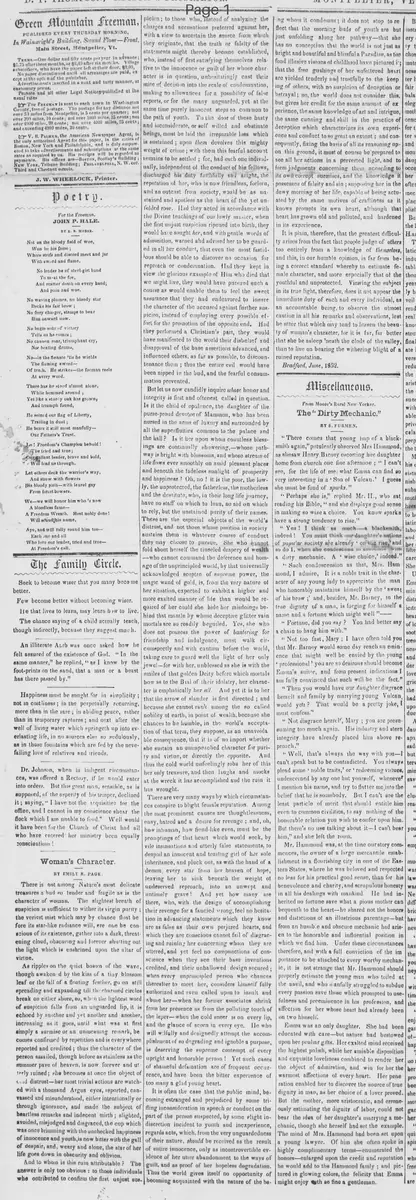
Woman's Character.
BY EMILY R. PAGE.
There is not among Nature's most delicate
treasures a bud so tender and fragile as is the
character of woman. The slightest breath of
suspicion is sufficient to wither its virgin purity:
the veriest mist which may by chance float be-
fore its star-like radiance will, ere one be con-
scious of its existence, gather into a dark, threat-
ening cloud, obscuring and forever shutting out
the light which is enshrined upon the altar of
virtue.
As ripples on the quiet bosom of the wave,
though awakened by the kiss of a tiny blossom
leaf or the fall of a floating feather, go on still
spreading and expanding till the charmed circles
break on either shore, so, when the lightest word
of suspicion falls from an unguarded lip, it is
echoed by another and yet another and another,
increasing as it goes, until what was at first
simply a surmise or an unmeaning remark, be-
comes confirmed by repetition and is everywhere
reported and credited; thus the character of the
person assailed, though before as stainless as the
summer dawn of heaven, is now forever and ut-
terly ruined; she becomes at once the object of
eyed distrust—her most trivial actions are watch-
ed with a thousand Argus eyes, reported, can-
vassed and misunderstood, either intentionally or
through ignorance, and made the subject of
heartless remarks and indecent mirth; slighted,
avoided, misjudged and disgraced, the cup which
was once brimming with the unchecked happiness
of innocence and youth, is now bitter with the gall
of despair, and, weary and alone, the star of her
life goes down in obscurity and oblivion.
And to whom is this ruin attributable? The
answer is only too obvious: to those individuals
who contributed to confirm the first unjust sus-
picion; to those who, instead of analyzing the
charges and accusations preferred against her,
with a view to ascertain the source from which
they originate, that the truth or falsity of the
statements might thereby become established,
who, instead of first satisfying themselves rela-
tive to the innocence or guilt of her whose char-
acter is in question, unhesitatingly cast their
mite of decision into the scale of condemnation,
making no allowances for a possibility of false
reports, or for the many unguarded, yet at the
same time purely innocent steps so common to
the path of youth. To the door of these hasty
and inconsiderate, or self-willed and obstinate
beings, must be laid the irreparable loss which
is sustained; upon them devolves this mighty
weight of crime; with them this fearful account
remains to be settled; for, had each one individ-
ually, independent of the conduct of his fellows,
discharged his duty faithfully and aright, the
reputation of her, who is now friendless, forlorn,
and an outcast from society, would be as un-
stained and spotless as the heart of the yet un-
folded rose. Had they acted in accordance with
the Divine teachings of our lowly Master, when
the first unjust suspicion ripened into birth, they
would have sought her, and with gentle words of
admonition, warned and advised her to be guard-
ed in all her conduct, that even the most fastid-
lous should be able to discover no occasion for
reproach or condemnation. Had they kept in
view the glorious example of Him who died that
we might live, they would have pursued such a
course as would enable them to feel the sweet
assurance that they had endeavored to insure
the character of the accused against further sus-
picion, instead of employing every possible ef-
fort for the promotion of the opposite end. Had
they performed a Christian's part, they would
have manifested to the world their disbelief and
disapproval of the base assertions advanced, and
influenced others, as far as possible, to discoun-
tenance them; thus the entire evil would have
been nipped in the bud, and the fearful consum-
mation prevented.
But let us now candidly inquire whose honor and
integrity is first and oftenest called in question.
Is it the child of opulence, the daughter of the
purse-proud devotee of Mammon, who has been
nursed in the arms of luxury and surrounded by
all the superfluities common to the palace and
the hall? Is it her upon whom countless bless-
ings are continually showering,—whose path-
way is bright with blossoms, and whose stream of
life flows ever smoothly on amid pleasant places
and beneath the fadeless sunlight of prosperity
and happiness? Oh, no! it is the poor, the low-
ly, the unprotected, the fatherless, the motherless
and the destitute, who, in their long life journey.
have no staff on which to lean, no aid on which
to rely, but the unstained purity of their names.
These are the especial objects of the world's
distrust, and not those whose position in society
sustains them in whatever course of conduct
they may choose to pursue. She who cannot
fold about herself the tinsel drapery of wealth
—who cannot command the deference and hom-
age of the unprincipled world, by that universally
acknowledged sceptre of supreme power, the
magic wand of gold, is, from the very nature of
her situation, expected to exhibit a higher and
more exalted manner of life than would be re-
quired of her could she hide her misdoings be-
hind that mantle by whose deceptive glitter vain
mortals are so readily beguiled. Yes, she who
does not possess the power of bartering for
friendship and indulgence, must walk cir-
cumspectly and with caution before the world,
taking care to guard well the light of her only
jewel—for with her, unblessed as she is with the
smiles of that golden Deity before which mortals
bow as to the Baal of their idolatry, her charac-
ter is emphatically her all. And yet it is to her
that the arrow of slander is first directed; and
because she cannot rank among the so called
nobility of earth, in point of wealth, because she
chances to be humble, in the world's accepta-
tion of that term, they suppose, as an unavoida-
ble consequence, that it is of no import whether
she sustain an unimpeached character for puri-
ty and virtue, or directly the opposite. And
thus the cold world unfeelingly robs her of this
her only treasure, and then laughs and mocks
at the wreck it has accomplished and the ruin it
has wrought.
There are very many ways by which circumstan-
ces conspire to blight female reputation. Among
the most prominent causes are thoughtlessness.
envy, hatred and a desire for revenge; and, oh.
how inhuman, how fiend-like even, must be the
promptings of that heart which would seek, by
vile insinuations and utterly false statements, to
despoil an innocent and trusting girl of her sole
inheritance, and pluck out, as with the hand of a
demon, every star from her heaven of hope,
leaving her to sink beneath the weight of
undeserved reproach, into an unwept and
untimely grave! And yet how many are
there, who, with the design of accomplishing
their revenge for a fancied wrong, feel no hesita-
tion in advancing statements which they know
are as false as their own perjured hearts, and
which they are conscious cannot fail of disgrac-
ing and ruining her concerning whom they are
uttered, and yet feel no compunctions of con-
science when they see their base inventions
credited, and their unhallowed design secured
when every unprincipled person who chances
thereafter to meet her, considers himself fully
authorized and even called upon to insult and
abuse her—when her former associates shrink
from her presence as from the polluting touch of
the leper—when the cold sneer is on every lip.
and the glance of scorn in every eye. He who
will willfully and designedly attempt the accom-
plishment of so degrading and ignoble a purpose.
is deserving the supreme contempt of every
upright and honorable person! Yet such cases
of shameful defamation are of frequent occur-
rence, and have been the bitter experience of
too many a glad young heart.
It is often the case that the public mind, be-
coming estranged and prejudiced by some tri-
fling inconsideration in speech or conduct on the
part of the person suspected, by some slight in-
discretion incident to youth and inexperience,
regards acts, which, from the very unguardedness
of their nature, should be received as the result
of entire innocence, only as incontrovertible ev-
idence of her utter abandonment to the ways of
guilt, and as proof of her hopeless degradation.
Thus the world gives itself no opportunity of
becoming acquainted with the nature of the be-
ing whom it condemns; it does not stop to re-
flect that the morning buds of youth are but
just unfolding along her pathway—that she
has no conception that the world is not just as
bright and beautiful and blissful a Paradise, as the
fond illusive visions of childhood have pictured it
that the free gushings of her unfettered heart
are yielded tenderly and trustfully to the keep-
ing of others, with no suspicion of deception or
betrayal; no, the world does not consider this
but gives her credit for the same amount of ex-
perience, the same knowledge of art and intrigue,
the same cunning and skill in the practice of
deception which characterizes its own experi-
ence and conduct to so great an extent; and con-
sequently, fixing the basis of all its reasoning up-
on this ground, it must of course be prepared to
see all her actions in a perverted light, and to
form judgments concerning them according to
its own corrupt surmises, and the knowledge it
possesses of falsity and sin; supposing her in the
dewy morning of her life, capable of being actu-
ated by the same motives of craftiness as it
knows prompts its own heart, although that
heart has grown old and polluted, and hardened
in its experience.
It is plain, therefore, that the greatest difficul-
ty arises from the fact that people judge of others
too entirely from a knowledge of themselves
and this, in our humble opinion, is far from be-
ing a correct standard whereby to estimate fe-
male character, and more especially that of the
youthful and unprotected. Viewing the subject
in its true light, therefore, does it not appear the
immediate duty of each and every individual, as
an accountable being, to observe the utmost
caution in all his remarks and observations, lest
he utter that which may tend to lessen the beau-
ty of woman's character, for it is far, far better
that she be asleep 'neath the clods of the valley
than to live on bearing the withering blight of
ruined reputation.
Bradford, June, 1852.
BY EMILY R. PAGE.
There is not among Nature's most delicate
treasures a bud so tender and fragile as is the
character of woman. The slightest breath of
suspicion is sufficient to wither its virgin purity:
the veriest mist which may by chance float be-
fore its star-like radiance will, ere one be con-
scious of its existence, gather into a dark, threat-
ening cloud, obscuring and forever shutting out
the light which is enshrined upon the altar of
virtue.
As ripples on the quiet bosom of the wave,
though awakened by the kiss of a tiny blossom
leaf or the fall of a floating feather, go on still
spreading and expanding till the charmed circles
break on either shore, so, when the lightest word
of suspicion falls from an unguarded lip, it is
echoed by another and yet another and another,
increasing as it goes, until what was at first
simply a surmise or an unmeaning remark, be-
comes confirmed by repetition and is everywhere
reported and credited; thus the character of the
person assailed, though before as stainless as the
summer dawn of heaven, is now forever and ut-
terly ruined; she becomes at once the object of
eyed distrust—her most trivial actions are watch-
ed with a thousand Argus eyes, reported, can-
vassed and misunderstood, either intentionally or
through ignorance, and made the subject of
heartless remarks and indecent mirth; slighted,
avoided, misjudged and disgraced, the cup which
was once brimming with the unchecked happiness
of innocence and youth, is now bitter with the gall
of despair, and, weary and alone, the star of her
life goes down in obscurity and oblivion.
And to whom is this ruin attributable? The
answer is only too obvious: to those individuals
who contributed to confirm the first unjust sus-
picion; to those who, instead of analyzing the
charges and accusations preferred against her,
with a view to ascertain the source from which
they originate, that the truth or falsity of the
statements might thereby become established,
who, instead of first satisfying themselves rela-
tive to the innocence or guilt of her whose char-
acter is in question, unhesitatingly cast their
mite of decision into the scale of condemnation,
making no allowances for a possibility of false
reports, or for the many unguarded, yet at the
same time purely innocent steps so common to
the path of youth. To the door of these hasty
and inconsiderate, or self-willed and obstinate
beings, must be laid the irreparable loss which
is sustained; upon them devolves this mighty
weight of crime; with them this fearful account
remains to be settled; for, had each one individ-
ually, independent of the conduct of his fellows,
discharged his duty faithfully and aright, the
reputation of her, who is now friendless, forlorn,
and an outcast from society, would be as un-
stained and spotless as the heart of the yet un-
folded rose. Had they acted in accordance with
the Divine teachings of our lowly Master, when
the first unjust suspicion ripened into birth, they
would have sought her, and with gentle words of
admonition, warned and advised her to be guard-
ed in all her conduct, that even the most fastid-
lous should be able to discover no occasion for
reproach or condemnation. Had they kept in
view the glorious example of Him who died that
we might live, they would have pursued such a
course as would enable them to feel the sweet
assurance that they had endeavored to insure
the character of the accused against further sus-
picion, instead of employing every possible ef-
fort for the promotion of the opposite end. Had
they performed a Christian's part, they would
have manifested to the world their disbelief and
disapproval of the base assertions advanced, and
influenced others, as far as possible, to discoun-
tenance them; thus the entire evil would have
been nipped in the bud, and the fearful consum-
mation prevented.
But let us now candidly inquire whose honor and
integrity is first and oftenest called in question.
Is it the child of opulence, the daughter of the
purse-proud devotee of Mammon, who has been
nursed in the arms of luxury and surrounded by
all the superfluities common to the palace and
the hall? Is it her upon whom countless bless-
ings are continually showering,—whose path-
way is bright with blossoms, and whose stream of
life flows ever smoothly on amid pleasant places
and beneath the fadeless sunlight of prosperity
and happiness? Oh, no! it is the poor, the low-
ly, the unprotected, the fatherless, the motherless
and the destitute, who, in their long life journey.
have no staff on which to lean, no aid on which
to rely, but the unstained purity of their names.
These are the especial objects of the world's
distrust, and not those whose position in society
sustains them in whatever course of conduct
they may choose to pursue. She who cannot
fold about herself the tinsel drapery of wealth
—who cannot command the deference and hom-
age of the unprincipled world, by that universally
acknowledged sceptre of supreme power, the
magic wand of gold, is, from the very nature of
her situation, expected to exhibit a higher and
more exalted manner of life than would be re-
quired of her could she hide her misdoings be-
hind that mantle by whose deceptive glitter vain
mortals are so readily beguiled. Yes, she who
does not possess the power of bartering for
friendship and indulgence, must walk cir-
cumspectly and with caution before the world,
taking care to guard well the light of her only
jewel—for with her, unblessed as she is with the
smiles of that golden Deity before which mortals
bow as to the Baal of their idolatry, her charac-
ter is emphatically her all. And yet it is to her
that the arrow of slander is first directed; and
because she cannot rank among the so called
nobility of earth, in point of wealth, because she
chances to be humble, in the world's accepta-
tion of that term, they suppose, as an unavoida-
ble consequence, that it is of no import whether
she sustain an unimpeached character for puri-
ty and virtue, or directly the opposite. And
thus the cold world unfeelingly robs her of this
her only treasure, and then laughs and mocks
at the wreck it has accomplished and the ruin it
has wrought.
There are very many ways by which circumstan-
ces conspire to blight female reputation. Among
the most prominent causes are thoughtlessness.
envy, hatred and a desire for revenge; and, oh.
how inhuman, how fiend-like even, must be the
promptings of that heart which would seek, by
vile insinuations and utterly false statements, to
despoil an innocent and trusting girl of her sole
inheritance, and pluck out, as with the hand of a
demon, every star from her heaven of hope,
leaving her to sink beneath the weight of
undeserved reproach, into an unwept and
untimely grave! And yet how many are
there, who, with the design of accomplishing
their revenge for a fancied wrong, feel no hesita-
tion in advancing statements which they know
are as false as their own perjured hearts, and
which they are conscious cannot fail of disgrac-
ing and ruining her concerning whom they are
uttered, and yet feel no compunctions of con-
science when they see their base inventions
credited, and their unhallowed design secured
when every unprincipled person who chances
thereafter to meet her, considers himself fully
authorized and even called upon to insult and
abuse her—when her former associates shrink
from her presence as from the polluting touch of
the leper—when the cold sneer is on every lip.
and the glance of scorn in every eye. He who
will willfully and designedly attempt the accom-
plishment of so degrading and ignoble a purpose.
is deserving the supreme contempt of every
upright and honorable person! Yet such cases
of shameful defamation are of frequent occur-
rence, and have been the bitter experience of
too many a glad young heart.
It is often the case that the public mind, be-
coming estranged and prejudiced by some tri-
fling inconsideration in speech or conduct on the
part of the person suspected, by some slight in-
discretion incident to youth and inexperience,
regards acts, which, from the very unguardedness
of their nature, should be received as the result
of entire innocence, only as incontrovertible ev-
idence of her utter abandonment to the ways of
guilt, and as proof of her hopeless degradation.
Thus the world gives itself no opportunity of
becoming acquainted with the nature of the be-
ing whom it condemns; it does not stop to re-
flect that the morning buds of youth are but
just unfolding along her pathway—that she
has no conception that the world is not just as
bright and beautiful and blissful a Paradise, as the
fond illusive visions of childhood have pictured it
that the free gushings of her unfettered heart
are yielded tenderly and trustfully to the keep-
ing of others, with no suspicion of deception or
betrayal; no, the world does not consider this
but gives her credit for the same amount of ex-
perience, the same knowledge of art and intrigue,
the same cunning and skill in the practice of
deception which characterizes its own experi-
ence and conduct to so great an extent; and con-
sequently, fixing the basis of all its reasoning up-
on this ground, it must of course be prepared to
see all her actions in a perverted light, and to
form judgments concerning them according to
its own corrupt surmises, and the knowledge it
possesses of falsity and sin; supposing her in the
dewy morning of her life, capable of being actu-
ated by the same motives of craftiness as it
knows prompts its own heart, although that
heart has grown old and polluted, and hardened
in its experience.
It is plain, therefore, that the greatest difficul-
ty arises from the fact that people judge of others
too entirely from a knowledge of themselves
and this, in our humble opinion, is far from be-
ing a correct standard whereby to estimate fe-
male character, and more especially that of the
youthful and unprotected. Viewing the subject
in its true light, therefore, does it not appear the
immediate duty of each and every individual, as
an accountable being, to observe the utmost
caution in all his remarks and observations, lest
he utter that which may tend to lessen the beau-
ty of woman's character, for it is far, far better
that she be asleep 'neath the clods of the valley
than to live on bearing the withering blight of
ruined reputation.
Bradford, June, 1852.
What sub-type of article is it?
Essay
What themes does it cover?
Moral Virtue
Social Manners
What keywords are associated?
Woman's Character
Reputation
Suspicion
Virtue
Slander
Poverty
Society
Gossip
Moral Judgment
Female Purity
What entities or persons were involved?
By Emily R. Page.
Literary Details
Title
Woman's Character.
Author
By Emily R. Page.
Key Lines
There Is Not Among Nature's Most Delicate Treasures A Bud So Tender And Fragile As Is The Character Of Woman.
Thus The Character Of The Person Assailed, Though Before As Stainless As The Summer Dawn Of Heaven, Is Now Forever And Utterly Ruined;
It Is The Poor, The Lowly, The Unprotected, The Fatherless, The Motherless And The Destitute, Who... Have No Staff On Which To Lean, No Aid On Which To Rely, But The Unstained Purity Of Their Names.
The Greatest Difficulty Arises From The Fact That People Judge Of Others Too Entirely From A Knowledge Of Themselves
It Is Far, Far Better That She Be Asleep 'Neath The Clods Of The Valley Than To Live On Bearing The Withering Blight Of Ruined Reputation.