Thank you for visiting SNEWPapers!
Sign up free
Norfolk Gazette And Publick Ledger
Norfolk, Virginia
What is this article about?
U.S. Congressional proceedings in February 1816: House debate on resolution regulating trade with foreign West Indian colonies; Senate considers bills on banks, copper mines, canals, library, courts, war property losses, and rejects House amendments to commercial convention with Britain.
Merged-components note: Sequential components covering congressional proceedings and debates; same logical unit on U.S. Congress activities.
Clipping
OCR Quality
Full Text
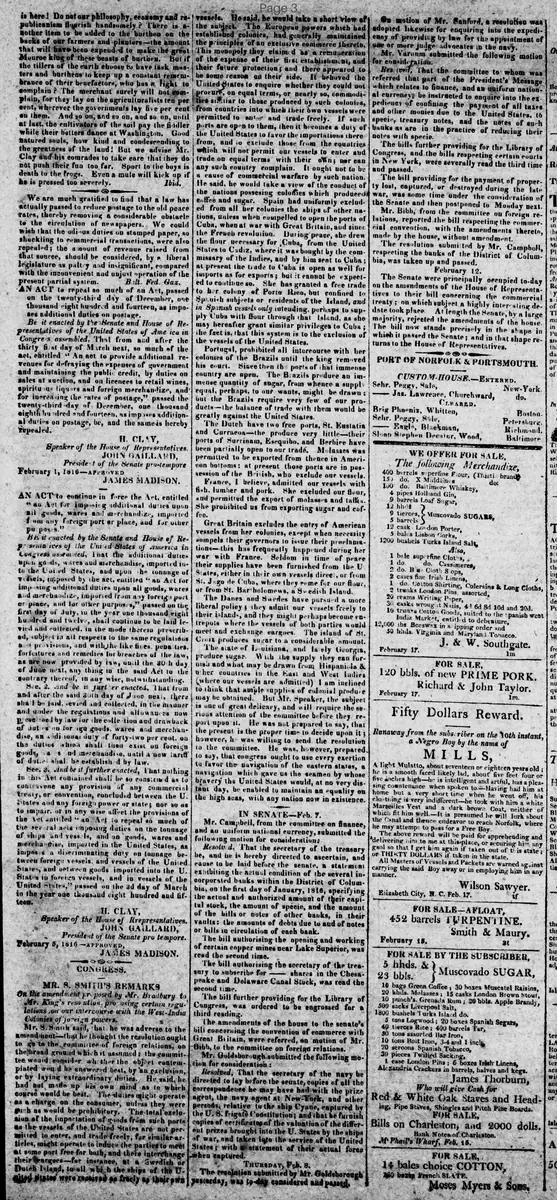
MR. S. SMITH'S REMARKS
On the amendment proposed by Mr. Bradbury to Mr. King's resolution, proposing certain regulations on our intercourse with the West-India Colonies of foreign powers.
Mr. S. Smith said, that he was adverse to the amendment; that he thought the resolution ought to go to the committee of foreign relations, on the broad ground which it assumed; the committee would consider whether the object contemplated would be answered best, by an exclusion, or by laying extraordinary duties. He said, he had not made up his own mind as to which course would be best. The duties might operate as a charge on the consumer, unless they were such as would be prohibitory. The total exclusion of the importation of goods from such port as the vessels of the United States are not permitted to enter, and trade freely, for similar articles, might operate to induce the parties to meet at some port free for both, and there interchange their cargoes—for instance, at a Swedish or Dutch Island, to all which the ships of the U. States were received as freely as their own vessels. He said, he would take a short view of the subject. The European powers which had established colonies, had generally maintained the principles of an exclusive commerce thereto. This monopoly they claimed as a remuneration of the expense of their first establishment, and their future protection; and there appeared to be some reason on their side. It behooved the United States to enquire whether they could not procure, on equal terms, or nearly so, commodities similar to those produced by such colonies, from countries into which their own vessels were permitted to enter and trade freely. If such ports are open to them, then it becomes a duty of the United States to favor the importations therefrom, and to exclude those from the countries which will not permit our vessels to enter and trade on equal terms with their own; nor can any such country complain. It ought not to be a cause of commercial warfare by such nation. He said, he would take a view of the conduct of the nations possessing colonies which produced coffee and sugar. Spain had uniformly excluded from all her colonies the ships of other nations, unless when compelled to open the ports of Cuba, when at war with Great Britain, and since the French revolution. During peace, she drew the flour necessary for Cuba, from the United States to Cadiz, where it was bought by the commissary of the Indies, and by him sent to Cuba; at present the trade to Cuba is open as well for imports as for exports; but it cannot be expected to continue so. She has granted a free trade to her colony of Porto Rico, but confined to Spanish subjects or residents of the Island, and in Spanish vessels only intending, perhaps to supply Cuba with flour through that Island, as she may hereafter grant similar privileges to Cuba; the fact is, that this system is to the exclusion of the vessels of the United States. Portugal, prohibited all intercourse with her colonies of the Brazils until the king removed his court. Since then the ports of that immense country are open. The Brazils produce an immense quantity of sugar, from whence a supply equal, perhaps, to our wants, might be drawn: but the Brazils require very few of our products—the balance of trade with them would be greatly against the United States. The Dutch have two free ports, St. Eustatia and Curacao—the produce very little—their ports of Surinam, Esequibo, and Berbice have been partially open to our trade. Molasses was permitted to be exported from thence in American bottoms: at present those ports are in possession of the British, who exclude our vessels. France, I believe, admitted our vessels with fish, lumber and pork. She excluded our flour, and permitted the export of molasses and tafia. She prohibited us from exporting sugar and coffee. Great Britain excludes the entry of American vessels from her colonies, except when necessity compels their governors to issue their proclamations— this has frequently happened during her war with France. Seldom in time of peace their supplies have been furnished from the United States, either in their own vessels direct, or from St. Jago de Cuba, where they come for our flour, or from St. Bartholomew, a Swedish Island. The Danes and Swedes have pursued a more liberal policy; they admit our vessels freely to their island, and they might perhaps become entrepots where the vessels of both parties would meet and exchange cargoes. The island of St. Croix produces sugar to a considerable amount. The state of Louisiana, and lately Georgia, produce sugar. With the supply they can furnish and what may be drawn from Hispaniola & other countries in the East and West Indies (where our vessels are admitted) I am inclined to think that ample supplies of colonial produce may be obtained. But Mr. Speaker, the subject is one of great delicacy, and will require the serious attention of the committee before they report upon it. He was not prepared to say, that the present is the proper time to decide upon it; however, he was willing to send the resolution to the committee. He was, however, prepared to say, that congress ought to use every exertion to favor the navigation of the eastern states, a navigation which gave us the seamen by whose bravery the United States would, at no very distant day, be enabled to maintain an equality on the high seas, with any nation now in existence.
IN SENATE—Feb. 7.
Mr. Campbell, from the committee on finance and a uniform national currency, submitted the following motion for consideration:
Resolved, That the secretary of the treasury be, and he is hereby directed to ascertain, and cause to be laid before the senate, a statement exhibiting the actual condition of the several incorporated banks within the District of Columbia, on the first day of January, 1816, specifying the actual and authorized amount of their capital stock, the amount of specie, and the amount of the bills or notes of other banks, in their vaults: the amounts of debts due to and of notes or bills in circulation of each bank.
The bill authorising the opening and working of certain copper mines near Lake Superior, was read the second time.
The bill authorising the secretary of the treasury to subscribe for shares in the Chesapeake and Delaware Canal Stock, was read the second time.
The bill further providing for the Library of Congress, was ordered to be engrossed for third reading
The amendments of the house to the senate's bill concerning the convention of commerce with Great Britain, were referred, on motion of Mr. Bibb, to the committee on foreign relations.
Mr. Goldsborough submitted the following motion for consideration:
Resolved, That the secretary of the navy be directed to lay before the senate, copies of all the correspondence he may have had with the prize agent, the navy agent at New-York, and other persons, relative to the ship Cyane, captured by the U. S. frigate Constitution; and that he furnish copies of certificates of the valuation of the different prizes brought into the U. States by the ships of war, and taken into the service of the United States; with a statement of their actual force when captured
THURSDAY, Feb. 8.
The resolution submitted by Mr. Goldsborough yesterday, was to-day considered and passed
On motion of Mr. Sanford, a resolution was adopted likewise for enquiring into the expediency of providing by law for the appointment of one or more judge advocates in the navy.
Mr. Varnum submitted the following motion for consideration.
Resolved, That the committee to whom was referred that part of the President's Message which relates to finance, and an uniform national currency, be instructed to enquire into the expediency of confining the payment of all taxes and other monies due to the United States, to specie, treasury notes, and the notes of such banks as are in the practice of redeeming their notes with specie.
The bills further providing for the Library of Congress, and the bills respecting certain courts in New York, were severally read the third time and passed.
The bill providing for the payment of property lost, captured, or destroyed during the late war, was some time under the consideration of the Senate and then postponed to Monday next.
Mr. Bibb, from the committee on foreign relations, reported the bill respecting the commercial convention, with the amendments thereto, made by the house, without amendment.
The resolution submitted by Mr. Campbell, respecting the banks of the District of Columbia, was taken up and passed.
February 12.
The Senate were principally occupied to-day on the amendments of the House of Representatives to their bill concerning the commercial treaty; on which subject a highly interesting debate took place. At length the Senate, by a large majority, rejected the amendments of the house. The bill now stands precisely in the shape in which it passed the Senate; and in that shape returns to the House of Representatives.
What sub-type of article is it?
What keywords are associated?
What entities or persons were involved?
Domestic News Details
Event Date
February 1816
Key Persons
Outcome
senate rejected house amendments to commercial convention bill by large majority; various bills read, passed, or postponed; resolutions submitted and adopted on banks, navy, finance.
Event Details
House debate on amendment to resolution regulating U.S. trade with foreign West Indian colonies, with Mr. S. Smith advocating referral to foreign relations committee. Senate sessions on Feb. 7, 8, and 12 considered motions on banks in D.C., copper mines, canal stock, Library of Congress, courts in New York, war property payments, commercial convention with Britain, navy correspondence, judge advocates, and tax payments in specie.