Thank you for visiting SNEWPapers!
Sign up free
Editorial
March 8, 1816
Daily National Intelligencer
Washington, District Of Columbia
What is this article about?
Editorial proposes using direct tax revenue to fund national roads and canals, with allocations proportional to state quotas, emphasizing federal aid for interstate projects to promote unity and economic benefits over debt reduction.
Clipping
OCR Quality
95%
Excellent
Full Text
ON ROADS & CANALS.
FOR THE NATIONAL INTELLIGENCER.
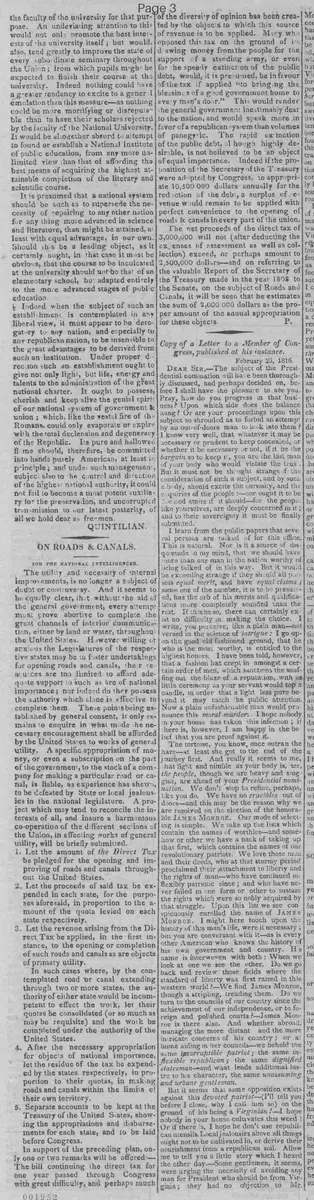
The utility and necessity of internal improvements, is no longer a Subject of doubt or controversy. And it seems to be equally clear, that without the aid of the general government, every attempt must prove abortive to complete the great channels of interior communication, either by land or water, throughout the United States. However willing or anxious the Legislatures of the respective states may be to foster undertakings for opening roads and canals, their resources are too limited to afford adequate support to such as are of national importance; nor indeed do they possess the authority which alone is effective to complete them. These points being established by general consent, it only remains to enquire in what mode the necessary encouragement shall be afforded by the United States to works of general utility. A specific appropriation of money, or even a subscription on the part of the government, to the stock of a company for making a particular road or canal, is liable, as experience has shewn, to be defeated by State or local jealousies in the national legislature. A project which may tend to reconcile the interests of all, and insure a harmonious co-operation of the different sections of the Union, in effecting works of general utility, will be briefly submitted.
1. Let the amount of the Direct Tax be pledged for the opening and improving of roads and canals throughout the United States.
2. Let the proceeds of said tax be expended in each state, for the purposes aforesaid, in proportion to the amount of the quota levied on each state respectively.
3. Let the revenue arising from the Direct Tax be applied, in the first instance, to the opening or completion of such roads and canals as are objects of primary utility.
In such cases where, by the contemplated road or canal extending through two or more states, the authority of either state would be incompetent to effect the work, let their quotas be consolidated (or so much as may be requisite) and the work be completed under the authority of the United States.
4. After the necessary appropriation for objects of national importance, let the residue of the tax be expended by the states respectively, in proportion to their quotas, in making roads and canals within the limits of their own territory.
5. Separate accounts to be kept at the Treasury of the United States, showing the appropriations and disbursements for each state, and to be laid before Congress.
In support of the preceding plan, only one or two remarks will be offered'-
The bill continuing the direct tax for one year passed through Congress with great difficulty, and perhaps much of the diversity of opinion has been created by the objects to which this source of revenue is to be applied. Many who opposed this tax on the ground of its drawing money from the people for the support of a standing army, or even for the speedy extinction of the public debt, would, it is presumed, be in favour of the tax if applied "to bringing the blessings of a good government home to every man's door." This would render the general government inestimably dear to the nation, and would speak more in favor of a republican system than volumes of panegyric. The rapid extinction of the public debt, although highly desirable, is not believed to be an object of equal importance. Indeed if the proposition of the Secretary of the Treasury were adopted by Congress, to appropriate 10,500,000 dollars annually for the reduction of the debt, a surplus of revenue would remain to be applied with perfect convenience to the opening of roads & canals in every part of the union.
The net proceeds of the direct tax of 3,000,000 will not (after deducting the expenses of assessment as well as collection) exceed, or perhaps amount to 2,500,000 dollars—and on referring to the valuable Report of the Secretary of the Treasury made in the year 1808 to the Senate, on the subject of Roads and Canals, it will be seen that he estimates the sum of 2,000,000 dollars as the proper amount of the annual appropriation for these objects
P.
FOR THE NATIONAL INTELLIGENCER.
The utility and necessity of internal improvements, is no longer a Subject of doubt or controversy. And it seems to be equally clear, that without the aid of the general government, every attempt must prove abortive to complete the great channels of interior communication, either by land or water, throughout the United States. However willing or anxious the Legislatures of the respective states may be to foster undertakings for opening roads and canals, their resources are too limited to afford adequate support to such as are of national importance; nor indeed do they possess the authority which alone is effective to complete them. These points being established by general consent, it only remains to enquire in what mode the necessary encouragement shall be afforded by the United States to works of general utility. A specific appropriation of money, or even a subscription on the part of the government, to the stock of a company for making a particular road or canal, is liable, as experience has shewn, to be defeated by State or local jealousies in the national legislature. A project which may tend to reconcile the interests of all, and insure a harmonious co-operation of the different sections of the Union, in effecting works of general utility, will be briefly submitted.
1. Let the amount of the Direct Tax be pledged for the opening and improving of roads and canals throughout the United States.
2. Let the proceeds of said tax be expended in each state, for the purposes aforesaid, in proportion to the amount of the quota levied on each state respectively.
3. Let the revenue arising from the Direct Tax be applied, in the first instance, to the opening or completion of such roads and canals as are objects of primary utility.
In such cases where, by the contemplated road or canal extending through two or more states, the authority of either state would be incompetent to effect the work, let their quotas be consolidated (or so much as may be requisite) and the work be completed under the authority of the United States.
4. After the necessary appropriation for objects of national importance, let the residue of the tax be expended by the states respectively, in proportion to their quotas, in making roads and canals within the limits of their own territory.
5. Separate accounts to be kept at the Treasury of the United States, showing the appropriations and disbursements for each state, and to be laid before Congress.
In support of the preceding plan, only one or two remarks will be offered'-
The bill continuing the direct tax for one year passed through Congress with great difficulty, and perhaps much of the diversity of opinion has been created by the objects to which this source of revenue is to be applied. Many who opposed this tax on the ground of its drawing money from the people for the support of a standing army, or even for the speedy extinction of the public debt, would, it is presumed, be in favour of the tax if applied "to bringing the blessings of a good government home to every man's door." This would render the general government inestimably dear to the nation, and would speak more in favor of a republican system than volumes of panegyric. The rapid extinction of the public debt, although highly desirable, is not believed to be an object of equal importance. Indeed if the proposition of the Secretary of the Treasury were adopted by Congress, to appropriate 10,500,000 dollars annually for the reduction of the debt, a surplus of revenue would remain to be applied with perfect convenience to the opening of roads & canals in every part of the union.
The net proceeds of the direct tax of 3,000,000 will not (after deducting the expenses of assessment as well as collection) exceed, or perhaps amount to 2,500,000 dollars—and on referring to the valuable Report of the Secretary of the Treasury made in the year 1808 to the Senate, on the subject of Roads and Canals, it will be seen that he estimates the sum of 2,000,000 dollars as the proper amount of the annual appropriation for these objects
P.
What sub-type of article is it?
Infrastructure
Taxation
What keywords are associated?
Internal Improvements
Roads And Canals
Direct Tax
Federal Funding
State Quotas
Public Debt
Secretary Of The Treasury Report
What entities or persons were involved?
General Government
Legislatures Of The Respective States
Congress
Secretary Of The Treasury
Editorial Details
Primary Topic
Proposal For Funding Roads And Canals With Direct Tax
Stance / Tone
Advocacy For Federal Support Of Internal Improvements
Key Figures
General Government
Legislatures Of The Respective States
Congress
Secretary Of The Treasury
Key Arguments
Utility Of Internal Improvements Is Undisputed
States Lack Resources And Authority For National Projects
Specific Appropriations Defeated By Jealousies
Pledge Direct Tax For Roads And Canals Proportionally By State Quotas
Prioritize National Importance Projects With Federal Authority For Interstate Works
Residue For State Level Improvements
Keep Separate Accounts At Treasury
Tax Opposition Stems From Misuse; Redirect To Improvements Gains Support
Debt Reduction Less Important Than Infrastructure
Surplus Revenue Allows Both Debt Reduction And Improvements
Direct Tax Yields ~2.5m, Matching 1808 Estimate Of 2m Needed Annually