Thank you for visiting SNEWPapers!
Sign up free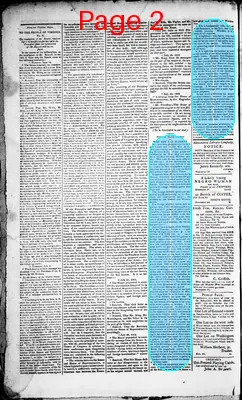
Editorial
November 27, 1813
Alexandria Gazette, Commercial And Political
Alexandria, Virginia
What is this article about?
An editorial from the Boston Centinel argues for taxing whiskey to fund the War of 1812, highlighting disparities in spirit consumption and taxation between Northern commercial people and Western whiskey drinkers, proposing it would avoid direct taxes on New England and promote equity and morality.
Clipping
OCR Quality
95%
Excellent
Full Text
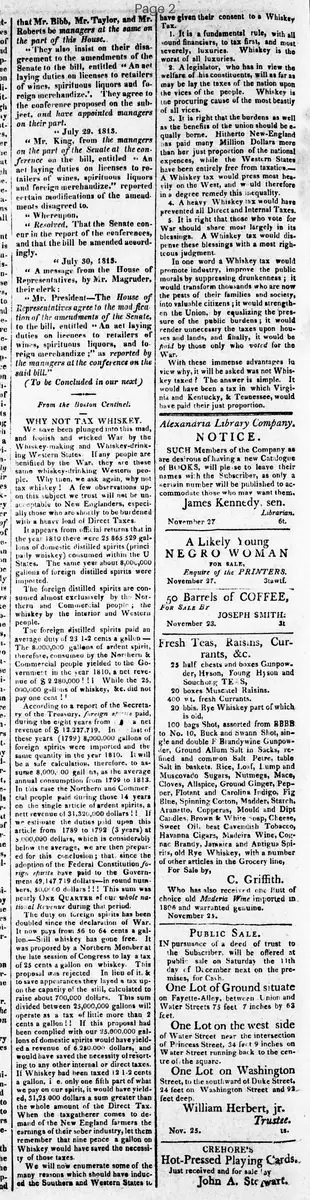
From the Boston Centinel:
WHY NOT TAX WHISKEY.
We have been plunged into this mad, and foolish and wicked War by the Whiskey-making and Whiskey-drinking Western States. If any people are benefited by the War, they are these same whiskey-drinking Western people. Why then, we ask again, why not tax whiskey! A few observations upon this subject we trust will not be unacceptable to New Englanders, especially those who are shortly to be burdened with a heavy load of Direct Taxes.
It appears from official returns that in the year 1810 there were 25,865,529 gallons of domestic distilled spirits (principally whiskey) consumed within the United States. The same year about 8,000,000 gallons of foreign distilled spirits were imported.
The foreign distilled spirits are consumed almost exclusively by the Northern and Commercial people; the whiskey by the interior and Western people.
The foreign distilled spirits paid an average duty of 23 1/2 cents a gallon—The 8,000,000 gallons of ardent spirit, therefore, consumed by the Northern & Commercial people yielded to the Government in the year 1810, a net revenue of $2,280,000!! While the 25,000,000 gallons of whiskey, &c. did not pay one cent!!
According to a report of the Secretary of the Treasury, foreign spirits paid, during the eight years from 1799 a net revenue of $12,227,719. In the last of these years (1799) 8,000,000 gallons of foreign spirits were imported and the same quantity in the year 1810. It will be a safe calculation, therefore, to assume 8,000,000 gallons, as the average annual consumption from 1799 to 1813. In this case the Northern and Commercial people paid during those 14 years on the single article of ardent spirits, a net revenue of $1,320,000 dollars !! If we estimate the duties paid upon this article from 1789 to 1792 (3 years) at $5,000,000 dollars, which is considerably below the average, we are then prepared for this conclusion; that, since the adoption of the Federal Constitution foreign spirits have paid to the Government $49,147,719 dollars—in round numbers, $50,000,000 dollars!!! This sum was nearly (One Quarter) of our whole national Revenue during that period.
The duty on foreign spirits has been doubled since the declaration of War. It now pays from 56 to 64 cents a gallon.—Still whiskey has gone free. It was proposed by a Northern Member at the late session of Congress to lay a tax of 25 cents a gallon on whiskey. This proposal was rejected. In lieu of it, & to save appearances they laid a tax upon the capacity of the still, calculated to raise about 700,000 dollars. This sum divided between 25,000,000 gallons will operate as a tax of little more than 2 cents a gallon!! If this proposal had been complied with our 25,000,000 gallons of domestic spirits would have yielded a revenue of 6,250,000 dollars, and would have saved the necessity of resorting to any other internal or direct taxes.
If Whiskey had been taxed 12 1/2 cents a gallon, i.e. only one fifth part of what we pay on our spirit, it would have yielded, $3,125,000 dollars a sum greater than the whole amount of the Direct Tax.
When the tax-gatherer comes to demand of the New England farmers the earnings of their sober industry, let them remember that nine pence a gallon on Whiskey would have saved the necessity of those taxes.
We will now enumerate some of the many reasons which should have induced the Southern and Western States to have given their consent to a Whiskey Tax.
1. It is a fundamental rule, with all sound financiers, to tax first, and most severely, luxuries. Whiskey is the worst of all luxuries.
2. A legislator, who has in view the welfare of his constituents, will as far as may be lay the taxes of the nation upon the vices of the people. Whiskey is the procuring cause of the most beastly of all vices.
3. It is right that the burdens as well as the benefits of the union should be equally borne. Hitherto New-England has paid many Million Dollars more than her just proportion of the national expenses, while the Western States have been entirely free from taxation. A Whiskey tax would press most heavily on the West, and would therefore in a degree remedy this inequality.
4. A heavy Whiskey tax would have prevented all Direct and Internal Taxes.
5. It is right that those who vote for War should share most largely in its blessings. A Whiskey tax would dispense these blessings with a most righteous judgment.
In one word a Whiskey tax would promote industry, improve the public morals by suppressing drunkenness; it would transform thousands who are now the pests of their families and society, into valuable citizens; it would strengthen the Union, by equalizing the pressure of the public burdens; it would render unnecessary the taxes upon houses and lands, and finally, it would be paid by those only who voted for the War.
With these immense advantages in view why, it will be asked was not Whiskey taxed? The answer is simple. It would have been a tax in which Virginia and Kentucky, & Tennessee, would have paid their just proportion.
WHY NOT TAX WHISKEY.
We have been plunged into this mad, and foolish and wicked War by the Whiskey-making and Whiskey-drinking Western States. If any people are benefited by the War, they are these same whiskey-drinking Western people. Why then, we ask again, why not tax whiskey! A few observations upon this subject we trust will not be unacceptable to New Englanders, especially those who are shortly to be burdened with a heavy load of Direct Taxes.
It appears from official returns that in the year 1810 there were 25,865,529 gallons of domestic distilled spirits (principally whiskey) consumed within the United States. The same year about 8,000,000 gallons of foreign distilled spirits were imported.
The foreign distilled spirits are consumed almost exclusively by the Northern and Commercial people; the whiskey by the interior and Western people.
The foreign distilled spirits paid an average duty of 23 1/2 cents a gallon—The 8,000,000 gallons of ardent spirit, therefore, consumed by the Northern & Commercial people yielded to the Government in the year 1810, a net revenue of $2,280,000!! While the 25,000,000 gallons of whiskey, &c. did not pay one cent!!
According to a report of the Secretary of the Treasury, foreign spirits paid, during the eight years from 1799 a net revenue of $12,227,719. In the last of these years (1799) 8,000,000 gallons of foreign spirits were imported and the same quantity in the year 1810. It will be a safe calculation, therefore, to assume 8,000,000 gallons, as the average annual consumption from 1799 to 1813. In this case the Northern and Commercial people paid during those 14 years on the single article of ardent spirits, a net revenue of $1,320,000 dollars !! If we estimate the duties paid upon this article from 1789 to 1792 (3 years) at $5,000,000 dollars, which is considerably below the average, we are then prepared for this conclusion; that, since the adoption of the Federal Constitution foreign spirits have paid to the Government $49,147,719 dollars—in round numbers, $50,000,000 dollars!!! This sum was nearly (One Quarter) of our whole national Revenue during that period.
The duty on foreign spirits has been doubled since the declaration of War. It now pays from 56 to 64 cents a gallon.—Still whiskey has gone free. It was proposed by a Northern Member at the late session of Congress to lay a tax of 25 cents a gallon on whiskey. This proposal was rejected. In lieu of it, & to save appearances they laid a tax upon the capacity of the still, calculated to raise about 700,000 dollars. This sum divided between 25,000,000 gallons will operate as a tax of little more than 2 cents a gallon!! If this proposal had been complied with our 25,000,000 gallons of domestic spirits would have yielded a revenue of 6,250,000 dollars, and would have saved the necessity of resorting to any other internal or direct taxes.
If Whiskey had been taxed 12 1/2 cents a gallon, i.e. only one fifth part of what we pay on our spirit, it would have yielded, $3,125,000 dollars a sum greater than the whole amount of the Direct Tax.
When the tax-gatherer comes to demand of the New England farmers the earnings of their sober industry, let them remember that nine pence a gallon on Whiskey would have saved the necessity of those taxes.
We will now enumerate some of the many reasons which should have induced the Southern and Western States to have given their consent to a Whiskey Tax.
1. It is a fundamental rule, with all sound financiers, to tax first, and most severely, luxuries. Whiskey is the worst of all luxuries.
2. A legislator, who has in view the welfare of his constituents, will as far as may be lay the taxes of the nation upon the vices of the people. Whiskey is the procuring cause of the most beastly of all vices.
3. It is right that the burdens as well as the benefits of the union should be equally borne. Hitherto New-England has paid many Million Dollars more than her just proportion of the national expenses, while the Western States have been entirely free from taxation. A Whiskey tax would press most heavily on the West, and would therefore in a degree remedy this inequality.
4. A heavy Whiskey tax would have prevented all Direct and Internal Taxes.
5. It is right that those who vote for War should share most largely in its blessings. A Whiskey tax would dispense these blessings with a most righteous judgment.
In one word a Whiskey tax would promote industry, improve the public morals by suppressing drunkenness; it would transform thousands who are now the pests of their families and society, into valuable citizens; it would strengthen the Union, by equalizing the pressure of the public burdens; it would render unnecessary the taxes upon houses and lands, and finally, it would be paid by those only who voted for the War.
With these immense advantages in view why, it will be asked was not Whiskey taxed? The answer is simple. It would have been a tax in which Virginia and Kentucky, & Tennessee, would have paid their just proportion.
What sub-type of article is it?
Taxation
Economic Policy
War Or Peace
What keywords are associated?
Whiskey Tax
War Funding
Direct Taxes
Western States
Foreign Spirits Duty
National Revenue
Moral Reform
What entities or persons were involved?
Western States
New England
Northern And Commercial People
Congress
Secretary Of The Treasury
Virginia
Kentucky
Tennessee
Editorial Details
Primary Topic
Advocacy For Taxing Whiskey To Fund The War Of 1812 And Avoid Direct Taxes
Stance / Tone
Strongly Supportive Of Whiskey Taxation, Critical Of Western States
Key Figures
Western States
New England
Northern And Commercial People
Congress
Secretary Of The Treasury
Virginia
Kentucky
Tennessee
Key Arguments
Domestic Whiskey Consumption Vastly Exceeds Foreign Spirits But Pays No Tax
Northern People Pay Heavy Duties On Imported Spirits While Western Whiskey Is Untaxed
Taxing Whiskey At 25 Cents Per Gallon Could Yield $6,250,000, Avoiding Direct Taxes
Whiskey Tax Would Equalize Burdens, As Western States Benefit From The War
Taxing Luxuries And Vices Like Whiskey Promotes Morality And Fiscal Responsibility
Those Who Voted For War Should Bear Its Costs