Thank you for visiting SNEWPapers!
Sign up free
Concord Register
Concord, Merrimack County, New Hampshire
What is this article about?
John Pattee defends his vote in the New Hampshire Senate to concur with the House's choice of Mr. Mason as U.S. Senator, citing republican principles and duty to constituents. He explains the election process, rejects pledges, and addresses a vote-counting dispute via certificates.
Merged-components note: This is a single letter to the editor split across two pages; merging for coherence as it continues seamlessly from page 1 to page 2.
Clippings
1 of 2
OCR Quality
Full Text
From the New-Hampshire Patriot, of Jan. 31.
MR. EDITOR
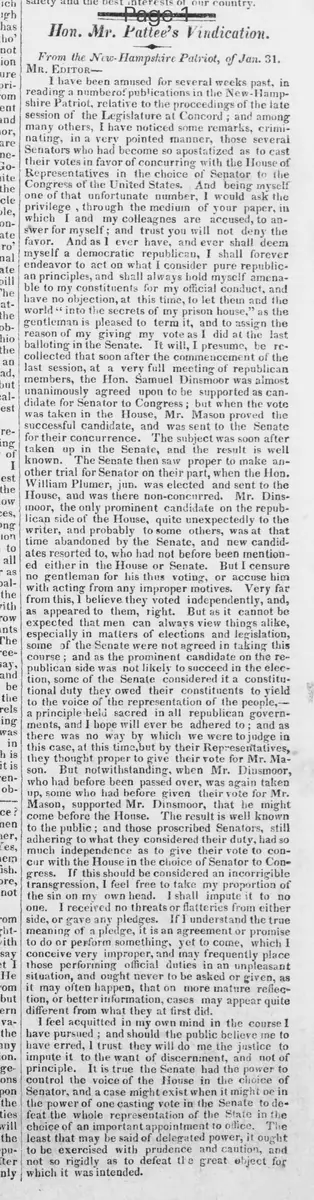
I have been amused for several weeks past, in reading a number of publications in the New-Hampshire Patriot, relative to the proceedings of the late session of the Legislature at Concord; and among many others, I have noticed some remarks, criminating, in a very pointed manner, those several Senators who had become so apostatized as to cast their votes in favor of concurring with the House of Representatives in the choice of Senator to the Congress of the United States. And being myself one of that unfortunate number, I would ask the privilege, through the medium of your paper, in which I and my colleagues are accused, to answer for myself; and trust you will not deny the favor. And as I ever have, and ever shall deem myself a democratic republican, I shall forever endeavor to act on what I consider pure republican principles, and shall always hold myself amenable to my constituents for my official conduct, and have no objection, at this time, to let them and the world "into the secrets of my prison house," as the gentleman is pleased to term it, and to assign the reason of my giving my vote as I did at the last balloting in the Senate. It will, I presume, be recollected that soon after the commencement of the last session, at a very full meeting of republican members, the Hon. Samuel Dinsmoor was almost unanimously agreed upon to be supported as candidate for Senator to Congress: but when the vote was taken in the House, Mr. Mason proved the successful candidate, and was sent to the Senate for their concurrence. The subject was soon after taken up in the Senate, and the result is well known. The Senate then saw proper to make another trial for Senator on their part, when the Hon. William Plumer, jun. was elected and sent to the House, and was there non-concurred. Mr. Dinsmoor, the only prominent candidate on the republican side of the House, quite unexpectedly to the writer, and probably to some others, was at that time abandoned by the Senate, and new candidates resorted to, who had not before been mentioned either in the House or Senate. But I censure no gentleman for his thus voting, or accuse him with acting from any improper motives. Very far from this, I believe they voted independently, and, as appeared to them, right. But as it cannot be expected that men can always view things alike, especially in matters of elections and legislation, some of the Senate were not agreed in taking this course; and as the prominent candidate on the republican side was not likely to succeed in the election, some of the Senate considered it a constitutional duty they owed their constituents to yield to the voice of the representation of the people,—a principle held sacred in all republican governments, and I hope will ever be adhered to; and as there was no way by which we were to judge in this case, at this time, but by their Representatives, they thought proper to give their vote for Mr. Mason. But notwithstanding, when Mr. Dinsmoor, who had before been passed over, was again taken up, some who had before given their vote for Mr. Mason, supported Mr. Dinsmoor, that he might come before the House. The result is well known to the public: and those proscribed Senators, still adhering to what they considered their duty, had so much independence as to give their vote to concur with the House in the choice of Senator to Congress. If this should be considered an incorrigible transgression, I feel free to take my proportion of the sin on my own head. I shall impute it to no one. I received no threats or flatteries from either side, or gave any pledges. If I understand the true meaning of a pledge, it is an agreement or promise to do or perform something, yet to come, which I conceive very improper, and may frequently place those performing official duties in an unpleasant situation, and ought never to be asked or given, as it may often happen, that on more mature reflection, or better information, cases may appear quite different from what they at first did.
I feel acquitted in my own mind in the course I have pursued; and should the public believe me to have erred, I trust they will do me the justice to impute it to the want of discernment, and not of principle. It is true the Senate had the power to control the voice of the House in the choice of Senator, and a case might exist when it might be in the power of one casting vote in the Senate to defeat the whole representation of the State in the choice of an important appointment to office. The least that may be said of delegated power, it ought to be exercised with prudence and caution, and not so rigidly as to defeat the great object for which it was intended.
But before I close, I must ask the indulgence of stating something about the certificate affair. On the last day of the session, (which was the day after the last vote had been taken in the Senate for concurring with the House in the choice of Senator to Congress) in conversation with some gentlemen of the House, it appeared that there must have been a mistake in counting the votes in the Senate, or some one of that body was playing a double game, and would have it thought he voted differently from what he had, as it was said seven had stated they had voted to concur with the House, and six only had been declared in favor. It was therefore apparent, provided this was the fact, that some one in the Senate wished to gain popularity by claiming what he did not do, or there was some error in counting the votes. The former was considered the most likely to be the case; and it was my wish, and the wish of others, to detect the imposition, if any existed; and I felt the more anxious to do this, as I had been suspected, from some intimations which was said to have come from some one of the Senate. To get at the truth of the matter, it was thought no course more sure and effectual than for each one to certify the manner of his voting, and then go into an investigation of the subject. I accordingly signed a certificate, and others did the same; and I do not feel disposed to deny the fact, nor do I regret so doing, as it has in my opinion resulted in a satisfactory detection of the imposition. I fully agree with the gentleman and others who wish for the publication of the journals of the House and Senate, and should be glad they might be seasonably published every year, and so much of them read at the annual meeting as relates to questions of importance, on which the yeas and nays are taken, that the people may be more able to judge of the doings of their Representatives. Had this been the course pursued for several years past, I believe many of our members, who have voted away so much of the public money to boards of agriculture and agricultural societies, so called, might have been favored with the privilege of staying at home and subduing the weeds in their gardens in the month of June.
JOHN PATTEE
What sub-type of article is it?
What themes does it cover?
What keywords are associated?
What entities or persons were involved?
Letter to Editor Details
Author
John Pattee
Recipient
Mr. Editor
Main Argument
the author defends his vote to concur with the house of representatives in selecting mr. mason as u.s. senator, arguing it was a constitutional duty to yield to the people's representatives based on republican principles, without pledges or improper influences.
Notable Details