Thank you for visiting SNEWPapers!
Sign up free
Gazette Of The United States, & Philadelphia Daily Advertiser
Philadelphia, Philadelphia County, Pennsylvania
What is this article about?
Philosophical essay on society's political oneness, justifying obedience to government as ordained by God, arguing revolt is only necessary when government harms the state, and deeming it unnecessary in America while criticizing inflammatory declamations against leaders. Signed AENEAS from Mecklenburg, July 21.
Clipping
OCR Quality
Full Text
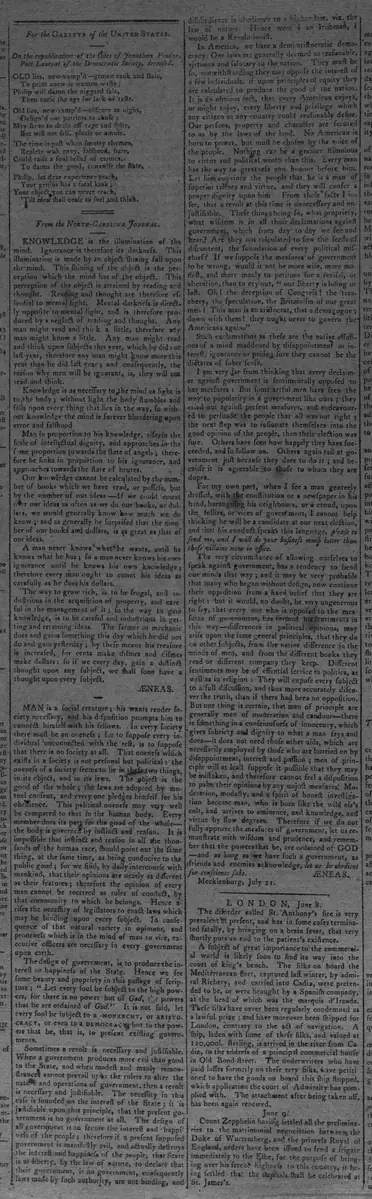
The design of government, is to produce the interest or happiness of the State. Hence we see some beauty and propriety in this passage of scripture; "Let every soul be subject to the higher powers, or there is no power but of God, the powers that be are ordained of God." It is not said, let every soul be subject to a MONARCHY, or ARISTOCRACY, or even to a DEMOCRACY but to the powers that be, that is, to present existing governments.
Sometimes a revolt is necessary and justifiable. When a government produces more evil than good to the State, and when modest and manly remonstrances cannot prevail and the rulers to alter the nature and operations of government, then a revolt is necessary and justifiable. The necessity in this case is founded on the interest of the State: it is justifiable upon this principle, that the present government is no government at all. The design of all government is to secure the interest and happiness of the people; therefore if a present supposed government is manifestly evil, and actually destroys the interest and happiness of the people, that State is at liberty, by the law of nature, to declare that their government, is no government, consequently laws made by such authority, are not binding, and disobedience is obedience to a higher law, viz. the law of nature. Hence were I an Irishman, I would be a Revolutionist.
In America, we have a demi-aristocratic democracy. Our laws are generally deemed as reasonable, virtuous and salutary to the nation. They must be so, notwithstanding they may oppose the interest of a few individuals, if upon principles of equity they are calculated to produce the good of the nation. It is an obvious fact, that every American enjoys, or might enjoy, every liberty and privilege which any citizen in any country could reasonably desire. Our persons, property and character are secured to us by the laws of the land. No American is born to power, but must be chosen by the voice of the people. Nothing can be a greater stimulus to virtue and political worth than this. Every man has the way to greatness and honour before him. Let him convince the people that he is a man of superior talents and virtue, and they will confer a proper dignity upon him. From these facts I infer, that a revolt at this time is unnecessary and unjustifiable. These things being so, what propriety, what wisdom is in all those declamations against government, which from day to day we see and hear? Are they not calculated to sow the seeds of discontent, the foundations of every political mischief? If we suppose the measures of government to be wrong, would it not be more wise, more modest, and more manly to petition for a revision, or alteration, than to cry out, "our liberty is losing or lost. Oh! the deception of Congress! the treachery, the peculation, the Britishism of our great men! This man is an aristocrat, that a demagogue; down with them! they ought never to govern the Americans again,"
Such exclamations as these are the native offspring of a mind maddened by disappointment or interest, ignorance or pride; are they cannot be the dictates of sober sense.
I am very far from thinking that every declaimer against government is sentimentally opposed to her measures: But some artful men have seen the way to popularity in a government like ours; they cried out against present measures, and endeavoured to persuade the people that all was not right; the next step was to insinuate themselves into the good opinion of the people, then their election was sure. Others have seen how happily they have succeeded, and so follow on. Others again rail at government just because they dare to do it; and because it is agreeable to those to whom they are dupes.
For my own part, when I see a man genteelly dressed, with the constitution or a newspaper in his hand, haranguing his neighbours, or a crowd, upon the follies, or vices of government, I cannot help thinking he will be a candidate at our next election, and that his conduct speaks this language, please to send me, and I will do your business much better than those villains now in office.
The very circumstance of allowing ourselves to speak against government, has a tendency to bend our minds that way; and it may be very probable that many who began without design, now continue their opposition from a fixed belief that they are right: but it would, no doubt, be very ungenerous to say, that every one who is opposed to the measures of government, has formed his sentiments in this way-differences in political opinions, may arise upon the same general principles, that they do on other subjects, from the native difference in the minds of men, and from the different books they read or different company they keep. Different sentiments may be of essential service in politics, as well as in religion: They will expose every subject to a full discussion, and thus more accurately discover the truth, than if there had been no opposition.
But one thing is certain, that men of principle are generally men of moderation and candour-there is something in a consciousness of innocence, which gives sobriety and dignity to what a man says and does--it does not need those other aids, which are necessarily employed by those who are hurried on by disappointment, interest and passion; men of principle will at least suppose it possible that they may be mistaken, and therefore cannot feel a disposition to palm their opinions by any unjust measures: Moderation, modesty, and a spirit of honest investigation become man, who is born like the wild ass's colt, and arrives to eminence, and knowledge, and virtue by slow degrees. Therefore if we do not fully approve the measures of government, let us remonstrate with wisdom and prudence, and remember that the powers that be, are ordained of GOD-and as long as we have such a government, as friends and enemies acknowledge, let us be obedient for conscience sake.
AENEAS.
Mecklenburg, July 21.
What sub-type of article is it?
What themes does it cover?
What keywords are associated?
What entities or persons were involved?
Letter to Editor Details
Author
Aeneas
Main Argument
society requires political oneness through shared objects and laws for the common good; current american government secures liberties and is ordained by god, making revolt unnecessary and unjustifiable, while declamations against it sow discontent; citizens should remonstrate modestly rather than incite rebellion.
Notable Details