Thank you for visiting SNEWPapers!
Sign up free
Alexandria Advertiser And Commercial Intelligencer
Alexandria, Virginia
What is this article about?
In September 1801, the Executive Directory of the Republic of Batavia (Holland) issued a proclamation criticizing the 1798 constitution as despotic and ineffective, calling for public input on reforms. The legislative assembly rejected it, prompting the Directory to suspend the assembly, seal its halls with military aid, and urge the people to express their views freely.
Clipping
OCR Quality
Full Text
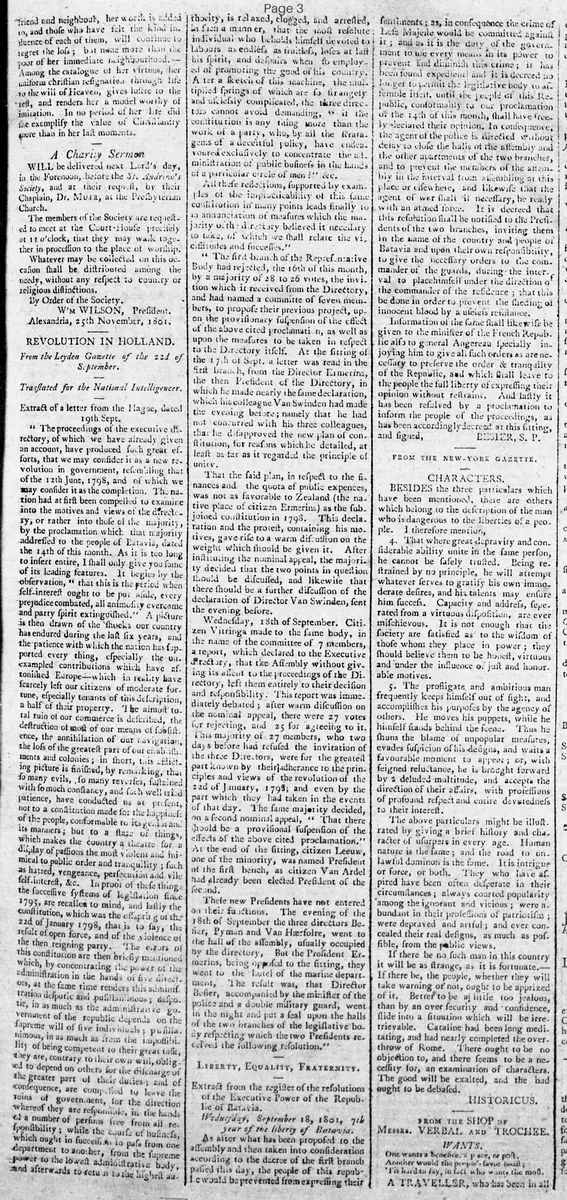
From the Leyden Gazette of the 22d September.
Translated for the National Intelligencer.
Extract of a letter from the Hague, dated 19th Sept.
"The proceedings of the executive directory, of which we have already given an account, have produced such great efforts, that we may consider it as a new revolution in government, resembling that of the 12th June, 1795, and of which we may consider it as the completion. The nation had at first been compelled to examine into the motives and views of the directory, or rather into those of the majority, by the proclamation which that majority addressed to the people of Batavia, dated the 14th of this month. As it is too long to insert entire, I shall only give you one of its leading features. It begins by the observation, 'that this is the period when self-interest ought to be put aside, every prejudice combated, all animosity overcome and party spirit extinguished.' A picture is then drawn of the shocks our country has endured during the last six years, and the patience with which the nation has supported every thing, especially the unprecedented contributions which have astonished Europe—which in reality have scarcely left our citizens of moderate fortune, especially tenants of this description, a half of their property. The almost total ruin of our commerce is described, the destruction of most of our means of subsistence, the annihilation of our navigation, the loss of the greatest part of our establishments and colonies: in short, this afflicting picture is finished, by remarking, that so many evils, so many reverses, sustained with so much constancy, and such well-tried patience, have conducted us at present, not to a constitution made for the happiness of the people, conformable to its genius and its manners; but to a state of things, which makes the country a theatre for a display of passions the most violent and inimical to public order and tranquility; such as hatred, vengeance, persecution and vile self-interest, &c. In proof of these things, the successive systems of legislation since 1795, are recalled to mind, and lastly the constitution, which was the offspring of the 22d of January 1798, that is to say, the result of open force, and of the violence of the then reigning party. The errors of this constitution are then briefly mentioned which, by concentrating the power of the administration in the hands of five directors, at the same time renders this administration despotic and pusillanimous; despotic, in as much as the administrative government of the republic depends on the supreme will of five individuals; pusillanimous, in as much as from the impossibility of being competent to their great task, they are, contrary to their own will, obliged to depend on others for the discharge of the greater part of their duties; and of consequence, are compelled to leave the reins of government, for the direction whereof they are responsible, in the hands of a number of persons free from all responsibility; while the course of business, which ought in succession to pass from one department to another, from the supreme power to the lowest administrative body, and afterwards to return to the highest authority, is relaxed, clogged, and arrested. In such a manner, that the most resolute individual who beholds himself devoted to labours as endless as fruitless, loses at last his spirit, and despairs when so employed of promoting the good of his country. After a sketch of this machine, the multiplied springs of which are so strangely and uselessly complicated, the three directors cannot avoid demanding, if the constitution is any thing more than the work of a party, who, by all the stratagems of a deceitful policy, have endeavoured exclusively to concentrate the administration of public business in the hands of a particular circle of men?" &c.
All these reflections, supported by examples of the impracticability of this same constitution in many points leads finally to an annunciation of measures which the majority of the directory believed it necessary to take, of which we shall relate the vicissitudes and successes.
"The first branch of the Representative Body had rejected, the 16th of this month, by a majority of 28 to 26 votes, the invitation which it received from the Directory, and had named a committee of seven members, to propose their previous project, upon the provisionary suspension of the effect of the above cited proclamation, as well as upon the measures to be taken in respect to the Directory itself. At the sitting of the 17th of Sept. a letter was read in the first branch, from the Director Ermerins, the then President of the Directory, in which he made nearly the same declaration, which his colleague Van Swinden had made the evening before; namely that he had not concurred with his three colleagues, that he disapproved the new plan of constitution, for reasons which he detailed, at least as far as it regarded the principle of unity. That the said plan, in respect to the finances and the quota of public expences, was not as favorable to Zealand (the native place of citizen Ermerins) as the subjoined constitution in 1798. This declaration and the protest, containing his motives, gave rise to a warm discussion on the weight which should be given it. After instituting the nominal appeal, the majority decided that the two points in question should be discussed, and likewise that there should be a further discussion of the declaration of Director Van Swinden, of the evening before.
Wednesday, 18th of September. Citizen Vitringa made to the same body, in the name of the committee of 7 members, a report, which declared to the Executive Directory, that the Assembly without giving its assent to the proceedings of the Directory, left them entirely to their decision and responsibility. This report was immediately debated; after warm discussion on the nominal appeal, there were 27 votes for rejecting, and 25 for agreeing to it. This majority of 27 members, who two days before had refused the invitation of the three Directors, were for the greatest part known by their adherence to the principles and views of the revolution of the 22d of January, 1798; and even by the part which they had taken in the events of that day. The same majority decided, on a second nominal appeal, 'That there should be a provisional suspension of the effects of the above cited proclamation.' At the end of the sitting, citizen Leeuw, one of the minority, was named President of the first bench, as citizen Van Ardel had already been elected President of the second."
These new Presidents have not entered on their functions. The evening of the 18th of September the three directors Befier, Pyman and Van Haarlem, went to the hall of the assembly, usually occupied by the directory. But the President Ermerins, being opposed to the sitting, they went to the hotel of the marine department. The result was, that Director Befier, accompanied by the minister of the police and a double military guard, went in the night and put a seal upon the halls of the two branches of the legislative body respecting which the two Presidents received the following resolution.
Liberty, Equality, Fraternity.
Extract from the register of the resolutions of the Executive Power of the Republic of Batavia.
Wednesday, September 18, 1801, 7th year of the liberty of Batavia.
As after what has been proposed to the assembly and then taken into consideration according to the decree of the first branch passed this day, the people of this republic would be prevented from expressing their sentiments: as, in consequence the crime of Lese Majeste would be committed against it; and as it is the duty of the government to use every means in its power to prevent and diminish this crime: it has been found expedient, and it is decreed no longer to permit the legislative body to assemble itself, until the people of this Republic, conformably to our proclamation of the 14th of this month, shall have freely declared their opinion. In consequence, the agent of the police is directed without delay to close the halls of the assembly and the other apartments of the two branches, and to prevent the members of the assembly in the interval from assembling at this place or elsewhere, and likewise that the agent of war shall if necessary, be ready with an armed force. It is decreed that this resolution shall be notified to the Presidents of the two branches, inviting them in the name of the country and people of Batavia and upon their own responsibility, to give the necessary orders to the commander of the guards, during the interval to place himself under the direction of the commander of the residence: that this be done in order to prevent the shedding of innocent blood by a useless resistance.
Information of the same shall likewise be given to the minister of the French Republic also to general Augereau specially enjoying him to give all such orders as are necessary to preserve the order & tranquility of the Republic, and which shall leave to the people the full liberty of expressing their opinion without restraint. And lastly it has been resolved by a proclamation to inform the people of the proceedings, as has been accordingly decreed at this sitting, and signed,
BESIER, S. P.
What sub-type of article is it?
What keywords are associated?
What entities or persons were involved?
Where did it happen?
Foreign News Details
Primary Location
The Hague
Event Date
September 1801
Key Persons
Outcome
legislative assembly suspended; halls sealed by police and military; no casualties reported; call for public opinion on constitutional reforms.
Event Details
The Executive Directory's majority issued a proclamation on September 14 criticizing the 1798 constitution as despotic and calling for public input. The assembly rejected it on the 16th and 18th, leading to protests from Directors Ermerins and Van Swinden. On September 18, the Directory decreed the suspension of the assembly, sealed its halls with military force, and notified French minister and General Augereau to maintain order.