Thank you for visiting SNEWPapers!
Sign up free
Story
August 23, 1827
Martinsburg Gazette And Public Advertiser
Martinsburg, Berkeley County, West Virginia
What is this article about?
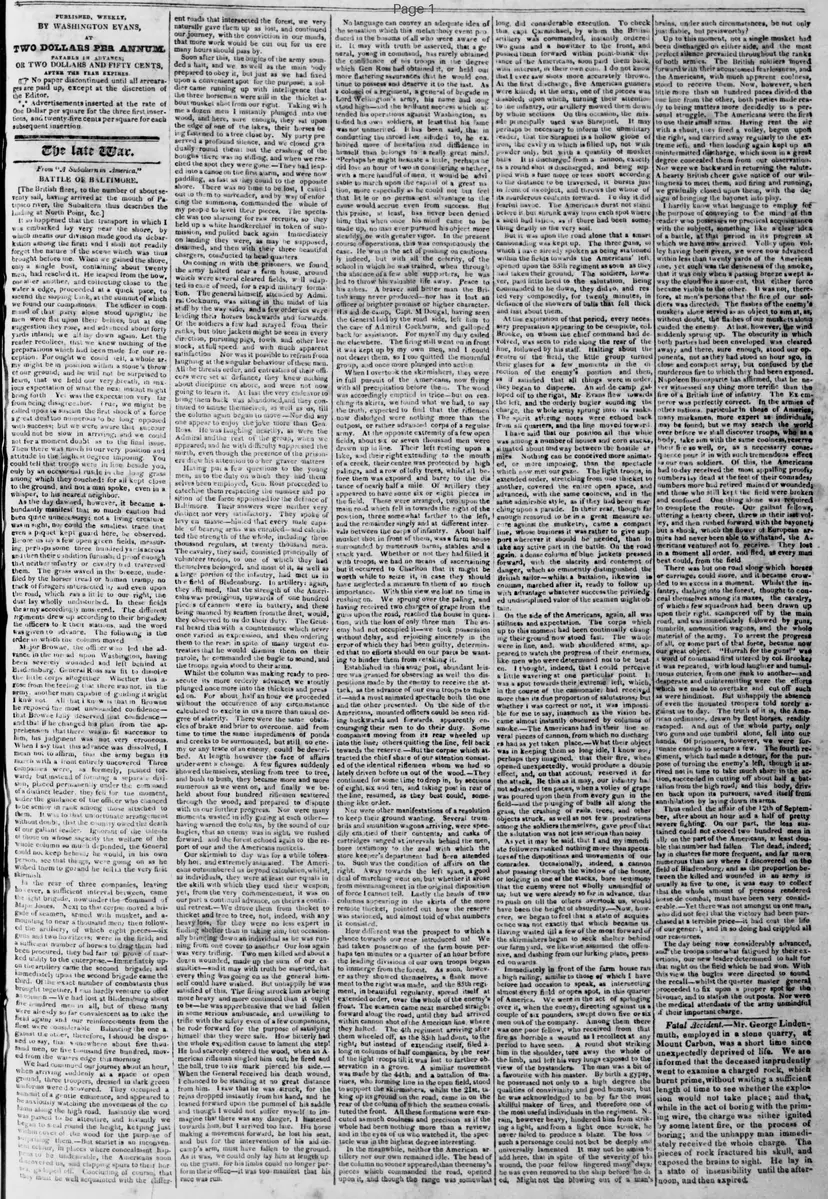
British subaltern recounts the 1814 landing at North Point near Baltimore during the War of 1812: cautious debarkation, skirmishes with American riflemen, fatal wounding of General Ross, advance to battle where British defeat larger American force but at great cost, capturing minimal artillery.
Clipping
OCR Quality
95%
Excellent
Full Text
The late War.
From "A Subaltern in America."
BATTLE OF BALTIMORE.
[The British fleet, to the number of about seventy sail, having arrived at the mouth of Patapsco river, the Subaltern thus describes the landing at North Point, &c.]
It so happened that the transport in which I was embarked lay very near the shore, by which means our division made good its debarkation among the first: and I shall not readily forget the nature of the scene which was thus brought before me. When we gained the shore, only a single boat, containing about twenty men, had reached it. He leaped from the bow, one after another, and collecting close to the water's edge, proceeded at a quick pace, to ascend the sloping bank, at the summit of which we found our companions. The officer in command of that party alone stood upright; he men were flat upon their bellies; but at one suggestion they rose, and advanced about forty yards inland; we all lay down again. Let the reader recollect, that we knew nothing of the preparations which had been made for our reception. For aught we could tell, a whole army might be in position within a stone's throw of our ground; and he will not be surprised to learn, that we held our very breath, in anxious expectation of what the next instant might bring forth Yet was the expectation very far from being disagreeable. True, we might be called upon to sustain the first shock of force a great deal too numerous to be long opposed with success; but we were aware that succour would not be slow in arriving; and we could not for a moment doubt as to the final issue.
Then there was much in our very position and attitude in the highest degree imposing. You could tell that troops were in line beside you, only by an occasional rustle in the long grass among which they couched: for all kept close to the ground, and not a man spoke, even in a whisper, to his nearest neighbor.
As the day dawned, however, it became abundantly manifest that so much caution had been quite unnecessary: not a living creature was in sight, nor could the smallest trace that even a piquet kept guard here, be observed.
Before us lay a few open green fields, measuring, perhaps some three hundred yards across and then their condition furnished proof enough that neither infantry or cavalry had traversed them. The grass waved in the breeze, undefiled by the horses tread or human tramp: no track of foragers intersected it; and even upon the road, which ran a little to our right, the dust lay wholly undisturbed. In these fields the army accordingly mustered. The different regiments drew up according to their brigades; the officers took their stations, and the word was given to advance. The following is the order in which the column moved.
Major Brooke, the officer who led the advance in the inroad upon Washington, having been severely wounded and left behind at Bladensburg, General Ross saw fit to dissolve the light corps altogether Whether this arose from the feeling that there was not, in the army, another man capable of guiding it aright I know not all that I know is that in Brooke he reposed the most unbounded confidence- that Brooke fully deserved that confidence- and that if he changed his plan from the apprehension that there was no fit successor to him, his judgment was not very erroneous.
When I say that this advance was dissolved, I mean not to affirm, that the army began its march with a front entirely uncovered Three Companies were, as formerly, pushed forward; but instead of forming a separate division, placed permanently under the command of a distinct leader, they fell for the moment, under the guidance of the officer who chanced to be senior in rank among those attached to them. It was to that unfortunate arrangement without doubt, that the country owed the death of our gallant leader. Ignorant of the talents of those on whose sagacity the welfare of the whole column so much depended, the General Could not keep behind; he would, in his own person, see that things, were going on as he wished them to go: and he fell in the very first skirmish
in the rear of three companies, leaving however, a sufficient interval between, came the light brigade, now under the command of Major Jones. Next to that corps moved a brigade of seamen, armed with musket, and amounting to near a thousand men; then followed the artillery, of which eight pieces-six guns and two howitzers; were in the field; and a sufficient number of horses to drag them had been procured, they bid fair to prove of marked utility to the enterprise.-Immediately upon the artillery came the second brigade: and immediately upon the second brigade came the third. Of the exact number of combatants thus brought together, I can hardly venture to offer an opinion --We had lost at Bladensburg about five hundred men in all, but of these many Were already so far convalescent as to take the field again; and our reinforcements from the fleet were considerable Balancing the one against the other, therefore, I should be disposed to say, that somewhere about five thousand men, or five thousand five hundred, moved from the water's edge this morning
We had continued our journey about an hour, when arriving suddenly at a space of open ground, three troopers, dressed in dark green uniforms were discovered. They occupied a summit of a gentle eminence, and appeared to be anxiously watching the movement of the column along the high road Instantly was passed to be attentive, and instantly we began to steal round the height, keeping just within cover of the wood for the purpose of surprising them -But scarlet is an inconvenient colour, in places where concealment happens to be undesirable, the Americans soon discovered us, and clapping spurs to their horses, galloped off. Concluding of course, that they must be well acquainted with the different roads that intersected the forest, we very naturally gave them up as lost, and continued our journey, with the conviction in our minds, that more work would be cut out for us ere many hours should pass by.
Soon after this, the bugles of the army sounded a halt, and we as well as the main body prepared to obey it, but just as we had fixed upon a convenient spot for the purpose; a soldier came running up with intelligence that the three horsemen were still in the thicket about musket shot from our right. Taking with me a dozen men I instantly plunged into the wood, and here, sure enough, they sat upon the edge of one of the lakes, their horses being fastened to a tree close by. My party preserved a profound silence, and we closed gradually round them: but the crashing of the boughs there was no stifling, and when we reached the spot they were gone -They had leaped into a canoe on the first alarm, and were now paddling, as fast as they could to the opposite shore. There was no time to be lost, I called out to them to surrender, and by way of enforcing the summons, commanded the whole of my people to level their pieces, The spectacle was too alarming for raw recruits, so they held up a white handkerchief in token of submission, and pulled back again Immediately on landing they were, as may be supposed, disarmed, and then with their three beautiful chargers, conducted to head quarters
On coming in with the prisoners, we found the army halted near a farm house. around which were several cleared fields, well adapted in case of need, for a rapid military formation. The general himself, attended by Admiral Cockburn, was sitting in the midst of his staff by the way side, and a few orderlies were leading their horses backwards and forwards.
Of the soldiers a few had strayed from their ranks, but blue jackets might be seen in every direction, pursuing pigs, fowls, and other live stock, at full speed, and with much apparent satisfaction Nor was it possible to refrain from laughing at the singular behaviour of these men.
All the threats order, and entreaties of their officers were set at defiance, they knew nothing about discipline on shore, and were not now going to learn it. At last the very endeavor to bring them back was abandoned, and they continued to amuse themselves, as well as us, till the column again began to move --Nor did any one appear to enjoy the joke more than Gen. Ross.' He was laughing heartily, as were the Admiral and the rest of the group, when we appeared; and he with difficulty suppressed the mirth, even though the presence of the prisoners drew his attention to other graver matters
Having put a few questions to the young men, as to the duty on which they had themselves been employed, Gen. Ross proceeded to catechise them respecting the number and position of the force appointed for the defence of Baltimore. Their answers were neither very distinct nor very satisfactory. They spoke of levy en masse -hinted that every male capable of bearing arms was enrolled-and calculated the strength of the whole, including three thousand regulars, at twenty thousand men.
The cavalry, they said, consisted principally of volunteer troops, to one of which they had themselves belonged, and most of it, as well as a large portion of the infantry, had met us in the field of Bladensburg. In artillery: again, they affirmed, that the strength of the Americans was prodigious, upwards of one hundred pieces of cannon were in battery, and these being manned by seamen from the fleet, would, they observed to us do their duty. The General heard this with a countenance which never once varied in expression, and then ordering them to the rear; in spite of many urgent entreaties that he would dismiss them on their parole, he commanded the bugle to sound, and the troops again stood to their arms.
Whilst the column was making ready to prosecute its more orderly advance, we stoutly plunged once more into the thickets and pressed on. For about half an hour we proceeded without the occurrence of any circumstance calculated to excite in us a more than usual degree of alacrity. There were the same obstacles of brake and briar to overcome, and from time to time the same impediments of ponds and creeks to be surmounted, but still no enemy or any trace of an enemy, could be described. At length however the face of affairs underwent a change. A few figures suddenly showed themselves, stealing from tree to tree, and bush to bush, they became more and more numerous as we went on, and finally we beheld about four hundred riflemen scattered through the wood, and prepared to dispute with us our further progress. Nor were many moments wasted in idly gazing at each other-- having warned the column, by the sound of our bugles, that an enemy was in sight, we rushed forward and the forest echoed again to the report of our and the Americans muskets.
Our skirmish to day was for a while tolerably hot, and extremely animated. The Americans outnumbered us beyond calculation, whilst, as individuals, they were at least our equals in the skill with which they used their weapon; yet, from the very commencement, it was on our part a continual advance, on theirs a continual retreat.-We drove them from thicket to thicket and tree to tree, not, indeed, with any heavy loss; for they were no less expert in finding shelter than in taking aim; but occasionally bringing down an individual as he was running from one cover to another Our loss again was very trifling. Two men killed and about a dozen wounded, made up the sum of our casualties-and it may with truth be asserted, that every thing was going on as the general himself could have wished. But unhappily he was satisfied of this. The firing struck him as being more heavy and more continued than it ought to be-he was apprehensive that we had fallen in some serious ambuscade, and unwilling to trifle with the safety even of a few companions, he rode forward for the purpose of satisfying himself that they were safe. How bitterly had the whole expedition cause to lament the step!
He had scarcely entered the wood, when an American rifleman singled him out; he fired and the ball, true to its mark pierced his side.—
When the General received his death wound, I chanced to be standing at no great distance from him. I saw that he was struck, for the reins dropped instantly from his hand, and he leaned forward upon the pommel of his saddle and though I would not suffer myself to imagine that there was any danger, I hastened towards him, but I arrived too late. His horse making a movement forward, he lost his seat, and but for the intervention of his aid de-camp's arm, must have fallen to the ground.
As it was, we could only lay him at length upon the grass, for his limbs could no longer perform their office-it was too manifest that his race was run.
No language can convey an adequate idea of the sensation which this melancholy event produced in the bosoms of all who were aware of it. It may with truth be asserted, that a general, young in command, has rarely obtained the confidence of his troops in the degree which Gen Ross had obtained it, or held out more flattering assurances that he would continue to possess and deserve it to the last. As a colonel of a regiment, a general of brigade in Lord Wellington's army, his name had long stood high-and the brilliant success which attended his operations against Washington, satisfied his own soldiers, at least that his fame was not unmerited. It has been said, that in conducting the inroad last alluded to, he exhibited more of hesitation and diffidence in himself than belongs to a really great mind.
"Perhaps he might hesitate a little, perhaps he did lose an hour or two in considering whether, with a mere handful of men, it would be advisable to march upon the capital of a great nation, more especially as he could not but feel that little or no permanent advantage to the cause would accrue even from success. But this praise, at least, has never been denied him, that when once his mind came to be made up, no man ever pursued his object more steadily, or with greater vigor. In the present course of operations, this was conspicuously the case. He was in the act of pushing on cautiously indeed, but with all the celerity, of the school in which he was trained, when through the absence of a few able supporters, he was led to throw his valuable life away. Peace to his ashes. A braver and better man the British army never produced-nor has it lost an officer of brighter promise or higher character.
His aid de-camp, Capt. M'Dougal, having seen the General laid by the road side, left him to the care of Admiral Cockburn, and galloped back for assistance. For myself my duty called me elsewhere. The firing still went on in front it was kept up by my own men, and I could not desert them, so I too quitted the mournful group, and once more plunged into action
When I overtook the skirmishers, they were in full pursuit of the Americans, now flying with all precipitation before them. The wood was accordingly emptied in trice-but on reaching its skirts, we found what we had, to say the truth, expected to find that the riflemen now dislodged were nothing more than the outpost, or rather advanced corps of a regular army. At the opposite extremity of a few open fields, about six or seven thousand men were drawn up in line. Their left resting upon a lake, and their right extending to the mouth of a creek, their centre was protected by high palings, and a row of lofty trees, while all before them was exposed and bare; to the distance of nearly half a mile. Of artillery they appeared to have some six or eight pieces in the field. There were arranged, two upon the main road which fell in towards the right of the position, three somewhat farther to the left, and the remainder singly and at different intervals between the corps of infantry. About half musket shot in front of them, was a farm house surrounded by numerous barns, stables and a stack yard. Whether or not they had filled it with troops; we had no means of ascertaining but it occurred to Charlton that it might be worth while to seize it, in case they should have neglected a measure to them of so much importance. With this view we lost no time in rushing on. We sprung over the paling, and having received two charges of grape from the guns upon the road, reached the house in question, with the loss of only three men The enemy had not occupied it-we took possession without delay, and rejoicing sincerely in the error of which they had been guilty, determined that no efforts should on our part be wanting to hinder them from retaking it.
Established in this snug post, abundant leisure was granted for observing as well the dispositions made by the enemy to receive the attack, as the advance of our own troops to make it-and a most animated spectacle both the one and the other presented. On the side of the Americans, mounted officers could be seen riding backwards and forwards, apparently encouraging their men to do their duty. Some companies moving from its rear wheeled up into the line; others quitting the line, fell back towards the reserve. But the corps which attracted the chief share of our attention consisted of the identical riflemen whom we had so lately driven before us out of the wood.-They continued for some time to drop in, by sections of eight, six and ten, and taking post in rear of the line, resumed, as they best could, something like order.
Nor were other manifestations of a resolution to keep their ground wanting. Several tumbrils and ammunition wagons arriving, were speedily emptied of their contents; and casks of cartridges ranged at intervals behind the men, bore testimony to the zeal with which the store keeper's department had been attended to. Such was the condition of affairs on the right. Away towards the left again, a good deal of marching went on; but whether it arose from mismanagement in the original disposition of force I cannot tell. Lastly the heads of two columns appearing in the skirts of the more remote thicket, pointed out how the reserve was stationed, and almost told of what numbers it consisted.
How different was the prospect to which a glance towards our rear introduced us! We had taken possession of the farm house perhaps ten minutes or a quarter of an hour before the leading divisions of our own troops began to emerge from the forest. As soon, however as they showed themselves, a flank movement to the right was made, and the 85th regiment, in beautiful regularity, spread itself at extended order, over the whole of the enemy's front. The seamen came next marched straight forward along the road, until they had arrived within cannon shot of the American line, where they halted. The 4th regiment arriving after them wheeled off, as the 85th had done, to the right; but instead of extending itself, filed along in columns of half companies, by the rear of the light troops til it was lost to further observation in a grove. A similar movement was made by the 44th; and a battalion of marines, who forming line in the open field, stood to support the skirmishers, whilst the 21st, taking up its ground on the road, came in on the rear of the column of which the seamen constituted the front. All these formations were executed with as much coolness and precision as if the whole had been nothing more than a review; and in the eyes of us who watched it, the spectacle was in the highest degree interesting
In the meanwhile, neither the American artillery nor our own remained idle. The head of the column no sooner appeared, than the enemy's pieces which commanded the road, opened upon it, and though the range was somewhat long, did considerable execution. To check this, Capt. Carmichael, by whom the British artillery was commanded, instantly ordered two guns and a howitzer to the front, and pushed them forward within point-blank distance of the Americans, soon paid them back, with interest, in their own coin. I do not know that I ever saw shots more accurately thrown.
At the first discharge, five American gunners were killed; at the next, one of the pieces was disabled; upon which, turning their attention to the infantry, our artillery mowed them down by whole sections On this occasion, the missile principally used was Shrapnel. It may perhaps be necessary to inform the un-military reader, that the Shrapnel is a hollow globe of iron, the cavity in which is filled up, not with powder only, but with a quantity of musket balls It is discharged from a cannon, exactly as a round shot is discharged, and being supplied with a fuse more or less short according to the distance to be traversed, it bursts just in front of its object, and throws the whole of its murderous contents forward. To day it did fearful havoc. The Americans durst not stand before it but shrunk away from each spot where a shell had fallen, as if there had been something deadly in the very soil.
But it was upon the road alone that a smart cannonading was kept up. The three guns, of which I have already spoken as being stationed within the fields towards the Americans' left, opened upon the 85th regiment as soon as they had taken their ground, The soldiers, however, paid little heed to the salutation, Being commanded to lie down, they did so, and rested very composedly, for twenty minutes, in defiance of the showers of balls that fell thick and fast about them.
At the expiration of that period, every necessary preparation appearing to be complete, Col. Brooke, on whom the chief command had devolved, was seen to ride along the rear of the line, followed by his staff. Halting about the centre of the field, the little group turned their glasses for a few moments in the direction of the enemy's position and then, as if satisfied that all things were in order, they began to disperse. An aid de-camp galloped off to the right, Mr Evans flew towards the left, and the orderly bugler sounding the charge, the whole army sprung into its ranks.
The spirit-stirring notes were echoed back from all quarters, and the line moved forward I have said that our position all this while was among a number of houses and corn stacks, situated about mid way between the hostile armies. Nothing can be conceived more animated, or more imposing, than the spectacle which now met our gaze. The light troops, in extended order, stretching from one thicket to another, covered the entire open space, and advanced, with the same coolness, and in the same admirable style, as if they had been marching upon a parade. In their rear, though far enough removed to be in a great measure secure against the musketry, came a compact line, whose business it was rather to give support wherever it should be needed, than to take any active part in the battle. On the road again, a dense column of blue jackets pressed forward, with the alacrity and contempt of danger, which so eminently distinguished the British sailor -whilst a battalion, likewise in column, marched after it, ready to follow up with advantage whatever success the privileged undisciplined valor of the seamen might obtain.
On the side of the Americans, again, all was stillness and expectation. The corps which up to this moment had been continually changing their ground now stood fast. The whole were in line, and, with shouldered arms, appeared to watch the progress of their enemies, like men who were determined not to be beaten. I thought, indeed, that I could perceive a little wavering at one particular point. It was a spot towards their extreme left, which, in the course of the cannonade, had received more than its due proportion of salutations; but whether I was correct or not, it was impossible for me to say, inasmuch as the vision became almost instantly obscured by columns of smoke.-The Americans had in their line several pieces of cannon, from which no discharges had as yet taken place.-What their object was in keeping them so long idle, I know not; perhaps they imagined, that their fire, when opened unexpectedly, would produce a double effect, and, on that account, reserved it for the attack. Be this as it may, our infantry had not advanced ten paces, when a volley of grape was poured upon them from every gun in the field-and the plunging of balls all along the ground, the crashing of rails, trees, and other objects struck, as well as not a few prostrations among the soldiers themselves, gave proof that the salutation was not less serious than noisy
As yet it may be said, that I and my immediate followers ranked nothing more than spectators of the dispositions and movements of our Comrades. Occasionally, indeed, a cannon shot passing through the window of the house, or lodging in one of the stacks, bore testimony that the enemy were not wholly unmindful of us; but we were already so far in advance, that to push on till the others overtook us, would have been the height of absurdity. Now, however, we began to feel that a state of acquiescence was not exactly that which became us.
Having waited till a few of the most forward of the skirmishers began to seek shelter behind our farm yard, we likewise assumed the offensive, and dashing from our lurking place, pressed onwards.
Immediately in front of the farm house ran a high railing, similar to those of which I have before had occasion to speak, as intersecting almost every field or open spot, in this quarter of America. We were in the act of springing over it, when the enemy, directing against us a couple of six pounders, swept down five or six men out of the company. Among them there was one poor fellow, who received from that fire as horrible a wound as I recollect at any period to have seen. A round shot striking him in the shoulder, tore away the whole of the limb, and left his very lungs exposed to the view of the bystanders. The man was a bit of a favourite with his master. By birth a gypsy, he possessed not only to a high degree the qualities of conviviality and good humour, but he was acknowledged to be by far the most skillful maker of fires, and therefore one of the most useful individuals in the regiment. No rain, however heavy, hindered him from striking a light, and from a light once struck, he never failed to produce a blaze. The loss of such a personage could not but be deeply and universally lamented It may not be amiss to add here, that in spite of the severity of his wound, the poor fellow lingered many days: he was even removed to the ship before he died. Might not the blowing out of a man's brains, under such circumstances, be not only justifiable, but praiseworthy
Up to this moment, not a single musket had been discharged on either side, and the most perfect silence prevailed throughout the ranks of both armies. The British soldiers moved forward with their accustomed fearlessness, and the Americans, with much apparent coolness, stood to receive them. Now, however, when little more than an hundred paces divided the one line from the other, both parties made ready to bring matters more decidedly to a personal struggle. The Americans were the first to use their small arms. Having rent the air with a shout, they fired a volley, begun upon the right, and carried away regularly to the extreme left, and then loading again kept up an unintermitted discharge, which soon in a great degree concealed them from our observation.
Nor were we backward in returning the salute. A hearty British cheer gave notice of our willingness to meet them, and firing and running, we gradually closed upon them, with the design of bringing the bayonet into play.
I hardly know what language to employ for the purpose of conveying to the mind of the reader who possesses no practical acquaintance with the subject, something like a clear idea of a battle, at that period in its progress at which we have now arrived. Volley upon volley having been given, we were now advanced within less than twenty yards of the American line, yet such was the denseness of the smoke, that it was only when a passing breeze swept away the cloud for a moment, that either force became visible to the other. It was not, therefore, at men's persons that the fire of our soldiers was directed. The flashes of the enemy's muskets alone served as an object to aim at, as, without doubt, the flashes of our muskets alone guided the enemy. At last, however, the wind suddenly sprung up. The obscurity in which both parties had been enveloped was cleared away; and there, sure enough, stood our opponents, not as they had stood an hour ago, in close and compact array, but confused by the murderous fire to which they had been exposed.
Napoleon Buonaparte has affirmed, that he never witnessed any thing more terrific than the fire of a British line of infantry. The Emperor was perfectly correct. In the armies of other nations, particularly in those of America; many marksmen, more expert as individuals may be found; but we may search the world over before we shall discover troops, who as a body, take aim with the same coolness, reserve their fire so well, or, as a necessary consequence pour it in with such tremendous effect as our own soldiers. Of this, the Americans had to-day received the most appalling proofs; numbers lay dead at the feet of their comrades; numbers more had retired maimed or wounded and those who still kept the field were broken and confused One thing alone was required to complete the rout. Our gallant fellows; uttering a hearty cheer, threw in their last volley, and then rushed forward with the bayonet but a shock, which the flower of European armies had never been able to withstand, the Americans ventured not to receive. They lost in a moment all order, and fled, as every man best could, from the field
There was but one road along which horse or carriage, could move, and it became crowded to an excess in a moment. Whilst the infantry, dashing into the forest, thought to conceal themselves among its mazes, the cavalry, of which a few squadrons had been drawn up upon their right, scampered off by the main road, and was immediately followed by guns- tumbrils, ammunition wagons, and the whole material of the army. To arrest the progress of all, or some part of that force, became now our great object. "Hurrah for the guns!" was a word of command first uttered by Col. Brooke it was repeated, with loud laughter and tumultuous outcries, from one rank to another-and desperate and unintermitting were the efforts which we made to overtake and cut off such as were hindmost. But unhappily the absence of even the mounted troopers told sorely against us to day. The truth of it is, the American ordnance, drawn by fleet horses, readily escaped. And out of the whole party, only two guns and one tumbril alone, fell into our hands. Of prisoners, however, we were fortunate enough to secure a few. The fourth regiment, which had made a detour, for the purpose of turning the enemy's left, though it arrived not in time to take much share in the action, succeeded in cutting off about half a battalion from the high road and this body, driven back upon its pursuers, saved itself from annihilation by laying down its arms.
Thus ended the affair of the 12th of September, after about an hour and a half of pretty severe fighting. On our part, the loss sustained could not exceed two hundred men in all; on the part of the Americans, at least double that number had fallen. The dead, indeed; lay in clusters far more frequent, and far more numerous than any where I discovered on the field of Bladensburg; and as the proportion between the killed and wounded in an army is usually as five to one, it was easy to collect that the whole amount of persons rendered horse-de combat, must have been very considerable.—Yet there was not amongst us one man, who did not feel that the victory had been purchased at a terrible price-it had cost the life of our general, and in so doing had crippled all our resources.
The day being now considerably advanced, and the troops some what fatigued by their exertions, our new leader determined to halt for that night on the field which he had won. With this view the bugles were directed to sound the recall-whilst the quarter master general proceeded to fix upon a proper spot for the bivouac, and to station the out posts. Nor were the medical attendants of the army unmindful of their important charge.
From "A Subaltern in America."
BATTLE OF BALTIMORE.
[The British fleet, to the number of about seventy sail, having arrived at the mouth of Patapsco river, the Subaltern thus describes the landing at North Point, &c.]
It so happened that the transport in which I was embarked lay very near the shore, by which means our division made good its debarkation among the first: and I shall not readily forget the nature of the scene which was thus brought before me. When we gained the shore, only a single boat, containing about twenty men, had reached it. He leaped from the bow, one after another, and collecting close to the water's edge, proceeded at a quick pace, to ascend the sloping bank, at the summit of which we found our companions. The officer in command of that party alone stood upright; he men were flat upon their bellies; but at one suggestion they rose, and advanced about forty yards inland; we all lay down again. Let the reader recollect, that we knew nothing of the preparations which had been made for our reception. For aught we could tell, a whole army might be in position within a stone's throw of our ground; and he will not be surprised to learn, that we held our very breath, in anxious expectation of what the next instant might bring forth Yet was the expectation very far from being disagreeable. True, we might be called upon to sustain the first shock of force a great deal too numerous to be long opposed with success; but we were aware that succour would not be slow in arriving; and we could not for a moment doubt as to the final issue.
Then there was much in our very position and attitude in the highest degree imposing. You could tell that troops were in line beside you, only by an occasional rustle in the long grass among which they couched: for all kept close to the ground, and not a man spoke, even in a whisper, to his nearest neighbor.
As the day dawned, however, it became abundantly manifest that so much caution had been quite unnecessary: not a living creature was in sight, nor could the smallest trace that even a piquet kept guard here, be observed.
Before us lay a few open green fields, measuring, perhaps some three hundred yards across and then their condition furnished proof enough that neither infantry or cavalry had traversed them. The grass waved in the breeze, undefiled by the horses tread or human tramp: no track of foragers intersected it; and even upon the road, which ran a little to our right, the dust lay wholly undisturbed. In these fields the army accordingly mustered. The different regiments drew up according to their brigades; the officers took their stations, and the word was given to advance. The following is the order in which the column moved.
Major Brooke, the officer who led the advance in the inroad upon Washington, having been severely wounded and left behind at Bladensburg, General Ross saw fit to dissolve the light corps altogether Whether this arose from the feeling that there was not, in the army, another man capable of guiding it aright I know not all that I know is that in Brooke he reposed the most unbounded confidence- that Brooke fully deserved that confidence- and that if he changed his plan from the apprehension that there was no fit successor to him, his judgment was not very erroneous.
When I say that this advance was dissolved, I mean not to affirm, that the army began its march with a front entirely uncovered Three Companies were, as formerly, pushed forward; but instead of forming a separate division, placed permanently under the command of a distinct leader, they fell for the moment, under the guidance of the officer who chanced to be senior in rank among those attached to them. It was to that unfortunate arrangement without doubt, that the country owed the death of our gallant leader. Ignorant of the talents of those on whose sagacity the welfare of the whole column so much depended, the General Could not keep behind; he would, in his own person, see that things, were going on as he wished them to go: and he fell in the very first skirmish
in the rear of three companies, leaving however, a sufficient interval between, came the light brigade, now under the command of Major Jones. Next to that corps moved a brigade of seamen, armed with musket, and amounting to near a thousand men; then followed the artillery, of which eight pieces-six guns and two howitzers; were in the field; and a sufficient number of horses to drag them had been procured, they bid fair to prove of marked utility to the enterprise.-Immediately upon the artillery came the second brigade: and immediately upon the second brigade came the third. Of the exact number of combatants thus brought together, I can hardly venture to offer an opinion --We had lost at Bladensburg about five hundred men in all, but of these many Were already so far convalescent as to take the field again; and our reinforcements from the fleet were considerable Balancing the one against the other, therefore, I should be disposed to say, that somewhere about five thousand men, or five thousand five hundred, moved from the water's edge this morning
We had continued our journey about an hour, when arriving suddenly at a space of open ground, three troopers, dressed in dark green uniforms were discovered. They occupied a summit of a gentle eminence, and appeared to be anxiously watching the movement of the column along the high road Instantly was passed to be attentive, and instantly we began to steal round the height, keeping just within cover of the wood for the purpose of surprising them -But scarlet is an inconvenient colour, in places where concealment happens to be undesirable, the Americans soon discovered us, and clapping spurs to their horses, galloped off. Concluding of course, that they must be well acquainted with the different roads that intersected the forest, we very naturally gave them up as lost, and continued our journey, with the conviction in our minds, that more work would be cut out for us ere many hours should pass by.
Soon after this, the bugles of the army sounded a halt, and we as well as the main body prepared to obey it, but just as we had fixed upon a convenient spot for the purpose; a soldier came running up with intelligence that the three horsemen were still in the thicket about musket shot from our right. Taking with me a dozen men I instantly plunged into the wood, and here, sure enough, they sat upon the edge of one of the lakes, their horses being fastened to a tree close by. My party preserved a profound silence, and we closed gradually round them: but the crashing of the boughs there was no stifling, and when we reached the spot they were gone -They had leaped into a canoe on the first alarm, and were now paddling, as fast as they could to the opposite shore. There was no time to be lost, I called out to them to surrender, and by way of enforcing the summons, commanded the whole of my people to level their pieces, The spectacle was too alarming for raw recruits, so they held up a white handkerchief in token of submission, and pulled back again Immediately on landing they were, as may be supposed, disarmed, and then with their three beautiful chargers, conducted to head quarters
On coming in with the prisoners, we found the army halted near a farm house. around which were several cleared fields, well adapted in case of need, for a rapid military formation. The general himself, attended by Admiral Cockburn, was sitting in the midst of his staff by the way side, and a few orderlies were leading their horses backwards and forwards.
Of the soldiers a few had strayed from their ranks, but blue jackets might be seen in every direction, pursuing pigs, fowls, and other live stock, at full speed, and with much apparent satisfaction Nor was it possible to refrain from laughing at the singular behaviour of these men.
All the threats order, and entreaties of their officers were set at defiance, they knew nothing about discipline on shore, and were not now going to learn it. At last the very endeavor to bring them back was abandoned, and they continued to amuse themselves, as well as us, till the column again began to move --Nor did any one appear to enjoy the joke more than Gen. Ross.' He was laughing heartily, as were the Admiral and the rest of the group, when we appeared; and he with difficulty suppressed the mirth, even though the presence of the prisoners drew his attention to other graver matters
Having put a few questions to the young men, as to the duty on which they had themselves been employed, Gen. Ross proceeded to catechise them respecting the number and position of the force appointed for the defence of Baltimore. Their answers were neither very distinct nor very satisfactory. They spoke of levy en masse -hinted that every male capable of bearing arms was enrolled-and calculated the strength of the whole, including three thousand regulars, at twenty thousand men.
The cavalry, they said, consisted principally of volunteer troops, to one of which they had themselves belonged, and most of it, as well as a large portion of the infantry, had met us in the field of Bladensburg. In artillery: again, they affirmed, that the strength of the Americans was prodigious, upwards of one hundred pieces of cannon were in battery, and these being manned by seamen from the fleet, would, they observed to us do their duty. The General heard this with a countenance which never once varied in expression, and then ordering them to the rear; in spite of many urgent entreaties that he would dismiss them on their parole, he commanded the bugle to sound, and the troops again stood to their arms.
Whilst the column was making ready to prosecute its more orderly advance, we stoutly plunged once more into the thickets and pressed on. For about half an hour we proceeded without the occurrence of any circumstance calculated to excite in us a more than usual degree of alacrity. There were the same obstacles of brake and briar to overcome, and from time to time the same impediments of ponds and creeks to be surmounted, but still no enemy or any trace of an enemy, could be described. At length however the face of affairs underwent a change. A few figures suddenly showed themselves, stealing from tree to tree, and bush to bush, they became more and more numerous as we went on, and finally we beheld about four hundred riflemen scattered through the wood, and prepared to dispute with us our further progress. Nor were many moments wasted in idly gazing at each other-- having warned the column, by the sound of our bugles, that an enemy was in sight, we rushed forward and the forest echoed again to the report of our and the Americans muskets.
Our skirmish to day was for a while tolerably hot, and extremely animated. The Americans outnumbered us beyond calculation, whilst, as individuals, they were at least our equals in the skill with which they used their weapon; yet, from the very commencement, it was on our part a continual advance, on theirs a continual retreat.-We drove them from thicket to thicket and tree to tree, not, indeed, with any heavy loss; for they were no less expert in finding shelter than in taking aim; but occasionally bringing down an individual as he was running from one cover to another Our loss again was very trifling. Two men killed and about a dozen wounded, made up the sum of our casualties-and it may with truth be asserted, that every thing was going on as the general himself could have wished. But unhappily he was satisfied of this. The firing struck him as being more heavy and more continued than it ought to be-he was apprehensive that we had fallen in some serious ambuscade, and unwilling to trifle with the safety even of a few companions, he rode forward for the purpose of satisfying himself that they were safe. How bitterly had the whole expedition cause to lament the step!
He had scarcely entered the wood, when an American rifleman singled him out; he fired and the ball, true to its mark pierced his side.—
When the General received his death wound, I chanced to be standing at no great distance from him. I saw that he was struck, for the reins dropped instantly from his hand, and he leaned forward upon the pommel of his saddle and though I would not suffer myself to imagine that there was any danger, I hastened towards him, but I arrived too late. His horse making a movement forward, he lost his seat, and but for the intervention of his aid de-camp's arm, must have fallen to the ground.
As it was, we could only lay him at length upon the grass, for his limbs could no longer perform their office-it was too manifest that his race was run.
No language can convey an adequate idea of the sensation which this melancholy event produced in the bosoms of all who were aware of it. It may with truth be asserted, that a general, young in command, has rarely obtained the confidence of his troops in the degree which Gen Ross had obtained it, or held out more flattering assurances that he would continue to possess and deserve it to the last. As a colonel of a regiment, a general of brigade in Lord Wellington's army, his name had long stood high-and the brilliant success which attended his operations against Washington, satisfied his own soldiers, at least that his fame was not unmerited. It has been said, that in conducting the inroad last alluded to, he exhibited more of hesitation and diffidence in himself than belongs to a really great mind.
"Perhaps he might hesitate a little, perhaps he did lose an hour or two in considering whether, with a mere handful of men, it would be advisable to march upon the capital of a great nation, more especially as he could not but feel that little or no permanent advantage to the cause would accrue even from success. But this praise, at least, has never been denied him, that when once his mind came to be made up, no man ever pursued his object more steadily, or with greater vigor. In the present course of operations, this was conspicuously the case. He was in the act of pushing on cautiously indeed, but with all the celerity, of the school in which he was trained, when through the absence of a few able supporters, he was led to throw his valuable life away. Peace to his ashes. A braver and better man the British army never produced-nor has it lost an officer of brighter promise or higher character.
His aid de-camp, Capt. M'Dougal, having seen the General laid by the road side, left him to the care of Admiral Cockburn, and galloped back for assistance. For myself my duty called me elsewhere. The firing still went on in front it was kept up by my own men, and I could not desert them, so I too quitted the mournful group, and once more plunged into action
When I overtook the skirmishers, they were in full pursuit of the Americans, now flying with all precipitation before them. The wood was accordingly emptied in trice-but on reaching its skirts, we found what we had, to say the truth, expected to find that the riflemen now dislodged were nothing more than the outpost, or rather advanced corps of a regular army. At the opposite extremity of a few open fields, about six or seven thousand men were drawn up in line. Their left resting upon a lake, and their right extending to the mouth of a creek, their centre was protected by high palings, and a row of lofty trees, while all before them was exposed and bare; to the distance of nearly half a mile. Of artillery they appeared to have some six or eight pieces in the field. There were arranged, two upon the main road which fell in towards the right of the position, three somewhat farther to the left, and the remainder singly and at different intervals between the corps of infantry. About half musket shot in front of them, was a farm house surrounded by numerous barns, stables and a stack yard. Whether or not they had filled it with troops; we had no means of ascertaining but it occurred to Charlton that it might be worth while to seize it, in case they should have neglected a measure to them of so much importance. With this view we lost no time in rushing on. We sprung over the paling, and having received two charges of grape from the guns upon the road, reached the house in question, with the loss of only three men The enemy had not occupied it-we took possession without delay, and rejoicing sincerely in the error of which they had been guilty, determined that no efforts should on our part be wanting to hinder them from retaking it.
Established in this snug post, abundant leisure was granted for observing as well the dispositions made by the enemy to receive the attack, as the advance of our own troops to make it-and a most animated spectacle both the one and the other presented. On the side of the Americans, mounted officers could be seen riding backwards and forwards, apparently encouraging their men to do their duty. Some companies moving from its rear wheeled up into the line; others quitting the line, fell back towards the reserve. But the corps which attracted the chief share of our attention consisted of the identical riflemen whom we had so lately driven before us out of the wood.-They continued for some time to drop in, by sections of eight, six and ten, and taking post in rear of the line, resumed, as they best could, something like order.
Nor were other manifestations of a resolution to keep their ground wanting. Several tumbrils and ammunition wagons arriving, were speedily emptied of their contents; and casks of cartridges ranged at intervals behind the men, bore testimony to the zeal with which the store keeper's department had been attended to. Such was the condition of affairs on the right. Away towards the left again, a good deal of marching went on; but whether it arose from mismanagement in the original disposition of force I cannot tell. Lastly the heads of two columns appearing in the skirts of the more remote thicket, pointed out how the reserve was stationed, and almost told of what numbers it consisted.
How different was the prospect to which a glance towards our rear introduced us! We had taken possession of the farm house perhaps ten minutes or a quarter of an hour before the leading divisions of our own troops began to emerge from the forest. As soon, however as they showed themselves, a flank movement to the right was made, and the 85th regiment, in beautiful regularity, spread itself at extended order, over the whole of the enemy's front. The seamen came next marched straight forward along the road, until they had arrived within cannon shot of the American line, where they halted. The 4th regiment arriving after them wheeled off, as the 85th had done, to the right; but instead of extending itself, filed along in columns of half companies, by the rear of the light troops til it was lost to further observation in a grove. A similar movement was made by the 44th; and a battalion of marines, who forming line in the open field, stood to support the skirmishers, whilst the 21st, taking up its ground on the road, came in on the rear of the column of which the seamen constituted the front. All these formations were executed with as much coolness and precision as if the whole had been nothing more than a review; and in the eyes of us who watched it, the spectacle was in the highest degree interesting
In the meanwhile, neither the American artillery nor our own remained idle. The head of the column no sooner appeared, than the enemy's pieces which commanded the road, opened upon it, and though the range was somewhat long, did considerable execution. To check this, Capt. Carmichael, by whom the British artillery was commanded, instantly ordered two guns and a howitzer to the front, and pushed them forward within point-blank distance of the Americans, soon paid them back, with interest, in their own coin. I do not know that I ever saw shots more accurately thrown.
At the first discharge, five American gunners were killed; at the next, one of the pieces was disabled; upon which, turning their attention to the infantry, our artillery mowed them down by whole sections On this occasion, the missile principally used was Shrapnel. It may perhaps be necessary to inform the un-military reader, that the Shrapnel is a hollow globe of iron, the cavity in which is filled up, not with powder only, but with a quantity of musket balls It is discharged from a cannon, exactly as a round shot is discharged, and being supplied with a fuse more or less short according to the distance to be traversed, it bursts just in front of its object, and throws the whole of its murderous contents forward. To day it did fearful havoc. The Americans durst not stand before it but shrunk away from each spot where a shell had fallen, as if there had been something deadly in the very soil.
But it was upon the road alone that a smart cannonading was kept up. The three guns, of which I have already spoken as being stationed within the fields towards the Americans' left, opened upon the 85th regiment as soon as they had taken their ground, The soldiers, however, paid little heed to the salutation, Being commanded to lie down, they did so, and rested very composedly, for twenty minutes, in defiance of the showers of balls that fell thick and fast about them.
At the expiration of that period, every necessary preparation appearing to be complete, Col. Brooke, on whom the chief command had devolved, was seen to ride along the rear of the line, followed by his staff. Halting about the centre of the field, the little group turned their glasses for a few moments in the direction of the enemy's position and then, as if satisfied that all things were in order, they began to disperse. An aid de-camp galloped off to the right, Mr Evans flew towards the left, and the orderly bugler sounding the charge, the whole army sprung into its ranks.
The spirit-stirring notes were echoed back from all quarters, and the line moved forward I have said that our position all this while was among a number of houses and corn stacks, situated about mid way between the hostile armies. Nothing can be conceived more animated, or more imposing, than the spectacle which now met our gaze. The light troops, in extended order, stretching from one thicket to another, covered the entire open space, and advanced, with the same coolness, and in the same admirable style, as if they had been marching upon a parade. In their rear, though far enough removed to be in a great measure secure against the musketry, came a compact line, whose business it was rather to give support wherever it should be needed, than to take any active part in the battle. On the road again, a dense column of blue jackets pressed forward, with the alacrity and contempt of danger, which so eminently distinguished the British sailor -whilst a battalion, likewise in column, marched after it, ready to follow up with advantage whatever success the privileged undisciplined valor of the seamen might obtain.
On the side of the Americans, again, all was stillness and expectation. The corps which up to this moment had been continually changing their ground now stood fast. The whole were in line, and, with shouldered arms, appeared to watch the progress of their enemies, like men who were determined not to be beaten. I thought, indeed, that I could perceive a little wavering at one particular point. It was a spot towards their extreme left, which, in the course of the cannonade, had received more than its due proportion of salutations; but whether I was correct or not, it was impossible for me to say, inasmuch as the vision became almost instantly obscured by columns of smoke.-The Americans had in their line several pieces of cannon, from which no discharges had as yet taken place.-What their object was in keeping them so long idle, I know not; perhaps they imagined, that their fire, when opened unexpectedly, would produce a double effect, and, on that account, reserved it for the attack. Be this as it may, our infantry had not advanced ten paces, when a volley of grape was poured upon them from every gun in the field-and the plunging of balls all along the ground, the crashing of rails, trees, and other objects struck, as well as not a few prostrations among the soldiers themselves, gave proof that the salutation was not less serious than noisy
As yet it may be said, that I and my immediate followers ranked nothing more than spectators of the dispositions and movements of our Comrades. Occasionally, indeed, a cannon shot passing through the window of the house, or lodging in one of the stacks, bore testimony that the enemy were not wholly unmindful of us; but we were already so far in advance, that to push on till the others overtook us, would have been the height of absurdity. Now, however, we began to feel that a state of acquiescence was not exactly that which became us.
Having waited till a few of the most forward of the skirmishers began to seek shelter behind our farm yard, we likewise assumed the offensive, and dashing from our lurking place, pressed onwards.
Immediately in front of the farm house ran a high railing, similar to those of which I have before had occasion to speak, as intersecting almost every field or open spot, in this quarter of America. We were in the act of springing over it, when the enemy, directing against us a couple of six pounders, swept down five or six men out of the company. Among them there was one poor fellow, who received from that fire as horrible a wound as I recollect at any period to have seen. A round shot striking him in the shoulder, tore away the whole of the limb, and left his very lungs exposed to the view of the bystanders. The man was a bit of a favourite with his master. By birth a gypsy, he possessed not only to a high degree the qualities of conviviality and good humour, but he was acknowledged to be by far the most skillful maker of fires, and therefore one of the most useful individuals in the regiment. No rain, however heavy, hindered him from striking a light, and from a light once struck, he never failed to produce a blaze. The loss of such a personage could not but be deeply and universally lamented It may not be amiss to add here, that in spite of the severity of his wound, the poor fellow lingered many days: he was even removed to the ship before he died. Might not the blowing out of a man's brains, under such circumstances, be not only justifiable, but praiseworthy
Up to this moment, not a single musket had been discharged on either side, and the most perfect silence prevailed throughout the ranks of both armies. The British soldiers moved forward with their accustomed fearlessness, and the Americans, with much apparent coolness, stood to receive them. Now, however, when little more than an hundred paces divided the one line from the other, both parties made ready to bring matters more decidedly to a personal struggle. The Americans were the first to use their small arms. Having rent the air with a shout, they fired a volley, begun upon the right, and carried away regularly to the extreme left, and then loading again kept up an unintermitted discharge, which soon in a great degree concealed them from our observation.
Nor were we backward in returning the salute. A hearty British cheer gave notice of our willingness to meet them, and firing and running, we gradually closed upon them, with the design of bringing the bayonet into play.
I hardly know what language to employ for the purpose of conveying to the mind of the reader who possesses no practical acquaintance with the subject, something like a clear idea of a battle, at that period in its progress at which we have now arrived. Volley upon volley having been given, we were now advanced within less than twenty yards of the American line, yet such was the denseness of the smoke, that it was only when a passing breeze swept away the cloud for a moment, that either force became visible to the other. It was not, therefore, at men's persons that the fire of our soldiers was directed. The flashes of the enemy's muskets alone served as an object to aim at, as, without doubt, the flashes of our muskets alone guided the enemy. At last, however, the wind suddenly sprung up. The obscurity in which both parties had been enveloped was cleared away; and there, sure enough, stood our opponents, not as they had stood an hour ago, in close and compact array, but confused by the murderous fire to which they had been exposed.
Napoleon Buonaparte has affirmed, that he never witnessed any thing more terrific than the fire of a British line of infantry. The Emperor was perfectly correct. In the armies of other nations, particularly in those of America; many marksmen, more expert as individuals may be found; but we may search the world over before we shall discover troops, who as a body, take aim with the same coolness, reserve their fire so well, or, as a necessary consequence pour it in with such tremendous effect as our own soldiers. Of this, the Americans had to-day received the most appalling proofs; numbers lay dead at the feet of their comrades; numbers more had retired maimed or wounded and those who still kept the field were broken and confused One thing alone was required to complete the rout. Our gallant fellows; uttering a hearty cheer, threw in their last volley, and then rushed forward with the bayonet but a shock, which the flower of European armies had never been able to withstand, the Americans ventured not to receive. They lost in a moment all order, and fled, as every man best could, from the field
There was but one road along which horse or carriage, could move, and it became crowded to an excess in a moment. Whilst the infantry, dashing into the forest, thought to conceal themselves among its mazes, the cavalry, of which a few squadrons had been drawn up upon their right, scampered off by the main road, and was immediately followed by guns- tumbrils, ammunition wagons, and the whole material of the army. To arrest the progress of all, or some part of that force, became now our great object. "Hurrah for the guns!" was a word of command first uttered by Col. Brooke it was repeated, with loud laughter and tumultuous outcries, from one rank to another-and desperate and unintermitting were the efforts which we made to overtake and cut off such as were hindmost. But unhappily the absence of even the mounted troopers told sorely against us to day. The truth of it is, the American ordnance, drawn by fleet horses, readily escaped. And out of the whole party, only two guns and one tumbril alone, fell into our hands. Of prisoners, however, we were fortunate enough to secure a few. The fourth regiment, which had made a detour, for the purpose of turning the enemy's left, though it arrived not in time to take much share in the action, succeeded in cutting off about half a battalion from the high road and this body, driven back upon its pursuers, saved itself from annihilation by laying down its arms.
Thus ended the affair of the 12th of September, after about an hour and a half of pretty severe fighting. On our part, the loss sustained could not exceed two hundred men in all; on the part of the Americans, at least double that number had fallen. The dead, indeed; lay in clusters far more frequent, and far more numerous than any where I discovered on the field of Bladensburg; and as the proportion between the killed and wounded in an army is usually as five to one, it was easy to collect that the whole amount of persons rendered horse-de combat, must have been very considerable.—Yet there was not amongst us one man, who did not feel that the victory had been purchased at a terrible price-it had cost the life of our general, and in so doing had crippled all our resources.
The day being now considerably advanced, and the troops some what fatigued by their exertions, our new leader determined to halt for that night on the field which he had won. With this view the bugles were directed to sound the recall-whilst the quarter master general proceeded to fix upon a proper spot for the bivouac, and to station the out posts. Nor were the medical attendants of the army unmindful of their important charge.
What sub-type of article is it?
Military Action
Historical Event
What themes does it cover?
Bravery Heroism
Tragedy
Triumph
What keywords are associated?
Battle Of Baltimore
General Ross Death
British Landing
North Point Skirmish
War Of 1812
What entities or persons were involved?
General Ross
Major Brooke
Admiral Cockburn
Subaltern
Where did it happen?
North Point, Near Baltimore, Patapsco River
Story Details
Key Persons
General Ross
Major Brooke
Admiral Cockburn
Subaltern
Location
North Point, Near Baltimore, Patapsco River
Event Date
12th Of September 1814
Story Details
British forces land at North Point, engage American skirmishers, General Ross is killed by a rifleman, leading to a victorious but costly battle against American forces, capturing some guns and prisoners.