Thank you for visiting SNEWPapers!
Sign up free
Vermont Telegraph
Brandon, Rutland County, Vermont
What is this article about?
Report on the persecution of Christians in Madagascar since March 1835, detailing the government's edict making Christianity a capital offense, stories of converts like Rafaravavy facing imprisonment, fines, and near-martyrdom, executions of others, and the escape of six persecuted Christians to Britain via Mauritius and South Africa, aided by missionaries.
Merged-components note: Continuation of the article on persecution of native Christians in Madagascar, split across pages with sequential reading orders.
Clippings
1 of 2
OCR Quality
Full Text
Persecution of Native Christians.
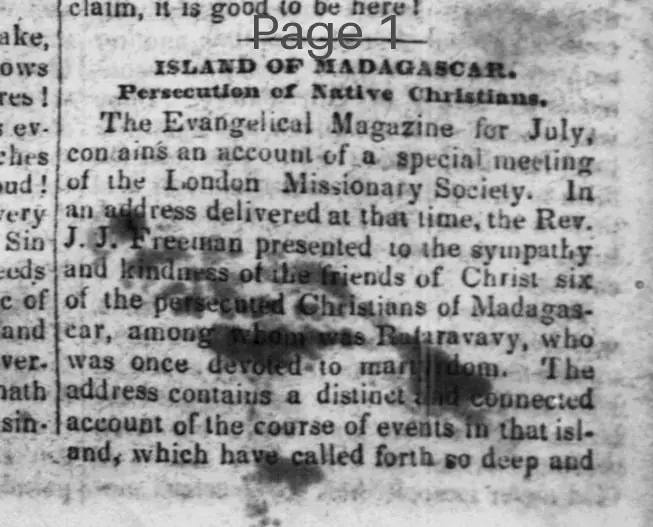
The Evangelical Magazine for July, contains an account of a special meeting of the London Missionary Society. In an address delivered at that time, the Rev. J. J. Freeman presented to the sympathy and kindness of the friends of Christ six, of the persecuted Christians of Madagascar, among whom was Rotavavy, who was once devoted to martyrdom. The address contains a distinct and connected account of the course of events in that island, which have called forth so deep and
It is now rather more than four years since the direct persecution of the Madagascan government against Christianity commenced. There had been previous indications of opposition to the ordinances of Christianity. But it was not till about that period, [March 1835,] that the Queen published her edict, making the profession and teaching of Christianity in any way a capital offence. At that time the prospects of the mission appeared to be highly satisfactory and encouraging. There were about 5,000 children enrolled in our mission schools, and some few thousands of the natives, including a vast multitude of adults, were also, by their own voluntary application, acquiring the art of reading, so that many thousands had become capable of perusing the Holy Scriptures, which were in circulation among them. Two places of worship had been erected, and were well filled with native congregations. About 200 natives had submitted to the rite of Christian baptism, nearly all of whom were received into Christian fellowship. About twenty meetings for prayer were established by the natives themselves, in their respective houses, in various parts of the capital and the immediate vicinity. Nearly the whole volume of the scriptures was translated, revised, printed, and put into circulation; but especially the New Testament and the book of Psalms.
At the time of the suppression of Christianity, all who had made a profession of it fell under the condemnation of the severe measures of the government. Several hundreds of officers in the army were reduced in rank, and the whole of those who had voluntarily acquired the art of reading, and attended our chapels, and especially those who had instituted voluntary prayer-meetings, were placed under penalties; so that, perhaps, from 2,000 to 3,000 natives suffered at once, in consequence of the publication of that edict against Christianity. The first direct measures of persecution fell upon that eminent woman, of whom we have all heard with deepest feelings of sympathy—Rafaravavy. She had been a convert prior to the suppression of Christianity. Previous to her conversion she was a most devoted idolater—one of the most zealous of the zealous there in sustaining the worship of idols; and it is well known that often her relations, in their attachment to idolatry, had sacrificed not merely the comforts and conveniences, but even the absolute necessaries of life. She then became one of the most zealous converts: she obtained one of the largest houses she could in the capital, for the purpose of instituting a prayer-meeting. We have attended there on various occasions. By her simplicity, fervor, and consistency, she became the means of inducing the regular attendance of many on the means of grace. This awakened the enmity of some around her, and three of her own servants accused her to the government. She was charged with encouraging meetings for prayer, having the scriptures in her possession, and keeping holy the Sabbath day. At that time her person and property were valued, and a fine imposed to half the estimated amount. Her father, who was not a converted man, filled with indignation against the servants who had accused her, put them in irons. The moment she was released, her heart cherished a burning desire to become the instrument of their conversion; she obtained a house at some distance from that in which her father lived,—for the very purpose of having them immediately under her care, direction, and instruction. Her earnest and persevering efforts were devoted to effect the conversion of her accusers. She prayed with them, she wept over them, till at last they wept for themselves, and confessed "We thought there was something in this religion, when we saw you, instead of reproaching, pitying us; and we now begin to feel in our own hearts what this religion is." There is reason to hope that two of these servants became savingly converted to God by her means. One of them has since been subjected to severe punishment for attachment to the gospel, and she is not without hope that the whole three have become lovers of the Savior. After this, she was again accused, with several others, of continuing to read and pray; in consequence of which her house was stripped of its contents, and she herself was put in irons. Her friends were apprehended, and Rafaravavy was ordered for execution, simply because she retained her faith in Christ. It was declared publicly that she had been put to death, and the news reached us that she had suffered martyrdom. In the providence of God, however, it occurred that on the very night preceding the morning on which she was to have been led forth at cock-crow to be executed, an alarming fire burst out in the capital where she was prisoner. The confusion became general; the soldiers who had her under guard, and the very executioners, forgot at the moment their duty, and the order for execution remained in suspense—not countermanded by higher authority, unless it was that of Him in whose hands are the issues of life and of death. Two or three days passed away amidst this confusion, and during that time another eminent woman uttered boldly her sentiments on behalf of Christianity. They were conveyed to the queen, and upon her head the indignation fell. She was led forth to the place of execution, and died there a believer in Jesus, pleading with him for the conversion of her beloved country.
Rafaravavy, who was then in irons, was kept in that situation for five months, unable to move a single inch, day or night. Five soldiers were appointed to guard the house where she was kept; but even there the desire of converting others to God never forsook her. She seized moments to offer affectionate prayers and counsels, which became the means of turning his heart to God. After suffering this confinement, he was sold into slavery, first in a private house; but as that was not deemed a sufficient disgrace, it was ordered that she should be taken into the most public part of the capital, and there, under the eye of all her friends and relations, sold publicly into slavery. She counted it a high honor to suffer shame for the sake of Christ. But again she was found ere long attending at a meeting for prayer, and a young man was accused of having permitted her to meet at his house. That young man was apprehended. He had been one of those, and I believe the only one of the Christians, who ventured to attend the martyrdom of the first female put to death. He returned from the scene prepared to yield his life to God, if called upon to do it. He was the next martyr. He fell upon the same spot. He supplicated the executioners, before the spear was plunged into his heart, to allow him a few moments to commit his soul to the hand of Christ. The very executioners, hard-hearted men as they were, granted his request. He knelt down on the spot where he was to die, lifted up his heart in prayer to God for the queen, the government, his fellow-countrymen, and prayed that the gospel might spread and triumph in that land. There are usually four or five executioners, sometimes more. They were about to throw him with violence on the ground. "No," he said, "there is no occasion for that; I have no fear of dying." He calmly prostrated himself on the ground, and the spears transfixed his heart. The government then sent their officers to the wife of that young man, to ascertain who the parties were that had been assembling for prayer at his house. She refused to name them. It is said that they then threatened torture, and brought their pincers, that they might pluck the flesh from their bones. Then they brought hammers, to crush the several joints of her fingers. She was next scourged, and her nails were extracted. It was more than flesh and blood could sustain, though we have reason to believe that she was a pious woman, and we know that she long concealed the names. It has since been to her a matter of grief that she divulged them. The names were carried to the government, and the parties were brought under fresh accusations. Rafaravavy was among them, and also two young men who are here present. Six of them immediately fled from the capital, and passed about sixty miles across the country to the west, to a village where they knew there were many who loved the Savior. They were welcomed there. A leading man in the district gave them the right hand of fellowship. "Come," he said, "to me. As long as I have food to eat, you shall share it with me; as long as I am safe, you are safe." He concealed them there, and his wife, who sits by us, assisted in the concealment. The soldiers came to the house and searched for those who had fled, and especially for Rafaravavy, for she was deemed the leader of this little band, whom neither threats nor spears could induce to relinquish their faith in Christ. She was in the house when the soldiers arrived, and there seemed no possibility of escape. She was concealed behind a piece of matting, which the soldiers did not descry, and her life was thus preserved. The soldiers retired from the village, expecting to find her in an adjoining mountain, where it was known that she and others retired to pray. During the absence of the soldiers they were enabled to escape and find refuge in another part of the country, where they were mercifully watched over. They continued there for a few months, till information came of the arrival of the Rev. David Johns on the coast of Madagascar, in the autumn of last year. Communications were made by means of confidential friends, and as soon as they heard of his arrival, they travelled by every possible means of secrecy, and arrangements were made to conduct them to the shores of Great Britain, where they might feel that they could worship God, and enjoy liberty. Mr. Johns mentioned their escape among our Christian friends at the Mauritius, and a young man there in the queen's service, an officer in the army, went among his brother officers, and collected in one day 70l. sterling, towards paying the expenses of bringing them from the coast of Madagascar. Thus aided, they safely reached the Mauritius, where they found a number of their fellow-countrymen who had formerly been in slavery in that land, and had subsequently obtained freedom. With those they mingled their prayers and thanksgiving to God. There is reason to hope that in the Mauritius some of those slaves, now freemen, have become freemen in Christ Jesus. If no other door of usefulness should open, there are one or two of these Madagascan friends who are desirous of going back and laboring among their countrymen and country-women—who are at present working to obtain a maintenance in the Mauritius. Thence they proceeded to Algoa Bay, and were kindly welcomed by the Christians of South Africa, particularly by the Hottentots. The Hottentots received them as brethren and sisters, with intense delight; but there was this difficulty—they could not understand each other's language. However, they devised a medium of intercourse. Each possessed their copies of the sacred volume. The Madagascans found a text, such a chapter, such a verse—"All one in Christ Jesus." The Hottentots turned to their Bibles and found the same verse "All one in Christ Jesus:" and they mutually expressed their sentiments of love and faith towards the Lord Jesus Christ by respectively pointing to texts in the holy volume. The Hottentots, poor indeed as to this world's goods, but rich in faith, of their own accord voluntarily made a little subscription on the morning of their departure, and handed in 23s. as a mark of their affection to these persecuted friends.
Since reaching this country, we have reason to believe that these, our Christian friends, have spent much of their time in fervent prayer to God. Last Tuesday morning—and I would not say these things in their presence, only that they are not familiar with our language, and know not what I am relating to you, so that I am not feeding their vanity—last Tuesday morning the two women who reside in the house of Mrs. Johns did not come down at the usual hour, and on ascertaining the cause of their detention, she found that they had consecrated that day to fasting and prayer, that God might preserve them in our midst, bless them in this visit to our land, and make them a blessing through the remnant of their days. On Saturday last, the younger of the two women not coming down, Mrs. Johns listened at her door, and heard her engaged in earnest prayer to God. The substance of her expressions was this—"We see that in this country the gospel of Christ is allowed to circulate freely. O that it might in our country!" What they had seen and witnessed already of the happiness of British Christians, induced them to pour out their whole heart before God, that Madagascar might receive such blessings too.
Having related all that I need state on the present occasion, I shall have the pleasure of introducing them by name to the chairman as the organ of the meeting. Rafaravavy is this excellent woman, who was at the point of death, and in the spirit of a martyr prepared for it, but whom God has preserved to this moment. They have all adopted new names, and she has chosen the name of Mary. She has read so much of Mary in the gospel, that she wishes to have that name herself. The second is Razafy. Her husband preserved their lives when wandering over Madagascar. He remains at the Mauritius to obtain a vessel, that he may go and visit the creeks on either side of the island, that if possible he may rescue his countrymen from destruction. This young man is Andrianomanana. He has assumed the name of Simeon, because Simeon said, when he took the Savior in his arms, "Mine eyes have seen thy salvation." The next is Rasoamaka, who has taken the name of Joseph. He is a young man of eminent piety. Though he is young, he has been looked up to during the persecution by all the friends in Madagascar with the utmost affection and confidence, as a wise and prudent adviser. Next to him is a young man, Ratsarahomba, David; he drank the tangena. The other is a youth, Andrianisa, James; whose father assisted in getting them out of the island. Whatever might be his duty as an officer of the queen, he felt it still more his duty to aid in rescuing these Christian friends; and he also has fled for his life to the Mauritius.
What sub-type of article is it?
What keywords are associated?
What entities or persons were involved?
Where did it happen?
Foreign News Details
Primary Location
Island Of Madagascar
Event Date
About [March 1835]
Key Persons
Outcome
persecution led to 2,000-3,000 natives suffering penalties; executions of at least two christians (one woman and one young man); rafaravavy and five others escaped persecution, traveled through mauritius and south africa to britain; some conversions among persecutors and slaves.
Event Details
The Madagascan government issued an edict in March 1835 making Christianity a capital offense, suppressing missions with 5,000 children in schools, thousands learning to read Scriptures, 200 baptized, and prayer meetings. Persecution included fines, imprisonment, enslavement, and executions. Rafaravavy, a zealous convert, faced multiple accusations, near-execution averted by a fire, five months in irons, public enslavement, but continued converting others. She and five others fled, hid, and escaped with aid from Rev. David Johns, reaching Britain where they were introduced at a London Missionary Society meeting.