Thank you for visiting SNEWPapers!
Sign up free
Alexandria Gazette, Commercial And Political
Alexandria, Virginia
What is this article about?
At Lancaster Summer Assizes, American merchant M'Evers sued ship charterer Schneider for damaged cotton cargo on the Neva, blaming improper stowage. Defense cited a severe Gulf of Florida storm causing leaks. Jury found for defendant, attributing damage to sea perils, not owners' fault. (214 characters)
Clipping
OCR Quality
Full Text
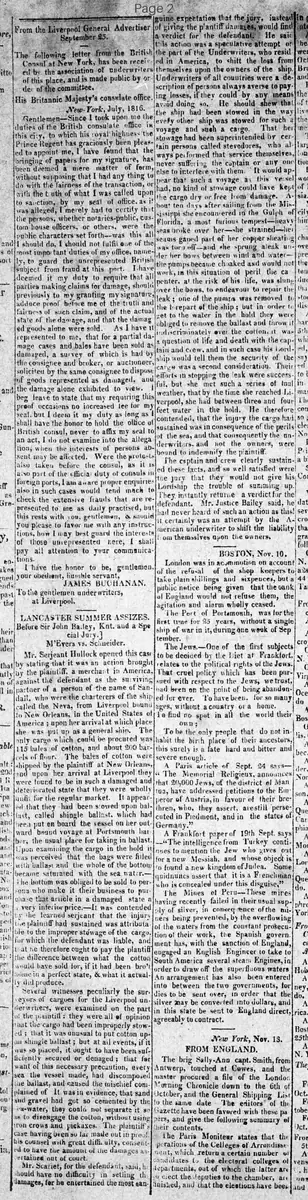
Before Sir John Bailey, Knt. and a Special Jury.]
M'Evers vs. Schneider.
Mr. Serjeant Hullock opened this case by stating that it was an action brought by the plaintiff, a merchant in America, against the defendant as the surviving partner of a person of the name of Sandall. who were the charterers of the ship called the Neva, from Liverpool bound to New Orleans, in the United States of America ; upon her arrival at which place she was put up as a general ship. The only cargo which could be procured was 115 bales of cotton, and about 200 barrels of flour. The bales of cotton were shipped by the plaintiff at New Orleans. and upon her arrival at Liverpool they were found to be in such a damaged and deteriorated state that they were wholly unfit for the regular market. It appeared that they had been stowed upon ballast, called shingle ballast. which had been put on board the vessel on her outward bound voyage at Portsmouth harbour, the usual place for taking in ballast. Upon examining the cargo in the hold it was perceived that the bags were filled with ballast and the whole of the bottom became saturated with the sea water.- The bottom was obliged to be sold to persons who make it their business to purchase that article in a damaged state at a very inferior price.--It was contended by the learned serjeant that the injury the plaintiff had sustained was attributable to the improper stowage of the cargo. for which the defendant was liable, and that he therefore ought to pay the plaintiff the difference between what the cotton would have sold for, if it had been brought home in a perfect state, & what it actually did produce.
Several witnesses particularly the surveyors of cargoes for the Liverpool underwriters, were examined on the part of the plaintiff : they were all of opinion that the cargo had been improperly stowed ; that it was unusual to put cotton upon shingle ballast; but at all events, if it was so placed, it ought to have been sufficiently secured or dunnaged; that for want of this necessary precaution, every sea the vessel made, had discomposed the ballast, and caused the mischief complained of It was in evidence, that sand and gravel had got so cemented by the sea-water, they could not separate it so as to disengage the cotton, without using iron crows and pickaxes. The plaintiff's case having been so far made out in proof his counsel with great difficulty, consented to have the amount of the damages ascertained out of court.
Mr. Scarlett, for the defendant, said, he should have no difficulty in settling the damages, for he entertained the most sanguine expectation that the jury, instead of giving the plaintiff damages, would find a verdict for the defendant. He said this action was a speculative attempt on the part of the Underwriters, who resided in America, to shift the loss from themselves upon the owners of the ship. Underwriters of all countries were a description of persons always averse to paying losses, if they could by any means avoid doing so. He should shew that the ship had been stowed in the way every other ship was stowed for such a voyage and such a cargo. That her stowage had been superintended by certain persons called stevedores, who always performed that service themselves. never suffering the captain or any one else to interfere with them. It would appear that such a voyage as this vessel had, no kind of stowage could have kept the cargo dry or free from damage. About ten days after sailing from the Mississippi she encountered in the Gulph of Florida, a most furious tempest--heavy seas broke over her--she strained--her seams gaped part of her copper sheathing was torn off--and she sprung a leak under her bows between wind and water- the pumps became choaked and would not work, in this situation of peril the carpenter, at the risk of his life, was slung over the bows, to endeavour to repair the leak ; one of the pumps was removed to the forepart of the ship; but in order to get to the water in the hold they were obliged to remove the ballast and throw it indiscriminately over the cotton, it was a question of life and death with the captain and crew, and in such case his Lordship would tell them the security of the cargo was a second consideration. Their efforts in stopping the leak were successful, but she met such a series of foul weather, that by the time she reached Liverpool, she had between three and four feet water in the hold. He therefore contended, that the injury the cargo had sustained was in consequence of the perils of the sea, and that consequently the underwriters, and not the owners, were bound to indemnify the plaintiff.
The captain and crew clearly sustained these facts. and so well satisfied were the jury that they would not give his Lordship the trouble of summing up. They instantly returned a verdict for the defendant. Mr. Justice Bailey said, he had never heard of such an action as this! it certainly was an attempt by the American underwriter to shift the liability from themselves upon the owners.
What sub-type of article is it?
What themes does it cover?
What keywords are associated?
What entities or persons were involved?
Where did it happen?
Story Details
Key Persons
Location
Lancaster Summer Assizes, Ship Neva From Liverpool To New Orleans, Gulf Of Florida, Portsmouth Harbour
Event Date
Summer Assizes
Story Details
Merchant M'Evers sued Schneider, surviving partner of Sandall, charterers of ship Neva, for damage to 115 bales of cotton shipped from New Orleans to Liverpool, claiming improper stowage on shingle ballast. Defense argued damage resulted from a furious tempest in the Gulf of Florida causing leaks and necessitating ballast shifts for survival. Witnesses confirmed perils of the sea; jury returned verdict for defendant, shifting liability to underwriters.