Thank you for visiting SNEWPapers!
Sign up free
Alexandria Gazette
Alexandria, Alexandria County, District Of Columbia
What is this article about?
An anonymous observer, possibly Maj. W. Noland, describes recent public improvements in Washington City, including Capitol repairs, innovative water systems, a new fountain, and enhancements to the President's House and grounds, expressing national pride amid political strife.
Clipping
OCR Quality
Full Text
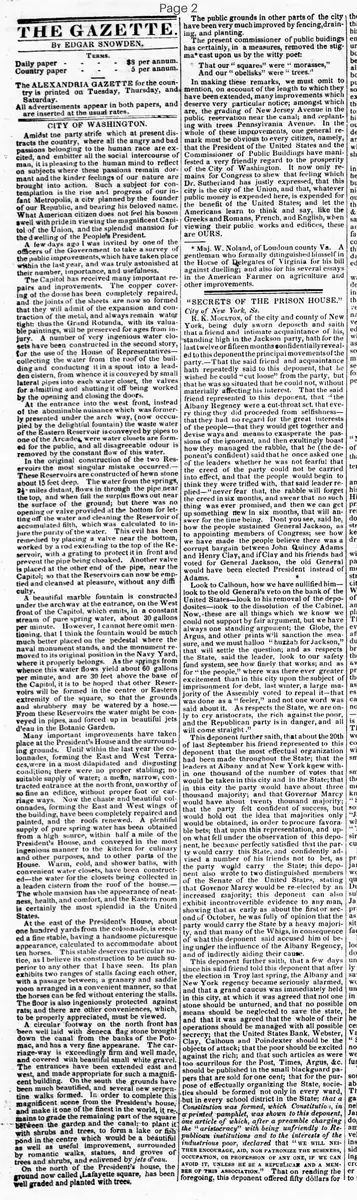
Amidst the party strife which at present distracts the country, where all the angry and bad passions belonging to the human race are excited, and embitter all the social intercourse of man, it is pleasing to the human mind to reflect on subjects where these passions remain dormant and the kinder feelings of our nature are brought into action. Such a subject for contemplation is the rise and progress of our infant Metropolis, a city planned by the founder of our Republic, and bearing his beloved name.
What American citizen does not feel his bosom swell with pride in viewing the magnificent Capitol of the Union, and the splendid mansion for the dwelling of the People's President.
A few days ago I was invited by one of the officers of the Government to take a survey of the public improvements, which have taken place within the last year, and was truly astonished at their number, importance, and usefulness.
The Capitol has received many important repairs and improvements. The copper covering of the dome has been completely repaired, and the joints of the sheets are now so formed that they will admit of the expansion and contraction of the metal, and always remain water tight: thus the Grand Rotunda, with its valuable paintings, will be preserved for ages from injury. A number of very ingenious water closets have been constructed in the second story, for the use of the House of Representatives—collecting the water from the roof of the building and conducting it in a spout into a leaden cistern, from whence it is conveyed by small lateral pipes into each water closet, the valves for admitting and shutting it off being worked by the opening and closing the doors.
At the entrance into the west front, instead of the abominable nuisance which was formerly presented under the arch way, (now occupied by the delightful fountain) the waste water of the Eastern Reservoir is conveyed by pipes to one of the Arcades where water closets are formed for the public, and all disagreeable odour is removed by the constant flow of this water.
In the original construction of the two Reservoirs the most singular mistake occurred. These Reservoirs are constructed of hewn stone about 15 feet deep. The water from the springs, 3/4 miles distant, flows in through the pipe near the top, and when full the surplus flows out near the surface of the ground; but there was no opening or valve provided at the bottom for letting off the water and cleaning the Reservoir of accumulated filth, which was calculated to injure the purity of the water. This evil has been remedied by placing a valve near the bottom, worked by a rod extending to the top of the Reservoir, with a grating to protect it in front and prevent the pipe being choaked. Another valve is placed at the other end of the pipe, near the Capitol; so that the Reservoirs can now be emptied and cleansed at pleasure, without any difficulty.
A beautiful marble fountain is constructed under the archway at the entrance, on the West front of the Capitol, which emits, in a constant stream of pure spring water, about 30 gallons per minute. However, I cannot here omit mentioning, that I think the fountain would be much better placed on the pedestal where the naval monument stands, and the monument removed to its original position in the Navy Yard, where it properly belongs. As the springs from whence this water flows yield about 60 gallons per minute, and are 30 feet above the base of the Capitol, it is to be hoped that other Reservoirs will be formed in the centre or Eastern extremity of the square, so that the grounds and shrubbery may be watered by a hose. From these Reservoirs the water might be conveyed in pipes, and forced up in beautiful jets d'eau in the Botanic Garden.
Many important improvements have taken place at the President's House and the surrounding grounds. Until within the last year the colonnades, forming the East and West Terraces, were in a most dilapidated and disgusting condition; there were no proper stabling; no suitable supply of water; a mean, narrow, contracted entrance at the north front, unworthy of so fine an edifice, without proper foot or carriage ways. Now the chaste and beautiful colonnades, forming the East and West wings of the building, have been completely repaired and painted, and the roofs renewed. A plentiful supply of pure spring water has been obtained from a high source, within half a mile of the President's House, and conveyed in the most ingenious manner to the kitchen for culinary and other purposes, and to other parts of the House. Warm, cold, and shower baths, with convenient water closets, have been constructed—the water for the closets being collected in a leaden cistern from the roof of the house. The whole mansion has the appearance of neatness, health, and comfort, and the Eastern room is certainly the most splendid in the United States.
At the east of the President's House, about one hundred yards from the colonnade, is erected a fine stable, having a handsome picturesque appearance, calculated to accommodate about ten horses. This stable deserves particular notice, as I believe its construction to be much superior to any other that I have seen. Its plan exhibits two ranges of stalls facing each other, with a passage between; a granary and saddle room arranged in a convenient manner, so that the horses can be fed without entering the stalls. The floor is also ingeniously protected against rats; and there are other conveniences, which, to be properly appreciated, must be viewed.
A circular footway on the north front has been well laid with Seneca flag stone brought down the canal from the banks of the Potomac, and has a very fine appearance. The carriage-way is exceedingly firm and well made, and covered with beautiful small white gravel. The entrances have been extended east and west, and made appropriate for such a magnificent building. On the south the grounds have been much beautified, and several new serpentine walks formed. In order to complete this magnificent scene from the President's house; and make it one of the finest in the world, it remains to grade the remaining part of the square between the garden and the canal;—to plant it with shrubs and trees, to form a lake or fish pond in the centre which would be a beautiful as well as useful improvement, surrounded by romantic walks, statues, and groves of trees and shrubs, and enlivened by jets d'eau.
On the north of the President's house, the ground now called Lafayette square, has been well graded and planted with trees,
The public grounds in other parts of the city have been very much improved by fencing, draining, and planting.
The present commissioner of public buildings has certainly, in a measure, removed the stigma cast upon us by the witty poet:
That our "squares" were "morasses,
And our "obelisks" were "trees."
In making these remarks, we must omit to mention, on account of the length to which they have been extended, many improvements which deserve very particular notice; amongst which are, the grading of New Jersey Avenue in the public reservation near the canal; and replanting with trees Pennsylvania Avenue. In the whole of these improvements, one general remark must be obvious to every citizen, namely, that the President of the United States and the Commissioner of Public Buildings have manifested a very friendly regard to the prosperity of the City of Washington. It now only remains for Congress to shew that feeling which Dr. Sutherland has justly expressed, that this city is the city of the Union, and that, whatever public money is expended here, is expended for the benefit of the United States; and let the Americans learn to think and say, like the Greeks and Romans, French, and English, when viewing their public works and edifices, these are OURS.
* Maj. W. Noland, of Loudoun county Va. A gentleman who formerly distinguished himself in the House of Delegates of Virginia for his bill against duelling; and also for his several essays in the American Farmer on agriculture and other improvements.
What sub-type of article is it?
What themes does it cover?
What keywords are associated?
What entities or persons were involved?
Where did it happen?
Story Details
Key Persons
Location
City Of Washington
Event Date
Within The Last Year
Story Details
An observer tours recent public improvements in Washington, detailing repairs to the Capitol's dome and water systems, construction of reservoirs and a fountain, enhancements to the President's House including colonnades, baths, and stables, and landscaping of grounds, praising the efforts for national pride.