Thank you for visiting SNEWPapers!
Sign up free
Foreign News
August 17, 1896
Freeland Tribune
Freeland, Luzerne County, Pennsylvania
What is this article about?
Mr. Scott-Elliott describes in Science Progress how annual African grass fires alter vegetation by preventing soil improvement and causing plants to adapt with bare flowering stems post-rains. Certain trees like Euphorbias resist fires due to bark structures, as analyzed by Professor Farmer.
Clipping
OCR Quality
95%
Excellent
Full Text
African Grass Fires.
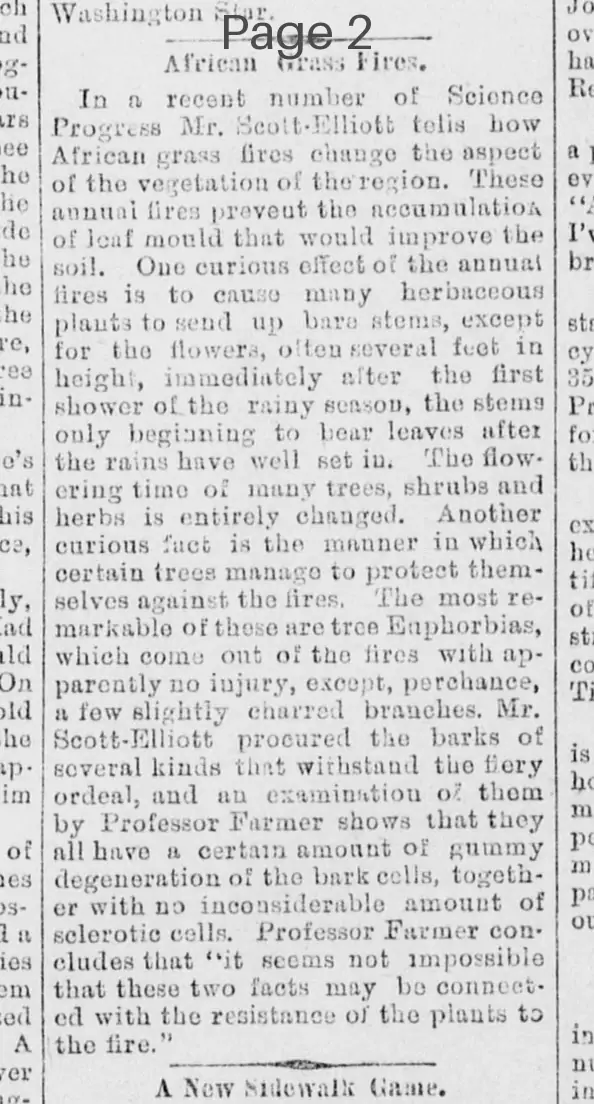
In a recent number of Science Progress Mr. Scott-Elliott tells how African grass fires change the aspect of the vegetation of the region. These annual fires prevent the accumulation of leaf mould that would improve the soil. One curious effect of the annual fires is to cause many herbaceous plants to send up bare stems, except for the flowers, often several feet in height, immediately after the first shower of the rainy season, the stems only beginning to bear leaves after the rains have well set in. The flowering time of many trees, shrubs and herbs is entirely changed. Another curious fact is the manner in which certain trees manage to protect themselves against the fires. The most remarkable of those are tree Euphorbias, which come out of the fires with apparently no injury, except, perchance, a few slightly charred branches. Mr. Scott-Elliott procured the barks of several kinds that withstand the fiery ordeal, and an examination of them by Professor Farmer shows that they all have a certain amount of gummy degeneration of the bark cells, together with no inconsiderable amount of sclerotic cells. Professor Farmer concludes that it seems not impossible that these two facts may be connected with the resistance of the plants to the fire.
In a recent number of Science Progress Mr. Scott-Elliott tells how African grass fires change the aspect of the vegetation of the region. These annual fires prevent the accumulation of leaf mould that would improve the soil. One curious effect of the annual fires is to cause many herbaceous plants to send up bare stems, except for the flowers, often several feet in height, immediately after the first shower of the rainy season, the stems only beginning to bear leaves after the rains have well set in. The flowering time of many trees, shrubs and herbs is entirely changed. Another curious fact is the manner in which certain trees manage to protect themselves against the fires. The most remarkable of those are tree Euphorbias, which come out of the fires with apparently no injury, except, perchance, a few slightly charred branches. Mr. Scott-Elliott procured the barks of several kinds that withstand the fiery ordeal, and an examination of them by Professor Farmer shows that they all have a certain amount of gummy degeneration of the bark cells, together with no inconsiderable amount of sclerotic cells. Professor Farmer concludes that it seems not impossible that these two facts may be connected with the resistance of the plants to the fire.
What sub-type of article is it?
Environmental Impact
Botanical Adaptation
What keywords are associated?
African Grass Fires
Vegetation Changes
Plant Adaptations
Euphorbias Resistance
Rainy Season Effects
What entities or persons were involved?
Mr. Scott Elliott
Professor Farmer
Where did it happen?
Africa
Foreign News Details
Primary Location
Africa
Key Persons
Mr. Scott Elliott
Professor Farmer
Event Details
Annual grass fires in Africa prevent leaf mould accumulation, improving soil, cause herbaceous plants to produce bare flowering stems after first rains, alter flowering times of trees, shrubs, and herbs. Tree Euphorbias resist fires unharmed due to bark with gummy degeneration and sclerotic cells.