Thank you for visiting SNEWPapers!
Sign up free
Soldier's Letter
Kansas City, Jackson County, Missouri
What is this article about?
History of the First Colorado Regiment's First Battalion: mustered in Denver December 1863, marched 800 miles to Leavenworth via Platte Route despite smallpox, reached St. Louis after train derailment injuring several; other companies endured severe winter march from Fort Lyon to Kansas City by January 1864, suffering frostbite.
Clipping
OCR Quality
Full Text
(Continued from No.3.)
ABOUT the middle of December, '63, Head-Quarters of the Regiment was removed to Camp Weld, near Denver, where five companies, A, B, C, D. and E, were mustered into service as the First Battalion—with the following announcement of Officers for the 1st Regiment:
James H. Ford, Colonel;
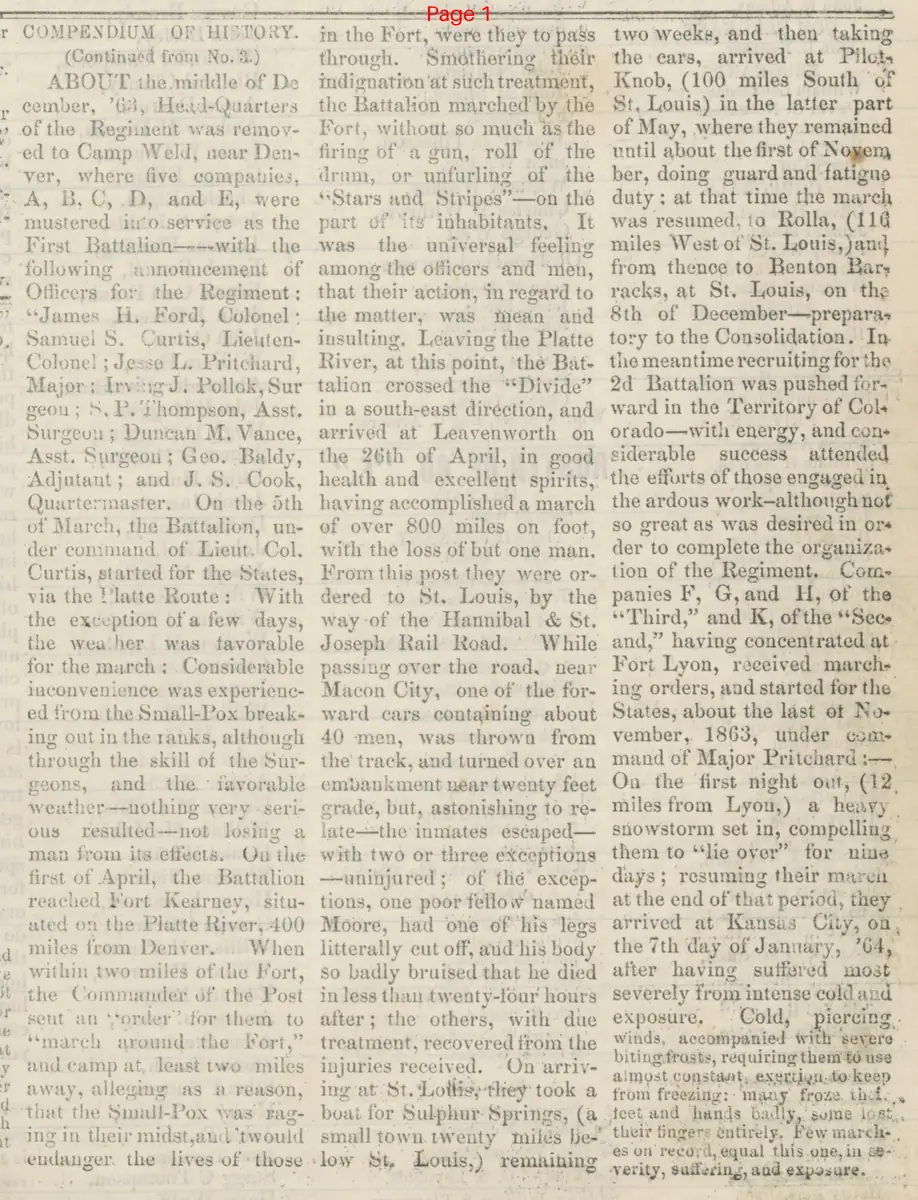
Samuel S. Curtis, Lieutenant Colonel; Jesse L. Pritchard, Major; Irving J. Pollok, Surgeon; S. P. Thompson, Asst. Surgeon; Duncan M. Vance, Asst. Surgeon; Geo. Baldy, Adjutant; and J. S. Cook, Quartermaster. On the 5th of March, the Battalion, under command of Lieut. Col. Curtis, started for the States, via the Platte Route. With the exception of a few days, the weather was favorable for the march. Considerable inconvenience was experienced from the Small-Pox breaking out in the ranks, although through the skill of the Surgeons, and the favorable weather nothing very serious resulted—not losing a man from its effects. On the first of April, the Battalion reached Fort Kearney, situated on the Platte River, 400 miles from Denver. When within two miles of the Fort, the Commander of the Post sent an order for them to "march around the Fort," and camp at least two miles away, alleging as a reason, that the Small-Pox was raging in their midst, and it would endanger the lives of those in the Fort, were they to pass through. Smothering their indignation at such treatment, the Battalion marched by the Fort, without so much as the firing of a gun, roll of the drum, or unfurling of the "Stars and Stripes" on the part of its inhabitants. It was the universal feeling among the officers and men, that their action, in regard to the matter, was mean and insulting. Leaving the Platte River, at this point, the Battalion crossed the "Divide" in a south-east direction, and arrived at Leavenworth on the 26th of April, in good health and excellent spirits, having accomplished a march of over 800 miles on foot, with the loss of but one man. From this post they were ordered to St. Louis, by the way of the Hannibal & St. Joseph Rail Road. While passing over the road, near Macon City, one of the forward cars containing about 40 men, was thrown from the track, and turned over an embankment near twenty feet grade, but, astonishing to relate, the inmates escaped—with two or three exceptions uninjured; of the exceptions, one poor fellow named Moore, had one of his legs literally cut off, and his body so badly bruised that he died in less than twenty-four hours after; the others, with due treatment, recovered from the injuries received. On arriving at St. Louis, they took a boat for Sulphur Springs, (a small town twenty miles below St. Louis,) remaining two weeks, and then taking the cars, arrived at Pilot Knob, (100 miles South of St. Louis) in the latter part of May, where they remained until about the first of November, doing guard and fatigue duty; at that time the march was resumed, to Rolla, (116 miles West of St. Louis,) and from thence to Benton Barracks, at St. Louis, on the 8th of December preparatory to the Consolidation. In the meantime recruiting for the 2d Battalion was pushed forward in the Territory of Colorado—with energy, and considerable success attended the efforts of those engaged in the arduous work—although not so great as was desired in order to complete the organization of the Regiment. Companies F, G, and H, of the "Third," and K, of the "Second," having concentrated at Fort Lyon, received marching orders, and started for the States, about the last of November, 1863, under command of Major Pritchard:— On the first night out, (12 miles from Lyon,) a heavy snowstorm set in, compelling them to "lie over" for nine days; resuming their march at the end of that period, they arrived at Kansas City, on the 7th day of January, '64, after having suffered most severely from intense cold and exposure. Cold, piercing winds, accompanied with severe biting frosts, requiring them to use almost constant exertion to keep from freezing: many froze their feet and hands badly, some lost their fingers entirely. Few marches on record, equal this one, in severity, suffering, and exposure.
What sub-type of article is it?
What themes does it cover?
What keywords are associated?
What entities or persons were involved?
Where did it happen?
Story Details
Key Persons
Location
Camp Weld Near Denver, Colorado; Platte Route; Fort Kearney On Platte River; Leavenworth; St. Louis, Missouri; Pilot Knob; Rolla; Benton Barracks; Fort Lyon; Kansas City
Event Date
December 1863 To January 1864
Story Details
The First Battalion of the First Colorado Regiment, under Lt. Col. Curtis, mustered in Denver in December 1863 with listed officers, marched from March 1864 via Platte Route to Leavenworth despite smallpox, faced exclusion at Fort Kearney, suffered a train derailment near Macon City killing one, then stationed in Missouri until December; meanwhile, Companies F, G, H, K under Major Pritchard marched from Fort Lyon in late November 1863, delayed by snowstorm, enduring extreme cold to reach Kansas City in January 1864 with frostbite injuries.