Thank you for visiting SNEWPapers!
Sign up free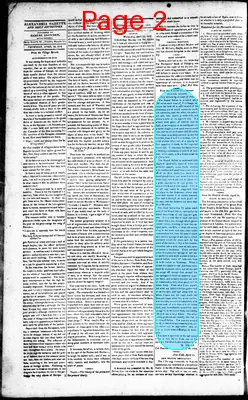
Story
April 16, 1818
Alexandria Gazette & Daily Advertiser
Alexandria, Virginia
What is this article about?
Detailed 1814 account by Sibley of Missouri's Grand Saline and Rock Saline, describing their vast salt plains, formations, surrounding terrain, and potential for extraction near Fort Osage and Arkansas River.
Clipping

OCR Quality
95%
Excellent
Full Text
From the National Intelligencer.
MISSOURI SALINES.
Very interesting account of them.
The Grand Saline is situated about 280 miles south west of Fort Osage, between the forks of a small branch of the Arkansas, one of which washes its south ern extremity, and the other, the principal one, runs nearly parallel with, and within a mile of its opposite side. It is a hard level plain, of reddish colored land, of an irregular or mixed figure—its greatest length is from north west to south east, and its circumference full 50 miles.
This plain is entirely covered in dry hot weather, from 2 to 6 inches deep, with a crust of clear white salt, of a quality rather superior, I think, to the imported blown salt. In this state the Saline bears a striking resemblance to a field of brilliant white snow, with a frozen crust on it after a rain.
The Grand Saline is environed with ridges of sand hills: some of which are perfectly naked; some thinly clothed with verdure and small trees: and others afford on their declivities thickets of dwarf plumb trees, not more than thirty inches high, which yielded us (June 28) a great abundance of ripe plums, the largest and finest I ever tasted. I think the salt may easily be waggoned from this place to the Arkansas, where keel boats may receive it at certain seasons. The road is through an open prairie all the way, and the distance not more than 80 or 90 miles:
The Rock Saline lies 75 miles north west of the Grand Saline, surrounded by naked mountains of red clay and gypsum. It is a level flat of hard red sand of about 500 acres, through which passes a small stream, dividing it into two unequal parts, one fifth, or about 100 acres, being on the south west side, close under a tremendous hill, from the base of which issue several springs of salt water, which gradually covers the plain, and by the action of the sun is, in dry or hot seasons, converted into a solid mass of salt, several inches in thickness. There are also within this plain four springs of salt water perfectly saturated, around which are formed hollow cones of rock salt, from 1½ to 20 inches in thickness. When I visited this Saline it had just been inundated by excessive rains, and all the salt was swept off, except that around the four springs—I found an immense quantity there, and actually blocked out with my tomahawk a very clear piece, full 16 inches thick. From what I saw myself, and what my faithful Indian guides told me on the spot, and had often told me before, I have not the least doubt but there are times when this whole section, next the hills, is covered completely with a solid rock of salt from 4 to 12 inches thick, and immediately around the four springs 12 to 20 inches thick, resembling a field of ice in large flakes. The other section produces salt exactly like that of the Grand Saline. The country around the Rock Saline is very mountainous, and the saline can be approached only on foot, or (with some difficulty) on horseback.
You have a specimen of the salt which I got at this Saline from one of the springs: therefore I need not describe it.
SIBLEY.
Col. Rector.
July 29, 1814.
MISSOURI SALINES.
Very interesting account of them.
The Grand Saline is situated about 280 miles south west of Fort Osage, between the forks of a small branch of the Arkansas, one of which washes its south ern extremity, and the other, the principal one, runs nearly parallel with, and within a mile of its opposite side. It is a hard level plain, of reddish colored land, of an irregular or mixed figure—its greatest length is from north west to south east, and its circumference full 50 miles.
This plain is entirely covered in dry hot weather, from 2 to 6 inches deep, with a crust of clear white salt, of a quality rather superior, I think, to the imported blown salt. In this state the Saline bears a striking resemblance to a field of brilliant white snow, with a frozen crust on it after a rain.
The Grand Saline is environed with ridges of sand hills: some of which are perfectly naked; some thinly clothed with verdure and small trees: and others afford on their declivities thickets of dwarf plumb trees, not more than thirty inches high, which yielded us (June 28) a great abundance of ripe plums, the largest and finest I ever tasted. I think the salt may easily be waggoned from this place to the Arkansas, where keel boats may receive it at certain seasons. The road is through an open prairie all the way, and the distance not more than 80 or 90 miles:
The Rock Saline lies 75 miles north west of the Grand Saline, surrounded by naked mountains of red clay and gypsum. It is a level flat of hard red sand of about 500 acres, through which passes a small stream, dividing it into two unequal parts, one fifth, or about 100 acres, being on the south west side, close under a tremendous hill, from the base of which issue several springs of salt water, which gradually covers the plain, and by the action of the sun is, in dry or hot seasons, converted into a solid mass of salt, several inches in thickness. There are also within this plain four springs of salt water perfectly saturated, around which are formed hollow cones of rock salt, from 1½ to 20 inches in thickness. When I visited this Saline it had just been inundated by excessive rains, and all the salt was swept off, except that around the four springs—I found an immense quantity there, and actually blocked out with my tomahawk a very clear piece, full 16 inches thick. From what I saw myself, and what my faithful Indian guides told me on the spot, and had often told me before, I have not the least doubt but there are times when this whole section, next the hills, is covered completely with a solid rock of salt from 4 to 12 inches thick, and immediately around the four springs 12 to 20 inches thick, resembling a field of ice in large flakes. The other section produces salt exactly like that of the Grand Saline. The country around the Rock Saline is very mountainous, and the saline can be approached only on foot, or (with some difficulty) on horseback.
You have a specimen of the salt which I got at this Saline from one of the springs: therefore I need not describe it.
SIBLEY.
Col. Rector.
July 29, 1814.
What sub-type of article is it?
Curiosity
Historical Event
Journey
What themes does it cover?
Exploration
Nature
What keywords are associated?
Grand Saline
Rock Saline
Salt Plains
Missouri
Natural Formations
Salt Extraction
What entities or persons were involved?
Sibley
Col. Rector
Where did it happen?
Missouri Salines, Near Fort Osage And Arkansas River
Story Details
Key Persons
Sibley
Col. Rector
Location
Missouri Salines, Near Fort Osage And Arkansas River
Event Date
July 29, 1814
Story Details
Sibley describes the Grand Saline as a 50-mile circumference plain covered in white salt crust, surrounded by sand hills with dwarf plum trees; suggests transport to Arkansas. The Rock Saline, 75 miles northwest, features salt springs forming rock salt cones up to 20 inches thick amid mountainous terrain, with personal observation of extracting salt.