Thank you for visiting SNEWPapers!
Sign up free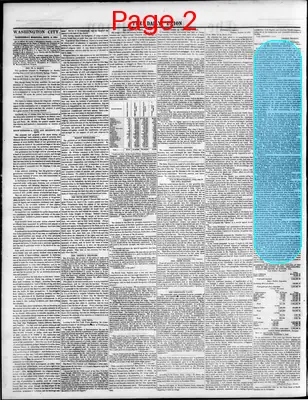
Editorial
September 6, 1854
The Daily Union
Washington, District Of Columbia
What is this article about?
Editorial from the Mississippian criticizes the New York Evening Post's proposal to prevent admission of new slave states, including those from Texas, as a violation of the U.S.-Texas compact, amid rising anti-slavery sentiment in the North.
Clipping
OCR Quality
98%
Excellent
Full Text
From the Mississippian.
THE NEW YORK EVENING POST, AND ITS "WAY TO WIN FREEDOM'S BATTLE."
If the indications of public sentiment of the free States are not greatly misrepresented by the abolition and free-soil journals, the conclusion must be forced on the minds of all that the anti-slavery feeling is now stronger in the North and West than at any former period. But little faith, however, should be placed upon the windy gasconade of excited fanaticism, and yet enough is developed to admonish the South to vigilance, but, we hope, to no further discussion. Nothing but the vote of the States can exhibit the conclusions of the public mind in a reliable manner. When this manifestation is made, the strength and the purpose of the anti-slavery party will be fully made known.
One portion of the abolitionists advocates the re-enactment of the Missouri restriction, and the unconditional repeal of the fugitive-slave law.
The Evening Post of 11th instant takes different ground, and endeavors to convince its friends that the most expeditious and certain mode to effect all their objects is to raise at once the question of admitting into the Union any new slave State. The Post imagines that the opponents of slavery extension in the free States are now sufficiently strong to elect a majority of representatives of their own opinions, and who will, at all times, be able to control the action of Congress upon the application of any Territory for admission into the Union of States. The proposition is simply to disregard the compact with Texas and reject Cuba, Nebraska, and all other portions of the South and West, if application be made under a State constitution tolerating slavery. We give that portion of the Post's article necessary to a clear understanding of its principles and policy.
"What, then, can be done, and what is it best to do? The great object to be accomplished is the prevention of the extension of slavery over territory in which it does not now exist. Why not, then, boldly take the position that not another slave State shall be admitted into this Union? If we take that ground, and maintain it, we shall accomplish our object. There can be little doubt that a large majority of the people of this country are in favor of it.
Neither is it obnoxious to any constitutional objection. The constitution, at the time of its adoption, did not contemplate the admission of States formed of territory not belonging at that time to the country. In admitting such States, it is clearly the right of the majority to prefix to their admission such conditions as they deem proper.
Let, then, the people of the free States elect men to Congress--from every congressional district, if possible-who will vote against the admission of any other slave State, no matter from what State the application for admission may come. If Kansas applies, if Nebraska applies, if Cuba applies, if the Sandwich islands apply, if new States from the territory now belonging to Mexico apply for admission as slave States, let a prompt and final rejection, until the offensive provisions in their constitution be abolished, be the answer.
It has been said that there was an implied understanding that new States formed of territory now constituting part of the great State of Texas should be admitted with slave constitutions. But if there ever was any such understanding, and if it ever was in any degree obligatory, the repeal of the Missouri Compromise has deprived it of all its binding force. We would, therefore, oppose the admission of new slave States carved out of Texas with the same unalterable determination with which we would oppose the admission of such States from every other quarter.
With this plain, simple, practical, righteous issue-with the great balance of pecuniary interest and the spirit of the age in our favor--with union and vigor on our side in the conflict-can we reasonably doubt of success?
At the same time that this position is taken, all purpose and all right to interfere, through the agency of the government, with the institution of slavery in the States in which it now exists should be disclaimed with equal distinctness and precision. This would almost disarm opposition at the North, and weaken it at the South."
Here is a deliberate and matured plan devised, and seriously and solemnly urged for adoption, to violate the act of Congress for the admission of Texas into the Union. Texas, at the time of the passage of this act of Congress, being a sovereign and independent State, and so recognised by this government, the act was merely a formal proposition of Congress for the admission of Texas into the federal Union, and had necessarily to be submitted to Texas for approval or rejection. Texas received and examined the act proposing her admission into the Union, and, agreeing to its provisions, formally accepted the terms and became a member of the Union, thus making the act of Congress a solemn and perpetual compact between the United States on one part and Texas on the other.
The Post now proposes, as the policy of the free-soilers and abolitionists of the country, to violate this compact for the avowed purpose of preventing any future slave State coming into the Union; and the plea which he urges for the disgraceful violation of the pledged faith of the United States is the repeal of the Missouri line of 36 deg. 30 min., in the Nebraska-Kansas bill!
Surely the Post man has entirely forgotten how ardently Gen. Houston-one of the Texas senators-labored in the Senate against this repeal of the Missouri line; what a speech he made against the bill, and how he voted in opposition to the whole matter with the free-soil and abolition friends of the Post! What black ingratitude to Gen. Houston and to Texas! What faith can ever be put in such men as he of the Post? If solemn acts of their country and pledged faith in compacts cannot bind their action, what influence of any moral or social consideration can restrain or govern their ungovernable proclivities to evil? Such men could not be safely trusted in the neighborhood of a hen-roost or chicken-coop.
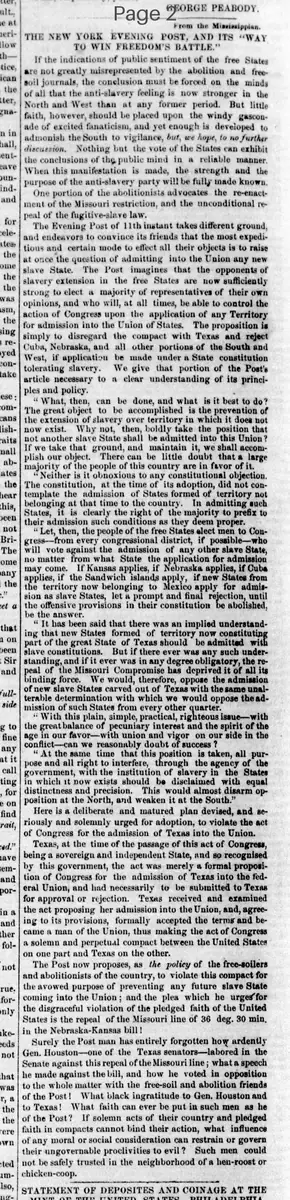
THE NEW YORK EVENING POST, AND ITS "WAY TO WIN FREEDOM'S BATTLE."
If the indications of public sentiment of the free States are not greatly misrepresented by the abolition and free-soil journals, the conclusion must be forced on the minds of all that the anti-slavery feeling is now stronger in the North and West than at any former period. But little faith, however, should be placed upon the windy gasconade of excited fanaticism, and yet enough is developed to admonish the South to vigilance, but, we hope, to no further discussion. Nothing but the vote of the States can exhibit the conclusions of the public mind in a reliable manner. When this manifestation is made, the strength and the purpose of the anti-slavery party will be fully made known.
One portion of the abolitionists advocates the re-enactment of the Missouri restriction, and the unconditional repeal of the fugitive-slave law.
The Evening Post of 11th instant takes different ground, and endeavors to convince its friends that the most expeditious and certain mode to effect all their objects is to raise at once the question of admitting into the Union any new slave State. The Post imagines that the opponents of slavery extension in the free States are now sufficiently strong to elect a majority of representatives of their own opinions, and who will, at all times, be able to control the action of Congress upon the application of any Territory for admission into the Union of States. The proposition is simply to disregard the compact with Texas and reject Cuba, Nebraska, and all other portions of the South and West, if application be made under a State constitution tolerating slavery. We give that portion of the Post's article necessary to a clear understanding of its principles and policy.
"What, then, can be done, and what is it best to do? The great object to be accomplished is the prevention of the extension of slavery over territory in which it does not now exist. Why not, then, boldly take the position that not another slave State shall be admitted into this Union? If we take that ground, and maintain it, we shall accomplish our object. There can be little doubt that a large majority of the people of this country are in favor of it.
Neither is it obnoxious to any constitutional objection. The constitution, at the time of its adoption, did not contemplate the admission of States formed of territory not belonging at that time to the country. In admitting such States, it is clearly the right of the majority to prefix to their admission such conditions as they deem proper.
Let, then, the people of the free States elect men to Congress--from every congressional district, if possible-who will vote against the admission of any other slave State, no matter from what State the application for admission may come. If Kansas applies, if Nebraska applies, if Cuba applies, if the Sandwich islands apply, if new States from the territory now belonging to Mexico apply for admission as slave States, let a prompt and final rejection, until the offensive provisions in their constitution be abolished, be the answer.
It has been said that there was an implied understanding that new States formed of territory now constituting part of the great State of Texas should be admitted with slave constitutions. But if there ever was any such understanding, and if it ever was in any degree obligatory, the repeal of the Missouri Compromise has deprived it of all its binding force. We would, therefore, oppose the admission of new slave States carved out of Texas with the same unalterable determination with which we would oppose the admission of such States from every other quarter.
With this plain, simple, practical, righteous issue-with the great balance of pecuniary interest and the spirit of the age in our favor--with union and vigor on our side in the conflict-can we reasonably doubt of success?
At the same time that this position is taken, all purpose and all right to interfere, through the agency of the government, with the institution of slavery in the States in which it now exists should be disclaimed with equal distinctness and precision. This would almost disarm opposition at the North, and weaken it at the South."
Here is a deliberate and matured plan devised, and seriously and solemnly urged for adoption, to violate the act of Congress for the admission of Texas into the Union. Texas, at the time of the passage of this act of Congress, being a sovereign and independent State, and so recognised by this government, the act was merely a formal proposition of Congress for the admission of Texas into the federal Union, and had necessarily to be submitted to Texas for approval or rejection. Texas received and examined the act proposing her admission into the Union, and, agreeing to its provisions, formally accepted the terms and became a member of the Union, thus making the act of Congress a solemn and perpetual compact between the United States on one part and Texas on the other.
The Post now proposes, as the policy of the free-soilers and abolitionists of the country, to violate this compact for the avowed purpose of preventing any future slave State coming into the Union; and the plea which he urges for the disgraceful violation of the pledged faith of the United States is the repeal of the Missouri line of 36 deg. 30 min., in the Nebraska-Kansas bill!
Surely the Post man has entirely forgotten how ardently Gen. Houston-one of the Texas senators-labored in the Senate against this repeal of the Missouri line; what a speech he made against the bill, and how he voted in opposition to the whole matter with the free-soil and abolition friends of the Post! What black ingratitude to Gen. Houston and to Texas! What faith can ever be put in such men as he of the Post? If solemn acts of their country and pledged faith in compacts cannot bind their action, what influence of any moral or social consideration can restrain or govern their ungovernable proclivities to evil? Such men could not be safely trusted in the neighborhood of a hen-roost or chicken-coop.
What sub-type of article is it?
Slavery Abolition
Constitutional
Partisan Politics
What keywords are associated?
Slavery Extension
Texas Compact
Missouri Compromise
Abolitionists
State Admission
Free Soilers
Gen Houston
What entities or persons were involved?
New York Evening Post
Abolitionists
Free Soilers
Texas
Gen. Houston
Congress
Editorial Details
Primary Topic
Critique Of New York Evening Post's Plan To Block Admission Of New Slave States
Stance / Tone
Strongly Pro Southern Defense Of Texas Compact Against Abolitionist Violation
Key Figures
New York Evening Post
Abolitionists
Free Soilers
Texas
Gen. Houston
Congress
Key Arguments
Anti Slavery Feeling Is Stronger In North But Unreliable Without Votes
Abolitionists Advocate Re Enactment Of Missouri Restriction And Repeal Of Fugitive Slave Law
Evening Post Proposes Blocking All New Slave States Including From Texas, Nebraska, Cuba
This Violates The Compact With Texas Approved By Congress
Repeal Of Missouri Compromise Does Not Justify Breaking Texas Compact
Gen. Houston Opposed The Repeal, Showing Ingratitude From Post
Such Men Cannot Be Trusted Due To Lack Of Moral Restraint