Thank you for visiting SNEWPapers!
Sign up free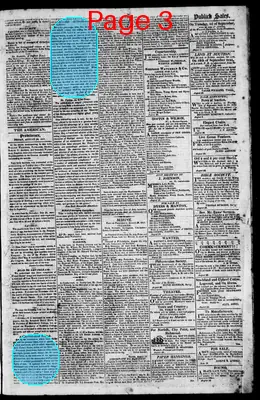
Editorial
August 29, 1817
The Rhode Island American, And General Advertiser
Providence, Providence County, Rhode Island
What is this article about?
Editorial satirizes rapid shifts in U.S. public opinion from opposing taxes, national bank, army, navy, and favoring agricultural power, to embracing them and seeing manufacturing as key to independence, while affirming self-perceived national superiority.
Clipping
OCR Quality
98%
Excellent
Full Text
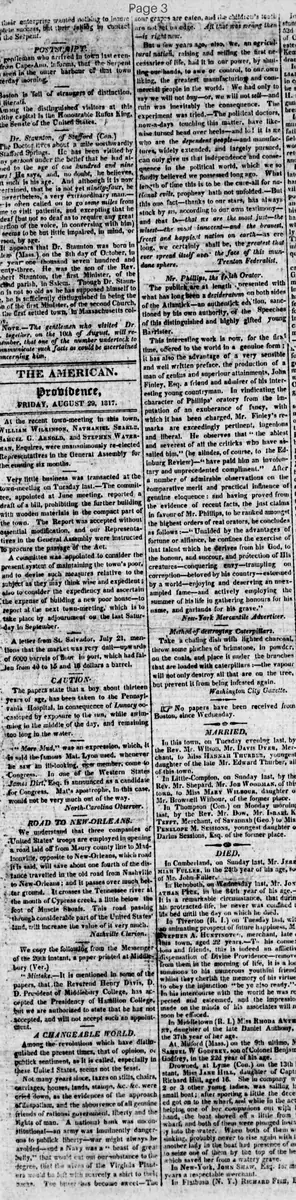
A CHANGEABLE WORLD
Among the revolutions which have distinguished the present times, that of opinion, or public sentiment, as it is called, especially in these United States, seems not the least.
Not many years since, taxes on stills, chairs, carriages, houses, lands, stamps, &c. &c. were cried down, as the evidences of the approach of despotism, and the abhorrence of all genuine friends of rational government, liberty and the rights of man. A national bank was unconstitutional—an army was eminently dangerous to public liberty—war might always be avoided—and a Navy was a "beast of great belly," that would eat out our substance to the degree, that the wives of the Virginia Planters would be left with scarcely a shirt to their backs. The bitter has become sweet—The sour grapes are eaten, and the children's teeth are not set on edge. All that was wrong then is right now.
But a few years ago, also, we, an agricultural nation, raising and selling the first necessaries of life, had it in our power, by shutting our hands, to awe—or control, to our own liking, the greatest manufacturing and commercial people in the world. We had only to say 'we will not buy—or, we will not sell—and ruin was inevitably the consequence. The experiment was tried.—The political doctors, now-a-days touching this matter, have likewise turned head over heels—and lo! it is we who are the dependent people—and manufactures, widely extended, and largely pursued, can only give us that independence and consequence in the political world, which we so fondly believed we possessed long ago. What length of time this is to be the cure-all for national evils, prophecy hath not unfolded.—But this one fact—thanks to our stars, has always stuck by us, according to our own testimony—and that is—that we are the most just—the freest and happiest nation on earth—as we are the wisest—the most innocent—and the bravest. Long, we certainly shall be, the greatest that ever spread itself over the face of this mundane sphere.
x. Trenton Federalist.
Among the revolutions which have distinguished the present times, that of opinion, or public sentiment, as it is called, especially in these United States, seems not the least.
Not many years since, taxes on stills, chairs, carriages, houses, lands, stamps, &c. &c. were cried down, as the evidences of the approach of despotism, and the abhorrence of all genuine friends of rational government, liberty and the rights of man. A national bank was unconstitutional—an army was eminently dangerous to public liberty—war might always be avoided—and a Navy was a "beast of great belly," that would eat out our substance to the degree, that the wives of the Virginia Planters would be left with scarcely a shirt to their backs. The bitter has become sweet—The sour grapes are eaten, and the children's teeth are not set on edge. All that was wrong then is right now.
But a few years ago, also, we, an agricultural nation, raising and selling the first necessaries of life, had it in our power, by shutting our hands, to awe—or control, to our own liking, the greatest manufacturing and commercial people in the world. We had only to say 'we will not buy—or, we will not sell—and ruin was inevitably the consequence. The experiment was tried.—The political doctors, now-a-days touching this matter, have likewise turned head over heels—and lo! it is we who are the dependent people—and manufactures, widely extended, and largely pursued, can only give us that independence and consequence in the political world, which we so fondly believed we possessed long ago. What length of time this is to be the cure-all for national evils, prophecy hath not unfolded.—But this one fact—thanks to our stars, has always stuck by us, according to our own testimony—and that is—that we are the most just—the freest and happiest nation on earth—as we are the wisest—the most innocent—and the bravest. Long, we certainly shall be, the greatest that ever spread itself over the face of this mundane sphere.
x. Trenton Federalist.
What sub-type of article is it?
Satire
Economic Policy
Partisan Politics
What keywords are associated?
Public Opinion
Political Revolutions
Taxes
National Bank
Army
Navy
Agriculture
Manufactures
Independence
What entities or persons were involved?
Virginia Planters
Editorial Details
Primary Topic
Shifts In Public Opinion On Taxes, Government Institutions, And Economic Independence
Stance / Tone
Satirical Commentary On Reversal Of Political Sentiments
Key Figures
Virginia Planters
Key Arguments
Taxes On Stills, Chairs, Carriages, Houses, Lands, Stamps Were Once Seen As Despotism
National Bank Was Unconstitutional
Army Dangerous To Liberty
War Avoidable
Navy Wasteful
Agriculture Once Gave Power To Control Manufacturing Nations
Now Manufactures Needed For Independence
Americans View Themselves As Most Just, Free, Happy, Wise, Innocent, Brave