Thank you for visiting SNEWPapers!
Sign up free
Alexandria Gazette, Commercial And Political
Alexandria, Virginia
What is this article about?
Report from the Federal Republican on John C. Calhoun's speech in the U.S. House Committee of the Whole on January 31, advocating for a strong military policy, including navy expansion, army size, militia training, and military roads, while discussing national defense against Britain in the context of the revenue bill debate.
Clipping
OCR Quality
Full Text
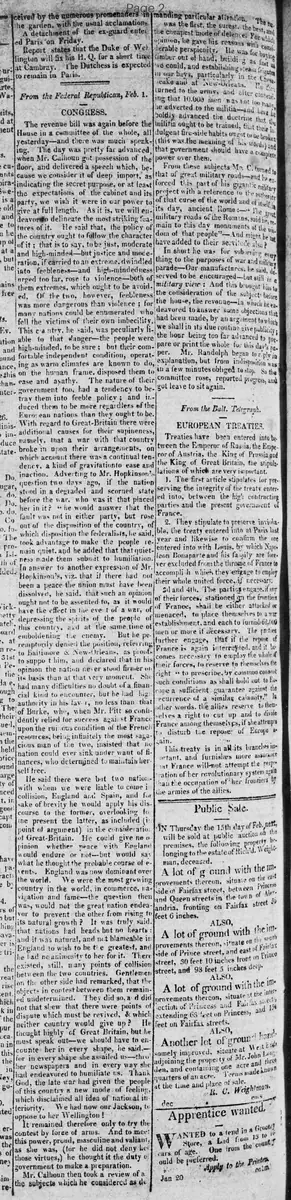
CONGRESS.
The revenue bill was again before the House in a committee of the whole, all yesterday—and there was much speaking. The day was pretty far advanced when Mr. Calhoun got possession of the floor, and delivered a speech which, because we consider it of deep import, as indicating the secret purpose, or at least the expectations of the cabinet and its party, we wish it were in our power to give at full length. As it is, we will endeavor to delineate the most striking features of it. He said that, the policy of the country ought to follow the character of it; that is to say, to be just, moderate and high-minded—but justice and moderation, if carried to an extreme, dwindled into feebleness—and high-mindedness urged too far, rose to violence—both of them extremes, which ought to be avoided. Of the two, however, feebleness was more dangerous than violence; for many nations could be enumerated who fell the victims of their own imbecility. This country, he said, was peculiarly liable to that danger—the people were high-minded, to be sure; but their comfortable independent condition, operating as warm climates are known to do, on the human frame, disposed them to ease and apathy. The nature of their government too, had a tendency to betray them into feeble policy; and induced them to be more regardless of the European nations than they ought to be. With regard to Great-Britain there were additional causes for their supineness, namely, that a war with that country broke in upon their arrangements, on which account there was a continual tendency, a kind of gravitation to ease and inaction. Adverting to Mr. Hopkinson's question two days ago, if the nation stood in a degraded and scorned state before the war, who was it that placed her in it? he would answer that the fault was not in either party, but rose out of the disposition of the country, of which disposition the federalists, he said, took advantage to make the people remain quiet, and he added that that quietness made them submit to humiliation. In answer to another expression of Mr. Hopkinson's, viz. that if there had not been a peace the union must have been dissolved, he said, that such an opinion ought not to be assented to, as it would have the effect in the event of a war, of depressing the spirits of the people of this country, and at the same time of emboldening the enemy. But he peremptorily denied the position, referring to Baltimore & New-Orleans, as proofs to support him, and declared that in his opinion the nation never stood firmer on its basis than at that very moment. She had many difficulties no doubt of a financial kind to encounter, but he had high authority in his favor, no less than that of Burke, who, when Mr. Pitt so confidently relied for success against France upon the ruinous condition of the French resources, being infinitely the most sagacious man of the two, insisted that no nation could ever sink under want of finances, who determined to maintain herself free. He said there were but two nations with whom we were liable to come in collision, England and Spain, and for sake of brevity he would apply his discourse to the former, overlooking to the present the latter, as included in point of argument in the consideration of Great-Britain. He could give no opinion whether peace with England would endure or not—but would say what he thought the probable course of events. England was now dominant over the world. We were the most growing country in the world, in commerce, navigation and fame—the question then was, would not the great nation endeavor to prevent the other from rising to its natural growth? It was truly said, that nations had heads but no hearts: and it was natural, and not blameable in England to wish to be the greatest, and he had no animosity to her for it. There existed, still, many points of collision between the two countries. Gentlemen on the other side had remarked, that the objects in contest between them remained undetermined. They did so, and did not that shew that there were points of dispute which must be revived, & which neither country would give up? He thought highly of Great Britain, but he must speak out—we should have to encounter her in every shape, he said,—for in every shape she assailed us—through her newspapers and in every way she had endeavored to humiliate us. Thank God, the late war had given the people of this country a new mode of feeling, which disclaimed all idea of national inferiority. We had now our Jackson, to oppose to her Wellington!
It remained therefore only to try the contest by force of arms. And to meet this power, proud, masculine and valiant as she was, (for he did not deny her those virtues,) he thought it the duty government to make a preparation.
Mr. Calhoun then took a review of all the subjects which he considered as demanding particular attention; The navy was the first, the surest, the best, and the cheapest mode of defence. For which opinion, he gave his reasons with considerable perspicuity. He was for boring timber out of hand, building as fast as we could, and establishing steam frigates in our bays, particularly in the Chesapeake and at New-Orleans. He then turned to the army, and after contending that 10,000 men was not too many he adverted to the militia—and here boldly advanced the doctrine that the militia ought to be trained, that their indulgent fire-side habits ought to be broken (this was the meaning of his words) and that government should have a complete power over them.
From these subjects Mr. C. turned to that of great military roads—and he enforced this part of his gigantic military project with a reference to the authority of that curse of the world and of itself, in its day, ancient Rome:—" The great military roads of the Romans, said he, remain to this day monuments of the wisdom of that people"—And might he not have added to their servitude also?
In short he was for suborning everything to the purposes of war and military parade—Our manufactures, he said, deserved to be encouraged—but still in a military view : And this brought him to the consideration of the subject before the house, the revenue—in which he endeavored to answer some objections that had been made, by an argument to which we shall in its due routine give publicity; the hour being too far advanced to prepare or print the whole for this day's paper. Mr. Randolph began to ply him with explanation, but from indisposition was in a few minutes obliged to stop. So the committee rose, reported progress, and got leave to sit again.
What sub-type of article is it?
What keywords are associated?
What entities or persons were involved?
Where did it happen?
Domestic News Details
Primary Location
Washington
Event Date
January 31 (Reported February 1)
Key Persons
Event Details
In a House committee of the whole debating the revenue bill, Mr. Calhoun delivered a speech advocating for a just and moderate national policy while warning against feebleness. He discussed U.S. relations with Britain, denied claims of pre-war degradation, praised national resilience citing Baltimore and New Orleans, and urged military preparations including navy expansion, a 10,000-man army, trained militia under government control, and military roads, referencing Roman examples. He tied this to encouraging manufactures for military purposes and addressed revenue objections. Mr. Randolph briefly interjected but stopped due to indisposition; the committee reported progress.