Thank you for visiting SNEWPapers!
Sign up free
Editorial
September 3, 1806
The National Intelligencer And Washington Advertiser
Washington, District Of Columbia
What is this article about?
Editorial from the Salem Register submits propositions to the U.S. legislative and executive branches as alternative remedies to counter British trade laws, duties, and restrictions that harm American commerce, manufacturing, and shipping.
Clipping
OCR Quality
95%
Excellent
Full Text
FROM THE SALEM REGISTER.
E PLURIBUS UNUM.
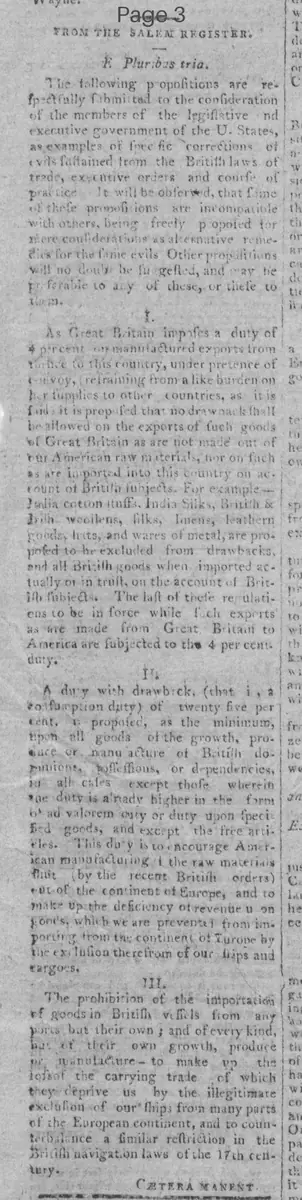
The following propositions are respectfully submitted to the consideration of the members of the legislative and executive government of the U. States, as examples of more specific corrections of evils sustained from the British laws of trade, executive orders and course of practice. It will be observed, that some of these propositions are incompatible with others, being freely proposed for necessary considerations as alternative remedies for the same evils. Other propositions will no doubt be suggested, and may be preferable to any of these, or these to them.
1. As Great Britain imposes a duty of 4 per cent. on manufactured exports from this country, under pretence of convoy, refraining from a like burden on her supplies to other countries, as it is found it is proposed that no drawback shall be allowed on the exports of such goods of Great Britain as are not made out of pure American raw material, nor on such as are imported into this country on account of British subjects. For example—British cotton stuffs, India silk, British woolens, silks, linens, leather goods, irons, and wares of metal, are proposed to be excluded from drawbacks, and all British goods when imported actually or in trust, on the account of British subjects. The last of these regulations to be in force while such exports as are made from Great Britain to America are subjected to the 4 per cent. duty.
II. A duty with drawback, (that is, a consumption duty) of twenty five per cent. is proposed, as the minimum, upon all goods of the growth, produce or manufacture of British dominions, possessions, or dependencies, in all cases except those wherein the duty is already higher in the form of ad valorem duty or duty upon specified goods, and except the free articles. This duty is to encourage American manufacturing in the raw materials thus (by the recent British orders) cut off from the continent of Europe, and to make up the deficiency of revenue upon goods, which we are prevented from importing from the continent of Europe by the exclusion therefrom of our ships and cargoes.
III. The prohibition of the importation of goods in British vessels from any ports but their own; and of every kind, but of their own growth, produce or manufacture—to make up the loss of the carrying trade of which they deprive us by the illegitimate exclusion of our ships from many parts of the European continent, and to counterbalance a similar restriction in the British navigation laws of the 17th century.
E PLURIBUS UNUM.
The following propositions are respectfully submitted to the consideration of the members of the legislative and executive government of the U. States, as examples of more specific corrections of evils sustained from the British laws of trade, executive orders and course of practice. It will be observed, that some of these propositions are incompatible with others, being freely proposed for necessary considerations as alternative remedies for the same evils. Other propositions will no doubt be suggested, and may be preferable to any of these, or these to them.
1. As Great Britain imposes a duty of 4 per cent. on manufactured exports from this country, under pretence of convoy, refraining from a like burden on her supplies to other countries, as it is found it is proposed that no drawback shall be allowed on the exports of such goods of Great Britain as are not made out of pure American raw material, nor on such as are imported into this country on account of British subjects. For example—British cotton stuffs, India silk, British woolens, silks, linens, leather goods, irons, and wares of metal, are proposed to be excluded from drawbacks, and all British goods when imported actually or in trust, on the account of British subjects. The last of these regulations to be in force while such exports as are made from Great Britain to America are subjected to the 4 per cent. duty.
II. A duty with drawback, (that is, a consumption duty) of twenty five per cent. is proposed, as the minimum, upon all goods of the growth, produce or manufacture of British dominions, possessions, or dependencies, in all cases except those wherein the duty is already higher in the form of ad valorem duty or duty upon specified goods, and except the free articles. This duty is to encourage American manufacturing in the raw materials thus (by the recent British orders) cut off from the continent of Europe, and to make up the deficiency of revenue upon goods, which we are prevented from importing from the continent of Europe by the exclusion therefrom of our ships and cargoes.
III. The prohibition of the importation of goods in British vessels from any ports but their own; and of every kind, but of their own growth, produce or manufacture—to make up the loss of the carrying trade of which they deprive us by the illegitimate exclusion of our ships from many parts of the European continent, and to counterbalance a similar restriction in the British navigation laws of the 17th century.
What sub-type of article is it?
Trade Or Commerce
Economic Policy
Foreign Affairs
What keywords are associated?
British Trade Laws
American Exports
Drawbacks Denial
Consumption Duties
Navigation Acts
American Manufacturing
What entities or persons were involved?
Great Britain
U. States Government
British Subjects
Editorial Details
Primary Topic
Remedies To British Trade Restrictions
Stance / Tone
Proposing Retaliatory Trade Measures
Key Figures
Great Britain
U. States Government
British Subjects
Key Arguments
Deny Drawbacks On British Exports Not Made From Pure American Raw Materials
Impose 25% Minimum Duty On British Goods To Encourage American Manufacturing And Offset Revenue Loss
Prohibit Importation Of Non British Goods In British Vessels To Counter Navigation Laws And Loss Of Carrying Trade