Thank you for visiting SNEWPapers!
Sign up free
Gazette Of The United States And Daily Evening Advertiser
Philadelphia, Philadelphia County, Pennsylvania
What is this article about?
Article reports foreign intelligence from Paris on a powder mill explosion and French naval preparations, Jacobin Club discussions, London military updates, Edinburgh fishing news, French scientific reforms, and a French victory in the Leeward Islands, concluding with US congressional resolutions on fortifications, Indian trade, western disturbances indemnification, and New York ratification of a constitutional amendment.
Merged-components note: The text content continues seamlessly from the House of Representatives proceedings into the Senate proceedings, forming a single coherent report on Congressional activities.
Clippings
1 of 2
OCR Quality
Full Text
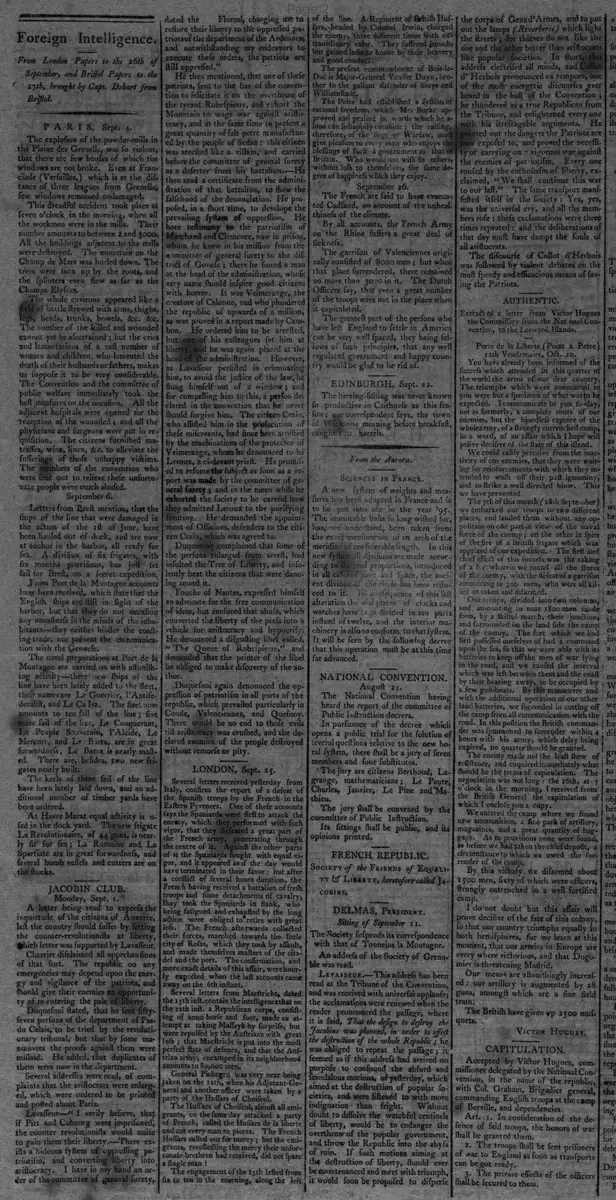
From London Papers to the 26th of September, and Bristol Papers to the 27th, brought by Capt. Dehart from Bristol.
PARIS, Sept. 4.
The explosion of the powder-mills in the Plaine des Grenelle, was so violent, that there are few houses of which the windows are not broke. Even at Francaide (Versailles,) which is at the distance of three leagues from Grenelle, few windows remained undamaged.
This dreadful accident took place at seven o'clock in the morning, when all the workmen were in the mills. Their number amounts to between 2 and 3000.
All the buildings adjacent to the mills were destroyed. The mountain on the Champ de Mars was hurled down. The trees were torn up by the roots, and the splinters even flew as far as the Champs Elysees.
The whole environs appeared like a field of battle strewed with arms, thighs, legs, heads, trunks, bowels, &c. &c.
The number of the killed and wounded cannot yet be ascertained; but the cries and lamentations of a vast number of women and children, who lamented the death of their husbands or fathers, makes us suppose it to be very considerable.
The Convention and the committee of public welfare immediately took the best measures on the occasion. All the adjacent hospitals were opened for the reception of the wounded; and all the physicians and surgeons were put in requisition. The citizens furnished mattresses, wine, linen, &c. to alleviate the sufferings of those unhappy victims.
The members of the convention who were sent out to relieve these unfortunate people were much abused.
September 6.
Letters from Brest mention, that the ships of the line that were damaged in the action of the 1st of June, have been hauled out of dock, and are now at anchor in the harbor, all ready for sea. A division of six frigates, with six months provisions, has just set sail for Brest, on a secret expedition.
From Port de la Montagne accounts have been received, which state that the English ships are still in sight of the harbor, but that they do not occasion any uneasiness in the minds of the inhabitants--they neither hinder the coasting trade, nor prevent the communication with the Genoese.
The naval preparations at Port de la Montagne are carried on with astonishing activity. Three new ships of the line have been lately added to the fleet. Their names are Le Guerrier, l'Antifédéraliste, and Le Ca Ira. The fleet now amounts to ten sail of the line; five more sail of the line, Le Conquerant, Le Peuple Souverain, L'Alcide, Le Mercure, and Le Barra, are in great forwardness. Le Barra is nearly masted. There are, besides, two new frigates nearly built.
The keels of three sail of the line have been lately laid down, and an additional number of timber yards have been ordered.
At Havre Marat equal activity is used in the dock yard. The new frigate La Révolutionnaire, of 44 guns, is nearly fit for sea; La Romaine and La Spartiate are in great forwardness, and several bomb vessels and cutters are on the stocks.
JACOBIN CLUB.
Monday, Sept. 1.
A letter being read to express the inquietude of the citizens of Auxerre, lest the country should suffer by setting the counter-revolutionists at liberty, which letter was supported by Lavateur.
Charrier disclaimed all apprehensions of that sort. The republic on any emergencies may depend upon the energy and vigilance of the patriots, and should give their enemies an opportunity of re-entering the pale of liberty.
Duquenoi stated, that he sent fifty-seven persons of the department of Pas-du-Calais, to be tried by the revolutionary tribunal, but that by some manoeuvres the proofs against them were mislaid. He added, that duplicates of them were now in the department.
Several addresses were read, of complaints that the aristocrats were enlarged, which were ordered to be printed and posted about Paris.
Lavateur-- "I verily believe, that if Pitt and Cobourg were imprisoned, the counter-revolutionists would unite to gain them their liberty.--There exists a hideous system of oppressing patriotism, and converting liberty into aristocracy. I have in my hand an order of the committee of general surety,
dated the Floreal, charging me to restore their liberty to the oppressed patriots of the department of the Ardennes; and notwithstanding my endeavors to execute these orders, the patriots are still oppressed."
He then mentioned, that one of these patriots, sent to the bar of the convention to felicitate it on the overthrow of the tyrant Robespierre, and exhort the Mountain to wage war against aristocracy, and at the same time to present a great quantity of salt petre manufactured by the people of Sedan: this citizen was arrested like a villain, and carried before the committee of general surety as a deserter from his battalion.--He then read a certificate from the administration of that battalion, to shew the falsehood of the denunciation. He proposed, in a short time, to develope the prevailing system of oppression. He bore testimony to the patriotism of Marchand and Clemence, now in prison, whom he knew in his mission from the committee of general surety to the district of Gonesse; there he found a man at the head of the administration, whose very name should inspire good citizens with horror. It was Veimerange, the creature of Calonne, and who plundered the republic of upwards of a million, as was proved in a report made by Cambon. He ordered him to be arrested, but one of his colleagues set him at liberty, and he was again placed at the head of the administration. However, as Lavateur persisted in criminating him, to avoid the justice of the law, he flung himself out of a window; and for compelling him to this, a person declared in the convention that he never should forgive him. The citizen Crain, who assisted him in the prosecution of these miscreants, had since been arrested by the machinations of the protector of Veimerange, whom he denounced to be Leroux, a ci-devant priest. He promised to resume the subject as soon as a report was made by the committee of general surety: and in the mean while he exhorted the society to be careful how they admitted Leroux to the purifying scrutiny. He demanded the appointment of Officians, defenders to the citizen Crain, which was agreed to.
Duquernay complained that some of the persons enlarged from arrest, had insulted the Tree of Liberty, and insolently beat the citizens that were dancing round it.
Fouche of Nantes, expressed himself an advocate for the free communication of ideas, but censured that abuse, which converted the liberty of the press into a vehicle for aristocracy and hypocrisy.
He denounced a disgusting libel called, "The Queue of Robespierre," and demanded that the printer of the libel be obliged to make discovery of the author.
Duquenoi again denounced the oppression of patriotism in all parts of the republic, which prevailed particularly in Conde, Valenciennes, and Quesnoy.
There would be no end to those evils till aristocracy was crushed, and the declared enemies of the people destroyed without remorse or pity.
LONDON, Sept. 25.
Several letters received yesterday from Italy, confirm the report of a defeat of the Spanish troops by the French in the Eastern Pyrenees. One of these accounts says the Spaniards were first to attack the enemy, which they performed with such vigor, that they defeated a great part of the French army, penetrating through the centre of it. Against the other parts of it the Spaniards fought with equal vigor, and it appeared as if the day would have terminated in their favor; but after a conflict of several hours duration, the French having received a battalion of fresh troops and some detachments of cavalry, they took the Spaniards in flank, who being fatigued and exhausted by the long action were obliged to retire with great loss. The French afterwards collected their forces, marched towards the little city of Roses, which they took by assault, and made themselves masters of the citadel and the port. The confirmation, and more exact details of this affair, were hourly expected when the last accounts came away on the 6th instant.
Several letters from Maestricht, dated the 12th inst. contain the intelligence that on the 12th inst. a Republican corps, consisting of 2000 horse and foot, made an attempt at taking Maeseyck by surprise, but were repulsed by the Austrians with great loss; that Maestricht is put into the most perfect state of defence, and that the Austrian army, encamped in its neighborhood amounts to 80,000 men.
General Pichegru was very near being taken on the 12th, when his Adjutant-General and another officer were taken by a party of the Hussars of Choiseul.
The Hussars of Choiseul, almost all emigrants, on the same day attacked a party of French, called the Hussars de la liberte and cut every man to pieces. The French Hussars called out for mercy; but the emigrants, recollecting the mercy their unfortunate brethren had received, did not spare a single man!
The engagement of the 15th lasted from six to ten in the morning, along the left of the line: A Regiment of British Hussars, headed by Colonel Irwin, charged the enemy, three different times with extraordinary valor. They suffered much; but gained infinite honor by their bravery and good conduct.
The present commandant of Bois-le-Duc is Major-General Vander Duyn, brother to the gallant defender of Sluys and Williamstadt.
The Poles had established a system of rational freedom, which Mr. Burke approved and praised in words which he alone can happily combine; the raising, therefore, of the siege of Warsaw, must give pleasure to every man who enjoys the blessings of such a government as that of Britain. Who would not wish to others, without loss to themselves, the same degree of happiness which they enjoy.
September 26.
The French are said to have evacuated Cadiz, on account of the unhealthiness of the climate.
By all accounts, the French Army on the Rhine suffers a great deal of sickness.
The garrison of Valenciennes originally consisted of 5000 men; but when that place surrendered, there remained no more than 300 in it. The Dutch Officers say, that even a great number of the troops were not in the place when it capitulated.
The greatest part of the persons who have left England to settle in America can be very well spared, they being fellows of such principles, that any well regulated government and happy country would be glad to be rid of.
EDINBURGH, Sept. 22.
The herring-fishing was never known so productive in Caithness as this season; our correspondent says, the town of Wick one morning before breakfast, caught 120 barrels.
From the Aurora.
Sciences in France.
A new system of weights and measures has been adopted in France and is to be put into use in the year '95.
The immutable basis so long wished for, has, we understand, been taken from the exact mensuration of an arch of the meridian of considerable length. In this new system all divisions are made according to decimal proportions, introduced in all cases of time and space, the ancient division of the circle has been reduced to it. In consequence of this last alteration the dial plates of clocks and watches have been divided in ten parts instead of twelve, and the interior machinery is also to conform to that system.
It will be seen by the following decree that this operation must be at this time far advanced.
NATIONAL CONVENTION.
August 21.
The National Convention having heard the report of the committee of Public Instruction decrees.
In pursuance of the decree which opens a public trial for the solution of several questions relative to the new horal system, there shall be a jury of seven members and four substitutes.
The jury are citizens Berthoud, Lagrange, mathematicians; Le Paute, Charles, Janvier, Le Pine and Mathieu.
The jury shall be convened by the committee of Public Instruction.
Its sittings shall be public, and its opinions printed.
FRENCH REPUBLIC.
Society of the FRIENDS of EQUALITY & LIBERTY, heretofore called JACOBINS.
DELMAS, PRESIDENT.
Sitting of September 11.
The Society suspends its correspondence with that of Tonneins la Montagne.
An address of the Society of Grenobles was read.
Levasseur. This address has been read at the Tribune of the Convention, and was received with universal applause; the acclamations were renewed when the reader pronounced the passage, where it is said, That the design to destroy the Jacobins was planned, in order to effect the destruction of the whole Republic; he was obliged to repeat the passage; it seemed as if this address had arrived on purpose-- to confound the absurd and scandalous motions, of yesterday, which aimed at the destruction of popular societies, and were listened to with more indignation than fright. Without doubt to dissolve the watchful sentinels of liberty, would be to endanger the overthrow of the popular government, and throw the Republic into the abyss of ruin. If such motions aiming at the destruction of liberty, should ever be countenanced and meet with triumph, it would soon be proposed to disperse the corps of Gens d'Armes, and to put out the lamps (Reverberes) which light the streets: for thieves do not like the one and the other better than aristocrats like popular societies. In short, this address electrified all minds, and Collot d'Herbois pronounced ex tempore, one of the most energetic discourses ever heard in the hall of the Convention; he thundered as a true Republican from the Tribune, and enlightened every one with his irrefragable arguments. He pointed out the dangers the Patriots are now exposed to, and proved the necessity of carrying on a vigorous war against the enemies of patriotism. Every one roused by the enthusiasm of liberty, exclaimed, "We shall continue this war to our last." The same transport manifested itself in the society: Yes, yes, was the universal cry, and all the members rose: these exclamations were three times repeated: and the deliberations of that day must have damped the souls of all aristocrats.
The discourse of Collot d'Herbois was followed by violent debates on the most speedy and efficacious means of saving the Patriots.
AUTHENTIC.
Extract of a letter from Victor Hugues the Commissary from the National Convention, to the Leeward Islands.
Porte de la Liberte (Point a Petre) 12th Vendemaire, Oct. 10.
You have already been informed of the success which attended in this quarter of the world the arms of our dear country.
The triumphs which were announced to you were but a specimen of what was to be expected. I communicate to you to-day, not as formerly, a complete route of our enemies, but the bloodless capture of the whole army, of a strongly entrenched camp. In a word, of an affair which I hope will prove decisive of the state of this island.
We could easily perceive from the inactivity of our enemies, that they were waiting for reinforcements with which they intended to wash off their past ignominy, and to strike a well directed blow. This we have prevented.
The 7th of this month (8th September) we embarked our troops to two different places, and landed them without any opposition on one part in view of the naval force of the enemy; on the other in spite of the fire of a British frigate which was apprised of our expedition. The first and chief effect of this success was the taking of a fort: wherein we found all the stores of the enemy, with the defeat of a garrison amounting to 300 men, who were all killed or taken and disarmed.
Our troops, divided into two columns and amounting to near 1800 men made soon, by a skilful march, their junction, and surrounded on the land side the camp of the enemy. The fort which we had first possessed ourselves of had a command upon the sea, so that we were able with its batteries to keep off the men of war lying in the road, and we caused the interval which was left between them and the coast by their bearing away, to be occupied by a few gun-boats. By this manoeuvre and with the additional operation of our other land batteries, we succeeded in cutting off the camp from all communication with the road. In this position the British commander was summoned to surrender within 4 hours with his army, which delay being expired, no quarter should be granted.
The enemy made not the least shew of resistance, and enquired immediately what should be the terms of capitulation. The negociation was not long: the 16th, at 7 o'clock in the morning, I received from the British General the capitulation of which I enclose you a copy.
We entered the camp where we found new ammunition, a fine park of artillery, magazines, and a great quantity of baggage. As to provisions none were found, as before we had taken the chief deposit, a circumstance to which we owed the surrender of the camp.
By this victory we disarmed about 1500 men, sixty of which were officers, strongly entrenched in a well fortified camp.
I do not doubt but this affair will prove decisive of the fate of this colony, so that our country triumphs equally in both hemispheres, for we learn at this moment, that our armies in Europe are every where victorious, and that Dugommier is threatening Madrid.
Our means are astonishingly increased: our artillery is augmented by 28 guns, amongst which are a fine field train.
The British have given up 2500 muskets.
Victor Hugues.
CAPITULATION.
Accepted by Victor Hugues, commissioner delegated by the National Convention, in the name of the republic with Col. Graham, Brigadier general, commanding English troops at the camp of Berville, and dependencies
Art. I. In consideration of the defence of said troops, the honors of war shall be granted them.
2. The troops shall be sent prisoners of war to England as soon as transports can be got ready.
3. The private effects of the officers shall be secured to them.
4. A covered loop shall be granted to the General.
5. The sick and wounded not in situation to embark on board the transports shall be taken care of by an English surgeon.
6. The artillery and magazines of all kinds shall be delivered to the commissary of war of the Republic without damage and depredation. If any dispute should arise among individuals, it shall be amicably settled without contravening the present capitulation.
(Signed) GRAHAM
Brigadier General.
Oct. 7, Camp of Berville.
A true copy. Victor Hugues.
Appointed to direct the proper officer to give information relative to the progress made in the fortifications directed by law.
A committee of two was appointed to communicate this resolution to the President.
Resolved, That so much of the President's speech as relates to the subject of opening trading houses to cultivate an intercourse with the Indian tribes, be referred to a committee.
The committee was appointed.
A motion was also brought forward to provide an indemnification for the sufferers by the Western Counties' disturbances; but was withdrawn from before the committee of the whole with intention of laying it on the table of the house, as some members requested time for consideration before the business was acted upon.
A message was received from the President communicating a letter from the Governor of New-York, enclosing an exemplification of an act of the legislature of that state ratifying the amendment relative to the powers of the judiciary, proposed at the last session of Congress to the Constitution of the United States.
What sub-type of article is it?
What keywords are associated?
What entities or persons were involved?
Domestic News Details
Key Persons
Event Details
Resolution appointed to direct officer on fortifications progress, communicated to President; referral of President's speech on Indian trading houses to committee; motion for indemnification of Western Counties' disturbances sufferers withdrawn for consideration; message from President on New-York legislature ratifying judiciary powers amendment to Constitution.