Thank you for visiting SNEWPapers!
Sign up free
The Wheeling Daily Intelligencer
Wheeling, Ohio County, West Virginia
What is this article about?
Chauncey M. Depew's speech at the Republican National Convention seconding President Benjamin Harrison's renomination, praising the administration's diplomatic successes, economic policies, tariff reforms, and overall prosperity compared to prior Democratic rule.
Clipping
OCR Quality
Full Text
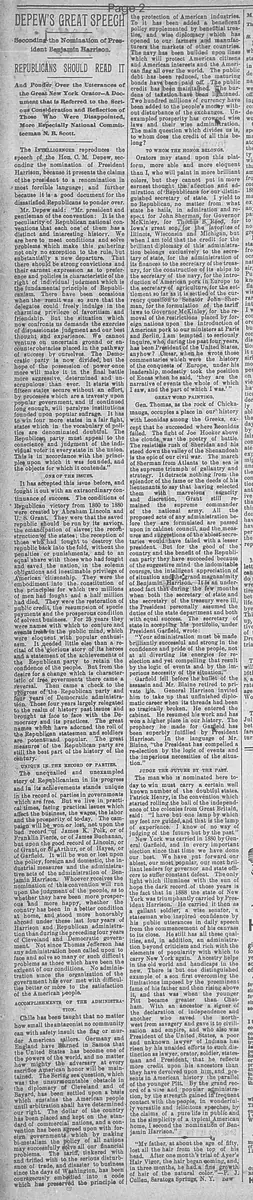
Seconding the Nomination of President Harrison.
REPUBLICANS SHOULD READ IT
And Ponder Over the Utterances of the Great New York Orator--A Document that is Referred to the Serious Consideration and Reflection of Those Who Were Disappointed More Especially National Committeeman N. B. Scott.
The INTELLIGENCER reproduces the speech of the Hon. C. M. Depew, seconding the nomination of President Harrison, because it presents the claims of the president to a renomination in most forcible language; and further because it is a good document for the dissatisfied Republicans to ponder over.
Mr. Depew said: "Mr. President and gentlemen of the convention: It is the peculiarity of Republican national conventions that each one of them has a distinct and interesting history. We are here to meet conditions and solve problems which make this gathering not only no exception to the rule, but substantially a new departure. That there should be strong convictions and their earnest expression as to preference and policies is characteristic of the right of individual judgment which is the fundamental principle of Republicanism. There have been occasions when the result was so sure that the delegates could freely indulge in the charming privilege of favoritism and friendship. But the situation which now confronts us demands the exercise of dispassionate judgment and our best thought and experience. We cannot venture on uncertain ground or encounter obstacles placed in the pathway of success by ourselves. The Democratic party is now divided, but the hope of the possession of power once more will make it in the final battle more aggressive, determined and unscrupulous than ever. It starts with fifteen states secure without an effort by processes which are a travesty upon popular government, and if continued long enough, will paralyze institutions founded upon popular suffrage. It has to win four more states in a fair fight, states which in the vocabulary of politics are denominated doubtful. The Republican party must appeal to the conscience and judgment of the individual voter in every state in the union. This is in accordance with the principles upon which it was founded, and the objects for which it contends."
ONE OF THE ISSUES.
It has accepted this issue before, and fought it out with an extraordinary continuance of success. The conditions of Republican victory from 1860 to 1880 were created by Abraham Lincoln and U. S. Grant. They were that the saved republic should be run by its saviors. The emancipation of slaves; the reconstruction of the states; the reception of those who had fought to destroy the republic back into the fold, without the penalties or punishments, and to an equal share with those who had fought and saved the nation, in the solemn obligations and inestimable privilege of American citizenship. They were the embodiment into the constitution of the principles for which two millions of men had fought and a half million had died. They were the restoration of public credit, the resumption of specie payments and the prosperous condition of solvent business. For 25 years they were names with which to conjure and events fresh in the public mind, which were eloquent with popular enthusiasm. It needed little else than a recital of the glorious story of its heroes and a statement of the achievements of the Republican party to retain the confidence of the people. But from the desire for a change which is characteristic of free governments there came a reversal. Then came a check to the progress of the Republican party and four years of Democratic administration. Those four years largely relegated to the realm of history past issues and brought us face to face with the Democracy and its practices. The great names which have adorned the roll of the Republican statesmen and soldiers are potent and popular. The great measures of the Republican party are still the best part of the history of the century.
UNIQUE IN THE RECORD OF PARTIES.
The unequalled and unexampled story of Republicanism in its progress and in its achievements stands unique in the record of parties in governments which are free. But we live in practical times, facing practical issues which affect the business, the wages, the labor and the prosperity of to-day. The campaign will be won or lost, not upon the bad record of James K. Polk, or of Franklin Pierce, or of James Buchanan, but upon the good record of Lincoln, or of Grant, or of Arthur, or of Hayes, or of Garfield. It will be won or lost upon the policy, foreign and domestic, the industrial measures and the administrative acts of the administration of Benjamin Harrison. Whoever receives the nomination of this convention will run upon the judgment of the people, as to whether they have been more prosperous and more happy, whether the country has been in a better condition at home, and stood more honorably abroad under these last four years of Harrison and Republican administration than during the preceding four years of Cleveland and Democratic government. Not since Thomas Jefferson has any administration been called upon to face and solve so many or such difficult problems as those which have been the exigent of our conditions. No administration since the organization of the government has ever met with difficulties better or more to the satisfaction of the American people.
ACCOMPLISHMENTS OF THE ADMINISTRATION.
Chile has been taught that no matter how small the antagonist no community can with safety insult the flag or murder American sailors. Germany and England have learned in Samoa that the United States has become one of the powers of the world, and no matter how mighty the adversary at every sacrifice American honor will be maintained. The Bering sea question, which was the unsurmountable obstacle in the diplomacy of Cleveland and of Bayard, has been settled upon a basis which sustains the American people until arbitration shall have determined our right. The dollar of the country has been placed and kept on the standard of commercial nations, and a convention has been agreed upon with foreign governments which by making bimetalism the policy of all nations may successfully solve all our financial problems. The tariff, tinkered with and trifled with to the serious disturbance of trade, and disaster to business since the days of Washington, has been courageously embodied into a code which has preserved the principle of the protection of American industries.
To it has been added a beneficent policy supplemented by beneficial treaties and wise diplomacy which has opened to our farmers and manufacturers the markets of other countries. The navy has been builded upon lines which will protect American citizens and American interests and the American flag all over the world. The public debt has been reduced, the maturing bonds have been paid off. The public credit has been maintained. The burdens of taxation have been lightened. Two hundred millions of currency have been added to the people's money without disturbance of the exchanges. Unexampled prosperity has crowned wise laws and their wise administration.
The main question which divides us is, to whom does the credit of all this belong?
TO WHOM THE HONOR BELONGS.
Orators may stand upon this platform, more able and more eloquent than I, who will paint in more brilliant colors, but they cannot put in more earnest thought the affection and admiration of Republicans for our distinguished secretary of state. I yield to no Republican, no matter from what state he hails, in admiration and respect for John Sherman, for Governor McKinley, for Thomas B. Reed, for Iowa's great son for the favorites of Illinois, Wisconsin and Michigan, but when I am told that the credit for the brilliant diplomacy of this administration belongs exclusively to the secretary of state, for the administration of its finances to the secretary of the treasury, for the construction of its ships to the secretary of the navy, for the introduction of American pork in Europe to the secretary of agriculture for the settlement so far as it is settled of the currency question to Senator John Sherman, for the formulation of the tariff laws to Governor McKinley, for the removal of the restrictions placed by foreign nations upon the introduction of American pork to our ministers at Paris and Berlin, I am tempted to seriously inquire, who, during the past four years, has been President of the United States, anyhow? Caesar, when he wrote those commentaries which were the history of the conquests of Europe, under his leadership, modestly took the position of Aeneas when he said, 'they are the narrative of events the whole of which I saw, and the part of which I was.'
GREAT WORD PAINTING.
Gen. Thomas, as the rock of Chickamauga, occupies a place in our history with Leonidas among the Greeks, except that he succeeded where Leonidas failed. The fight of Joe Hooker above the clouds was the poetry of battle. The resistless rush of Sheridan and his steed down the valley of the Shenandoah is the epic of our civil war. The march of Sherman from Atlanta to the sea is the supreme triumph of gallantry and strategy. It detracts nothing from the splendor of the fame or the deeds of his lieutenants to say that having selected them with marvelous sagacity and discretion, Grant still remained the supreme commander of the national army.
All the proposed acts of any administration before they are formulated are passed upon in cabinet council, and the measures and suggestions of the ablest secretaries would have failed with a lesser president. But for the good of the country, and the benefit of the Republican party they have succeeded because of the suggestive mind the indomitable courage, the intelligent appreciation of situation and the grand magnanimity of Benjamin Harrison. It is an understood fact that during the few months when both the secretary of state and the secretary of the treasury were ill, the President personally assumed the duties of the state department and both with equal success. The secretary of state in accepting his portfolio, under President Garfield, wrote: "Your administration must be made brilliantly successful and strong in the confidence and pride of the people, not at all diverting its energies for re-election and yet compelling that result by the logic of events and by the imperious necessity of the situation."
Garfield fell before the bullet of the assassin and Mr. Blaine retired to private life. General Harrison invited him to take up that unfinished diplomatic career when its threads had been so tragically broken. He entered the cabinet. He resumed his work and has won a higher place in our history. The prophecy he made for Garfield has been superbly fulfilled by President Harrison. In the language of Mr. Blaine, "the President has compelled a re-election by the logic of events and the imperious necessities of the situation."
JUDGE THE FUTURE BY THE PAST,
The man who is nominated here to-day to win must carry a certain well known number of the doubtful states. Patrick Henry, in the convention which started rolling the ball of the independence of the colonies from Great Britain, said: "I have but one lamp by which my feet are guided, and that is the lamp of experience. I know of no way of judging of the future but by the past."
New York was carried in 1880 by General Garfield, and in every important election since that time we have done our best. We have put forward our ablest, our most popular, our most brilliant leaders for governor and state officers to suffer constant defeat. The only light which illumines with the sun of hope the dark record of those years is the fact that in 1888 the state of New York was triumphantly carried by President Harrison. He carried it then as a gallant soldier, a wise senator, a statesman who inspired confidence by his public utterances in daily speech from the commencement of his canvass to its close. He still has all these qualities, and, in addition, an administration beyond criticism and rich with the elements of popularity with which to carry New York again. Ancestry helps in the old world and handicaps in the new. There is but one distinguished example of a son first overcoming the limitations imposed by the preeminent fame of his father and then rising above it, and that was when the younger Pitt became greater than Chatham. With an ancestor a signer of the declaration of independence and another who saved the northwest from savagery and gave it to civilization and empire, and who also was President of the United States, a poor and unknown lawyer of Indiana has risen by his unaided efforts to such distinction as lawyer, orator, soldier, statesman and President, that he reflects more credit upon his ancestors than they have devolved upon him, and presents in American history the parallel of the younger Pitt. By the grand record of a wise and popular administration, by the strength gained in frequent contact with the people, in wonderfully versatile and felicitous speeches, by the claims of a pure life in public and in the simplicity of a typical American home, I second the nomination of Benjamin Harrison.
What sub-type of article is it?
What themes does it cover?
What keywords are associated?
What entities or persons were involved?
Where did it happen?
Story Details
Key Persons
Location
Republican National Convention
Event Date
1892
Story Details
Chauncey M. Depew delivers a speech seconding Benjamin Harrison's nomination for re-election, extolling the Republican administration's diplomatic triumphs in Chile, Samoa, and Bering Sea; economic policies including tariff protection, bimetallism, debt reduction, and prosperity; crediting Harrison's leadership over cabinet members; and arguing for his renomination based on past successes and experience.