Thank you for visiting SNEWPapers!
Sign up free
Story
February 15, 1947
The Chicago Star
Chicago, Cook County, Illinois
What is this article about?
In January 1947, President Truman urged Congress to maintain rent controls amid pressures for increases. Officials eased hardship rules, but rumors and Republican bills for 15% hikes caused confusion. The article warns tenants of impending rises and calls for action during National Rent Control Week (Feb 17-23).
Clipping
OCR Quality
98%
Excellent
Full Text
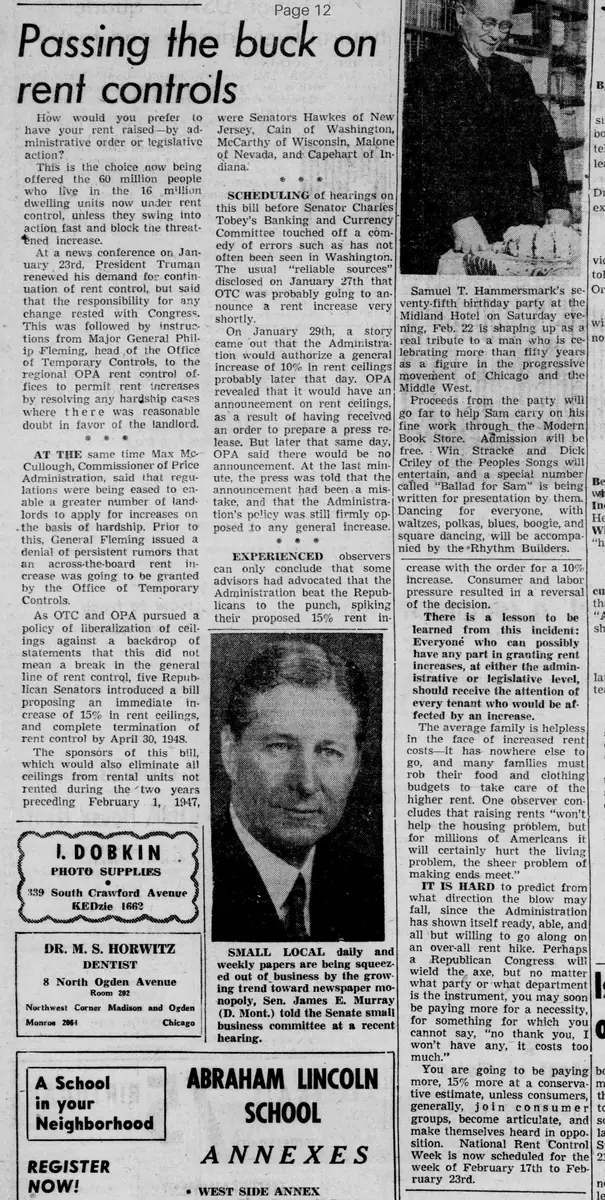
Passing the buck on rent controls
How would you prefer to have your rent raised—by administrative order or legislative action?
This is the choice now being offered the 60 million people who live in the 16 million dwelling units now under rent control, unless they swing into action fast and block the threatened increase.
At a news conference on January 23rd, President Truman renewed his demand for continuation of rent control, but said that the responsibility for any change rested with Congress.
This was followed by instructions from Major General Philip Fleming, head of the Office of Temporary Controls, to the regional OPA rent control offices to permit rent increases by resolving any hardship cases where there was reasonable doubt in favor of the landlord.
AT THE same time Max McCullough, Commissioner of Price Administration, said that regulations were being eased to enable a greater number of landlords to apply for increases on the basis of hardship. Prior to this, General Fleming issued a denial of persistent rumors that an across-the-board rent increase was going to be granted by the Office of Temporary Controls.
As OTC and OPA pursued a policy of liberalization of ceilings against a backdrop of statements that this did not mean a break in the general line of rent control, five Republican Senators introduced a bill proposing an immediate increase of 15% in rent ceilings, and complete termination of rent control by April 30, 1948.
The sponsors of this bill, which would also eliminate all ceilings from rental units not rented during the two years preceding February 1, 1947, were Senators Hawkes of New Jersey, Cain of Washington, McCarthy of Wisconsin, Malone of Nevada, and Capehart of Indiana.
SCHEDULING of hearings on this bill before Senator Charles Tobey's Banking and Currency Committee touched off a comedy of errors such as has not often been seen in Washington.
The usual "reliable sources" disclosed on January 27th that OTC was probably going to announce a rent increase very shortly.
On January 29th, a story came out that the Administration would authorize a general increase of 10% in rent ceilings probably later that day. OPA revealed that it would have an announcement on rent ceilings, as a result of having received an order to prepare a press release. But later that same day, OPA said there would be no announcement. At the last minute, the press was told that the announcement had been a mistake, and that the Administration's policy was still firmly opposed to any general increase.
EXPERIENCED observers can only conclude that some advisors had advocated that the Administration beat the Republicans to the punch, spiking their proposed 15% rent increase with the order for a 10% increase.
Consumer and labor pressure resulted in a reversal of the decision.
There is a lesson to be learned from this incident: Everyone who can possibly have any part in granting rent increases, at either the administrative or legislative level, should receive the attention of every tenant who would be affected by an increase.
The average family is helpless in the face of increased rent costs—it has nowhere else to go, and many families must rob their food and clothing budgets to take care of the higher rent. One observer concludes that raising rents "won't help the housing problem, but for millions of Americans it will certainly hurt the living problem, the sheer problem of making ends meet."
IT IS HARD to predict from what direction the blow may fall, since the Administration has shown itself ready, able, and all but willing to go along on an over-all rent hike. Perhaps a Republican Congress will wield the axe, but no matter what party or what department is the instrument, you may soon be paying more for a necessity, for something for which you cannot say, "no thank you, I won't have any, it costs too much."
You are going to be paying more, 15% more at a conservative estimate, unless consumers, generally, join consumer groups, become articulate, and make themselves heard in opposition. National Rent Control Week is now scheduled for the week of February 17th to February 23rd.
How would you prefer to have your rent raised—by administrative order or legislative action?
This is the choice now being offered the 60 million people who live in the 16 million dwelling units now under rent control, unless they swing into action fast and block the threatened increase.
At a news conference on January 23rd, President Truman renewed his demand for continuation of rent control, but said that the responsibility for any change rested with Congress.
This was followed by instructions from Major General Philip Fleming, head of the Office of Temporary Controls, to the regional OPA rent control offices to permit rent increases by resolving any hardship cases where there was reasonable doubt in favor of the landlord.
AT THE same time Max McCullough, Commissioner of Price Administration, said that regulations were being eased to enable a greater number of landlords to apply for increases on the basis of hardship. Prior to this, General Fleming issued a denial of persistent rumors that an across-the-board rent increase was going to be granted by the Office of Temporary Controls.
As OTC and OPA pursued a policy of liberalization of ceilings against a backdrop of statements that this did not mean a break in the general line of rent control, five Republican Senators introduced a bill proposing an immediate increase of 15% in rent ceilings, and complete termination of rent control by April 30, 1948.
The sponsors of this bill, which would also eliminate all ceilings from rental units not rented during the two years preceding February 1, 1947, were Senators Hawkes of New Jersey, Cain of Washington, McCarthy of Wisconsin, Malone of Nevada, and Capehart of Indiana.
SCHEDULING of hearings on this bill before Senator Charles Tobey's Banking and Currency Committee touched off a comedy of errors such as has not often been seen in Washington.
The usual "reliable sources" disclosed on January 27th that OTC was probably going to announce a rent increase very shortly.
On January 29th, a story came out that the Administration would authorize a general increase of 10% in rent ceilings probably later that day. OPA revealed that it would have an announcement on rent ceilings, as a result of having received an order to prepare a press release. But later that same day, OPA said there would be no announcement. At the last minute, the press was told that the announcement had been a mistake, and that the Administration's policy was still firmly opposed to any general increase.
EXPERIENCED observers can only conclude that some advisors had advocated that the Administration beat the Republicans to the punch, spiking their proposed 15% rent increase with the order for a 10% increase.
Consumer and labor pressure resulted in a reversal of the decision.
There is a lesson to be learned from this incident: Everyone who can possibly have any part in granting rent increases, at either the administrative or legislative level, should receive the attention of every tenant who would be affected by an increase.
The average family is helpless in the face of increased rent costs—it has nowhere else to go, and many families must rob their food and clothing budgets to take care of the higher rent. One observer concludes that raising rents "won't help the housing problem, but for millions of Americans it will certainly hurt the living problem, the sheer problem of making ends meet."
IT IS HARD to predict from what direction the blow may fall, since the Administration has shown itself ready, able, and all but willing to go along on an over-all rent hike. Perhaps a Republican Congress will wield the axe, but no matter what party or what department is the instrument, you may soon be paying more for a necessity, for something for which you cannot say, "no thank you, I won't have any, it costs too much."
You are going to be paying more, 15% more at a conservative estimate, unless consumers, generally, join consumer groups, become articulate, and make themselves heard in opposition. National Rent Control Week is now scheduled for the week of February 17th to February 23rd.
What sub-type of article is it?
Historical Event
What themes does it cover?
Misfortune
Justice
Survival
What keywords are associated?
Rent Control
Rent Increase
Truman Administration
Republican Bill
Housing Policy
1947
Consumer Action
What entities or persons were involved?
President Truman
Major General Philip Fleming
Max Mccullough
Senator Hawkes
Senator Cain
Senator Mccarthy
Senator Malone
Senator Capehart
Senator Charles Tobey
Where did it happen?
Washington
Story Details
Key Persons
President Truman
Major General Philip Fleming
Max Mccullough
Senator Hawkes
Senator Cain
Senator Mccarthy
Senator Malone
Senator Capehart
Senator Charles Tobey
Location
Washington
Event Date
January 1947
Story Details
Political maneuvering and confusion over potential rent increases in rent-controlled units affecting 60 million Americans, with Truman deferring to Congress, administrative easings, Republican bill for 15% hike and end by April 1948, false announcements, and call for tenant action.