Thank you for visiting SNEWPapers!
Sign up free
Story
June 28, 1865
The Potter Journal
Coudersport, Potter County, Pennsylvania
What is this article about?
The Tribune advocates limited Negro suffrage in Southern states for literate, property-owning, tax-paying blacks as a compromise to settle the issue amicably, criticizing permanent disenfranchisement by rebels as unjust taxation without representation.
Clipping
OCR Quality
98%
Excellent
Full Text
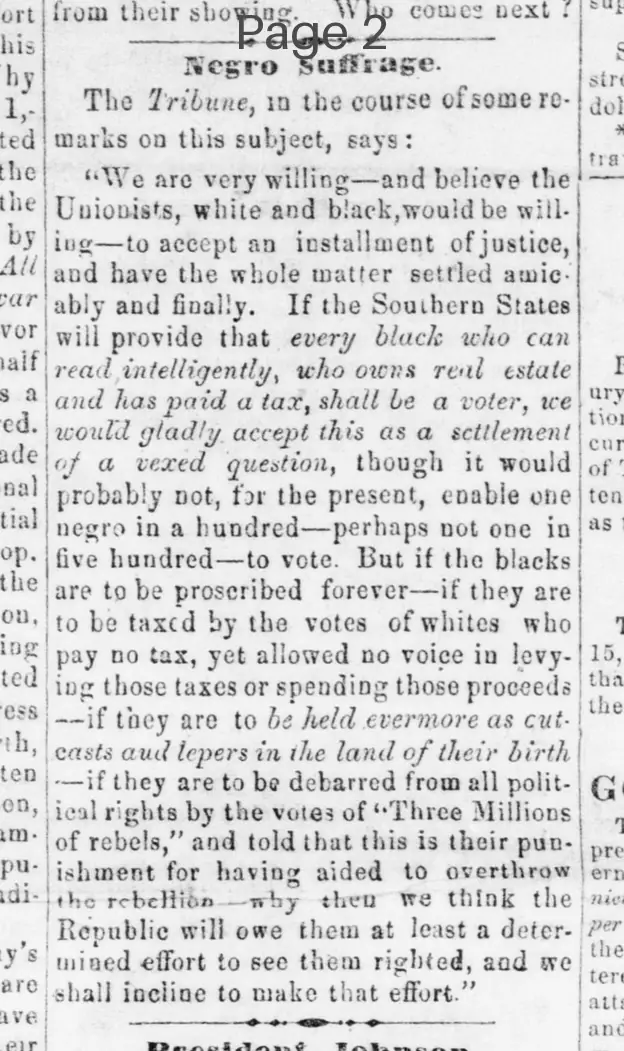
Negro Suffrage.
The Tribune, in the course of some remarks on this subject, says:
"We are very willing—and believe the Unionists, white and black, would be willing—to accept an installment of justice, and have the whole matter settled amicably and finally. If the Southern States will provide that every black who can read intelligently, who owns real estate and has paid a tax, shall be a voter, we would gladly accept this as a settlement of a vexed question, though it would probably not, for the present, enable one negro in a hundred—perhaps not one in five hundred—to vote. But if the blacks are to be proscribed forever—if they are to be taxed by the votes of whites who pay no tax, yet allowed no voice in levying those taxes or spending those proceeds—if they are to be held evermore as outcasts and lepers in the land of their birth—if they are to be debarred from all political rights by the votes of "Three Millions of rebels," and told that this is their punishment for having aided to overthrow the rebellion—why then we think the Republic will owe them at least a determined effort to see them righted, and we shall incline to make that effort."
The Tribune, in the course of some remarks on this subject, says:
"We are very willing—and believe the Unionists, white and black, would be willing—to accept an installment of justice, and have the whole matter settled amicably and finally. If the Southern States will provide that every black who can read intelligently, who owns real estate and has paid a tax, shall be a voter, we would gladly accept this as a settlement of a vexed question, though it would probably not, for the present, enable one negro in a hundred—perhaps not one in five hundred—to vote. But if the blacks are to be proscribed forever—if they are to be taxed by the votes of whites who pay no tax, yet allowed no voice in levying those taxes or spending those proceeds—if they are to be held evermore as outcasts and lepers in the land of their birth—if they are to be debarred from all political rights by the votes of "Three Millions of rebels," and told that this is their punishment for having aided to overthrow the rebellion—why then we think the Republic will owe them at least a determined effort to see them righted, and we shall incline to make that effort."
What sub-type of article is it?
Historical Event
What themes does it cover?
Justice
Moral Virtue
What keywords are associated?
Negro Suffrage
Voting Rights
Reconstruction
Southern States
Unionists
Rebels
Where did it happen?
Southern States
Story Details
Location
Southern States
Story Details
Editorial from The Tribune proposing limited voting rights for qualified black men in the South as a just settlement post-rebellion, opposing permanent exclusion from political rights.