Thank you for visiting SNEWPapers!
Sign up free
The Daily Minnesota Pioneer
Saint Paul, Ramsey County, Minnesota
What is this article about?
Gov. W. A. Gorman defends against accusations in the St. Paul Daily Democrat that he caused the Winnebago Indians' relocation to the Blue Earth River reserve in Minnesota Territory via a 1855 treaty, providing documents showing he protested the location while certifying the report as required.
Clipping
OCR Quality
Full Text
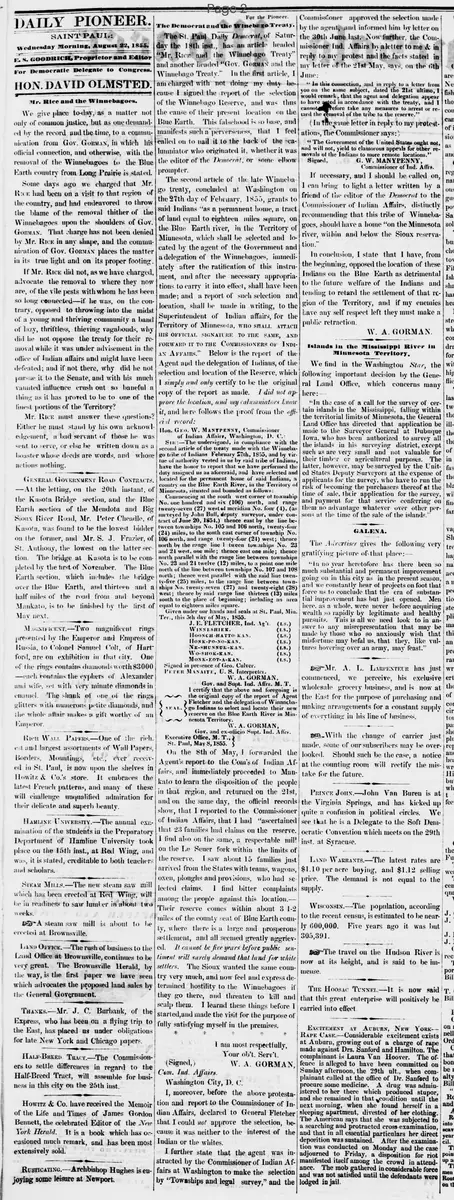
HON. DAVID OLMSTED
Mr. Rice and the Winnebagoes.
We give place to-day, as a matter not only of common justice, but as one demanded by the record and the time, to a communication from Gov. Gorman, in which his official connection, and otherwise, with the removal of the Winnebagoes to the Blue Earth country from Long Prairie is stated.
Some days ago we charged that Mr. Rice had been on a visit to that region of the country, and had endeavored to throw the blame of the removal thither of the Winnebagoes upon the shoulders of Gov. Gorman. That charge has not been denied by Mr. Rice in any shape, and the communication of Gov. Gorman places the matter in its true light and on its proper footing.
If Mr. Rice did not, as we have charged, advocate the removal to where they now are, of the vile pests with whom he has been so long connected—if he was, on the contrary, opposed to throwing into the midst of a young and thriving community a band of lazy, thriftless, thieving vagabonds, why did he not oppose the treaty for their removal while it was under advisement in the office of Indian affairs and might have been defeated; and if not there, why did he not pursue it to the Senate, and with his much vaunted influence crush out so baneful a thing as it has proved to be to one of the finest portions of the Territory?
Mr. Rice must answer these questions. Either he must stand by his own acknowledgement, a bad servant of those he was sent to serve, or else be written down as a boaster whose deeds are words, and whose actions nothing.
For the Pioneer.
The Democrat and the Winnebago Treaty.
The St. Paul Daily Democrat, of Saturday the 18th inst., has an article headed "Mr. Rice and the Winnebago Treaty" and another headed "Gov. Gorman and the Winnebago Treaty." In the first article, I am charged with not doing my duty because I signed the report of the selection of the Winnebago Reserve, and was thus the cause of their present location on the Blue Earth. This falsehood is so base, and manifests such a perverseness, that I feel called on to nail it to the back of the calumniator who originated it, whether it was the editor of the Democrat, or some elbow prompter.
The second article of the late Winnebago treaty, concluded at Washington on the 27th day of February, 1855, grants to said Indians "as a permanent home, a tract of land equal to eighteen miles square, on the Blue Earth river, in the Territory of Minnesota, which shall be selected and located by the agent of the Government and a delegation of the Winnebagoes, immediately after the ratification of this instrument, and after the necessary appropriations to carry it into effect, shall have been made; and a report of such selection and location, shall be made in writing, to the Superintendent of Indian affairs, for the Territory of Minnesota, WHO SHALL ATTACH HIS OFFICIAL SIGNATURE TO THE SAME, AND FORWARD IT TO THE COMMISSIONERS OF INDIAN AFFAIRS." Below is the report of the Agent and the delegation of Indians, of the selection and location of the Reserve, which I simply and only certify to be the original copy of the report as made. I did not approve the location, and my calumniators know it, and here follows the proof from the official record:
Hon. GEO. W. MANYPENNY, Commissioner of Indian Affairs, Washington, D. C.:
Sir:—The undersigned, in compliance with the second article of the treaty made with the Winnebago tribe of Indians February 28th, 1855, and by virtue of authority vested in us by said tribe of Indians, have the honor to report that we have performed the duty assigned us as aforesaid, and have selected and located for the permanent home of said Indians, a country on the Blue Earth River, in the Territory of Minnesota, situated and bounded as follows:
Commencing at the south west corner of township No. one hundred and six (106) north, and range twenty-seven (27) west of meridian No. four (4), (as surveyed by John Bull, deputy surveyor, under contract of June 20, 1854,) thence east by the line between townships No. 105 and 106 north, twenty-four (24) miles, to the south east corner of township No. 106 north, and range twenty-four (24) west; thence north by the range line between townships No. 23 and 24 west, one mile; thence east one mile; thence north parallel with the range line between townships No. 23 and 24 twelve (12) miles, to a point one mile north of the line between townships No. 107 and 108 north; thence west parallel with the said line twenty-five (25) miles, to the range line between townships No. twenty-seven (27) and twenty-eight (28) west; thence by said range line thirteen (13) miles south to the place of beginning; including an area equal to eighteen miles square.
Given under our hands and seals at St. Paul, Minn. Ter., this 5th day of May, 1855.
J. E. FLETCHER, Ind. Ag't. (L.S.)
WINNESHIEK. (L.S.)
HOONCH-HATTO-KAN. (L.S.)
HONK-PO-NO-KAN. (L.S.)
NE-SHUNNUK-KAN. (L.S.)
WO-SHOK-KAN. (L.S.)
MONK-EOT-A-KAN. (L.S.)
Signed in presence of Geo. Culver.
PETER MANAIYE, U. S. Interpreter.
W. A. GORMAN,
Gov. and Supt. Ind. Affrs. M. T.
I certify that the above and foregoing is the original copy of the report of Agent Fletcher and the delegation of Winnebago Indians to select and locate their new reserve on the Blue Earth River in Minnesota Territory.
W. A. GORMAN,
Gov. and ex-officio Supt. Ind. Affrs.
Executive Office, M. T.,
St. Paul, May 8, 1855.
On the 8th of May, I forwarded the Agent's report to the Com's of Indian Affairs, and immediately proceeded to Mankato to learn the disposition of the people in that region, and returned on the 21st, and on the same day, the official records show, that I reported to the Commissioner of Indian Affairs, that I had "ascertained that 23 families had claims on the reserve. I find also on the same, a respectable mill on the Le Sueur fork within the limits of the reserve. I saw about 15 families just arrived from the States with teams, wagons, oxen, ploughs and provisions, who had selected claims. I find bitter complaints among the people against this location. Their reserve comes within about 3 1/2 miles of the county seat of Blue Earth county, where there is a large and prosperous settlement, and all seemed greatly aggrieved. It cannot be five years before public sentiment will surely demand that land for white settlers. The Sioux wanted the same country very much, and now feel and express determined hostility to the Winnebagoes if they go there, and threaten to kill and scalp them. I learned these things before I started, and made the visit for the purpose of fully satisfying myself in the premises."
I am most respectfully,
Your ob't. Serv't.
(Signed,) W. A. GORMAN
Com. Ind. Affairs
Washington City, D. C.
I, moreover, before the above protestation and report to the Commissioner of Indian Affairs, declared to General Fletcher that I could not approve the selection, because it was neither to the interest of the Indian or the whites.
I further state that the agent was instructed by the Commissioner of Indian Affairs at Washington to make the selection by "Townships and legal survey," and the Commissioner approved the selection made by the agent, and informed him by letter on the 30th June last. Now further, the Commissioner Ind. Affairs by a letter to me & in reply to my protest and the facts stated in my letter of the 21st May, says, on the 6th June:
"In this connection, and in reply to a letter from you on the same subject, dated the 21st ultimo, I would remark, that the agent and delegation appear to have acted in accordance with the treaty, and cannot therefore take any measures to arrest or retard the removal of the tribe to the reserve."
(In the same letter in reply to my protestations, the Commissioner says:
"The Government of the United States ought not, and will not, yield to clamorous appeals for other removals of the Indians to more remote locations."
Signed, G. W. MANYPENNY,
Commissioner of Ind. Affrs.
If necessary, and I should be called on, I can bring to light a letter written by a friend of the editor of the Democrat to the Commissioner of Indian Affairs, distinctly recommending that this tribe of Winnebagoes, should have a home "on the Minnesota river, within and below the Sioux reservation."
In conclusion, I state that I have, from the beginning, opposed the location of these Indians on the Blue Earth as detrimental to the future welfare of the Indians and tending to retard the settlement of that region of the Territory, and if my enemies have any self respect left they must make a public retraction.
W. A. GORMAN.
What sub-type of article is it?
What keywords are associated?
What entities or persons were involved?
Where did it happen?
Domestic News Details
Primary Location
Blue Earth River, Minnesota Territory
Event Date
February 27, 1855
Key Persons
Outcome
the reserve location was approved by the commissioner despite gorman's protests; local settlers aggrieved; potential sioux hostility to winnebagoes noted.
Event Details
Gov. Gorman certifies the report of the Winnebago reserve selection on the Blue Earth River as required by the 1855 treaty but protests the location due to conflicts with white settlers and Sioux threats, responding to accusations in the St. Paul Daily Democrat blaming him for the removal.