Thank you for visiting SNEWPapers!
Sign up free
Literary
July 14, 1802
The Recorder, Or, Lady's And Gentleman's Miscellany
Richmond, Virginia
What is this article about?
An extract from Chapter XXXI of 'The Prospect Before Us' critiques the U.S. federal funding system, arguing that unlimited congressional borrowing power leads to abuse, endless debt, prolonged wars, and corruption, contrasting it with historical practices and advocating for direct taxation and an independent press.
Clipping
OCR Quality
95%
Excellent
Full Text
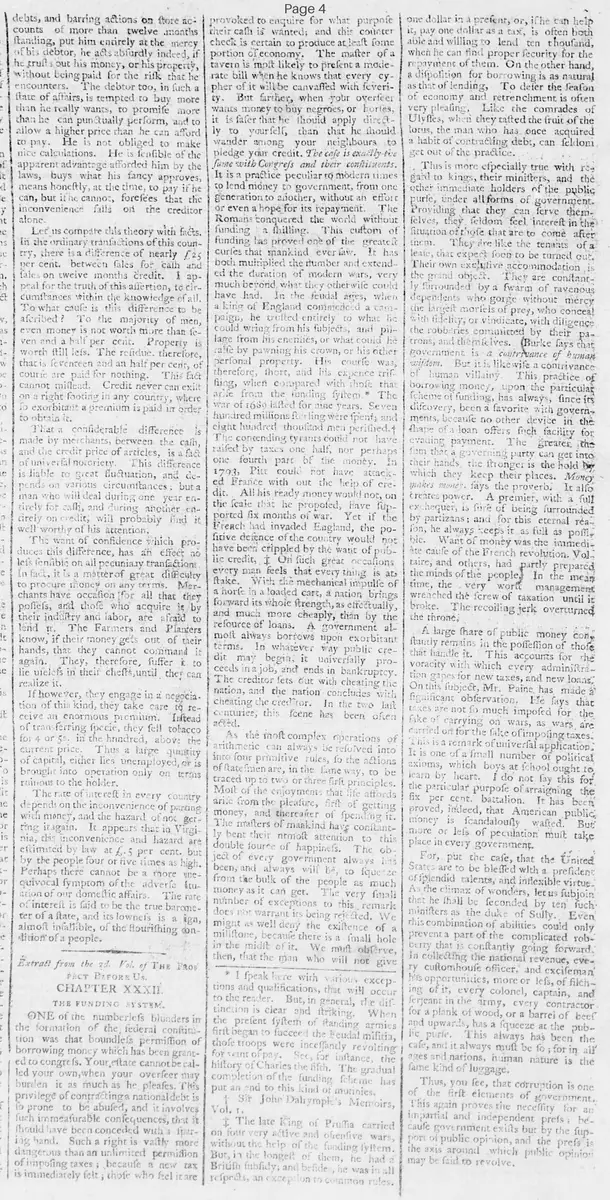
Extract from the 2d Vol. of The Prospect Before Us.
CHAPTER XXXI.
THE FUNDING SYSTEM.
One of the numberless blunders in the formation of the federal constitution was that boundless permission of borrowing money which has been granted to congress. Your estate cannot be called your own, when your overseer may burden it as much as he pleases. This privilege of contracting a national debt is so prone to be abused, and it involves such immeasurable consequences, that it should have been conceded with a sparing hand. Such a right is vastly more dangerous than an unlimited permission of imposing taxes; because a new tax is immediately felt; those who feel it are provoked to enquire for what purpose their cash is wanted: and this counter check is certain to produce at least some portion of economy. The master of a tavern is most likely to present a moderate bill when he knows that every cypher of it will be canvassed with severity. But farther, when your overseer wants money to buy negroes, or horses, it is safer that he should apply directly to yourself, than that he should wander among your neighbours to pledge your credit. The case is exactly the same with Congress and their constituents.
It is a practice peculiar to modern times to lend money to government, from one generation to another, without an effort or even a hope for its repayment. The Romans conquered the world without funding a shilling. This custom of funding has proved one of the greatest curses that mankind ever saw. It has both multiplied the number and extended the duration of modern wars, very much beyond what they otherwise could have had. In the feudal ages, when a king of England commenced a campaign, he trusted entirely to what he could wring from his subjects, and pillage from his enemies, or what could he raise by pawning his crown, or his other personal property. His course was, therefore, short, and his expense trifling, when compared with those that arise from the funding system. The war of 1680 lasted for nine years. Seven hundred millions sterling were spent; and eight hundred thousand men perished.
The contending tyrants could not have raised by taxes one half, nor perhaps one fourth part of the money. In 1793, Pitt could not have attacked France without the help of credit. All his ready money would not, on the scale that he proposed, have supported six months of war. Yet if the French had invaded England, the positive defence of the country would not have been crippled by the want of public credit. On such great occasions every man feels that every thing is at stake. With the mechanical impulse of a horse in a loaded cart, a nation brings forward its whole strength, as effectually, and much more cheaply, than by the resource of loans. A government almost always borrows upon exorbitant terms. In whatever way public credit may begin, it universally proceeds in a job, and ends in bankruptcy. The creditor sets out with cheating the nation, and the nation concludes with cheating the creditor. In the two last centuries, this scene has been often acted.
As the most complex operations of arithmetic can always be resolved into four primitive rules, so the actions of statesmen are, in the same way, to be traced up to two or three first principles. Most of the enjoyments that life affords arise from the pleasure, first of getting money, and thereafter of spending it.
The masters of mankind have constantly bent their utmost attention to this double source of happiness. The object of every government always has been, and always will be, to squeeze from the bulk of the people as much money as it can get. The very small number of exceptions to this remark does not warrant its being rejected. We might as well deny the existence of a millstone, because there is a small hole in the midst of it. We must observe, then, that the man who will not give one dollar in a present, or, if he can help it, pay one dollar as a tax, is often both able and willing to lend ten thousand, when he can find proper security for the repayment of them. On the other hand, a disposition for borrowing is as natural as that of lending. To defer the season of economy and retrenchment is often very pleasing. Like the comrades of Ulysses, when they tasted the fruit of the lotus, the man who has once acquired a habit of contracting debt, can seldom get out of the practice.
This is more especially true with regard to kings, their ministers, and the other immediate holders of the public purse, under all forms of government. Providing that they can serve themselves, they seldom feel interest in the situation of those that are to come after them. They are like the tenants of a lease, that expect soon to be turned out. Their own exclusive accommodation is the grand object. They are constantly surrounded by a swarm of ravenous dependents who gorge without mercy the largest morsels of prey, who conceal with fidelity, or vindicate, with diligence the robberies committed by their patrons, and themselves. (Burke says that government is a contrivance of human wisdom. But it is likewise a contrivance of human villainy.) This practice of borrowing money, upon the particular scheme of funding, has always, since its discovery, been a favorite with governments, because no other device in the shape of a loan offers such facility for evading payment. The greater the sum that a governing party can get into their hands, the stronger is the hold by which they keep their places. Money makes money, says the proverb: It also creates power. A premier, with a full exchequer, is sure of being surrounded by partisans; and for this eternal reason, he always keeps it as full as possible. Want of money was the immediate cause of the French revolution. Voltaire, and others, had partly prepared the minds of the people. In the mean time, the very worst management wretched the screw of taxation until it broke. The recoiling jerk overturned the throne.
A large share of public money constantly remains in the possession of those that handle it. This accounts for the voracity with which every administration gapes for new taxes, and new loans. On this subject, Mr. Paine, has made a significant observation. He says that taxes are not so much imposed for the sake of carrying on wars, as wars are carried on for the sake of imposing taxes.
This is a remark of universal application. It is one of a small number of political axioms, which boys at school ought to learn by heart. I do not say this for the particular purpose of arraigning the Six per cent. battalion. It has been proved, indeed, that American public money is scandalously wasted. But more or less of peculation must take place in every government.
For, put the case, that the United States are to be blessed with a president of splendid talents, and inflexible virtue. As the climax of wonders, let us subjoin that he shall be seconded by ten such ministers as the duke of Sully. Even this combination of abilities could only prevent a part of the complicated robbery that is constantly going forward.
In collecting the national revenue, every customhouse officer, and exciseman has opportunities, more or less, of filching of it, every colonel, captain, and serjeant in the army, every contractor for a plank of wood, or a barrel of beef and upwards, has a squeeze at the public purse. This always has been the case, and it always must be so; for in all ages and nations, human nature is the same kind of luggage.
Thus, you see, that corruption is one of the first elements of government. This again proves the necessity for an impartial and independent press, because government exists but by the support of public opinion, and the press is the axis around which public opinion may be said to revolve.
I speak here with various exceptions and qualifications, that will occur to the reader. But, in general, the distinction is clear and striking.
When the present system of standing armies first began to succeed the Feudal militia, those troops were incessantly revolting for want of pay. See, for instance, the history of Charles the fifth. The gradual completion of the funding scheme has put an end to this kind of mutinies.
Sir John Dalrymple's Memoirs, Vol. I.
The late King of Prussia carried on four very active and offensive wars, without the help of the funding system. But, in the longest of them, he had a British subsidy, and besides, he was in all respects, an exception to common rules.
CHAPTER XXXI.
THE FUNDING SYSTEM.
One of the numberless blunders in the formation of the federal constitution was that boundless permission of borrowing money which has been granted to congress. Your estate cannot be called your own, when your overseer may burden it as much as he pleases. This privilege of contracting a national debt is so prone to be abused, and it involves such immeasurable consequences, that it should have been conceded with a sparing hand. Such a right is vastly more dangerous than an unlimited permission of imposing taxes; because a new tax is immediately felt; those who feel it are provoked to enquire for what purpose their cash is wanted: and this counter check is certain to produce at least some portion of economy. The master of a tavern is most likely to present a moderate bill when he knows that every cypher of it will be canvassed with severity. But farther, when your overseer wants money to buy negroes, or horses, it is safer that he should apply directly to yourself, than that he should wander among your neighbours to pledge your credit. The case is exactly the same with Congress and their constituents.
It is a practice peculiar to modern times to lend money to government, from one generation to another, without an effort or even a hope for its repayment. The Romans conquered the world without funding a shilling. This custom of funding has proved one of the greatest curses that mankind ever saw. It has both multiplied the number and extended the duration of modern wars, very much beyond what they otherwise could have had. In the feudal ages, when a king of England commenced a campaign, he trusted entirely to what he could wring from his subjects, and pillage from his enemies, or what could he raise by pawning his crown, or his other personal property. His course was, therefore, short, and his expense trifling, when compared with those that arise from the funding system. The war of 1680 lasted for nine years. Seven hundred millions sterling were spent; and eight hundred thousand men perished.
The contending tyrants could not have raised by taxes one half, nor perhaps one fourth part of the money. In 1793, Pitt could not have attacked France without the help of credit. All his ready money would not, on the scale that he proposed, have supported six months of war. Yet if the French had invaded England, the positive defence of the country would not have been crippled by the want of public credit. On such great occasions every man feels that every thing is at stake. With the mechanical impulse of a horse in a loaded cart, a nation brings forward its whole strength, as effectually, and much more cheaply, than by the resource of loans. A government almost always borrows upon exorbitant terms. In whatever way public credit may begin, it universally proceeds in a job, and ends in bankruptcy. The creditor sets out with cheating the nation, and the nation concludes with cheating the creditor. In the two last centuries, this scene has been often acted.
As the most complex operations of arithmetic can always be resolved into four primitive rules, so the actions of statesmen are, in the same way, to be traced up to two or three first principles. Most of the enjoyments that life affords arise from the pleasure, first of getting money, and thereafter of spending it.
The masters of mankind have constantly bent their utmost attention to this double source of happiness. The object of every government always has been, and always will be, to squeeze from the bulk of the people as much money as it can get. The very small number of exceptions to this remark does not warrant its being rejected. We might as well deny the existence of a millstone, because there is a small hole in the midst of it. We must observe, then, that the man who will not give one dollar in a present, or, if he can help it, pay one dollar as a tax, is often both able and willing to lend ten thousand, when he can find proper security for the repayment of them. On the other hand, a disposition for borrowing is as natural as that of lending. To defer the season of economy and retrenchment is often very pleasing. Like the comrades of Ulysses, when they tasted the fruit of the lotus, the man who has once acquired a habit of contracting debt, can seldom get out of the practice.
This is more especially true with regard to kings, their ministers, and the other immediate holders of the public purse, under all forms of government. Providing that they can serve themselves, they seldom feel interest in the situation of those that are to come after them. They are like the tenants of a lease, that expect soon to be turned out. Their own exclusive accommodation is the grand object. They are constantly surrounded by a swarm of ravenous dependents who gorge without mercy the largest morsels of prey, who conceal with fidelity, or vindicate, with diligence the robberies committed by their patrons, and themselves. (Burke says that government is a contrivance of human wisdom. But it is likewise a contrivance of human villainy.) This practice of borrowing money, upon the particular scheme of funding, has always, since its discovery, been a favorite with governments, because no other device in the shape of a loan offers such facility for evading payment. The greater the sum that a governing party can get into their hands, the stronger is the hold by which they keep their places. Money makes money, says the proverb: It also creates power. A premier, with a full exchequer, is sure of being surrounded by partisans; and for this eternal reason, he always keeps it as full as possible. Want of money was the immediate cause of the French revolution. Voltaire, and others, had partly prepared the minds of the people. In the mean time, the very worst management wretched the screw of taxation until it broke. The recoiling jerk overturned the throne.
A large share of public money constantly remains in the possession of those that handle it. This accounts for the voracity with which every administration gapes for new taxes, and new loans. On this subject, Mr. Paine, has made a significant observation. He says that taxes are not so much imposed for the sake of carrying on wars, as wars are carried on for the sake of imposing taxes.
This is a remark of universal application. It is one of a small number of political axioms, which boys at school ought to learn by heart. I do not say this for the particular purpose of arraigning the Six per cent. battalion. It has been proved, indeed, that American public money is scandalously wasted. But more or less of peculation must take place in every government.
For, put the case, that the United States are to be blessed with a president of splendid talents, and inflexible virtue. As the climax of wonders, let us subjoin that he shall be seconded by ten such ministers as the duke of Sully. Even this combination of abilities could only prevent a part of the complicated robbery that is constantly going forward.
In collecting the national revenue, every customhouse officer, and exciseman has opportunities, more or less, of filching of it, every colonel, captain, and serjeant in the army, every contractor for a plank of wood, or a barrel of beef and upwards, has a squeeze at the public purse. This always has been the case, and it always must be so; for in all ages and nations, human nature is the same kind of luggage.
Thus, you see, that corruption is one of the first elements of government. This again proves the necessity for an impartial and independent press, because government exists but by the support of public opinion, and the press is the axis around which public opinion may be said to revolve.
I speak here with various exceptions and qualifications, that will occur to the reader. But, in general, the distinction is clear and striking.
When the present system of standing armies first began to succeed the Feudal militia, those troops were incessantly revolting for want of pay. See, for instance, the history of Charles the fifth. The gradual completion of the funding scheme has put an end to this kind of mutinies.
Sir John Dalrymple's Memoirs, Vol. I.
The late King of Prussia carried on four very active and offensive wars, without the help of the funding system. But, in the longest of them, he had a British subsidy, and besides, he was in all respects, an exception to common rules.
What sub-type of article is it?
Essay
Satire
What themes does it cover?
Political
Taxation Oppression
Commerce Trade
What keywords are associated?
Funding System
National Debt
Government Borrowing
Political Corruption
Public Credit
Taxation
Wars Loans
Literary Details
Title
The Funding System
Subject
Critique Of The Federal Funding System And National Debt
Form / Style
Political Essay In Prose
Key Lines
One Of The Numberless Blunders In The Formation Of The Federal Constitution Was That Boundless Permission Of Borrowing Money Which Has Been Granted To Congress.
This Custom Of Funding Has Proved One Of The Greatest Curses That Mankind Ever Saw.
The Object Of Every Government Always Has Been, And Always Will Be, To Squeeze From The Bulk Of The People As Much Money As It Can Get.
Taxes Are Not So Much Imposed For The Sake Of Carrying On Wars, As Wars Are Carried On For The Sake Of Imposing Taxes.
Corruption Is One Of The First Elements Of Government.