Thank you for visiting SNEWPapers!
Sign up free
Domestic News
July 4, 1861
The Alleghanian
Ebensburg, Cambria County, Pennsylvania
What is this article about?
A New York Tribune correspondent describes the harsh, uncomfortable conditions at Fort Pickens on June 14, including pervasive sand, intense heat, poor water, and insect infestations.
Clipping
OCR Quality
95%
Excellent
Full Text
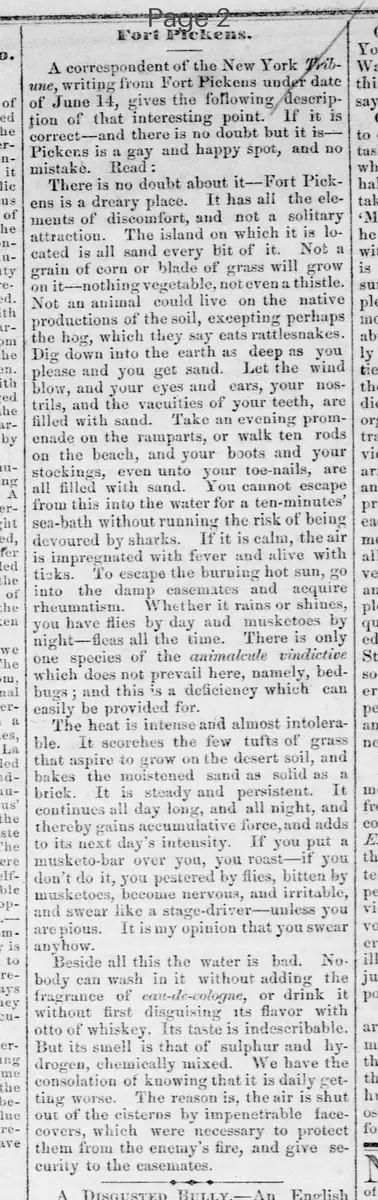
Fort Pickens.
A correspondent of the New York Tribune, writing from Fort Pickens under date of June 14, gives the following description of that interesting point. If it is correct—and there is no doubt but it is—Pickens is a gay and happy spot, and no mistake. Read:
There is no doubt about it—Fort Pickens is a dreary place. It has all the elements of discomfort, and not a solitary attraction. The island on which it is located is all sand every bit of it. Not a grain of corn or blade of grass will grow on it—nothing vegetable, not even a thistle. Not an animal could live on the native productions of the soil, excepting perhaps the hog, which they say eats rattlesnakes. Dig down into the earth as deep as you please and you get sand. Let the wind blow, and your eyes and ears, your nostrils, and the vacuities of your teeth, are filled with sand. Take an evening promenade on the ramparts, or walk ten rods on the beach, and your boots and your stockings, even unto your toe-nails, are all filled with sand. You cannot escape from this into the water for a ten-minutes' sea-bath without running the risk of being devoured by sharks. If it is calm, the air is impregnated with fever and alive with ticks. To escape the burning hot sun, go into the damp casemates and acquire rheumatism. Whether it rains or shines, you have flies by day and mosquitoes by night—fleas all the time. There is only one species of the animalcule vindictive which does not prevail here, namely, bed-bugs; and this is a deficiency which can easily be provided for.
The heat is intense and almost intolerable. It scorches the few tufts of grass that aspire to grow on the desert soil, and bakes the moistened sand as solid as a brick. It is steady and persistent. It continues all day long, and all night, and thereby gains accumulative force, and adds to its next day's intensity. If you put a mosquito-bar over you, you roast—if you don't do it, you pestered by flies, bitten by mosquitoes, become nervous, and irritable, and swear like a stage-driver—unless you are pious. It is my opinion that you swear anyhow.
Beside all this the water is bad. Nobody can wash in it without adding the fragrance of eau-de-cologne, or drink it without first disguising its flavor with otto of whiskey. Its taste is indescribable. But its smell is that of sulphur and hydrogen, chemically mixed. We have the consolation of knowing that it is daily getting worse. The reason is, the air is shut out of the cisterns by impenetrable face-covers, which were necessary to protect them from the enemy's fire, and give security to the casemates.
A correspondent of the New York Tribune, writing from Fort Pickens under date of June 14, gives the following description of that interesting point. If it is correct—and there is no doubt but it is—Pickens is a gay and happy spot, and no mistake. Read:
There is no doubt about it—Fort Pickens is a dreary place. It has all the elements of discomfort, and not a solitary attraction. The island on which it is located is all sand every bit of it. Not a grain of corn or blade of grass will grow on it—nothing vegetable, not even a thistle. Not an animal could live on the native productions of the soil, excepting perhaps the hog, which they say eats rattlesnakes. Dig down into the earth as deep as you please and you get sand. Let the wind blow, and your eyes and ears, your nostrils, and the vacuities of your teeth, are filled with sand. Take an evening promenade on the ramparts, or walk ten rods on the beach, and your boots and your stockings, even unto your toe-nails, are all filled with sand. You cannot escape from this into the water for a ten-minutes' sea-bath without running the risk of being devoured by sharks. If it is calm, the air is impregnated with fever and alive with ticks. To escape the burning hot sun, go into the damp casemates and acquire rheumatism. Whether it rains or shines, you have flies by day and mosquitoes by night—fleas all the time. There is only one species of the animalcule vindictive which does not prevail here, namely, bed-bugs; and this is a deficiency which can easily be provided for.
The heat is intense and almost intolerable. It scorches the few tufts of grass that aspire to grow on the desert soil, and bakes the moistened sand as solid as a brick. It is steady and persistent. It continues all day long, and all night, and thereby gains accumulative force, and adds to its next day's intensity. If you put a mosquito-bar over you, you roast—if you don't do it, you pestered by flies, bitten by mosquitoes, become nervous, and irritable, and swear like a stage-driver—unless you are pious. It is my opinion that you swear anyhow.
Beside all this the water is bad. Nobody can wash in it without adding the fragrance of eau-de-cologne, or drink it without first disguising its flavor with otto of whiskey. Its taste is indescribable. But its smell is that of sulphur and hydrogen, chemically mixed. We have the consolation of knowing that it is daily getting worse. The reason is, the air is shut out of the cisterns by impenetrable face-covers, which were necessary to protect them from the enemy's fire, and give security to the casemates.
What sub-type of article is it?
Military
What keywords are associated?
Fort Pickens
Military Conditions
Harsh Environment
Where did it happen?
Fort Pickens
Domestic News Details
Primary Location
Fort Pickens
Event Date
June 14
Event Details
A correspondent describes Fort Pickens as a dreary, uncomfortable military outpost with pervasive sand, intense heat, insects, poor water quality, and health risks due to the environment and enemy threats.