Thank you for visiting SNEWPapers!
Sign up free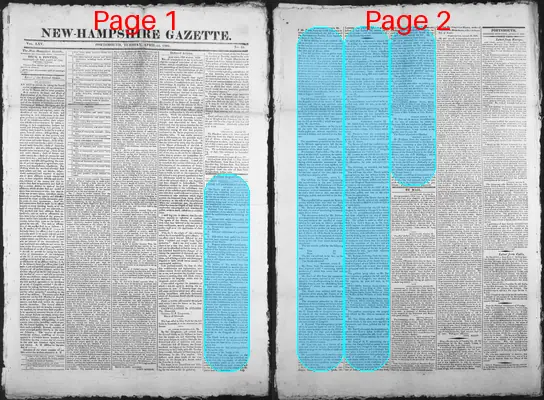
The New Hampshire Gazette
Portsmouth, Rockingham County, New Hampshire
What is this article about?
Proceedings of the 16th U.S. Congress, First Session, in the House and Senate from March 28 to April 3, 1820. Key actions included adopting orders for business consideration, debating and passing bills on revolutionary pensions, military appropriations, land forfeitures, and apportionment for Massachusetts and Maine; resolutions on constitutional amendments and Spanish treaty; Senate discussions on bankruptcy bill, piracy punishment, and adjournment date.
Merged-components note: Continuation of the report on National Legislature proceedings from page 1 to page 2, covering House and Senate sessions sequentially.
Clippings
1 of 2
OCR Quality
Full Text
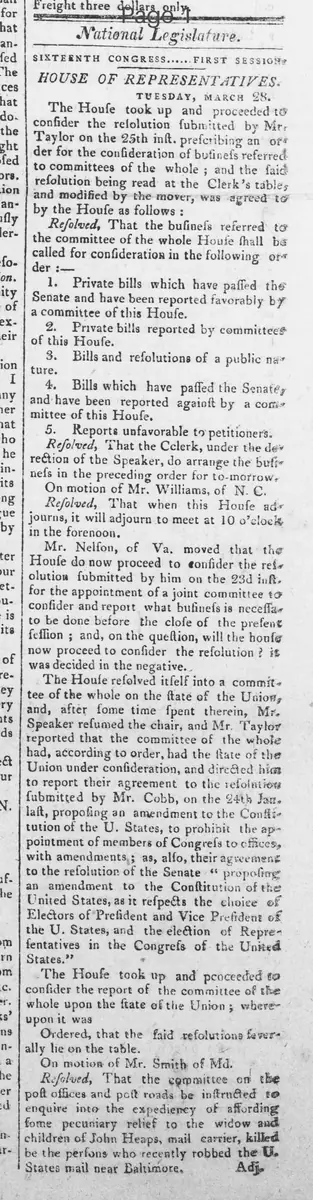
SIXTEENTH CONGRESS—FIRST SESSION.
HOUSE OF REPRESENTATIVES.
TUESDAY, MARCH 28.
The House took up and proceeded to consider the resolution submitted by Mr. Taylor on the 25th inst. prescribing an order for the consideration of business referred to committees of the whole: and the said resolution being read at the Clerk's table and modified by the mover, was agreed to by the House as follows:
Resolved, That the business referred to the committee of the whole House shall be called for consideration in the following order:
1. Private bills which have passed the Senate and have been reported favorably by a committee of this House.
2. Private bills reported by committees of this House.
3. Bills and resolutions of a public nature.
4. Bills which have passed the Senate and have been reported against by a committee of this House.
5. Reports unfavorable to petitioners.
Resolved, That the Clerk, under the direction of the Speaker, do arrange the business in the preceding order for to-morrow.
On motion of Mr. Williams, of N. C.
Resolved, That when this House adjourns, it will adjourn to meet at 10 o'clock in the forenoon.
Mr. Nelson, of Va. moved that the House do now proceed to consider the resolution submitted by him on the 23d inst. for the appointment of a joint committee to consider and report what business is necessary to be done before the close of the present session; and, on the question, will the house now proceed to consider the resolution? it was decided in the negative.
The House resolved itself into a committee of the whole on the state of the Union and, after some time spent therein, Mr. Speaker resumed the chair, and Mr. Taylor reported that the committee of the whole had, according to order, had the state of the Union under consideration, and directed him to report their agreement to the resolution submitted by Mr. Cobb, on the 24th Jan. last, proposing an amendment to the Constitution of the U. States, to prohibit the appointment of members of Congress to offices, with amendments; as, also, their agreement to the resolution of the Senate "proposing an amendment to the Constitution of the United States, as it respects the choice of Electors of President and Vice President of the U. States, and the election of Representatives in the Congress of the United States."
The House took up and proceeded to consider the report of the committee of the whole upon the state of the Union; whereupon it was
Ordered, that the said resolutions severally lie on the table.
On motion of Mr. Smith of Md.
Resolved, That the committee on the post offices and post roads be instructed to enquire into the expediency of affording some pecuniary relief to the widow and children of John Heaps, mail carrier, killed by the persons who recently robbed the U. States mail near Baltimore.
Adjourned.
WEDNESDAY, MARCH 29.
Mr. Storrs, from the select committee to whom was recommitted the bill to amend the Revolutionary Pension Law reported, by leave of the House,
A Bill in addition to an act entitled 'An act to provide for certain persons engaged in the land and naval service of the United States, in the revolutionary war, passed on the 18th day of March, 1818.'
This bill provides that no person entitled to a pension by virtue of the act of March 18, 1818, shall continue to receive such pension after the payment which was due on the 4th of March last, unless he shall have exhibited in some court of record within whose jurisdiction he resides, a schedule of all his estate and income, except necessary bedding and clothing, to be subscribed and sworn to by himself. A certified copy of this schedule, with the opinion of the court of the value of the property, is to be delivered to the Secretary of War, and the pension is not to be continued unless in the opinion of the Secretary of War the pensioner is in such indigent circumstances, as to be unable to support himself.
THURSDAY, MARCH 30.
The bill from the Senate, to apportion the Representatives of the States of Massachusetts and Maine, was received, twice read, and referred to a select committee.
The bill from the Senate further to suspend, for a limited time the sale or forfeiture of lands for non payment of the monies due therefore was read a third time.
A motion was made by Mr. Slocumb to lay the bill on the table; which was opposed by Mr. Anderson.
After debate the motion to lay the bill on the table was overruled; and it was finally passed, not without opposition, but without a division, and returned to the Senate.
FRIDAY, MARCH 31.
The amendments proposed by the Senate to the Military appropriation bill for the current year were read and referred to a committee of the whole house.
Revolutionary Pension Bill.--The bill reported by the select committee, for amending the Pension Law of 1818, was taken up, and debated, at considerable length, during which numerous amendments were offered, but the whole of them rejected, and the bill ordered to a third reading by a large majority. Mr. Strother moved a provision for the total repeal of the law: but it was rejected by a majority of 90.
SATURDAY, APRIL 1.
The bill from the Senate apportioning the representation in the next Congress, from the states of Massachusetts and Maine was reported by Mr. Holmes, from a select committee, without amendment, ordered to be read a third time to day, was read accordingly, passed, and returned to the Senate.
The engrossed bill to amend the Revolutionary Pension Law, was read the third time, and the question stated on its passage.
Mr. Barbour proposed to recommit the bill with the view of introducing the amendment stated below
The amendment desired by Mr. Barbour was adopted by the House, by general consent, and obviated the necessity of recommitting it: and was, to insert a provision that in those cases where any person who had relinquished a pension (as many invalid pensioners have to take the benefit of the act of March 18, 1818,) should be excluded from its benefit by the operation of this bill, the said person shall be forthwith restored to the pension list from which he had been transferred.
The bill was then passed by the following vote:
Yeas 80
Nays 72
The bill was ordered to be sent to the Senate for concurrence; and
The House adjourned.
MONDAY, APRIL 3.
Mr. Rhea, from the committee on pensions, reported a bill 'concerning invalid pensioners;' which was twice read and committed.
Mr. Smith of Md. from the committee of ways and means, reported a bill 'to amend the several acts providing for sick and disabled seamen, and for establishing Navy Hospitals;' which was twice read and committed.
The House then resolved itself into a committee of the whole. Mr. Taylor, of N. Y. in the chair, on the State of the Union; and
The committee proceeded to the consideration of the following resolutions, which were some days ago submitted by Mr. Clay:
1. Resolved, That the Constitution of the U. States vests in Congress the power to dispose of the territory belonging to them, and that no treaty, purporting to alienate any portion thereof, is valid without the concurrence of Congress.
2. Resolved, That the equivalent proposed to be given by Spain to the U. States, in the treaty between them, on the 22d day of Feb 1819, for that part of Louisiana lying west of the Sabine, was inadequate; and that it would be inexpedient to make a transfer thereof to any foreign power, or to renew the aforesaid treaty.
Mr. Clay rose, and in a speech of an hour and a half in length, delivered his opinions at large on the subjects of these resolutions.
Mr. Lowndes rose, not so much in reply, as to shew that it was inexpedient to act on the resolves, and, under all the circumstances, that it was not expedient to engage in a discussion of them.
It being late in the day, and other gentlemen seeming inclined to speak, Mr. Lowndes was prevailed upon to give way before he had finished the remarks he intended to make; and the committee rose; and the House adjourned.
IN SENATE, WEDNESDAY, MARCH 29.
A message was received from the President of the U. States, transmitting, in pursuance of a resolution of the 1st ult. a report of the Secretary of State, respecting the late treaty with Great Britain, relative to the restitution of slaves; and the message and report were read.
Missouri Expedition.--The house resumed the consideration of the military appropriation bill--the question on increasing the appropriation for the Quarter Master General's Department, from 450,000 to 500,000 dollars being still under consideration--
After debate, the question was taken on concurring in the amendment reported by the committee of finance, to increase the appropriation for the Quarter Master General's department, from 450,000 to 500,000 dollars, and decided in the affirmative, yeas 24 nays 18.
Some discussion took place on other points after which,
The amendments were ordered to be engrossed, and, with the bill, to be read a third time.
The engrossed bill apportioning the Representatives from the states of Massachusetts and Maine in the next Congress, was read a third time, passed, and sent to the other House for concurrence.
THURSDAY, MARCH 30.
Mr. Smith from the judiciary committee reported the bill for the punishment of piracy and other crimes, with sundry amendments.
Mr. Pleasants, from the committee on naval affairs, reported a bill establishing the grade of Rear Admiral in the naval service of the U. States.
The Senate resumed the consideration of the resolution offered some days ago by Mr. Otis, that the present session, of Congress be adjourned on the 17th of April.
Mr. Lowrie moved to strike out the 17th and insert the 24th, as the day proposed for the adjournment; which was decided in the affirmative, by yeas and nays--22 to 17.
The resolution, as amended, was finally agreed to, yeas 21, nays 20.
The bill from the other House, making appropriations for the military service for the year 1820, was read the third time, as amended by the Senate, passed, and returned to the House of Representatives for concurrence in the amendments.
The engrossed bill for the relief of certain sufferers at Savannah, was also read the third time, passed, and sent to the other House for concurrence.
Bankrupt Bill.--The Senate then on motion of Mr. Burrill, resumed the consideration of the bill to establish a uniform system of bankruptcy.
Mr. Otis observed that the bill had undergone so material a change in its character, by the principles and provisions which had been added to it by way of amendments, that it had lost much of his friendship. He wished to make an effort to restore it to such a shape as, in his view, would improve its utility and render it less objectionable; and therefore moved 'that the bill be recommitted to the committee on the Judiciary, with instruction to amend the same by striking out the proviso in the first section of the bill enumerating the classes of mechanics and others who are excluded from the operation of the bill; and also with instructions to amend the same by extending the privileges of the act to persons imprisoned for debt, upon their voluntary application therefor.'
Mr. Barbour, believing, from the indications he had perceived, that there was little chance of a majority of the Senate being united in support of any system of bankruptcy at this session, rose to move that this bill be postponed until the next session of Congress.
The question being taken on Mr. Barbour's motion to postpone the bill until the next session of Congress, was decided in the negative, by yeas and nays, as follows:
YEAS--Messrs Barbour, Eaton, Johnson, of Ken. Johnson, of Lou King, of Alab. Leake, Logan, Macon, Morril, Noble, Palmer, Pleasants, Ruggles, Smith, Taylor, Walker, of Alabama, Walker, of Geo Williams, of Tenn. Wilson.--19.
NAYS--Messrs. Brown, Burrill, Dana, Dickerson, Edwards, Elliott, Gaillard, Hunter, King, of N. Y. Lanman, Lowrie, Mellen, Otis, Parrott, Pinkney, Roberts, Sanford, Stokes, Tichenor, Trimble, Van Dyke, Williams, of Miss.--22.
The question recurring on the proposition offered by Mr. Otis to recommit the bill;
Mr. Van Dyke offered succinctly the reasons which, in his view, were opposed to the motion, and which justified the bill as it stood.
Mr. Burrill advocated the recommittal, particularly from a desire to discard that feature which applies the act, to all classes of debtors to a certain amount, by their voluntary consent.
Mr. King of N. Y. maintaining the opinion that Congress had no power to enact an insolvent law, though it had the power, emphatically given, to pass a bankrupt law, was rather in favor of a course that would try specific questions on these principles, instead of recommittal. If the Senate should finally insist on stretching the powers of the government to the enactment of the principles adopted on the motion of Mr. Van Dyke anxious as he was for a bankrupt law of some kind, and of almost any kind,
within the terms of the constitution--for defects might be remedied hereafter, according to experience--he should be constrained to vote against the bill. Mr. K. argued his opinions at some length.
Mr. Otis defended the course he had proposed, as the only mode of getting at his object, inasmuch as the amendments having been agreed to, could not now be reached by any specific and direct motion in the Senate; and he also explained more at large his views of the principles in question, concurring with Mr. King so far as to doubt whether an insolvent act, which Mr. Van Dyke's amendment would amount to, was in the contemplation of the framers of the constitution; he argued against this principle also from its practical operation upon the business and affairs of society.
The question was then taken on the motion to recommit the bill, and was negatived, without a division.
The question was taken on ordering the bill, as amended, to be engrossed and read a third time, and was decided in the negative, by ayes and nays, as follows:
YEAS--Messrs. Burrill, Dana, Dickerson, Elliott, Gaillard, Hunter, Lanman, Mellen, Parrott, Pinkney Roberts, Sanford, Stokes, Tichenor, Van Dyke.--15.
NAYS--Messrs. Barbour, Brown, Eaton. Johnson, of Ky. Johnson, of Lou. King. of Alab King. of N. Y. Leake. Lowrie, Macon, Morril, Otis. Palmer. Pleasants, Ruggles, Smith, Taylor, Trimble. Walker, of Alab. Walker, of Georgia Williams of Miss. Williams, of Tenn. Wilson,--23.
FRIDAY, MARCH 31.
Mr Otis rose to move a reconsideration of the vote of yesterday, by which the Bankrupt Bill was indefinitely postponed.--
The question being taken on the motion for reconsideration. it was decided in the negative, yeas 17, nays 19.
The Senate adjourned to Monday.
MONDAY, APRIL 3.
Mr. Pleasants, from the committee on naval affairs, communicated to the Senate a document, containing a plan (by Lieut. Ramage, of the Navy) for the defence of the commerce and the protection of the revenue of the United States in the Gulf of Mexico, near the river Mississippi: which was read and ordered to be printed.
The Senate resumed, as in committee of the whole, the bill 'more effectually to provide for the punishment of crimes against the U. States, and for other purposes, (to revise and embody in one act various penal laws of the United States.)
The bill--consisting of thirty-three printed folio pages, and embracing a great mass of detail--was read through, and some progress made in the consideration of its provisions: when The Senate adjourned.
What sub-type of article is it?
What keywords are associated?
What entities or persons were involved?
Domestic News Details
Event Date
March 28 April 3, 1820
Key Persons
Outcome
various bills passed or rejected, including revolutionary pension bill (passed house 80-72), military appropriation bill (amendments passed senate 24-18), bankrupt bill (postponed indefinitely in senate), land forfeiture suspension bill passed house, apportionment bill for massachusetts and maine passed both houses; resolutions on business order adopted, constitutional amendments tabled, adjournment set for april 24; relief inquired for mail carrier's family.
Event Details
The House of Representatives and Senate conducted sessions discussing and voting on multiple legislative items: order of business resolution adopted; committee reports on pensions, seamen, invalid pensioners; debates on constitutional amendments prohibiting congressional appointments and elector choices; Clay's resolutions on Spanish treaty and territorial disposition begun; Senate received presidential message on slave treaty, passed military appropriations and apportionment bills, debated and rejected bankruptcy bill recommittal and passage, reported bills on piracy, rear admiral grade, crimes punishment; adjournment resolution amended to April 24.