Thank you for visiting SNEWPapers!
Sign up free
Story
June 6, 1939
Imperial Valley Press
El Centro, Imperial County, California
What is this article about?
Post-Prohibition, U.S. Treasury focuses on moonshiners as big-city bootlegging and smuggling decline; 1938 tax hike has little effect; per capita liquor consumption below pre-1910 levels despite population growth.
Clipping
OCR Quality
98%
Excellent
Full Text
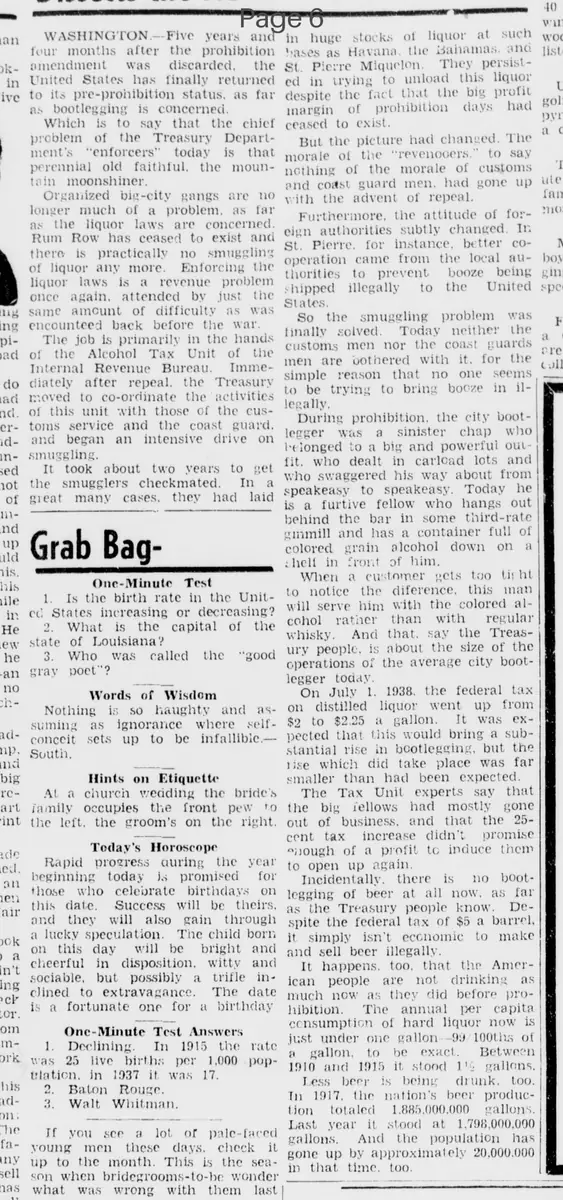
WASHINGTON.—Five years and four months after the prohibition amendment was discarded, the United States has finally returned to its pre-prohibition status, as far as bootlegging is concerned.
Which is to say that the chief problem of the Treasury Department's "enforcers" today is that perennial old faithful, the mountain moonshiner.
Organized big-city gangs are no longer much of a problem, as far as the liquor laws are concerned. Rum Row has ceased to exist and there is practically no smuggling of liquor any more. Enforcing the liquor laws is a revenue problem once again, attended by just the same amount of difficulty as was encountered back before the war.
The job is primarily in the hands of the Alcohol Tax Unit of the Internal Revenue Bureau. Immediately after repeal, the Treasury moved to co-ordinate the activities of this unit with those of the customs service and the coast guard, and began an intensive drive on smuggling.
It took about two years to get the smugglers checkmated. In a great many cases, they had laid in huge stocks of liquor at such bases as Havana, the Bahamas, and St. Pierre Miquelon. They persisted in trying to unload this liquor despite the fact that the big profit margin of prohibition days had ceased to exist.
But the picture had changed. The morale of the "revenooers," to say nothing of the morale of customs and coast guard men, had gone up with the advent of repeal.
Furthermore, the attitude of foreign authorities subtly changed. In St. Pierre, for instance, better co-operation came from the local authorities to prevent booze being shipped illegally to the United States.
So the smuggling problem was finally solved. Today neither the customs men nor the coast guardsmen are bothered with it, for the simple reason that no one seems to be trying to bring booze in illegally.
During prohibition, the city bootlegger was a sinister chap who belonged to a big and powerful outfit, who dealt in carload lots and who swaggered his way about from speakeasy to speakeasy. Today he is a furtive fellow who hangs out behind the bar in some third-rate ginmill and has a container full of colored grain alcohol down on a shelf in front of him.
When a customer gets too tight to notice the difference, this man will serve him with the colored alcohol rather than with regular whisky. And that, say the Treasury people, is about the size of the operations of the average city bootlegger today.
On July 1, 1938, the federal tax on distilled liquor went up from $2 to $2.25 a gallon. It was expected that this would bring a substantial rise in bootlegging, but the rise which did take place was far smaller than had been expected.
The Tax Unit experts say that the big fellows had mostly gone out of business, and that the 25-cent tax increase didn't promise enough of a profit to induce them to open up again.
Incidentally, there is no bootlegging of beer at all now, as far as the Treasury people know. Despite the federal tax of $5 a barrel, it simply isn't economic to make and sell beer illegally.
It happens, too, that the American people are not drinking as much now as they did before prohibition. The annual per capita consumption of hard liquor now is just under one gallon—0.99 tenths of a gallon, to be exact. Between 1910 and 1915 it stood 1.1 gallons.
Less beer is being drunk, too. In 1917, the nation's beer production totaled 1,885,000,000 gallons. Last year it stood at 1,798,000,000 gallons. And the population has gone up by approximately 20,000,000 in that time, too.
Which is to say that the chief problem of the Treasury Department's "enforcers" today is that perennial old faithful, the mountain moonshiner.
Organized big-city gangs are no longer much of a problem, as far as the liquor laws are concerned. Rum Row has ceased to exist and there is practically no smuggling of liquor any more. Enforcing the liquor laws is a revenue problem once again, attended by just the same amount of difficulty as was encountered back before the war.
The job is primarily in the hands of the Alcohol Tax Unit of the Internal Revenue Bureau. Immediately after repeal, the Treasury moved to co-ordinate the activities of this unit with those of the customs service and the coast guard, and began an intensive drive on smuggling.
It took about two years to get the smugglers checkmated. In a great many cases, they had laid in huge stocks of liquor at such bases as Havana, the Bahamas, and St. Pierre Miquelon. They persisted in trying to unload this liquor despite the fact that the big profit margin of prohibition days had ceased to exist.
But the picture had changed. The morale of the "revenooers," to say nothing of the morale of customs and coast guard men, had gone up with the advent of repeal.
Furthermore, the attitude of foreign authorities subtly changed. In St. Pierre, for instance, better co-operation came from the local authorities to prevent booze being shipped illegally to the United States.
So the smuggling problem was finally solved. Today neither the customs men nor the coast guardsmen are bothered with it, for the simple reason that no one seems to be trying to bring booze in illegally.
During prohibition, the city bootlegger was a sinister chap who belonged to a big and powerful outfit, who dealt in carload lots and who swaggered his way about from speakeasy to speakeasy. Today he is a furtive fellow who hangs out behind the bar in some third-rate ginmill and has a container full of colored grain alcohol down on a shelf in front of him.
When a customer gets too tight to notice the difference, this man will serve him with the colored alcohol rather than with regular whisky. And that, say the Treasury people, is about the size of the operations of the average city bootlegger today.
On July 1, 1938, the federal tax on distilled liquor went up from $2 to $2.25 a gallon. It was expected that this would bring a substantial rise in bootlegging, but the rise which did take place was far smaller than had been expected.
The Tax Unit experts say that the big fellows had mostly gone out of business, and that the 25-cent tax increase didn't promise enough of a profit to induce them to open up again.
Incidentally, there is no bootlegging of beer at all now, as far as the Treasury people know. Despite the federal tax of $5 a barrel, it simply isn't economic to make and sell beer illegally.
It happens, too, that the American people are not drinking as much now as they did before prohibition. The annual per capita consumption of hard liquor now is just under one gallon—0.99 tenths of a gallon, to be exact. Between 1910 and 1915 it stood 1.1 gallons.
Less beer is being drunk, too. In 1917, the nation's beer production totaled 1,885,000,000 gallons. Last year it stood at 1,798,000,000 gallons. And the population has gone up by approximately 20,000,000 in that time, too.
What sub-type of article is it?
Historical Event
What themes does it cover?
Crime Punishment
What keywords are associated?
Bootlegging
Prohibition Repeal
Moonshining
Liquor Enforcement
Alcohol Consumption
Where did it happen?
United States
Story Details
Location
United States
Event Date
1938
Story Details
Five years after Prohibition repeal, U.S. liquor enforcement returns to pre-war focus on mountain moonshiners, with organized city gangs and smuggling diminished; tax increase has minimal impact on bootlegging, and alcohol consumption is lower than pre-Prohibition levels.