Thank you for visiting SNEWPapers!
Sign up free
The Virginia Gazette
Richmond, Williamsburg, Richmond County, Virginia
What is this article about?
London, June 16, 1779: Spanish Ambassador delivers manifesto declaring war on Britain over mediation failures in Anglo-French-American disputes, territorial violations in Americas, and flag insults. King's message rejects claims, recalls ambassador. Parliament debates, passes address supporting mobilization against Spain and France; proclamation of reprisals issued June 27.
Clipping
OCR Quality
Full Text
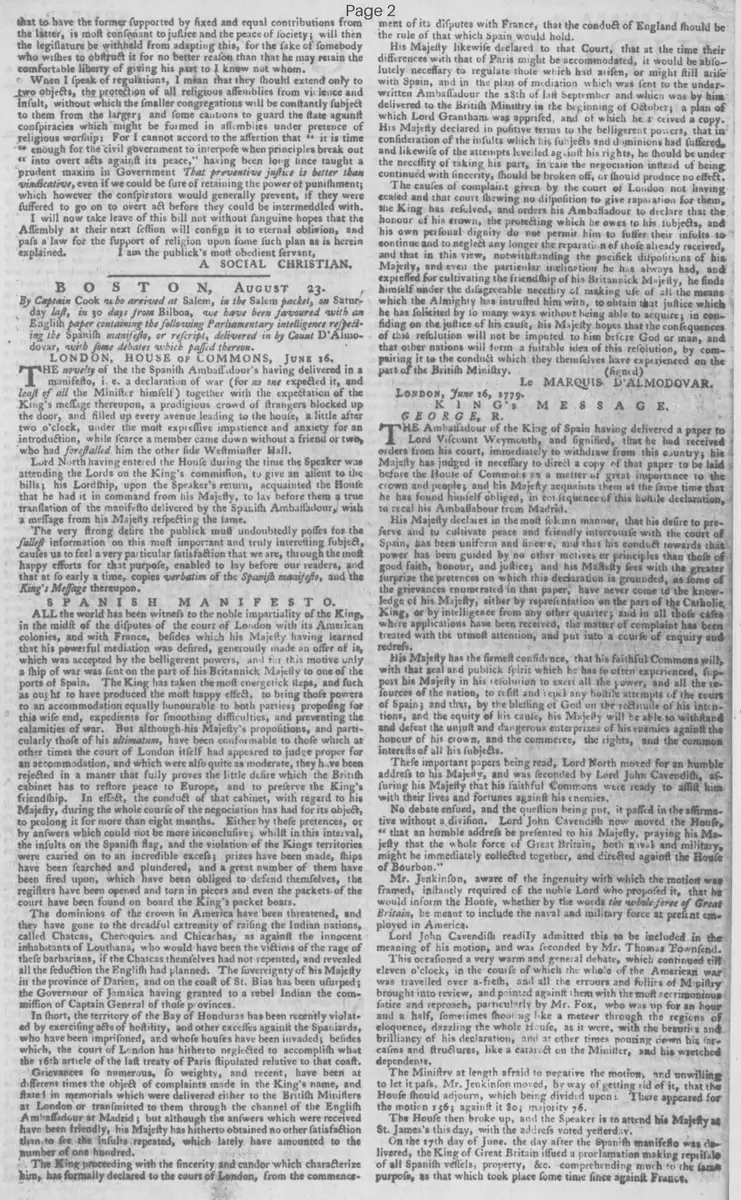
By Captain Cook who arrived at Salem, in the Salem packet, on Saturday last, in 30 days from Bilboa, we have been favoured with an English paper containing the following Parliamentary intelligence respecting the Spanish manifesto, or rescript, delivered in by Count D'Almodovar, with some debates which passed thereon.
LONDON, HOUSE OF COMMONS, JUNE 16.
manifesto, i. e. a declaration of war (for no one expected it, and least of all the Minister himself) together with the expectation of the King's message thereupon, a prodigious crowd of strangers blocked up the door, and filled up every avenue leading to the house, a little after two o'clock, under the most expressive impatience and anxiety for an introduction, while scarce a member came down without a friend or two who had forestalled him the other side Westminster Hall.
Lord North having entered the House during the time the Speaker was attending the Lords on the King's commission, to give an assent to the bills; his Lordship, upon the Speaker's return, acquainted the House that he had it in command from his Majesty, to lay before them a true translation of the manifesto delivered by the Spanish Ambassador, with a message from his Majesty respecting the same.
The very strong desire the publick must undoubtedly possess for the fullest information on this most important and truly interesting subject, causes us to feel a very particular satisfaction that we are, through the most happy efforts for that purpose, enabled to lay before our readers, and that at so early a time, copies verbatim of the Spanish manifesto, and the King's Message thereupon.
SPANISH MANIFESTO.
ALL the world has been witness to the noble impartiality of the King in the midst of the disputes of the court of London with its American colonies, and with France, besides which his Majesty having learned that his powerful mediation was desired, generously made an offer of it, which was accepted by the belligerent powers, and for this motive only a ship of war was sent on the part of his Britannick Majesty to one of the ports of Spain. The King has taken the most energetick steps, and such as ought to have produced the most happy effect, to bring those powers to an accommodation equally honourable to both parties; proposing for this wise end, expedients for smoothing difficulties, and preventing the calamities of war. But although his Majesty's propositions, and particularly those of his ultimatum, have been conformable to those which at other times the court of London itself had appeared to judge proper for an accommodation, and which were also quite as moderate, they have been rejected in a manner that fully proves the little desire which the British cabinet has to restore peace to Europe, and to preserve the King's friendship. In effect, the conduct of that cabinet, with regard to his Majesty, during the whole course of the negociation has had for its object, to prolong it for more than eight months. Either by these pretences, or by answers which could not be more inconclusive; whilst in this interval, the insults on the Spanish flag, and the violation of the Kings territories were carried on to an incredible excess; prizes have been made, ships have been searched and plundered, and a great number of them have been fired upon, which have been obliged to defend themselves, the registers have been opened and torn in pieces and even the packets of the court have been found on board the King's packet boats.
The dominions of the crown in America have been threatened, and they have gone to the dreadful extremity of raising the Indian nations, called Chactas, Cheroquies and Chicachas, as against the innocent inhabitants of Louisiana, who would have been the victims of the rage of these barbarians, if the Chactas themselves had not repented, and revealed all the seduction the English had planned. The sovereignty of his Majesty in the province of Darien, and on the coast of St. Bias has been usurped; the Governour of Jamaica having granted to a rebel Indian the commission of Captain General of those provinces.
In short, the territory of the Bay of Honduras has been recently violated by exercising acts of hostility, and other excesses against the Spaniards, who have been imprisoned, and whose houses have been invaded; besides which, the court of London has hitherto neglected to accomplish what the 6th article of the last treaty of Paris stipulated relative to that coast.
Grievances numerous, weighty, and recent, have been at different times the object of complaints made in the King's name, and stated in memorials which were delivered either to the British Ministers at London or transmitted to them through the channel of the English Ambassador at Madrid; but although the answers which were received have been friendly, his Majesty has hitherto obtained no other satisfaction than, to see the insults repeated, which lately have amounted to the number of one hundred.
The King proceeding with the sincerity and candor which characterize him, has formally declared to the court of London, from the commencement of its disputes with France, that the conduct of England should be the rule of that which Spain would hold.
His Majesty likewise declared to that Court, that at the time their differences with that of Paris might be accommodated, it would be absolutely necessary to regulate those which had arisen, or might still arise with Spain, and in the plan of mediation which was sent to the underwritten Ambassador the 28th of last September and which was by him delivered to the British Ministry in the beginning of October; a plan of which Lord Grantham was apprised, and of which he received a copy.
His Majesty declared in positive terms to the belligerent powers, that in consideration of the insults which his subjects and dominions had suffered. and likewise of the attempts levelled against his rights, he should be under the necessity of taking his part, in case the negociation instead of being continued with sincerity, should be broken off, or should produce no effect.
The causes of complaint given by the court of London not having ceased and that court shewing no disposition to give reparation for them, the King has resolved, and orders his Ambassador to declare that the honour of his crown, the protecting which he owes to his subjects, and his own personal dignity do not permit him to suffer their insults to continue and to neglect any longer the reparation of those already received, and that in this view, notwithstanding the pacifick dispositions of his Majesty, and even the particular inclination he has always had, and expressed for cultivating the friendship of his Britannick Majesty, he finds himself under the disagreeable necessity of making use of all the means which the Almighty has intrusted him with, to obtain that justice which he has solicited by so many ways without being able to acquire; in confiding on the justice of his cause, his Majesty hopes that the consequences of this resolution will not be imputed to him before God or man, and that other nations will form a suitable idea of this resolution, by comparing it to the conduct which they themselves have experienced on the part of the British Ministry.
(signed)
Le MARQUIS D'ALMODOVAR.
London, June 16, 1779
KING'S MESSAGE.
GEORGE, R.
Lord Viscount Weymouth, and signified, that he had received orders from his court, immediately to withdraw from this country; his Majesty has judged it necessary to direct a copy of that paper to be laid before the House of Commons as a matter of great importance to the crown and people; and his Majesty acquaints them at the same time that he has found himself obliged, in consequence of this hostile declaration, to recall his Ambassador from Madrid.
His Majesty declares in the most solemn manner, that his desire to preserve and to cultivate peace and friendly intercourse with the court of Spain, has been uniform and sincere, and that his conduct towards that power has been guided by no other motives or principles than those of good faith, honour, and justice; and his Majesty sees with the greater surprise the pretences on which this declaration is grounded, as some of the grievances enumerated in that paper, have never come to the knowledge of his Majesty, either by representation on the part of the Catholie King, or by intelligence from any other quarter; and in all those cases where applications have been received, the matter of complaint has been treated with the utmost attention, and put into a course of enquiry and redress.
His Majesty has the firmest confidence, that his faithful Commons will, with that zeal and publick spirit which he has so often experienced, support his Majesty in his resolution to exert all the power, and all the resources of the nation, to resist and repel any hostile attempts of the court of Spain; and that, by the blessing of God on the rectitude of his intentions, and the equity of his cause, his Majesty will be able to withstand and defeat the unjust and dangerous enterprizes of his enemies against the honour of his crown, and the commerce, the rights, and the common interests of all his Subjects.
These important papers being read, Lord North moved for an humble address to his Majesty, and was seconded by Lord John Cavendish, assuring his Majesty that his faithful Commons were ready to assist him with their lives and fortunes against his enemies.
No debate ensued, and the question being put, it passed in the affirmative without a division. Lord John Cavendish now moved the House, "that an humble address be presented to his Majesty, praying his Majesty that the whole force of Great Britain, both naval and military. might be immediately collected together, and directed against the House of Bourbon."
Mr. Jenkinson, aware of the ingenuity with which the motion was framed, instantly required of the noble Lord who proposed it, that he would inform the House, whether by the words the whole force of Great Britain, he meant to include the naval and military force at present employed in America.
Lord John Cavendish readily admitted this to be included in the meaning of his motion, and was seconded by Mr. Thomas Townshend.
This occasioned a very warm and general debate, which continued till eleven o'clock, in the course of which the whole of the American war was travelled over afresh, and all the errors and follies of Ministry brought into review, and pointed against them with the most acrimonious satire and reproach, particularly by Mr. Fox, who was up for an hour and a half, sometimes shooting like a meteor through the regions of eloquence, dazzling the whole House, as it were, with the beauties and brilliancy of his declamation, and at other times pouring down his sarcasms and strictures, like a cataract on the Minister, and his wretched dependents.
The Ministry at length afraid to negative the motion, and unwilling to let it pass, Mr. Jenkinson moved, by way of getting rid of it, that the House should adjourn, which being divided upon: There appeared for the motion 156; against it 80; majority 76.
The House then broke up, and the Speaker is to attend his Majesty at St. James's this day, with the address voted yesterday.
On the 27th day of June, the day after the Spanish manifesto was delivered, the King of Great Britain issued a proclamation making reprisal of all Spanish vessels, property, &c. comprehending much to the same purpose, as that which took place some time since against France.
What sub-type of article is it?
What keywords are associated?
What entities or persons were involved?
Where did it happen?
Foreign News Details
Primary Location
London
Event Date
June 16, 1779
Key Persons
Outcome
spain declares war on britain via manifesto listing grievances including mediation failures, flag insults, and american territorial violations; britain recalls ambassador, issues reprisal proclamation on june 27, parliament passes address supporting resistance and debates full mobilization against bourbon powers.
Event Details
Spanish manifesto delivered by Marquis d'Almodovar details Spain's impartial mediation in British disputes with France and American colonies, rejected British proposals, prolonged negotiations amid escalating insults to Spanish flag and territories in America (Louisiana, Darien, Honduras Bay), incitement of Indian nations, and treaty violations. Spain declares necessity to use force for justice. King's message asserts sincere peace efforts, denies unknown grievances, calls for parliamentary support to resist Spain. Lord North lays papers before Commons; address passed unanimously. Debate on Cavendish's motion to direct all British forces against House of Bourbon, including American theater, adjourned by ministry majority.