Thank you for visiting SNEWPapers!
Sign up free
Literary
November 4, 1826
Literary Cadet, And Saturday Evening Bulletin
Providence, Providence County, Rhode Island
What is this article about?
English officer Arthur Dearden, seeking health in Madeira, encounters and romances Rose Raimonde, the only daughter of a retired British army gentleman. He woos her with promises of marriage amid idyllic settings, but deceives her regarding his intentions, causing her distress as her health declines.
Clipping
OCR Quality
98%
Excellent
Full Text
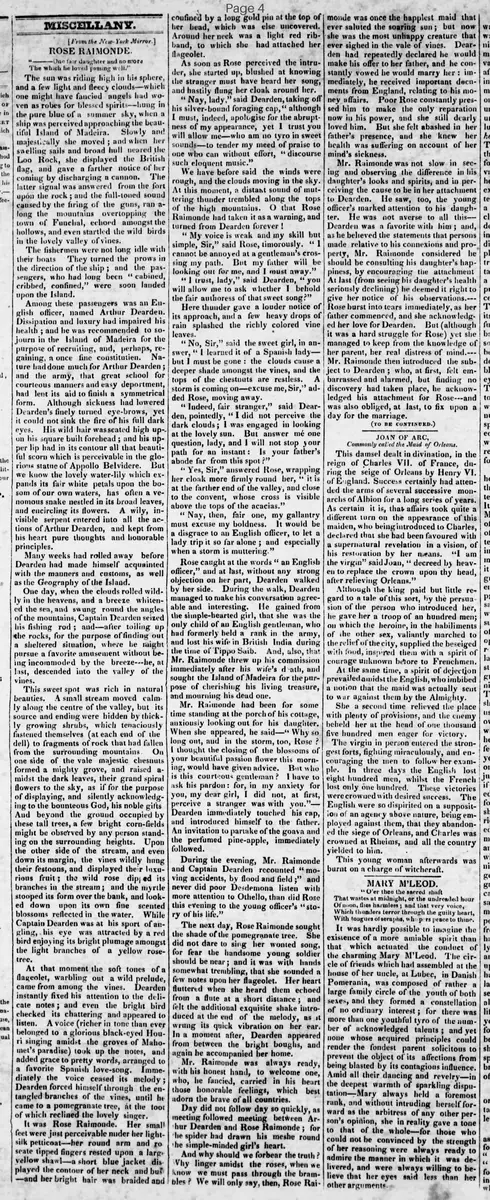
MISCELLANY.
[From the New-York Mirror.]
ROSE RAIMONDE.
-One fair daughter and no more
The which he loved passing well.'
The sun was riding high in his sphere, and a few light and fleecy clouds--which one might have fancied angels had woven as robes for blessed spirits--hung in the pure blue of a summer sky, when a ship was perceived approaching the beautiful Island of Madeira. Slowly and majestically she moved; and when her swelling sails and broad hull neared the Loo Rock, she displayed the British flag, and gave a farther notice of her coming by discharging a cannon. The latter signal was answered from the fort upon the rock; and the full-toned sound caused by the firing of the guns, ran along the mountains overtopping the town of Funchal, echoed amongst the hollows, and even startled the wild birds in the lovely valley of vines.
The fishermen were not long idle with their boats. They turned the prows in the direction of the ship; and the passengers, who had long been "cabined, cribbed, confined," were soon landed upon the Island.
Among these passengers was an English officer, named Arthur Dearden. Dissipation and luxury had impaired his health; and he was recommended to sojourn in the Island of Madeira for the purpose of recruiting, and, perhaps, regaining, a once fine constitution. Nature had done much for Arthur Dearden; and the army, that great school for courteous manners and easy deportment, had lent its aid to finish a symmetrical form. Although sickness had lowered Dearden's finely turned eye-brows, yet it could not sink the fire of his full dark eyes. His wild hair was seated high up on his square built forehead; and his upper lip had in its contour all that beautiful scorn which is perceivable in the glorious statue of Apollo Belvidere. But we know the lovely water-lily which expands its fair white petals upon the bosom of our own waters, has often a venomous snake nestled in its broad leaves, and encircling its flowers. A wily, invisible serpent entered into all the actions of Arthur Dearden, and kept from his heart pure thoughts and honorable principles.
Many weeks had rolled away before Dearden had made himself acquainted with the manners and customs, as well as the Geography of the Island. One day, when the clouds rolled wildly in the heavens, and a breeze whitened the sea, and swung round the angles of the mountains, Captain Dearden seized his fishing rod; and--after toiling up the rocks, for the purpose of finding out a sheltered situation, where he might pursue a favorite amusement without being incommoded by the breeze---he, at last, descended into the valley of the vines.
This sweet spot was rich in natural beauties. A small stream moved calmly along the centre of the valley, but its source and ending were hidden by thickly growing shrubs, which tenaciously fastened themselves (at each end of the dell) to fragments of rock that had fallen from the surrounding mountains. On one side of the vale majestic chestnuts formed a mighty grove, and raised amidst the dark leaves, their grand spiral flowers to the sky, as if for the purpose of displaying, and silently acknowledging to the bounteous God, his noble gifts. And beyond the ground occupied by these tall trees, a few bright corn-fields might be observed by any person standing on the surrounding heights. Upon the other side of the stream, and even down its margin, the vines wildly hung their festoons, and displayed their luxurious fruit; the wild rose dipt its branches in the stream; and the myrtle stooped its form over the bank, and looked down upon its own fine scented blossoms reflected in the water. While Captain Dearden was at his sport of angling, his eye was attracted by a red bird enjoying its bright plumage amongst the light branches of a yellow rose-tree.
At that moment the soft tones of a flageolet, warbling out a wild prelude, came from among the vines. Dearden instantly fixed his attention to the delicate notes; and even the bright bird checked its chattering and appeared to listen. A voice (richer in tone than ever belonged to a glorious black-eyed Houri singing amidst the groves of Mahomet's paradise) took up the notes, and added grace to pretty words, arranged to a favorite Spanish love-song. Immediately the voice ceased its melody: Dearden forced himself through the entangled branches of the vines, until he came to a pomegranate tree, at the foot of which reclined the lovely singer.
It was Rose Raimonde. Her small feet were just perceivable under her light-silk petticoat--her round arm and roseate tipped fingers rested upon a large yellow shawl--a short blue jacket displayed the contour of her neck and bust--and her bright hair was braided and confined by a long gold pin at the top of her head, which was else uncovered. Around her neck was a light red ribbon, to which she had attached her flageolet.
As soon as Rose perceived the intruder, she started up, blushed at knowing the stranger must have heard her song, and hastily flung her cloak around her.
"Nay, lady," said Dearden, taking off his silver-bound foraging cap, "although I must, indeed, apologise for the abruptness of my appearance, yet I trust you will allow me--who am no tyro in sweet sounds--to tender my meed of praise to one who can without effort, 'discourse such eloquent music.'"
We have before said the winds were rough, and the clouds moving in the sky. At this moment, a distant sound of muttering thunder trembled along the tops of the high mountains. O that Rose Raimonde had taken it as a warning, and turned from Dearden forever!
"My voice is weak and my skill but simple, Sir," said Rose, timorously. "I cannot be annoyed at a gentleman's crossing my path. But my father will be looking out for me, and I must away."
"I trust, lady," said Dearden, "you will allow me to ask whether I behold the fair authoress of that sweet song?"
Here thunder gave a louder notice of its approach, and a few heavy drops of rain splashed the richly colored vine leaves.
"No, Sir," said the sweet girl, in answer, "I learned it of a Spanish lady--but I must be gone: the clouds cause a deeper shade amongst the vines, and the tops of the chestnuts are restless. A storm is coming on--excuse me, Sir," added Rose, moving away.
"Indeed, fair stranger," said Dearden, pointedly, "I did not perceive the dark clouds; I was engaged in looking at the lovely sun. But answer me one question, lady, and I will not stop your path for an instant: Is your father's abode far from this spot?"
"Yes, Sir," answered Rose, wrapping her cloak more firmly round her, "it is at the farther end of the valley, and close to the convent, whose cross is visible above the tops of the acacias."
"Nay, then, fair one, my gallantry must excuse my boldness. It would be a disgrace to an English officer, to let a lady trip it so far alone; and especially when a storm is muttering."
Rose caught at the words "an English officer," and at last, without any strong objection on her part, Dearden walked by her side. During the walk, Dearden managed to make his conversation agreeable and interesting. He gained from the simple-hearted girl, that she was the only child of an English gentleman, who had formerly held a rank in the army, and lost his wife in British India during the time of Tippo Saib. And, also, that Mr. Raimonde threw up his commission immediately after his wife's death, and sought the Island of Madeira for the purpose of cherishing his living treasure, and mourning his dead one.
Mr. Raimonde had been for some time standing at the porch of his cottage, anxiously looking out for his daughter. When she appeared, he said--"Why so long out, and in the storm, too, Rose? I thought the closing of the blossoms of your beautiful passion flower this morning, would have given advice. But who is this courteous gentleman? I have to ask his pardon: for, in my anxiety for you, my dear girl, I did not, at first, perceive a stranger was with you."
Dearden immediately touched his cap, and introduced himself to the father. An invitation to partake of the guava and the perfumed pine-apple, immediately followed.
During the evening, Mr. Raimonde and Captain Dearden recounted "moving accidents, by flood and field;" and never did poor Desdemona listen with more attention to Othello, than did Rose this evening to the young officer's "story of his life."
The next day, Rose Raimonde sought the shade of the pomegranate tree. She did not dare to sing her wonted song, for fear the handsome young soldier should be near; and it was with hands somewhat trembling, that she sounded a few notes upon her flageolet. Her heart fluttered when she heard them echoed from a flute at a short distance: and felt the additional exquisite shake introduced at the end of the melody, as it wrung its quick vibration on her ear.
In a moment after, Dearden appeared from between the bright boughs, and again he accompanied her home.
Mr. Raimonde was always ready with his honest hand, to welcome one, who, he fancied, carried in his heart those honorable feelings, which best adorn the brave of all countries.
Day did not follow day so quickly, as meeting followed meeting between Arthur Dearden and Rose Raimonde; for the spider had drawn his meshes round the simple-minded girl's heart.
And why should we forbear the truth? Why linger amidst the roses, when we know we must pass through the brambles? We will only say, then, Rose Raimonde was once the happiest maid that ever saluted the soaring sun; but now she was the most unhappy creature that ever sighed in the vale of vines. Dearden had repeatedly declared he would make his offer to her father, and he constantly vowed he would marry her: immediately, he received important documents from England, relating to his money affairs. Poor Rose constantly pressed him to make the only reparation now in his power, and she still dearly loved him. But she felt abashed in her father's presence, and she knew her health was suffering on account of her mind's sickness.
Mr. Raimonde was not slow in seeing and observing the difference in his daughter's looks and spirits, and in perceiving the cause to be in her attachment to Dearden. He saw, too, the young officer's marked attention to his daughter. He was not averse to all this--Dearden was a favorite with him; and, as he believed the statements that persons made relative to his connexions and property, Mr. Raimonde considered he should be consulting his daughter's happiness, by encouraging the attachment.
At last (from seeing his daughter's health seriously declining) he deemed it right to give her notice of his observations.--
Rose burst into tears immediately, as her father commenced, and she acknowledged her love for Dearden. But (although it was a hard struggle for Rose) yet she managed to keep from the knowledge of her parent, her real distress of mind.--
Mr. Raimonde then introduced the subject to Dearden; who, at first, felt embarrassed and alarmed, but finding no discovery had taken place, he acknowledged his attachment for Rose---and was also obliged, at last, to fix upon a day for the marriage.
(TO BE CONTINUED.)
[From the New-York Mirror.]
ROSE RAIMONDE.
-One fair daughter and no more
The which he loved passing well.'
The sun was riding high in his sphere, and a few light and fleecy clouds--which one might have fancied angels had woven as robes for blessed spirits--hung in the pure blue of a summer sky, when a ship was perceived approaching the beautiful Island of Madeira. Slowly and majestically she moved; and when her swelling sails and broad hull neared the Loo Rock, she displayed the British flag, and gave a farther notice of her coming by discharging a cannon. The latter signal was answered from the fort upon the rock; and the full-toned sound caused by the firing of the guns, ran along the mountains overtopping the town of Funchal, echoed amongst the hollows, and even startled the wild birds in the lovely valley of vines.
The fishermen were not long idle with their boats. They turned the prows in the direction of the ship; and the passengers, who had long been "cabined, cribbed, confined," were soon landed upon the Island.
Among these passengers was an English officer, named Arthur Dearden. Dissipation and luxury had impaired his health; and he was recommended to sojourn in the Island of Madeira for the purpose of recruiting, and, perhaps, regaining, a once fine constitution. Nature had done much for Arthur Dearden; and the army, that great school for courteous manners and easy deportment, had lent its aid to finish a symmetrical form. Although sickness had lowered Dearden's finely turned eye-brows, yet it could not sink the fire of his full dark eyes. His wild hair was seated high up on his square built forehead; and his upper lip had in its contour all that beautiful scorn which is perceivable in the glorious statue of Apollo Belvidere. But we know the lovely water-lily which expands its fair white petals upon the bosom of our own waters, has often a venomous snake nestled in its broad leaves, and encircling its flowers. A wily, invisible serpent entered into all the actions of Arthur Dearden, and kept from his heart pure thoughts and honorable principles.
Many weeks had rolled away before Dearden had made himself acquainted with the manners and customs, as well as the Geography of the Island. One day, when the clouds rolled wildly in the heavens, and a breeze whitened the sea, and swung round the angles of the mountains, Captain Dearden seized his fishing rod; and--after toiling up the rocks, for the purpose of finding out a sheltered situation, where he might pursue a favorite amusement without being incommoded by the breeze---he, at last, descended into the valley of the vines.
This sweet spot was rich in natural beauties. A small stream moved calmly along the centre of the valley, but its source and ending were hidden by thickly growing shrubs, which tenaciously fastened themselves (at each end of the dell) to fragments of rock that had fallen from the surrounding mountains. On one side of the vale majestic chestnuts formed a mighty grove, and raised amidst the dark leaves, their grand spiral flowers to the sky, as if for the purpose of displaying, and silently acknowledging to the bounteous God, his noble gifts. And beyond the ground occupied by these tall trees, a few bright corn-fields might be observed by any person standing on the surrounding heights. Upon the other side of the stream, and even down its margin, the vines wildly hung their festoons, and displayed their luxurious fruit; the wild rose dipt its branches in the stream; and the myrtle stooped its form over the bank, and looked down upon its own fine scented blossoms reflected in the water. While Captain Dearden was at his sport of angling, his eye was attracted by a red bird enjoying its bright plumage amongst the light branches of a yellow rose-tree.
At that moment the soft tones of a flageolet, warbling out a wild prelude, came from among the vines. Dearden instantly fixed his attention to the delicate notes; and even the bright bird checked its chattering and appeared to listen. A voice (richer in tone than ever belonged to a glorious black-eyed Houri singing amidst the groves of Mahomet's paradise) took up the notes, and added grace to pretty words, arranged to a favorite Spanish love-song. Immediately the voice ceased its melody: Dearden forced himself through the entangled branches of the vines, until he came to a pomegranate tree, at the foot of which reclined the lovely singer.
It was Rose Raimonde. Her small feet were just perceivable under her light-silk petticoat--her round arm and roseate tipped fingers rested upon a large yellow shawl--a short blue jacket displayed the contour of her neck and bust--and her bright hair was braided and confined by a long gold pin at the top of her head, which was else uncovered. Around her neck was a light red ribbon, to which she had attached her flageolet.
As soon as Rose perceived the intruder, she started up, blushed at knowing the stranger must have heard her song, and hastily flung her cloak around her.
"Nay, lady," said Dearden, taking off his silver-bound foraging cap, "although I must, indeed, apologise for the abruptness of my appearance, yet I trust you will allow me--who am no tyro in sweet sounds--to tender my meed of praise to one who can without effort, 'discourse such eloquent music.'"
We have before said the winds were rough, and the clouds moving in the sky. At this moment, a distant sound of muttering thunder trembled along the tops of the high mountains. O that Rose Raimonde had taken it as a warning, and turned from Dearden forever!
"My voice is weak and my skill but simple, Sir," said Rose, timorously. "I cannot be annoyed at a gentleman's crossing my path. But my father will be looking out for me, and I must away."
"I trust, lady," said Dearden, "you will allow me to ask whether I behold the fair authoress of that sweet song?"
Here thunder gave a louder notice of its approach, and a few heavy drops of rain splashed the richly colored vine leaves.
"No, Sir," said the sweet girl, in answer, "I learned it of a Spanish lady--but I must be gone: the clouds cause a deeper shade amongst the vines, and the tops of the chestnuts are restless. A storm is coming on--excuse me, Sir," added Rose, moving away.
"Indeed, fair stranger," said Dearden, pointedly, "I did not perceive the dark clouds; I was engaged in looking at the lovely sun. But answer me one question, lady, and I will not stop your path for an instant: Is your father's abode far from this spot?"
"Yes, Sir," answered Rose, wrapping her cloak more firmly round her, "it is at the farther end of the valley, and close to the convent, whose cross is visible above the tops of the acacias."
"Nay, then, fair one, my gallantry must excuse my boldness. It would be a disgrace to an English officer, to let a lady trip it so far alone; and especially when a storm is muttering."
Rose caught at the words "an English officer," and at last, without any strong objection on her part, Dearden walked by her side. During the walk, Dearden managed to make his conversation agreeable and interesting. He gained from the simple-hearted girl, that she was the only child of an English gentleman, who had formerly held a rank in the army, and lost his wife in British India during the time of Tippo Saib. And, also, that Mr. Raimonde threw up his commission immediately after his wife's death, and sought the Island of Madeira for the purpose of cherishing his living treasure, and mourning his dead one.
Mr. Raimonde had been for some time standing at the porch of his cottage, anxiously looking out for his daughter. When she appeared, he said--"Why so long out, and in the storm, too, Rose? I thought the closing of the blossoms of your beautiful passion flower this morning, would have given advice. But who is this courteous gentleman? I have to ask his pardon: for, in my anxiety for you, my dear girl, I did not, at first, perceive a stranger was with you."
Dearden immediately touched his cap, and introduced himself to the father. An invitation to partake of the guava and the perfumed pine-apple, immediately followed.
During the evening, Mr. Raimonde and Captain Dearden recounted "moving accidents, by flood and field;" and never did poor Desdemona listen with more attention to Othello, than did Rose this evening to the young officer's "story of his life."
The next day, Rose Raimonde sought the shade of the pomegranate tree. She did not dare to sing her wonted song, for fear the handsome young soldier should be near; and it was with hands somewhat trembling, that she sounded a few notes upon her flageolet. Her heart fluttered when she heard them echoed from a flute at a short distance: and felt the additional exquisite shake introduced at the end of the melody, as it wrung its quick vibration on her ear.
In a moment after, Dearden appeared from between the bright boughs, and again he accompanied her home.
Mr. Raimonde was always ready with his honest hand, to welcome one, who, he fancied, carried in his heart those honorable feelings, which best adorn the brave of all countries.
Day did not follow day so quickly, as meeting followed meeting between Arthur Dearden and Rose Raimonde; for the spider had drawn his meshes round the simple-minded girl's heart.
And why should we forbear the truth? Why linger amidst the roses, when we know we must pass through the brambles? We will only say, then, Rose Raimonde was once the happiest maid that ever saluted the soaring sun; but now she was the most unhappy creature that ever sighed in the vale of vines. Dearden had repeatedly declared he would make his offer to her father, and he constantly vowed he would marry her: immediately, he received important documents from England, relating to his money affairs. Poor Rose constantly pressed him to make the only reparation now in his power, and she still dearly loved him. But she felt abashed in her father's presence, and she knew her health was suffering on account of her mind's sickness.
Mr. Raimonde was not slow in seeing and observing the difference in his daughter's looks and spirits, and in perceiving the cause to be in her attachment to Dearden. He saw, too, the young officer's marked attention to his daughter. He was not averse to all this--Dearden was a favorite with him; and, as he believed the statements that persons made relative to his connexions and property, Mr. Raimonde considered he should be consulting his daughter's happiness, by encouraging the attachment.
At last (from seeing his daughter's health seriously declining) he deemed it right to give her notice of his observations.--
Rose burst into tears immediately, as her father commenced, and she acknowledged her love for Dearden. But (although it was a hard struggle for Rose) yet she managed to keep from the knowledge of her parent, her real distress of mind.--
Mr. Raimonde then introduced the subject to Dearden; who, at first, felt embarrassed and alarmed, but finding no discovery had taken place, he acknowledged his attachment for Rose---and was also obliged, at last, to fix upon a day for the marriage.
(TO BE CONTINUED.)
What sub-type of article is it?
Prose Fiction
What themes does it cover?
Love Romance
Moral Virtue
What keywords are associated?
Romance
Madeira
Deception
English Officer
Vine Valley
Love Song
What entities or persons were involved?
[From The New York Mirror]
Literary Details
Title
Rose Raimonde
Author
[From The New York Mirror]
Key Lines
One Fair Daughter And No More
The Which He Loved Passing Well.
A Wily, Invisible Serpent Entered Into All The Actions Of Arthur Dearden, And Kept From His Heart Pure Thoughts And Honorable Principles.
O That Rose Raimonde Had Taken It As A Warning, And Turned From Dearden Forever!
Rose Raimonde Was Once The Happiest Maid That Ever Saluted The Soaring Sun; But Now She Was The Most Unhappy Creature That Ever Sighed In The Vale Of Vines.