Thank you for visiting SNEWPapers!
Sign up free
Alexandria Daily Gazette, Commercial & Political
Alexandria, Virginia
What is this article about?
In the U.S. House of Representatives on March 9, members debated printing disclosures by Mr. Henry alleging British efforts to divide the nation. Concerns raised about public alarm and national unity; motions passed unanimously to print and refer to the Foreign Relations Committee, with powers to summon persons and papers (104-10).
Clipping
OCR Quality
Full Text
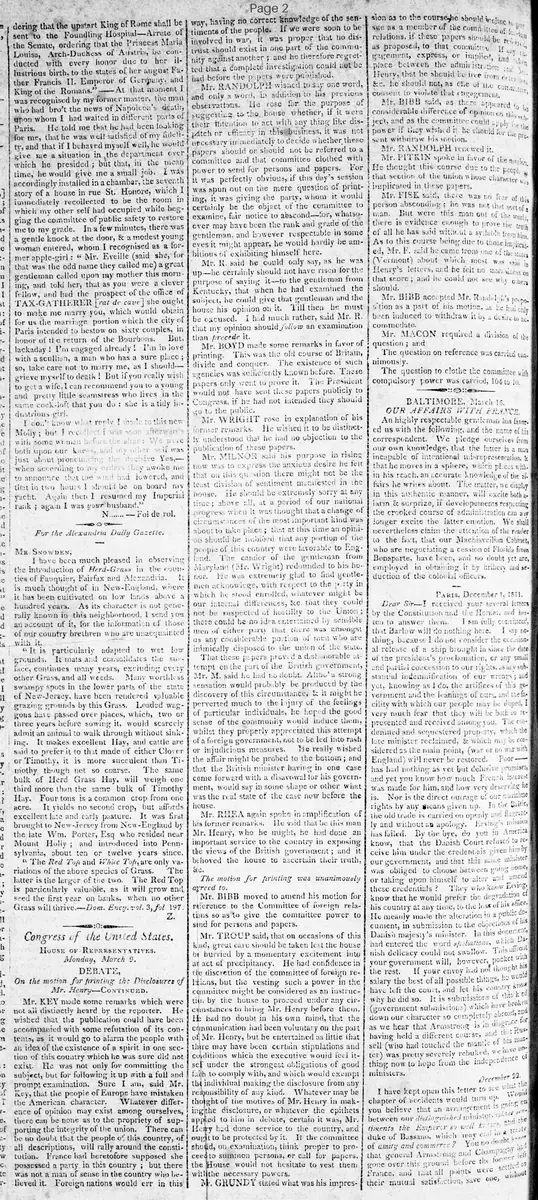
HOUSE OF REPRESENTATIVES.
Monday, March 9.
DEBATE,
On the motion for printing the Disclosures of Mr. Henry--Continued.
Mr. KEY made some remarks which were not all distinctly heard by the reporter. He wished that the publication could have been accompanied with some refutation of its contents, as it would go to alarm the people with an idea of the existence of a spirit in one section of this country which he was sure did not exist. He was not only for committing the subject, but for following it up with a full and prompt examination. Sure I am, said Mr. Key, that the people of Europe have mistaken the American character. Whatever difference of opinion may exist among ourselves, there can be none as to the propriety of supporting the integrity of the union. There can be no doubt that the people of this country, of all descriptions, will rally around the constitution. France had heretofore supposed she possessed a party in this country ; but there was not a man of sense in the country who believed it. Foreign nations would err in this way, having no correct knowledge of the sentiments of the people. : If we were soon to be involved in war, it was proper that no distrust should exist in one part of the community against another ; and he therefore regretted that a complete investigation could not be had before the papers were published.
Mr. RANDOLPH wished to say one word, and only a word, in addition to his previous observations. He rose for the purpose of suggesting to the house whether, if it were their intention to act with any thing like dispatch or efficacy in this business, it was not necessary immediately to decide whether these papers should or should not be referred to a committee and that committee clothed with power to send for persons and papers. For it was perfectly obvious, if this day's session was spun out on the mere question of printing, it was giving the party, whom it would certainly be the object of the committee to examine, fair notice to abscond--for, whatsoever may have been the rank and grade of the gentleman, and however respectable in some eyes it might appear, he would hardly be ambitious of exhibiting himself here.
Mr. R. said he could only say, as he was up--he certainly should not have risen for the purpose of saving it--to the gentleman from Kentucky, that when he had examined the subject, he could give that gentleman and the house his opinion on it. Till then he must be excused. I had much rather, said Mr. R. that my opinion should follow an examination than precede it.
Mr. BOYD made some remarks in favor of printing. This was the old course of Britain, divide and conquer. The existence of such agencies was sufficiently known before. These papers only went to prove it. The President would not have sent these papers publicly to Congress, if he had not intended they should go to the public.
Mr. WRIGHT rose in explanation of his former remarks. He wished it to be distinctly understood that he had no objection to the publication of these papers.
Mr. MILNOR said his purpose in rising now was to express the anxious desire he felt that on this question there might not be the least division of sentiment manifested in the house. He should be extremely sorry at any time; above all, at a period of our national progress when it was thought that a change of circumstances of the most important kind was about to take place; that at this time an opinion should be imbibed that any portion of the people of this country were favorable to England. The candor of the gentleman from Maryland (Mr. Wright) redounded to his honor. He was extremely glad to find gentlemen acknowledge, with respect to the party in which he stood enrolled, whatever might be our internal differences, &c. that they could not be suspected of hostility to the Union ; there could be no idea entertained by sensible men of either party that there was amongst us any considerable portion of men who are inimically disposed to the union of the state. That these papers proved a dishonorable attempt on the part of the British government, Mr. M. said he had no doubt. Altho' a strong sensation would probably be produced by the discovery of this circumstance, & it might be perverted much to the injury of the feelings of particular individuals, he hoped the good sense of the community would induce them, whilst they properly appreciated this attempt of a foreign government, not to be led into rash or injudicious measures. He really wished the affair might be probed to the bottom; and that the British minister having in one case come forward with a disavowal for his government, would say in some shape or other what was the real state of the case now before the house.
Mr. RHEA again spoke in amplification of his former remarks. He said that be this man Mr. Henry, who he might, he had done an important service to the country in exposing the views of the British government; and it behoved the house to ascertain their truth &c.
The motion for printing was unanimously agreed to.
Mr. BIBB moved to amend his motion for reference to the Committee of foreign relations so as to give the committee power to send for persons and papers.
Mr. TROUP said, that on occasions of this kind, great care should be taken lest the house be hurried by a momentary excitement into an act of precipitancy. He had confidence in the discretion of the committee of foreign relations, but the vesting such a power in the committee might be considered as an instruction by the house to proceed under any circumstances to bring Mr. Henry before them. He had no doubt in his own mind, that the communication had been voluntary on the part of Mr. Henry, but he entertained as little that there may have been certain stipulations and conditions which the executive would feel itself under the strongest obligations of good faith to comply with, and which would exempt the individual making the disclosure from any responsibility of any kind. Whatever may be thought of the motives of Mr. Henry in making the disclosure, or whatever the epithets applied to him in debate, certain it was, Mr. Henry had done service to the country, and ought to be protected by it. If the committee should, on examination, think proper to proceed to summon persons, or call for papers, the House would not hesitate to vest them with the necessary powers.
Mr. GRUNDY stated what was his impression as to the course he should incline to pursue as proposed as a member if these papers that of the committee should be of any engagement, express, or implied, had taken place between the administration and Henry, that he should be free from d &c. he should not, as one of the committee, consent to violate that engagement.
Mr. BIBB said, as there appeared to be considerable difference of opinion on this subject and as the committee could apply for the power if they wished it he should for the present withdraw his motion.
Mr. RANDOLPH renewed it.
Mr. PITKIN spoke in favor of the motion. He thought this course due to the people of that section of the union whose character was implicated in these papers.
Mr. FISK said, there was no fear of this person absconding ; he was not that sort of a man. But were this man out of the world, there is evidence enough to prove the truth of all he has said without a syllable from him. As to this course being due to those implicated, Mr. F. said he came from one of the states (Vermont) about which most was said in Henry's letters, and he felt no uneasiness on that score; and he could not see why others should.
Mr. BIBB accepted Mr. Randolph's proposition as a part of his motion, as he had only been induced to withdraw it by a desire to accommodate.
Mr. MACON required a division of the question; and
The question on reference was carried unanimously.
The question to clothe the committee with compulsory power was carried, 104 to 10.
What sub-type of article is it?
What keywords are associated?
What entities or persons were involved?
Where did it happen?
Domestic News Details
Primary Location
United States House Of Representatives
Event Date
Monday, March 9.
Key Persons
Outcome
motion for printing unanimously agreed to. motion for reference to committee of foreign relations unanimously carried. motion to clothe committee with power to send for persons and papers carried 104 to 10.
Event Details
Debate on printing disclosures by Mr. Henry regarding British government attempts to influence parts of the United States. Speakers expressed concerns about alarming the public, need for investigation, unity of the union, and protection of Mr. Henry. Motions passed to print papers, refer to committee, and grant committee powers.