Thank you for visiting SNEWPapers!
Sign up free
Literary
August 28, 1823
Alexandria Gazette & Advertiser
Alexandria, Virginia
What is this article about?
An introduction praises a manuscript poem, 'Lament of a Friend o'er the grave of Decatur,' written by someone who knew the naval hero. Extracts from the elegy mourn Decatur's death and recount his brave actions in battle, emphasizing patriotism and loss.
Clipping
OCR Quality
95%
Excellent
Full Text
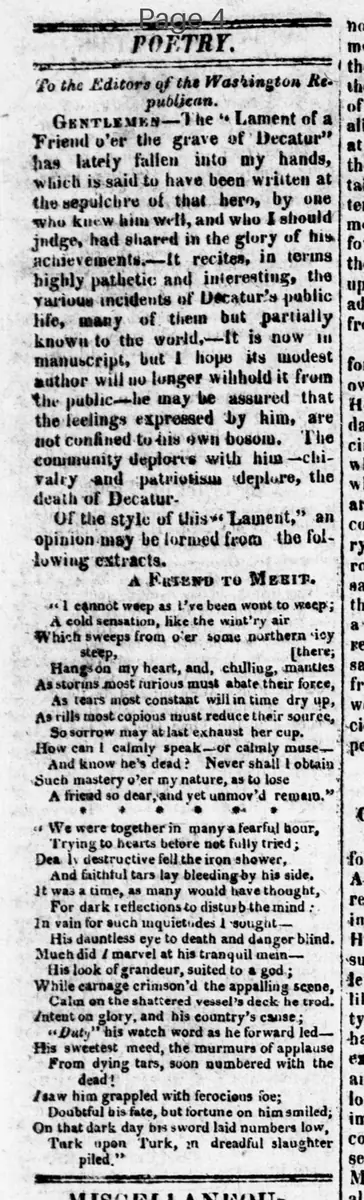
POETRY.
Gentlemen—The "Lament of a Friend o'er the grave of Decatur" has lately fallen into my hands, which is said to have been written at the sepulchre of that hero, by one who knew him well, and who I should judge, had shared in the glory of his achievements.—It recites, in terms highly pathetic and interesting, the various incidents of Decatur's public life, many of them but partially known to the world,—it is now in manuscript, but I hope its modest author will no longer withhold it from the public—he may be assured that the feelings expressed by him, are not confined to his own bosom. The community deplores with him—chivalry and patriotism deplore, the death of Decatur—
Of the style of this Lament, an opinion may be formed from the following extracts.
A FRIEND TO MERIT.
I cannot weep as I've been wont to weep;
A cold sensation, like the wintry air
Which sweeps from o'er some northern icy steep,
Hangs on my heart, and, chilling, mantles there;
As storms most furious must abate their force,
As tears most constant will in time dry up.
As rills most copious must reduce their source,
So sorrow may at last exhaust her cup.
How can I calmly speak—or calmly muse—
And know he's dead? Never shall I obtain
Such mastery o'er my nature, as to lose
A friend so dear, and yet unmoved remain.
We were together in many a fearful hour,
Trying to hearts before not fully tried;
Death destructive fell the iron shower,
And faithful tars lay bleeding by his side.
It was a time, as many would have thought,
For dark reflections to disturb the mind:
In vain for such inquietudes I sought—
His dauntless eye to death and danger blind.
Much did I marvel at his tranquil mien—
His look of grandeur, suited to a god;
While carnage crimson'd the appalling scene,
Calm on the shattered vessel's deck he trod.
Intent on glory, and his country's cause.;
"Duty," his watch-word as he forward led—
His sweetest meed, the murmurs of applause
From dying tars, soon numbered with the dead!
I saw him grappled with ferocious foe;
Doubtful his fate, but fortune on him smiled:
On that dark day his sword laid numbers low.
Turk upon Turk, in dreadful slaughter piled."
Gentlemen—The "Lament of a Friend o'er the grave of Decatur" has lately fallen into my hands, which is said to have been written at the sepulchre of that hero, by one who knew him well, and who I should judge, had shared in the glory of his achievements.—It recites, in terms highly pathetic and interesting, the various incidents of Decatur's public life, many of them but partially known to the world,—it is now in manuscript, but I hope its modest author will no longer withhold it from the public—he may be assured that the feelings expressed by him, are not confined to his own bosom. The community deplores with him—chivalry and patriotism deplore, the death of Decatur—
Of the style of this Lament, an opinion may be formed from the following extracts.
A FRIEND TO MERIT.
I cannot weep as I've been wont to weep;
A cold sensation, like the wintry air
Which sweeps from o'er some northern icy steep,
Hangs on my heart, and, chilling, mantles there;
As storms most furious must abate their force,
As tears most constant will in time dry up.
As rills most copious must reduce their source,
So sorrow may at last exhaust her cup.
How can I calmly speak—or calmly muse—
And know he's dead? Never shall I obtain
Such mastery o'er my nature, as to lose
A friend so dear, and yet unmoved remain.
We were together in many a fearful hour,
Trying to hearts before not fully tried;
Death destructive fell the iron shower,
And faithful tars lay bleeding by his side.
It was a time, as many would have thought,
For dark reflections to disturb the mind:
In vain for such inquietudes I sought—
His dauntless eye to death and danger blind.
Much did I marvel at his tranquil mien—
His look of grandeur, suited to a god;
While carnage crimson'd the appalling scene,
Calm on the shattered vessel's deck he trod.
Intent on glory, and his country's cause.;
"Duty," his watch-word as he forward led—
His sweetest meed, the murmurs of applause
From dying tars, soon numbered with the dead!
I saw him grappled with ferocious foe;
Doubtful his fate, but fortune on him smiled:
On that dark day his sword laid numbers low.
Turk upon Turk, in dreadful slaughter piled."
What sub-type of article is it?
Elegy
Poem
Soliloquy
What themes does it cover?
Death Mortality
Patriotism
War Peace
What keywords are associated?
Decatur Lament
Naval Hero
Patriotism
Battle Bravery
Mourning Friend
War Glory
Death Sorrow
What entities or persons were involved?
A Friend To Merit
Literary Details
Title
Lament Of A Friend O'er The Grave Of Decatur
Author
A Friend To Merit
Subject
Lament For The Death Of Naval Hero Decatur
Key Lines
I Cannot Weep As I've Been Wont To Weep;
A Cold Sensation, Like The Wintry Air
Which Sweeps From O'er Some Northern Icy Steep,
Hangs On My Heart, And, Chilling, Mantles There;
As Storms Most Furious Must Abate Their Force,
As Tears Most Constant Will In Time Dry Up.
As Rills Most Copious Must Reduce Their Source,
So Sorrow May At Last Exhaust Her Cup.
We Were Together In Many A Fearful Hour,
Trying To Hearts Before Not Fully Tried;
Death Destructive Fell The Iron Shower,
And Faithful Tars Lay Bleeding By His Side.
Intent On Glory, And His Country's Cause.;
"Duty," His Watch Word As He Forward Led—
His Sweetest Meed, The Murmurs Of Applause
From Dying Tars, Soon Numbered With The Dead!
I Saw Him Grappled With Ferocious Foe;
Doubtful His Fate, But Fortune On Him Smiled:
On That Dark Day His Sword Laid Numbers Low.
Turk Upon Turk, In Dreadful Slaughter Piled."