Thank you for visiting SNEWPapers!
Sign up free
Story
August 24, 1869
Staunton Spectator
Staunton, Virginia
What is this article about?
In 1869, Judge Louis Dent writes a critical letter to Treasury Secretary George S. Boutwell, accusing him of using his office to manipulate Southern politics against President Grant's inclusive policies, aiming to build his own presidential bid at the expense of the Republican Party.
Clipping
OCR Quality
95%
Excellent
Full Text
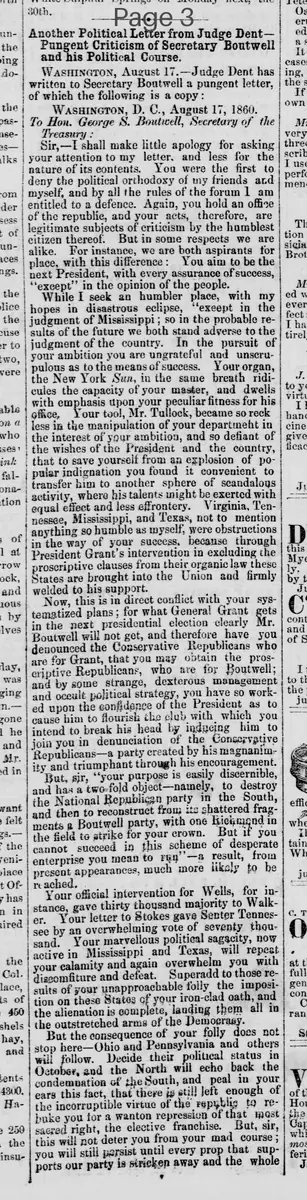
Another Political Letter from Judge Dent—Pungent Criticism of Secretary Boutwell and his Political Course.
WASHINGTON, August 17.—Judge Dent has written to Secretary Boutwell a pungent letter, of which the following is a copy:
WASHINGTON, D. C., August 17, 1869.
To Hon. George S. Boutwell, Secretary of the Treasury:
Sir,—I shall make little apology for asking your attention to my letter, and less for the nature of its contents. You were the first to deny the political orthodoxy of my friends and myself, and by all the rules of the forum I am entitled to a defence. Again, you hold an office of the republic, and your acts, therefore, are legitimate subjects of criticism by the humblest citizen thereof. But in some respects we are alike. For instance, we are both aspirants for place, with this difference: You aim to be the next President, with every assurance of success, "except" in the opinion of the people. While I seek an humbler place, with my hopes in disastrous eclipse, "except" in the judgment of Mississippi; so in the probable results of the future we both stand adverse to the judgment of the country. In the pursuit of your ambition you are ungrateful and unscrupulous as to the means of success. Your organ, the New York Sun, in the same breath ridicules the capacity of your master, and dwells with emphasis upon your peculiar fitness for his office. Your tool, Mr. Tullock, became so reckless in the manipulation of your department in the interest of your ambition, and so defiant of the wishes of the President and the country, that to save yourself from an explosion of popular indignation you found it convenient to transfer him to another sphere of scandalous activity, where his talents might be exerted with equal effect and less effrontery. Virginia, Tennessee, Mississippi, and Texas, not to mention anything so humble as myself, were obstructions in the way of your success, because through President Grant's intervention in excluding the proscriptive clauses from their organic law these States are brought into the Union and firmly welded to his support.
Now, this is in direct conflict with your systematized plans; for what General Grant gets in the next presidential election clearly Mr. Boutwell will not get, and therefore have you denounced the Conservative Republicans who are for Grant, that you may obtain the proscriptive Republicans, who are for Boutwell; and by some strange, dexterous management and occult political strategy, you have so worked upon the confidence of the President as to cause him to flourish the club with which you intend to break his head by inducing him to join you in denunciation of the Conservative Republicans—a party created by his magnanimity and triumphant through his encouragement.
But, sir, "your purpose is easily discernible, and has a two-fold object—namely, to destroy the National Republican party in the South, and then to reconstruct from its shattered fragments a Boutwell party, with one Richmond in the field to strike for your crown. But if you cannot succeed in this scheme of desperate enterprise you mean to run"—a result, from present appearances, much more likely to be reached.
Your official intervention for Wells, for instance, gave thirty thousand majority to Walker. Your letter to Stokes gave Senter Tennessee by an overwhelming vote of seventy thousand. Your marvellous political sagacity, now active in Mississippi and Texas, will repeat your calamity and again overwhelm you with discomfiture and defeat. Superadd to those results of your unapproachable folly the imposition on these States of your iron-clad oath, and the alienation is complete, landing them all in the outstretched arms of the Democracy.
But the consequence of your folly does not stop here—Ohio and Pennsylvania and others will follow. Decide their political status in October, and the North will echo back the condemnation of the South, and peal in your ears this fact, that there is still left enough of the incorruptible virtue of the republic to rebuke you for a wanton repression of that most sacred right, the elective franchise. But, sir, this will not deter you from your mad course; you will still persist until every prop that supports our party is stricken away and the whole grand superstructure tumbles about our ears in hopeless ruin.
When you were appointed Secretary of the Treasury, and unanimously confirmed by a Senate of every shade of political opinion, did you not take an oath to administer your office impartially and for the exclusive objects of its creation: "To collect the revenue and control the finances of the country?" Is not that office the property of the nation, and yourself only clothed for a time with a little brief authority?
Then, sir, how do you explain this perversion of its legitimate uses and functions into a means and instrument of oppression to force and compel an election of obnoxious rulers upon the people of the South?
Is such a course consistent with your oath of office, or do you call this a great moral idea?
But, Mr. Boutwell, though you have thus prostituted the power of your office for purpose of oppression, "without the warrant of conscience or law," it may be that you can tell me by what authority you assume to pronounce upon my political orthodoxy. Who constituted you the infallible pope of Republicanism?
Who gave you authority to hurl the political anathemas of the party? Again, what right had you to commit the Administration to your policy? Have you to learn yet that you are only a part of the Administration, and not the whole of it? though your friends believe that a monomania has seized your mind on that subject, and that you verily believe yourself "the State."
Very respectfully,
Louis Dent
WASHINGTON, August 17.—Judge Dent has written to Secretary Boutwell a pungent letter, of which the following is a copy:
WASHINGTON, D. C., August 17, 1869.
To Hon. George S. Boutwell, Secretary of the Treasury:
Sir,—I shall make little apology for asking your attention to my letter, and less for the nature of its contents. You were the first to deny the political orthodoxy of my friends and myself, and by all the rules of the forum I am entitled to a defence. Again, you hold an office of the republic, and your acts, therefore, are legitimate subjects of criticism by the humblest citizen thereof. But in some respects we are alike. For instance, we are both aspirants for place, with this difference: You aim to be the next President, with every assurance of success, "except" in the opinion of the people. While I seek an humbler place, with my hopes in disastrous eclipse, "except" in the judgment of Mississippi; so in the probable results of the future we both stand adverse to the judgment of the country. In the pursuit of your ambition you are ungrateful and unscrupulous as to the means of success. Your organ, the New York Sun, in the same breath ridicules the capacity of your master, and dwells with emphasis upon your peculiar fitness for his office. Your tool, Mr. Tullock, became so reckless in the manipulation of your department in the interest of your ambition, and so defiant of the wishes of the President and the country, that to save yourself from an explosion of popular indignation you found it convenient to transfer him to another sphere of scandalous activity, where his talents might be exerted with equal effect and less effrontery. Virginia, Tennessee, Mississippi, and Texas, not to mention anything so humble as myself, were obstructions in the way of your success, because through President Grant's intervention in excluding the proscriptive clauses from their organic law these States are brought into the Union and firmly welded to his support.
Now, this is in direct conflict with your systematized plans; for what General Grant gets in the next presidential election clearly Mr. Boutwell will not get, and therefore have you denounced the Conservative Republicans who are for Grant, that you may obtain the proscriptive Republicans, who are for Boutwell; and by some strange, dexterous management and occult political strategy, you have so worked upon the confidence of the President as to cause him to flourish the club with which you intend to break his head by inducing him to join you in denunciation of the Conservative Republicans—a party created by his magnanimity and triumphant through his encouragement.
But, sir, "your purpose is easily discernible, and has a two-fold object—namely, to destroy the National Republican party in the South, and then to reconstruct from its shattered fragments a Boutwell party, with one Richmond in the field to strike for your crown. But if you cannot succeed in this scheme of desperate enterprise you mean to run"—a result, from present appearances, much more likely to be reached.
Your official intervention for Wells, for instance, gave thirty thousand majority to Walker. Your letter to Stokes gave Senter Tennessee by an overwhelming vote of seventy thousand. Your marvellous political sagacity, now active in Mississippi and Texas, will repeat your calamity and again overwhelm you with discomfiture and defeat. Superadd to those results of your unapproachable folly the imposition on these States of your iron-clad oath, and the alienation is complete, landing them all in the outstretched arms of the Democracy.
But the consequence of your folly does not stop here—Ohio and Pennsylvania and others will follow. Decide their political status in October, and the North will echo back the condemnation of the South, and peal in your ears this fact, that there is still left enough of the incorruptible virtue of the republic to rebuke you for a wanton repression of that most sacred right, the elective franchise. But, sir, this will not deter you from your mad course; you will still persist until every prop that supports our party is stricken away and the whole grand superstructure tumbles about our ears in hopeless ruin.
When you were appointed Secretary of the Treasury, and unanimously confirmed by a Senate of every shade of political opinion, did you not take an oath to administer your office impartially and for the exclusive objects of its creation: "To collect the revenue and control the finances of the country?" Is not that office the property of the nation, and yourself only clothed for a time with a little brief authority?
Then, sir, how do you explain this perversion of its legitimate uses and functions into a means and instrument of oppression to force and compel an election of obnoxious rulers upon the people of the South?
Is such a course consistent with your oath of office, or do you call this a great moral idea?
But, Mr. Boutwell, though you have thus prostituted the power of your office for purpose of oppression, "without the warrant of conscience or law," it may be that you can tell me by what authority you assume to pronounce upon my political orthodoxy. Who constituted you the infallible pope of Republicanism?
Who gave you authority to hurl the political anathemas of the party? Again, what right had you to commit the Administration to your policy? Have you to learn yet that you are only a part of the Administration, and not the whole of it? though your friends believe that a monomania has seized your mind on that subject, and that you verily believe yourself "the State."
Very respectfully,
Louis Dent
What sub-type of article is it?
Historical Event
What themes does it cover?
Deception
Justice
What keywords are associated?
Political Criticism
Republican Party
Southern Reconstruction
Grant Administration
Boutwell Ambition
Electoral Manipulation
What entities or persons were involved?
Louis Dent
George S. Boutwell
Ulysses S. Grant
Mr. Tullock
Wells
Walker
Stokes
Senter
Where did it happen?
Washington, D. C.
Story Details
Key Persons
Louis Dent
George S. Boutwell
Ulysses S. Grant
Mr. Tullock
Wells
Walker
Stokes
Senter
Location
Washington, D. C.
Event Date
August 17, 1869
Story Details
Judge Louis Dent accuses Secretary Boutwell of misusing his Treasury position to manipulate Southern elections, denounce Conservative Republicans, and pursue presidential ambitions against President Grant's inclusive policies, predicting political backlash and party ruin.