Thank you for visiting SNEWPapers!
Sign up free
Story
February 16, 1827
The National Republican And Ohio Political Register
Cincinnati, Hamilton County, Ohio
What is this article about?
Article from Louisville Public Advertiser critiques Henry Clay's political inconsistency toward Andrew Jackson, praising his War of 1812 heroism in 1816-17 but denouncing him as a usurper in 1819 and 'mere soldier' in 1825 due to presidential rivalry and ambition.
Clipping
OCR Quality
98%
Excellent
Full Text
From the Louisville Public Advertiser.
CLAY AND JACKSON.
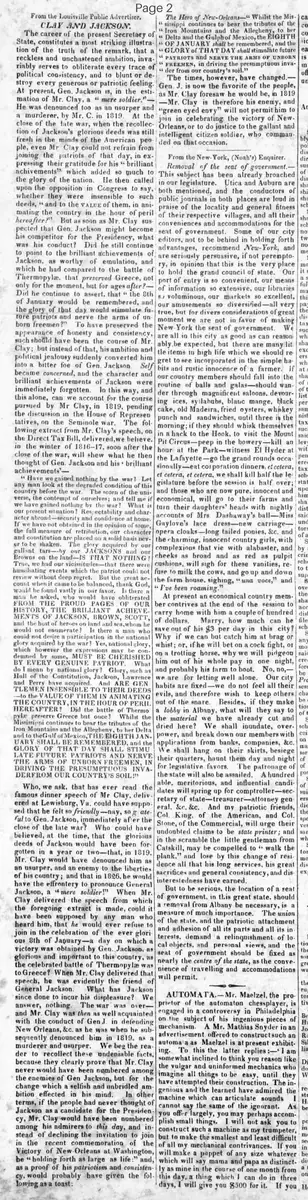
The career of the present Secretary of State, constitutes a most striking illustration of the truth of the remark, that a reckless and unchastened ambition, invariably serves to obliterate every trace of political consistency, and to blunt or destroy every generous or patriotic feeling.
At present, Gen. Jackson is, in the estimation of Mr. Clay, a "mere soldier."— He was denounced too as an usurper and a murderer, by Mr. C. in 1819. At the close of the late war, when the recollection of Jackson's glorious deeds was still fresh in the minds of the American people, even Mr. Clay could not refrain from joining the patriots of that day, in expressing their gratitude for his "brilliant achievements" which added so much to the glory of the nation. He then called upon the opposition in Congress to say, whether they were insensible to such deeds, "and to the value of them in animating the country in the hour of peril hereafter?" But as soon as Mr. Clay suspected that Gen. Jackson might become his competitor for the Presidency, what was his conduct? Did he still continue to point to the brilliant achievements of Jackson, as worthy of emulation, and which he had compared to the battle of Thermopylae that preserved Greece, not only for the moment, but for ages after?— Did he continue to assert, that "the 8th of January would be remembered, and the glory of that day would stimulate future patriots and nerve the arms of unborn freemen?" To have preserved the appearance of honesty and consistency, such should have been the course of Mr. Clay; but instead of that, his ambition and political jealousy suddenly converted him into a bitter foe of Gen. Jackson. Self became concerned, and the character and brilliant achievements of Jackson were immediately forgotten. In this way, and this alone, can we account for the course pursued by Mr. Clay, in 1819, pending the discussion in the House of Representatives, on the Seminole war. The following extract from Mr. Clay's speech, on the Direct Tax Bill, delivered, we believe, in the winter of 1816-17, soon after the close of the war, will show what he then thought of Gen. Jackson and his brilliant achievements?
"Have we gained nothing by the war? Let any man look at the degraded condition of this country before the war. The scorn of the universe, the contempt of ourselves; and tell me if we have gained nothing by the war? What is our present situation? Respectability and character abroad—security and confidence at home. If we have not obtained in the opinion of some, the full measure of retribution, our character and constitution are placed on a solid basis never to be shaken. The glory acquired by our gallant tars—by our JACKSONS and our BROWNS on the land—IS THAT NOTHING?
True, we had our vicissitudes—that there were humiliating events which the patriot could not review without deep regret. But the great account when it came to be balanced, thank God, would be found vastly in our favor. Is there a man, he asked, who would have obliterated FROM THE PROUD PAGES OF OUR HISTORY, THE BRILLIANT ACHIEVEMENTS OF JACKSON, BROWN, SCOTT, and the host of heroes on land and sea, whom he would not enumerate? Is there a man who could not desire a participation in the national glory acquired by the war? Yes, national glory, which however the expressions may be condemned by some, MUST BE CHERISHED BY EVERY GENUINE PATRIOT. What do I mean by national glory? Glory, such as Hall of the Constitution, Jackson, Lawrence and Perry have acquired. AND ARE GENTLEMEN INSENSIBLE TO THEIR DEEDS—to the VALUE OF THEM IN ANIMATING THE COUNTRY, IN THE HOUR OF PERIL HEREAFTER? Did the battle of Thermopylae preserve Greece but once? Whilst the Mississippi continues to bear the tributes of the Iron Mountains and the Allegheny, to her Delta and to the Gulf of Mexico, THE EIGHTH OF JANUARY SHALL BE REMEMBERED, and the GLORY OF THAT DAY SHALL STIMULATE FUTURE PATRIOTS AND NERVE THE ARMS OF UNBORN FREEMEN, IN DRIVING THE PRESUMPTUOUS INVADER FROM OUR COUNTRY'S SOIL!"
Who, we ask, that has ever read the famous dinner speech of Mr. Clay, delivered at Lewisburg, Va. could have supposed that he felt so friendly—nay, so grateful to Gen. Jackson, immediately after the close of the late war? Who could have believed, at the time, that the glorious deeds of Jackson would have been forgotten in a year or two—that, in 1819, Mr. Clay would have denounced him as an usurper, and an enemy to the liberties of his country; and that in 1825 he would have the effrontery to pronounce General Jackson, a "mere soldier!" When Mr. Clay delivered the speech from which the foregoing extract is made, could it have been supposed by any man who heard him, that he would ever refuse to join in the celebration of the ever glorious 8th of January—a day on which a victory was obtained by Gen. Jackson, as glorious and important to this country, as the celebrated battle of Thermopylae was to Greece? When Mr. Clay delivered that speech, he was evidently the friend of General Jackson. What has Jackson since done to incur his displeasure? We answer, nothing. The war was over—and Mr. Clay was then as well acquainted with the conduct of Gen. J. in defending New Orleans, &c. as he was when he subsequently denounced him in 1819, as a murderer and usurper. We beg the reader to recollect these undeniable facts, because they clearly prove that Mr. Clay never would have been numbered among the enemies of Gen. Jackson, but for the change which a selfish and unbridled ambition effected in his mind. In other terms, if the people had never thought of Jackson as a candidate for the Presidency, Mr. Clay would have been numbered among his admirers to this day, and instead of declining the invitation to join in the recent commemoration of the Victory of New Orleans at Washington, he "holding forth as large as life:" and, as a proof of his patriotism and consistency, would probably have given the following as a toast:
The Hero of New-Orleans—"Whilst the Mississippi continues to bear the tributes of the Iron Mountains and the Allegheny, to her Delta and the Gulf of Mexico—the EIGHTH OF JANUARY shall be remembered, and the GLORY of THAT DAY shall stimulate future PATRIOTS AND NERVE THE ARMS OF UNBORN FREEMEN, in driving the presumptuous invader from our country's soil."
The times, however, have changed. Gen. J. is now the favorite of the people, as Mr. Clay foresaw he would be, in 1819—Mr. Clay is therefore his enemy, and "green eyed envy" will not permit him to join in celebrating the victory of New Orleans, or to do justice to the gallant and intelligent citizen soldier, who commanded on that occasion.
CLAY AND JACKSON.
The career of the present Secretary of State, constitutes a most striking illustration of the truth of the remark, that a reckless and unchastened ambition, invariably serves to obliterate every trace of political consistency, and to blunt or destroy every generous or patriotic feeling.
At present, Gen. Jackson is, in the estimation of Mr. Clay, a "mere soldier."— He was denounced too as an usurper and a murderer, by Mr. C. in 1819. At the close of the late war, when the recollection of Jackson's glorious deeds was still fresh in the minds of the American people, even Mr. Clay could not refrain from joining the patriots of that day, in expressing their gratitude for his "brilliant achievements" which added so much to the glory of the nation. He then called upon the opposition in Congress to say, whether they were insensible to such deeds, "and to the value of them in animating the country in the hour of peril hereafter?" But as soon as Mr. Clay suspected that Gen. Jackson might become his competitor for the Presidency, what was his conduct? Did he still continue to point to the brilliant achievements of Jackson, as worthy of emulation, and which he had compared to the battle of Thermopylae that preserved Greece, not only for the moment, but for ages after?— Did he continue to assert, that "the 8th of January would be remembered, and the glory of that day would stimulate future patriots and nerve the arms of unborn freemen?" To have preserved the appearance of honesty and consistency, such should have been the course of Mr. Clay; but instead of that, his ambition and political jealousy suddenly converted him into a bitter foe of Gen. Jackson. Self became concerned, and the character and brilliant achievements of Jackson were immediately forgotten. In this way, and this alone, can we account for the course pursued by Mr. Clay, in 1819, pending the discussion in the House of Representatives, on the Seminole war. The following extract from Mr. Clay's speech, on the Direct Tax Bill, delivered, we believe, in the winter of 1816-17, soon after the close of the war, will show what he then thought of Gen. Jackson and his brilliant achievements?
"Have we gained nothing by the war? Let any man look at the degraded condition of this country before the war. The scorn of the universe, the contempt of ourselves; and tell me if we have gained nothing by the war? What is our present situation? Respectability and character abroad—security and confidence at home. If we have not obtained in the opinion of some, the full measure of retribution, our character and constitution are placed on a solid basis never to be shaken. The glory acquired by our gallant tars—by our JACKSONS and our BROWNS on the land—IS THAT NOTHING?
True, we had our vicissitudes—that there were humiliating events which the patriot could not review without deep regret. But the great account when it came to be balanced, thank God, would be found vastly in our favor. Is there a man, he asked, who would have obliterated FROM THE PROUD PAGES OF OUR HISTORY, THE BRILLIANT ACHIEVEMENTS OF JACKSON, BROWN, SCOTT, and the host of heroes on land and sea, whom he would not enumerate? Is there a man who could not desire a participation in the national glory acquired by the war? Yes, national glory, which however the expressions may be condemned by some, MUST BE CHERISHED BY EVERY GENUINE PATRIOT. What do I mean by national glory? Glory, such as Hall of the Constitution, Jackson, Lawrence and Perry have acquired. AND ARE GENTLEMEN INSENSIBLE TO THEIR DEEDS—to the VALUE OF THEM IN ANIMATING THE COUNTRY, IN THE HOUR OF PERIL HEREAFTER? Did the battle of Thermopylae preserve Greece but once? Whilst the Mississippi continues to bear the tributes of the Iron Mountains and the Allegheny, to her Delta and to the Gulf of Mexico, THE EIGHTH OF JANUARY SHALL BE REMEMBERED, and the GLORY OF THAT DAY SHALL STIMULATE FUTURE PATRIOTS AND NERVE THE ARMS OF UNBORN FREEMEN, IN DRIVING THE PRESUMPTUOUS INVADER FROM OUR COUNTRY'S SOIL!"
Who, we ask, that has ever read the famous dinner speech of Mr. Clay, delivered at Lewisburg, Va. could have supposed that he felt so friendly—nay, so grateful to Gen. Jackson, immediately after the close of the late war? Who could have believed, at the time, that the glorious deeds of Jackson would have been forgotten in a year or two—that, in 1819, Mr. Clay would have denounced him as an usurper, and an enemy to the liberties of his country; and that in 1825 he would have the effrontery to pronounce General Jackson, a "mere soldier!" When Mr. Clay delivered the speech from which the foregoing extract is made, could it have been supposed by any man who heard him, that he would ever refuse to join in the celebration of the ever glorious 8th of January—a day on which a victory was obtained by Gen. Jackson, as glorious and important to this country, as the celebrated battle of Thermopylae was to Greece? When Mr. Clay delivered that speech, he was evidently the friend of General Jackson. What has Jackson since done to incur his displeasure? We answer, nothing. The war was over—and Mr. Clay was then as well acquainted with the conduct of Gen. J. in defending New Orleans, &c. as he was when he subsequently denounced him in 1819, as a murderer and usurper. We beg the reader to recollect these undeniable facts, because they clearly prove that Mr. Clay never would have been numbered among the enemies of Gen. Jackson, but for the change which a selfish and unbridled ambition effected in his mind. In other terms, if the people had never thought of Jackson as a candidate for the Presidency, Mr. Clay would have been numbered among his admirers to this day, and instead of declining the invitation to join in the recent commemoration of the Victory of New Orleans at Washington, he "holding forth as large as life:" and, as a proof of his patriotism and consistency, would probably have given the following as a toast:
The Hero of New-Orleans—"Whilst the Mississippi continues to bear the tributes of the Iron Mountains and the Allegheny, to her Delta and the Gulf of Mexico—the EIGHTH OF JANUARY shall be remembered, and the GLORY of THAT DAY shall stimulate future PATRIOTS AND NERVE THE ARMS OF UNBORN FREEMEN, in driving the presumptuous invader from our country's soil."
The times, however, have changed. Gen. J. is now the favorite of the people, as Mr. Clay foresaw he would be, in 1819—Mr. Clay is therefore his enemy, and "green eyed envy" will not permit him to join in celebrating the victory of New Orleans, or to do justice to the gallant and intelligent citizen soldier, who commanded on that occasion.
What sub-type of article is it?
Biography
Historical Event
Deception Fraud
What themes does it cover?
Deception
Moral Virtue
Fortune Reversal
What keywords are associated?
Henry Clay
Andrew Jackson
Political Inconsistency
War Of 1812
Seminole War
New Orleans Victory
Presidential Rivalry
What entities or persons were involved?
Henry Clay
Andrew Jackson
Where did it happen?
United States
Story Details
Key Persons
Henry Clay
Andrew Jackson
Location
United States
Event Date
1816 1825
Story Details
Henry Clay praised Andrew Jackson's War of 1812 achievements in 1816-17 speeches, comparing them to Thermopylae, but turned against him in 1819 during Seminole war debates, denouncing him as usurper and murderer, and in 1825 as a mere soldier, due to presidential rivalry and ambition eroding his consistency.