Thank you for visiting SNEWPapers!
Sign up free
Literary
September 9, 1835
The Rhode Island Republican
Newport, Newport County, Rhode Island
What is this article about?
In this tale from the French, the Comte de Merset suspects his wife, the Comtesse, of hiding a lover in her oratory. She swears innocence on a crucifix, but he walls up the door, trapping the man inside, leading to her despair and his vigilant watch.
Clipping
OCR Quality
95%
Excellent
Full Text
THE ORATORY.
FROM THE FRENCH.
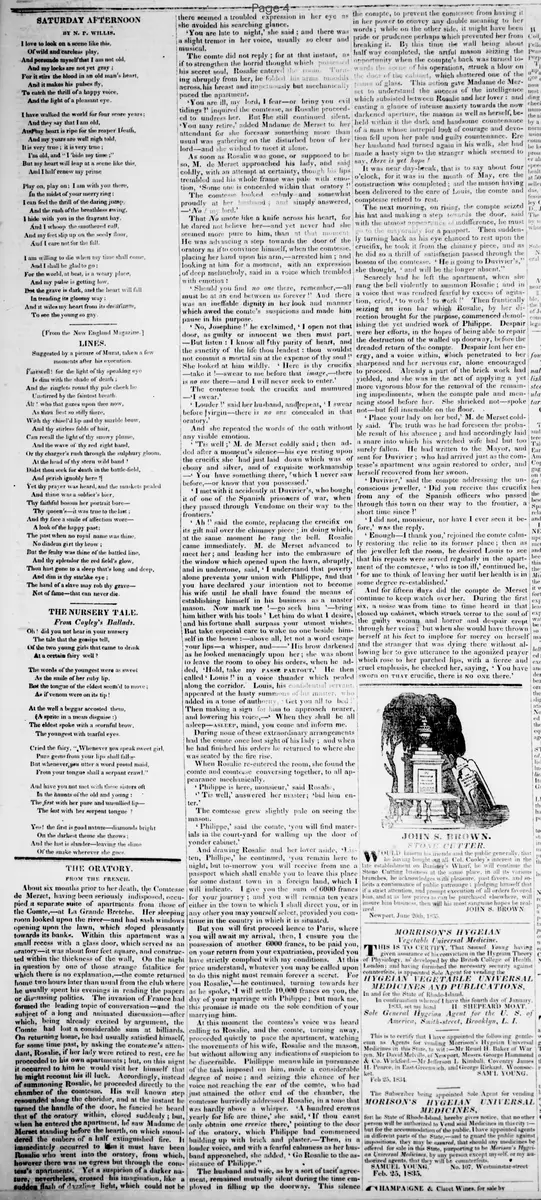
About six months prior to her death, the Comtesse de Merset, having been seriously indisposed, occupied a separate suite of apartments from those of the Comte,-at La Grande Bretche. Her sleeping room looked upon the river--and had sash windows opening upon the lawn, which sloped pleasantly towards its banks. Within this apartment was a small recess with a glass door, which served as an oratory-it was about four feet square, and constructed within the thickness of the wall. On the night in question by one of those strange fatalities for which there is no explanation, the comte returned home two hours later than usual from the club where he usually spent his evenings in reading the papers or discussing politics. The invasion of France had formed the leading topic of conversation-and the subject of a long and animated discussion-after which, being already excited by argument, the Comte had lost a considerable sum at billiards.
On returning home, he had usually satisfied himself, for some time past, by asking the comtesse's attendant, Rosalie, if her lady were retired to rest, ere he proceeded to his own apartments; but, on this night it occurred to him he would visit her himself that he might recount his ill luck. Accordingly, instead of summoning Rosalie, he proceeded directly to the chamber of the comtesse. His well known step resounded along the corridor, and at the instant he turned the handle of the door, he fancied he heard that of the oratory within, closed suddenly; but, when he entered the apartment, he saw Madame de Merset standing before the hearth, on which smouldered the embers of a half extinguished fire. It immediately occurred to him it must have been Rosalie who went into the oratory, from which however there was no egress but through the comtesse's apartments. Yet a suspicion of a darker nature, nevertheless, crossed his imagination, like a sudden flash of dazzling light, which could not be there seemed a troubled expression in her eye as she avoided his searching glance.
'You are late to night,' she said; and there was a slight tremor in her voice, usually so clear and musical.
The comte did not reply; for at that instant, as if to strengthen the horrid thought which possessed his secret soul, Rosalie entered the room. Turning abruptly from her, he folded his arms moodily across his breast and impatiently but mechanically paced the apartment.
'You are ill, my lord, I fear-or bring you evil tidings?' inquired the comtesse, as Rosalie proceeded to undress her. But he still continued silent.
'You may retire,' added Madame de Merset to her attendant for she foresaw something more than usual was gathering on the disturbed brow of her lord-and she wished to meet it alone.
As soon as Rosalie was gone, or supposed to be so, M. de Merset approached his lady, and said coldly, with an attempt at certainty, though his lips trembled and his whole frame was pale with emotion, 'Some one is concealed within that oratory!'
The comtesse looked calmly-and somewhat proudly at her husband; and simply answered,
—No! my lord.
That No smote like a knife across his heart, for he dared not believe her-and yet never had she seemed more pure to him, than at that moment.
He was advancing a step towards the door of the oratory as if to convince himself, when the comtesse, placing her hand upon his arm,-arrested him; and looking at him for a moment, with an expression of deep melancholy, said in a voice which trembled with emotion:
'Should you find no one there, remember,-all must be at an end between us forever!' And there was an ineffable dignity in her look and manner which awed the comte's suspicions and made him pause in his purpose.
No, Josephine!' he exclaimed, 'I open not that door, as guilty or innocent we then must part. -But listen: I know all thy purity of heart, and the sanctity of the life thou leadest: thou wouldst not commit a mortal sin at the expense of thy soul!'
She looked at him wildly. Here is thy crucifix-take it!-swear to me before that image,-there is no one there-and I will never seek to enter.'
The comtesse took the crucifix and murmured —'I swear.'
'Louder!' said her husband, and repeat, 'I swear before the virgin-there is no one concealed in that oratory.'
And she repeated the words of the oath without any visible emotion.
'Tis well;' M. de Merset coldly said; then added after a moment's silence-his eye resting upon the crucifix she had just laid down which was of ebony and silver, and of exquisite workmanship -'You have something there, 'which I never saw before,-or know that you possessed.'
I met with it accidentally at Duvivier's, who bought it of one of the Spanish prisoners of war, when they passed through Vendome on their way to the frontiers.'
Ah!' said the comte, replacing the crucifix on its gilt nail over the chimney piece; in doing which, at the same moment he rang the bell. Rosalie came immediately. M. de Merset advanced to meet her; and leading her into the embrasure of the window which opened upon the lawn, abruptly, and in undertone, said, 'I understand that poverty alone prevents your union with Philippe, and that you have declared your intention not to become his wife until he shall have found the means of establishing himself in his business as a master mason. Now mark me!-go seek him—bring him hither with his tools' Let him do what I desire, and his fortune shall surpass your utmost wishes. But take especial care to wake no one beside himself in the house :-above all, let not a word escape your lips-a whisper, and-'
His brow darkened as he looked menacingly upon her; she was about to leave the room to obey his orders, when he added, Hold, take my passe-partout.' He then called 'Louis!' in a voice thunder which pealed along the corridor.' Louis, his confidential servant, appeared at the hasty summons of his master, who added in a tone of authority, 'Get you all to bed!' Then making a sign for him to approach nearer, and lowering his voice,--'When they shall be all asleep--Asleep, mind, you come and inform me.'
During none of these extraordinary arrangements had the comte once lost sight of his lady; and when he had finished his orders he returned to where she was seated by the fire side.
When Rosalie re-entered the room, she found the comte and comtesse conversing together, to all appearance mechanically.
Philippe is here, monsieur,' said Rosalie
'Tis well,' answered her master; 'bid him enter.'
The comtesse grew slightly pale on seeing the mason.
'Philippe,' said the comte, 'you will find materials in the court-yard for walling up the door of yonder cabinet.'
And drawing Rosalie and her lover aside, 'Listen, Philippe,' he continued, 'you remain here to night, but to-morrow you will receive from me a passport which shall enable you to leave this place for some distant town in a foreign land, which I will indicate. I give you the sum of 6000 francs for your journey; and you will remain ten years either in the town to which I shall direct you, or in any other you may yourself select, provided you continue in the country in which it is situated. But you will first proceed hence to Paris, where you will await my arrival, then, I ensure you the possession of another 6000 francs, to be paid you, on your return from your expatriation, provided you have strictly complied with my conditions. At this price understand, whatever you may be called upon to do this night must remain forever a secret. For you Rosalie,'-he continued, turning towards her as he spoke, 'I will settle 10,000 francs on you, the day of your marriage with Philippe; but mark me, this promise is made on the sole condition of your marrying him.'
At this moment the comtesse's voice was heard calling to Rosalie, and the comte, turning away, proceeded quietly to pace the apartment, watching the movements of his wife, Rosalie and the mason, but without allowing any indications of suspicion to be discernible. Philippe meanwhile in pursuance of the task imposed on him, made a considerable degree of noise; and seizing this chance of her voice not reaching the ear of the comte, who had just attained the other end of the chamber, the comtesse hurriedly addressed Rosalie, in a tone that was hardly above a whisper. 'A hundred crowns yearly for life are thine,' she said, 'If thou canst only obtain one crevice there,' pointing to the door of the oratory, which Philippe had commenced building up with brick and plaster.-Then, in a louder voice, and with a fearful calmness as her husband approached, she added, 'Go Rosalie to the assistance of Philippe.'
The husband and wife, as by a sort of tacit agreement, remained mutually silent during the time employed in filling up the doorway.
This silence words; while on the other side, it might have been pride or prudence perhaps which prevented her from breaking it. By this time the wall being about half way completed, the artful mason seizing the opportunity when the comte's back was turned towards the scene of his operations, struck a blow on the door of the cabinet, which shattered one of the panes of glass. This action gave Madame de Merset to understand the success of the intelligence which subsisted between Rosalie and her lover: and casting a glance of intense anxiety towards the now darkened aperture, the mason as well as herself, beheld within it the dark and handsome countenance of a man whose intrepid look of courage and devotion fell upon her pale and guilty countenance. Ere her husband had turned again in his walk, she had made a hasty sign to the stranger which seemed to say, there is yet hope!
It was near day-break, that is to say about four o'clock, for it was in the month of May, ere the construction was completed: and the mason having been delivered to the care of Louis, the comte and comtesse retired to rest.
The next morning, on rising, the comte seized his hat and making a step towards the door, said with the utmost appearance of indifference, he must go to the mayoralty for a passport. Then suddenly turning back as his eye chanced to rest upon the crucifix, he took it from the chimney piece, and as he did so a thrill of satisfaction passed through the bosom of the comtesse. 'He is going to Duvivier's,' she thought, 'and will be the longer absent.'
Scarcely had he left the apartment, when she rang the bell violently to summon Rosalie; and in a voice that was rendered fearful by excess of agitation, cried, 'to work! to work!' Then frantically seizing an iron bar which Rosalie, by her direction brought for the purpose, commenced demolishing the yet undried work of Philippe. Despair were her efforts, in the hopes of being able to repair the destruction of the walled up doorway, before the dreaded return of the comte. Despair lent her energy, and a voice within, which penetrated to her sharpened and her nervous ear, alone encouraged to proceed. Already a part of the brick work had yielded, and she was in the act of applying a yet more vigorous blow for the removal of the remaining impediments, when the comte pale and menacing stood before her. She shrieked not-spoke not--but fell insensible on the floor.
'Place your lady on her bed,' M. de Merset coldly said. The truth was he had foreseen the probable result of his absence; and had accordingly laid a snare into which his wretched wife had but too surely fallen. He had written to the Mayor, and sent for Duvivier; who had arrived just as the comtesse's apartment was again restored to order, and herself recovered from her swoon.
'Duvivier,' said the comte addressing the unconscious jeweller, 'Did you receive this crucifix from any of the Spanish officers who passed through this town on their way to the frontier, a short time since?'
'I did not, monsieur, nor have I ever seen it before,' was the reply.
'Enough—I thank you,' rejoined the comte calmly restoring the relic to its former place; then as the jeweller left the room, he desired Louis to see that his repasts were served regularly in the apartment of the comtesse, 'who is too ill,' continued he, 'for me to think of leaving her until her health is in some degree re-established.'
And for fifteen days did the comte de Merset continue to keep watch over her. During the first six, a noise was from time to time heard in that closed up cabinet, which struck terror to the soul of the guilty woman and horror and despair crept through her veins; but when she would have thrown herself at his feet to implore for mercy on herself and the stranger that was dying there without allowing her to give utterance to the agonized prayer which rose to her parched lips, with a fierce and cruel emphasis, he checked her, saying, 'You have sworn on that crucifix, there is no one there.'
FROM THE FRENCH.
About six months prior to her death, the Comtesse de Merset, having been seriously indisposed, occupied a separate suite of apartments from those of the Comte,-at La Grande Bretche. Her sleeping room looked upon the river--and had sash windows opening upon the lawn, which sloped pleasantly towards its banks. Within this apartment was a small recess with a glass door, which served as an oratory-it was about four feet square, and constructed within the thickness of the wall. On the night in question by one of those strange fatalities for which there is no explanation, the comte returned home two hours later than usual from the club where he usually spent his evenings in reading the papers or discussing politics. The invasion of France had formed the leading topic of conversation-and the subject of a long and animated discussion-after which, being already excited by argument, the Comte had lost a considerable sum at billiards.
On returning home, he had usually satisfied himself, for some time past, by asking the comtesse's attendant, Rosalie, if her lady were retired to rest, ere he proceeded to his own apartments; but, on this night it occurred to him he would visit her himself that he might recount his ill luck. Accordingly, instead of summoning Rosalie, he proceeded directly to the chamber of the comtesse. His well known step resounded along the corridor, and at the instant he turned the handle of the door, he fancied he heard that of the oratory within, closed suddenly; but, when he entered the apartment, he saw Madame de Merset standing before the hearth, on which smouldered the embers of a half extinguished fire. It immediately occurred to him it must have been Rosalie who went into the oratory, from which however there was no egress but through the comtesse's apartments. Yet a suspicion of a darker nature, nevertheless, crossed his imagination, like a sudden flash of dazzling light, which could not be there seemed a troubled expression in her eye as she avoided his searching glance.
'You are late to night,' she said; and there was a slight tremor in her voice, usually so clear and musical.
The comte did not reply; for at that instant, as if to strengthen the horrid thought which possessed his secret soul, Rosalie entered the room. Turning abruptly from her, he folded his arms moodily across his breast and impatiently but mechanically paced the apartment.
'You are ill, my lord, I fear-or bring you evil tidings?' inquired the comtesse, as Rosalie proceeded to undress her. But he still continued silent.
'You may retire,' added Madame de Merset to her attendant for she foresaw something more than usual was gathering on the disturbed brow of her lord-and she wished to meet it alone.
As soon as Rosalie was gone, or supposed to be so, M. de Merset approached his lady, and said coldly, with an attempt at certainty, though his lips trembled and his whole frame was pale with emotion, 'Some one is concealed within that oratory!'
The comtesse looked calmly-and somewhat proudly at her husband; and simply answered,
—No! my lord.
That No smote like a knife across his heart, for he dared not believe her-and yet never had she seemed more pure to him, than at that moment.
He was advancing a step towards the door of the oratory as if to convince himself, when the comtesse, placing her hand upon his arm,-arrested him; and looking at him for a moment, with an expression of deep melancholy, said in a voice which trembled with emotion:
'Should you find no one there, remember,-all must be at an end between us forever!' And there was an ineffable dignity in her look and manner which awed the comte's suspicions and made him pause in his purpose.
No, Josephine!' he exclaimed, 'I open not that door, as guilty or innocent we then must part. -But listen: I know all thy purity of heart, and the sanctity of the life thou leadest: thou wouldst not commit a mortal sin at the expense of thy soul!'
She looked at him wildly. Here is thy crucifix-take it!-swear to me before that image,-there is no one there-and I will never seek to enter.'
The comtesse took the crucifix and murmured —'I swear.'
'Louder!' said her husband, and repeat, 'I swear before the virgin-there is no one concealed in that oratory.'
And she repeated the words of the oath without any visible emotion.
'Tis well;' M. de Merset coldly said; then added after a moment's silence-his eye resting upon the crucifix she had just laid down which was of ebony and silver, and of exquisite workmanship -'You have something there, 'which I never saw before,-or know that you possessed.'
I met with it accidentally at Duvivier's, who bought it of one of the Spanish prisoners of war, when they passed through Vendome on their way to the frontiers.'
Ah!' said the comte, replacing the crucifix on its gilt nail over the chimney piece; in doing which, at the same moment he rang the bell. Rosalie came immediately. M. de Merset advanced to meet her; and leading her into the embrasure of the window which opened upon the lawn, abruptly, and in undertone, said, 'I understand that poverty alone prevents your union with Philippe, and that you have declared your intention not to become his wife until he shall have found the means of establishing himself in his business as a master mason. Now mark me!-go seek him—bring him hither with his tools' Let him do what I desire, and his fortune shall surpass your utmost wishes. But take especial care to wake no one beside himself in the house :-above all, let not a word escape your lips-a whisper, and-'
His brow darkened as he looked menacingly upon her; she was about to leave the room to obey his orders, when he added, Hold, take my passe-partout.' He then called 'Louis!' in a voice thunder which pealed along the corridor.' Louis, his confidential servant, appeared at the hasty summons of his master, who added in a tone of authority, 'Get you all to bed!' Then making a sign for him to approach nearer, and lowering his voice,--'When they shall be all asleep--Asleep, mind, you come and inform me.'
During none of these extraordinary arrangements had the comte once lost sight of his lady; and when he had finished his orders he returned to where she was seated by the fire side.
When Rosalie re-entered the room, she found the comte and comtesse conversing together, to all appearance mechanically.
Philippe is here, monsieur,' said Rosalie
'Tis well,' answered her master; 'bid him enter.'
The comtesse grew slightly pale on seeing the mason.
'Philippe,' said the comte, 'you will find materials in the court-yard for walling up the door of yonder cabinet.'
And drawing Rosalie and her lover aside, 'Listen, Philippe,' he continued, 'you remain here to night, but to-morrow you will receive from me a passport which shall enable you to leave this place for some distant town in a foreign land, which I will indicate. I give you the sum of 6000 francs for your journey; and you will remain ten years either in the town to which I shall direct you, or in any other you may yourself select, provided you continue in the country in which it is situated. But you will first proceed hence to Paris, where you will await my arrival, then, I ensure you the possession of another 6000 francs, to be paid you, on your return from your expatriation, provided you have strictly complied with my conditions. At this price understand, whatever you may be called upon to do this night must remain forever a secret. For you Rosalie,'-he continued, turning towards her as he spoke, 'I will settle 10,000 francs on you, the day of your marriage with Philippe; but mark me, this promise is made on the sole condition of your marrying him.'
At this moment the comtesse's voice was heard calling to Rosalie, and the comte, turning away, proceeded quietly to pace the apartment, watching the movements of his wife, Rosalie and the mason, but without allowing any indications of suspicion to be discernible. Philippe meanwhile in pursuance of the task imposed on him, made a considerable degree of noise; and seizing this chance of her voice not reaching the ear of the comte, who had just attained the other end of the chamber, the comtesse hurriedly addressed Rosalie, in a tone that was hardly above a whisper. 'A hundred crowns yearly for life are thine,' she said, 'If thou canst only obtain one crevice there,' pointing to the door of the oratory, which Philippe had commenced building up with brick and plaster.-Then, in a louder voice, and with a fearful calmness as her husband approached, she added, 'Go Rosalie to the assistance of Philippe.'
The husband and wife, as by a sort of tacit agreement, remained mutually silent during the time employed in filling up the doorway.
This silence words; while on the other side, it might have been pride or prudence perhaps which prevented her from breaking it. By this time the wall being about half way completed, the artful mason seizing the opportunity when the comte's back was turned towards the scene of his operations, struck a blow on the door of the cabinet, which shattered one of the panes of glass. This action gave Madame de Merset to understand the success of the intelligence which subsisted between Rosalie and her lover: and casting a glance of intense anxiety towards the now darkened aperture, the mason as well as herself, beheld within it the dark and handsome countenance of a man whose intrepid look of courage and devotion fell upon her pale and guilty countenance. Ere her husband had turned again in his walk, she had made a hasty sign to the stranger which seemed to say, there is yet hope!
It was near day-break, that is to say about four o'clock, for it was in the month of May, ere the construction was completed: and the mason having been delivered to the care of Louis, the comte and comtesse retired to rest.
The next morning, on rising, the comte seized his hat and making a step towards the door, said with the utmost appearance of indifference, he must go to the mayoralty for a passport. Then suddenly turning back as his eye chanced to rest upon the crucifix, he took it from the chimney piece, and as he did so a thrill of satisfaction passed through the bosom of the comtesse. 'He is going to Duvivier's,' she thought, 'and will be the longer absent.'
Scarcely had he left the apartment, when she rang the bell violently to summon Rosalie; and in a voice that was rendered fearful by excess of agitation, cried, 'to work! to work!' Then frantically seizing an iron bar which Rosalie, by her direction brought for the purpose, commenced demolishing the yet undried work of Philippe. Despair were her efforts, in the hopes of being able to repair the destruction of the walled up doorway, before the dreaded return of the comte. Despair lent her energy, and a voice within, which penetrated to her sharpened and her nervous ear, alone encouraged to proceed. Already a part of the brick work had yielded, and she was in the act of applying a yet more vigorous blow for the removal of the remaining impediments, when the comte pale and menacing stood before her. She shrieked not-spoke not--but fell insensible on the floor.
'Place your lady on her bed,' M. de Merset coldly said. The truth was he had foreseen the probable result of his absence; and had accordingly laid a snare into which his wretched wife had but too surely fallen. He had written to the Mayor, and sent for Duvivier; who had arrived just as the comtesse's apartment was again restored to order, and herself recovered from her swoon.
'Duvivier,' said the comte addressing the unconscious jeweller, 'Did you receive this crucifix from any of the Spanish officers who passed through this town on their way to the frontier, a short time since?'
'I did not, monsieur, nor have I ever seen it before,' was the reply.
'Enough—I thank you,' rejoined the comte calmly restoring the relic to its former place; then as the jeweller left the room, he desired Louis to see that his repasts were served regularly in the apartment of the comtesse, 'who is too ill,' continued he, 'for me to think of leaving her until her health is in some degree re-established.'
And for fifteen days did the comte de Merset continue to keep watch over her. During the first six, a noise was from time to time heard in that closed up cabinet, which struck terror to the soul of the guilty woman and horror and despair crept through her veins; but when she would have thrown herself at his feet to implore for mercy on herself and the stranger that was dying there without allowing her to give utterance to the agonized prayer which rose to her parched lips, with a fierce and cruel emphasis, he checked her, saying, 'You have sworn on that crucifix, there is no one there.'
What sub-type of article is it?
Prose Fiction
Dialogue
What themes does it cover?
Moral Virtue
Religious
What keywords are associated?
Oratory
Comtesse
Comte
Infidelity
Oath
Crucifix
Walled Up
Suspicion
What entities or persons were involved?
From The French.
Literary Details
Title
The Oratory
Author
From The French.
Key Lines
'Some One Is Concealed Within That Oratory !'
'Should You Find No One There, Remember, All Must Be At An End Between Us Forever!'
'I Swear Before The Virgin There Is No One Concealed In That Oratory.'
'You Have Sworn On That Crucifix, There Is No One There.'