Thank you for visiting SNEWPapers!
Sign up free
Red Lodge Daily News Combined With Carbon County News
Red Lodge, Carbon County, Montana
What is this article about?
Legend of buried gold from 1880 prospectors attacked by Indians near Cooke City; survivor marked spot on tree with cryptic inscription. Nephews searched in vain; site now owned by George Ogden for tourist development. (187 chars)
Merged-components note: Merged continuation of story on buried treasure across pages.
Clippings
1 of 2
OCR Quality
Full Text
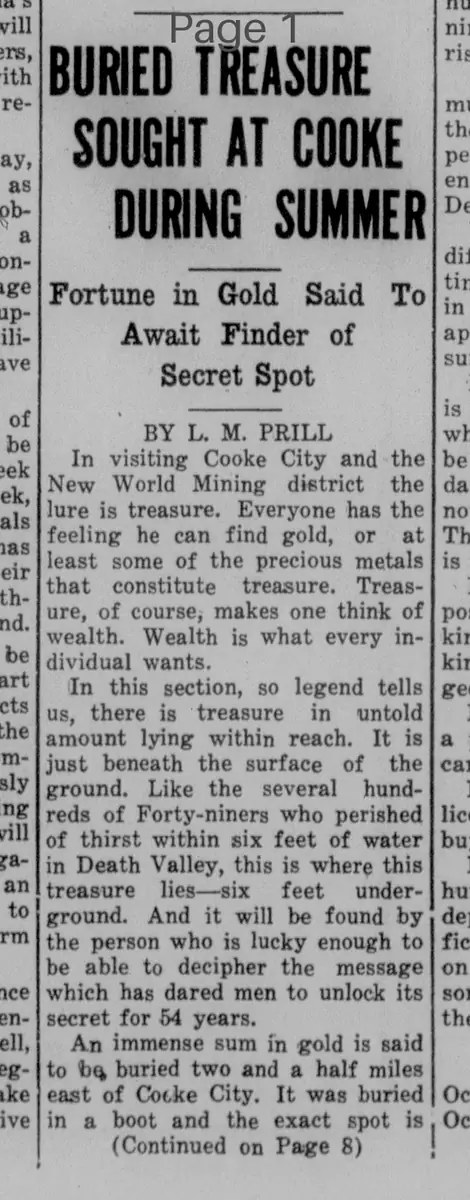
Fortune in Gold Said To Await Finder of Secret Spot
BY L. M. PRILL
In visiting Cooke City and the New World Mining district the lure is treasure. Everyone has the feeling he can find gold, or at least some of the precious metals that constitute treasure. Treasure, of course, makes one think of wealth. Wealth is what every individual wants.
In this section, so legend tells us, there is treasure in untold amount lying within reach. It is just beneath the surface of the ground. Like the several hundreds of Forty-niners who perished of thirst within six feet of water in Death Valley, this is where this treasure lies-six feet underground. And it will be found by the person who is lucky enough to be able to decipher the message which has dared men to unlock its secret for 54 years.
An immense sum in gold is said to be buried two and a half miles east of Cooke City. It was buried in a boot and the exact spot is
(Continued on Page 8)
BURIED TREASURE
(Continued from Page 1)
somewhere within a hundred and fifty yards of the new Red Lodge-Cooke City highway-the north side of the road, to be exact. The key to the spot is boldly inscribed on the remains of what was once a mighty tree. However, all that is left of the tree today is a stump, perhaps six and a half feet high, and the inscription is now badly weathered.
The inscription is as follows: At the top is a circle about eight inches in diameter. Inside this circle is a cross with the arms about three inches in width. Immediately below the circle and cross is the date upon which the tragedy occurred 1880. Below this is a triangle, or perhaps the outline of an Indian tepee, and in large figures underneath are the figures 6 and 5.
The legend that goes with the inscription is somewhat as follows: In the year 1880 two prospectors who had made a stake at Virginia City decided to return east and live in a luxury that their hard work entitled them to. They had an immense amount of gold and, fearing robbery, they decided to "back trail" and come through a country that was infested with Indians, rather than brave the hazards of robbery by white men. Proceeding east over the old Indian trail which passed through Cooke City, the two lonely men camped for the night in the meadows east of town. They were traveling light and had a mule for packing. The camp was made about 300 yards from the trail, but the men had been followed and in the night the camp was attacked. One of the travelers was killed, and the other escaped on foot in the dark. But before leaving it is claimed he buried the gold in one of the boots belonging to his erstwhile partner and then laboriously carved directions on the tree as to where to again locate the treasure.
He made his escape, as history tells us that in later years three nephews armed with a map showing the spot appeared and attempted to locate the gold. But their trip was in vain and now the ground in every direction from the old tree has been thoroughly excavated. Some of the digging has been done this summer and one hole was sunk by direction of a "doodle-bug."
Some people read the "65" as meaning so many feet from the tree, so a circle of holes, all an equal distance from the stump have been dug. Others take the figures to mean yards, and some figure in rods. So far the gold has not been found.
The mule bones lie a short distance from the road, but so far no one has dug in that vicinity in order to prove the gold is not there. In the early nineties three young men, said to be nephews of the only survivor of the tragedy, appeared one day at the old Eagle's Nest road ranch, just north of the present town of Cody, Wyoming, and showing the proprietor, Sam Launchberry, the map given them by their uncle, engaged him to guide them into this section of the mountains. The trip was unsuccessful, as the party gave up after reaching the Crandall creek section. What became of their map has never been learned, but so far as they were concerned no further attempt was ever made to locate the gold.
The land upon which the hidden treasure tree is located is today owned by George Ogden, and the exact spot will be marked by a sign along the road next season by him. Originally this was a 320-acre piece of ground located in 1895 by two brothers, Frank and Leonard Seeright, but Mr. Ogden acquired it in 1930, and he intends to establish a tourist camp in the Wyman meadows, perhaps next summer. In the timber to the north he will erect summer cabins and, as it is along the Clark's Fork river, the place will become a popular place for summer homes. More than likely he will deem it advisable to call it the "Hidden Treasure" camp.
In the meantime, if you desire to become a hunter of hidden treasure, get permission from Mr. Ogden to do some additional digging. He will grant the permission, only asking a share of what is found.
What sub-type of article is it?
What themes does it cover?
What keywords are associated?
What entities or persons were involved?
Where did it happen?
Story Details
Key Persons
Location
Two And A Half Miles East Of Cooke City, North Side Of The New Red Lodge Cooke City Highway
Event Date
1880
Story Details
In 1880, two prospectors buried their gold in a boot near Cooke City after an Indian attack killed one and the other escaped, carving directions on a tree. The inscription includes a circle, cross, date 1880, triangle, and 65. Nephews later searched unsuccessfully with a map. The site is now owned by George Ogden, who plans a tourist camp.