Thank you for visiting SNEWPapers!
Sign up free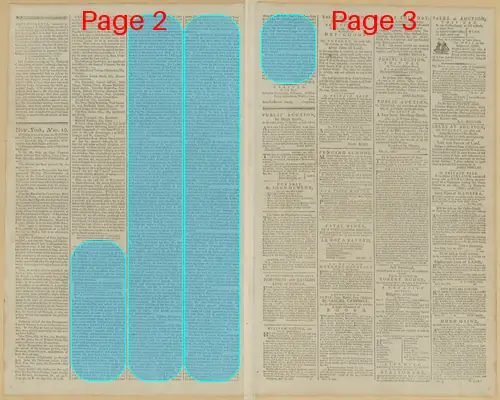
The Daily Advertiser
New York, New York County, New York
What is this article about?
An anonymous editorial signed 'PHILOPOLEMEN' critiques the heated, irrational debates surrounding the ratification of the new U.S. Constitution, particularly James Wilson's address. It defends the Constitution, urges rational discourse, and addresses misconceptions about state governments and press freedoms.
Merged-components note: This is a continuation of the editorial piece spanning from page 2 to page 3, as indicated by the sequential reading order and the text flow.
Clippings
1 of 2
OCR Quality
Full Text
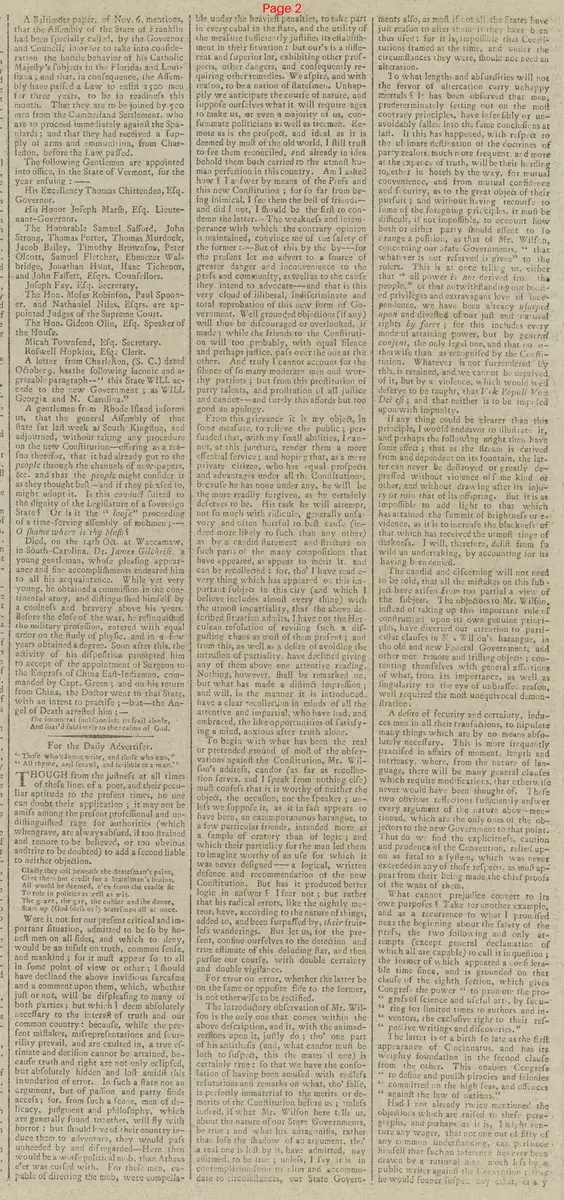
Those who cannot write, and those who can,
" All rhyme, and crawl, and scribble to a man."
THOUGH from the justice at all times of these lines of a poet, and their peculiar aptitude to the present times, no one can doubt their application; it may not be amiss among the present professional and undistinguished rage for authorities (which whenever, are always absurd, if too strained and remote to be believed, or too obvious and trite to be doubted) to add a second liable to neither objection.
Gladly they coil beneath the Statesman's pains,
Give them but credit for a Statesman's brains,
All would be deemed, e'en from the cradle fit
To rule in politics as well as wit.
The grave, the gay, the cobler and the dunce,
Start up (God bless us!) Statesmen all at once.
Were it not for our present critical and important situation, admitted to be so by honest men on all sides, and which to deny, would be an insult on truth, common sense, and mankind; for it must appear so to all in some point of view or other; I should have declined the above invidious arcana and a comment upon them, which, whether just or not, will be displeasing to many of both parties; but which I deem absolutely necessary to the interest of truth and our common country: because, while the present mistakes, misrepresentations and scurrility prevail, and are exulted in, a true estimate and decision cannot be attained, because truth and right are not only eclipsed, but absolutely hidden and lost amidst this inundation of error. In such a state not an argument, but of passion and party finds access; for, from such a scene, men of delicacy, judgment and philosophy, which are generally found together, will fly with horror: but should love of their country induce them to adventure, they would pass unheeded by and disregarded---Here then would be a worse political mob, than Athens e'er was cursed with. For these men, capable of directing the mob, were compelled under the heaviest penalties, to take part in every cabal in the state, and the utility of the measure sufficiently justifies its establishment in their situation: but ours is a different and superior lot, exhibiting other prospects, other dangers, and consequently requiring other remedies. We aspire, and with reason, to be a nation of statesmen. Unhappily we anticipate the course of nature, and suppose ourselves what it will require ages to make us, or even a majority of us, consummate politicians as well as freemen. Remote as is the prospect, and ideal as it is deemed by most of the old world, I still trust to see them reconciled, and already in idea behold them both carried to the utmost human perfection in this country. Am I asked how? I answer by means of the Press and this new Constitution; for so far from being inimical, I see them the best of friends--- and did I not, I should be the first to condemn the latter. ---The weakness and intemperance with which the contrary opinion is maintained, convince me of the safety of the former :---But of this by the by---or the present let me advert to a source of greater danger and inconvenience to the press and community, as well as to the cause they intend to advocate---and that is this very cloud of illiberal, indiscriminate and total reprobation of this new form of Government. Well grounded objections (if any) will thus be discouraged or overlooked, if made; while the friends to the Constitution will too probably, with equal silence and perhaps justice, pass over the one as the other. And truly I cannot account for the silence of so many moderate men and worthy patriots: but from this prostitution of party talents, and prostration of all justice and candor---and surely this affords but too good an apology.
From this grievance it is my object, in some measure, to relieve the public; persuaded that, with my small abilities, I cannot, at this juncture, render them a more essential service; and hoping that, as a mere private citizen, who has equal prospects and advantages under all the Constitutions, because he has none under any, he will be the more readily forgiven, as he certainly deserves to be. His task he will attempt, not so much with ridicule, generally unsavory and often hurtful to best cause (indeed more likely to such than any other) as by a candid statement and stricture on such parts of the many compositions that have appeared, as appear to merit it, and can be recollected: for, tho I have read every thing which has appeared on this important subject in this city (and which I believe includes almost every thing) with the utmost impartiality, that the above described situation admits, I have not the Herculean resolution of revising such a disgusting chaos as most of them present; and from this, as well as a desire of avoiding the intrusion of partiality, have declined giving any of them above one attentive reading. Nothing, however, shall be remarked on, but what has made a distinct impression; and will, in the manner it is introduced, have a clear recollection in minds of all the attentive and impartial, who have had, and embraced, the like opportunities of satisfying a mind, anxious after truth alone.
To begin with what has been the real or pretended ground of most of the observations against the Constitution, Mr. Wilson's address, candor (as far as recollection serves, and I speak from nothing else) must confess that it is worthy of neither the object, the occasion, nor the speaker; unless we suppose it, as it in fact appears to have been, an extemporaneous harangue, to a few particular friends, intended more as a sample of oratory than of logic; and which their partiality for the man led them to imagine worthy of an use for which it was never designed ---a logical, written defence and recommendation of the new Constitution. But has it produced better logic in answer? I fear not; but rather that his radical errors, like the nightly meteor, have, according to the nature of things, added to, and been surpassed by, their fruitless wanderings. But let us, for the present, confine ourselves to the detection and true estimate of this deluding star, and then pursue our course, with double certainty and double vigilance.
For error on error, whether the latter be on the same or opposite side to the former, is not otherwise to be rectified.
The introductory observation of Mr. Wilson is the only one that comes within the above description, and it, with the animadversions upon it, justly do; tho' one part of his antithesis (and, what candor must be loth to repeat, this the material one) is certainly true: so that we have the consolation of having been amused with endless refutations and remarks on what, tho' false, is perfectly immaterial to the merits or demerits of the Constitution before us; unless indeed, if what Mr. Wilson here tells us, about the nature of our State Governments, be true; and what his antagonists, rather than lose the shadow of an argument, tho' a real one is lost by it, have admitted, nay affirmed, to be true; unless, I say, it is in contemplation soon to alter and accommodate to circumstances, our State Governments also, as most if not all the States have just reason to alter them if they have been thus used: for it is impossible that Constitutions framed at the time, and under the circumstances they were, should not need an alteration.
To what lengths and absurdities will not the fervor of altercation carry unhappy mortals? It has been observed that men, predeterminately setting out on the most contrary principles, have insensibly or unavoidably fallen into the same conclusions at last. If this has happened, with respect to the ultimate determination of the doctrines of party zealots, much more frequent, and more at the expense of truth, will be their herding together in hotels by the way, for mutual convenience, and from mutual confidence and security, as to the great object of their pursuit; and without having recourse to some of the foregoing principles, it must be difficult, if not impossible, to account how both or either party should assert to so strange a position, as that of Mr. Wilson, concerning our State Governments, "that whatever is not reserved is given" to the rulers. This is at once telling us, either that all power is not derived from the people, or that notwithstanding our boasted privileges and extravagant love of independence, we have been already usurped upon and divested of our just and natural rights by force; for this includes every mode of attaining power, but by general consent, the only legal one, and that no otherwise than as recognized by the Constitution. Whatever is not surrendered by this, is retained, and we cannot be deprived of it, but by a violence, which would well deserve to be taught, that Vox Populi Vox Dei est; and that neither is to be imposed upon with impunity.
If any thing could be clearer than this principle, I would endeavor to illustrate it, and perhaps the following might then have some effect: that as the stream is derived from and dependent on its fountain, the latter can never be destroyed or greatly depressed without violence of some kind or other, and without drawing after its injury or ruin that of its offspring. But it is as impossible to add light to that which has attained the summit of brightness or evidence, as it is to increase the blackness of that which has received the utmost tinge of darkness. I will, therefore, desist from so wild an undertaking, by accounting for its having been denied.
The candid and discerning will not need to be told, that all the mistakes on this subject have arisen from too partial a view of the subject. The objectors to Mr. Wilson, instead of taking up this important rule of construction upon its own genuine principles, have diverted our attention to particular clauses in Mr. Wilson's harangue, in the old and new Federal Government, and other more remote and trifling objects; contenting themselves with general assertions of what, from its importance, as well as singularity to the eye of unbiased reason, well required the most unequivocal demonstration.
A desire of security and certainty, induces men in all their transactions, to stipulate many things which are by no means absolutely necessary. This is more frequently practiced in affairs of moment, length and intricacy, where, from the nature of language, there will be many general clauses which require modifications, that otherwise never would have been thought of. These two obvious reflections sufficiently answer every argument of the nature above-mentioned, which are the only ones of the objectors to the new Government to that point. Thus do we find the explicitness, caution and prudence of the Convention, relied upon as fatal to a system, which was never exceeded in any of those respects, as must appear from their being made the chief proofs of the want of them.
What cannot prejudice convert to its own purposes? Take for another example, and as a recurrence to what I promised near the beginning about the safety of the press, the two following and only attempts (except general declamation of which all are capable) to call it in question; the former of which appeared a considerable time since, and is grounded on that clause of the eighth section, which gives Congress the power "to promote the progress of science and useful arts, by securing for limited times to authors and inventors, the exclusive right to their respective writings and discoveries."
The latter is not a birth so late as the first appearance of Cincinnatus, and has its weighty foundation in the second clause from the other. This enables Congress "to define and punish piracies and felonies committed on the high seas, and offences against the law of nations."
Had I not already twice mentioned the objections which are raised to these paragraphs, and perhaps as it is, I might venture any wager, that not one out of fifty of any common understanding, can persuade himself that such an inference has ever been drawn by a rational man, much less by a public writer against the Convention; that he would sooner upset any other, quam viam.
thing than the fat ; that it must have been
quoted by the opposite party for a directly
contrary purpose. But unluckily, neither
this nor almost any other part of the Constitution, has been produced in its defence.
and what may seem strange to the illiterate,
and to them only, its advocates seem
less zealous and assuming, with the most
express and unanimous approbation of near
half a hundred patriots, and the concurrence
of all America on their side, than its opponents with arguments like those which have
been noticed.
It may be asked, if such the prospects and
inequality, why this anxiety in you & I answer. that for our honor and interest, as
well as that of the world (unhappily beyond
the views of individuals too little regarded)
the subject may have as cool, disinterested
and discreet an examination, and as peace-
able and unanimous a determination as the
subject admits, and our situation requires.
PHILOPOLEMEN.
What sub-type of article is it?
What keywords are associated?
What entities or persons were involved?
Editorial Details
Primary Topic
Critique Of Irrational Debates On The New Constitution
Stance / Tone
Supportive Of The Constitution With Call For Rational Discourse
Key Figures
Key Arguments