Thank you for visiting SNEWPapers!
Sign up free
Concord Register
Concord, Merrimack County, New Hampshire
What is this article about?
Committee report from Brighton Cattle Show on fat cattle, bulls, and bull calves. Awards premiums to Seth Wyman's heavy oxen, Benjamin Harrington's bull, and others. Praises stock quality and breeding improvements, urging more competition.
Clipping
OCR Quality
Full Text
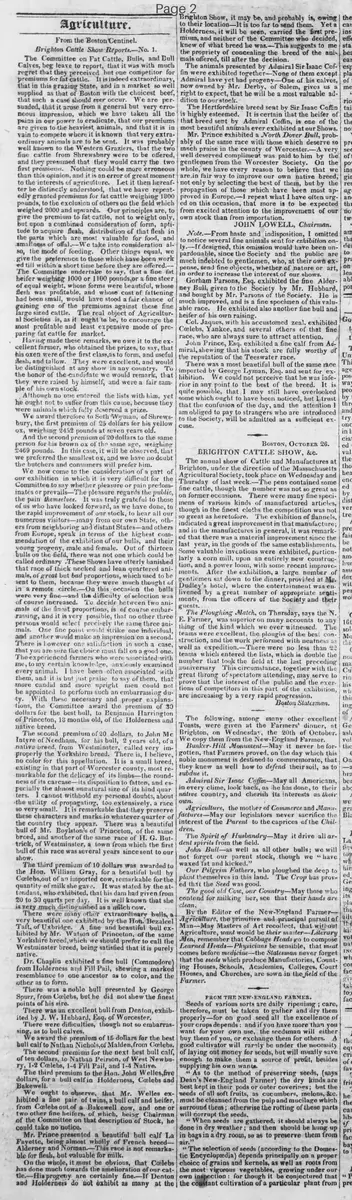
From the Boston Centinel.
Brighton Cattle Show Reports.—No. 1.
The Committee on Fat Cattle, Bulls, and Bull Calves, beg leave to report, that it was with much regret that they perceived but one competitor for premiums for fat cattle. It is indeed extraordinary, that in this grazing State, and in a market so well supplied as that of Boston with the choicest beef, that such a case should ever occur. We are persuaded, that it arose from a general but very erroneous impression, which we have taken all the pains in our power to eradicate, that our premiums are given to the heaviest animals, and that it is in vain to compete where it is known that very extraordinary animals are to be sent. It was probably well known to the Western Graziers, that the two fine cattle from Shrewsbury were to be offered, and they presumed that they would carry the two first premiums. Nothing could be more erroneous than this opinion, and it is an error of great moment to the interests of agriculture. Let it then hereafter be distinctly understood, that we have repeatedly granted premiums for fat cattle weighing 1800 pounds, to the exclusion of others on the field which weighed 2000 and upwards. Our principles are, to give the premium to fat cattle, not to weight only, but upon a combined consideration of form, aptitude to acquire flesh, distribution of that flesh in the parts which are most valuable for food, and smallness of offal.—We take into consideration also, the mode of feeding. Other things equal, we give the preference to those which have been worked till within a short time before they are offered.—The Committee undertake to say, that a fine fat heifer weighing 1000 or 1100 pounds, or a fine steer of equal weight, whose forms were beautiful, whose flesh was profitable, and whose cost of fattening had been small, would have stood a fair chance of gaining one of the premiums against these fine large sized cattle. The real object of Agricultural Societies is, as it ought to be, to encourage the most profitable and least expensive mode of preparing fat cattle for market.
Having made these remarks, we owe it to the excellent farmer, who obtained the prizes, to say, that his oxen were of the first class, as to form, and useful flesh, and tallow. They were excellent, and would be distinguished at any show in any country. To the honor of the candidate we would remark, that they were raised by himself, and were a fair sample of his own stock.
Although no one entered the lists with him, yet he ought not to suffer from this cause, because they were animals which fully deserved a prize.
We award therefore to Seth Wyman, of Shrewsbury, the first premium of 25 dollars for his yellow ox, weighing 2452 pounds at seven years old.
And the second premium of 20 dollars to the same person for his brown ox of the same age, weighing 2469 pounds. In this case, it will be observed, that we preferred the smallest ox, and we have no doubt the butchers and consumers will prefer him.
We now come to the consideration of a part of our exhibition in which it is very difficult for the Committee to say whether pleasure or pain predominates or prevails—The pleasure regards the public, the pain themselves. It was truly grateful to those of us who have looked forward, as we have done, to the rapid improvement of our stock, to hear all our numerous visitors—many from our own State, others from neighboring and distant States—and others from Europe, speak in terms of the highest commendation of the exhibition of our bulls, and their young progeny, male and female. Out of thirteen bulls on the field, there was not one which could be called ordinary. These Shows have utterly banished that race of thick necked and lean quartered animals, of great but bad proportions, which used to be sent to them, because they were much thought of in a remote circle.—On this occasion the bulls were very fine—and the difficulty of selection was of course increased. To decide between two animals of the finest proportions, is of course embarrassing, and it is very possible, that no other three persons would select precisely the same three animals. One fine point would strike one individual, and another would make an impression on a second. There is however one satisfaction in such a case, that you are sure the choice must fall on a good one.
The experienced farmers who were associated with me, to my certain knowledge, anxiously examined every animal. I have been often associated with them, and it is but just praise to say of them, that more candid and more upright men could not be appointed to perform such an embarrassing duty. With these necessary and proper explanations, the Committee award the premium of 30 dollars for the best bull, to Benjamin Harrington of Princeton, 18 months old, of the Holderness and native breed.
The second premium of 20 dollars, to John Mc Intyre of Needham, for his bull, 2 years old, of a native breed from Westminster, called very improperly the Yorkshire breed. There is, I believe, no color for this appellation. It is a small breed, existing in that part of Worcester county, most remarkable for the delicacy of its limbs—the roundness of its carcase—its disposition to fatten, and especially the almost unnatural size of its hind quarters. I cannot withhold my personal doubts, about the utility of propagating, too extensively, a race so very small. It is remarkable that they preserve these characters and marks in whatever quarter of the country they appear. There was a beautiful bull of Mr. Boylston's of Princeton, of the same breed, and another of the same race of H. G. Buttrick, of Westminster, a town from which the first bull of this race was several years since sent to our show.
The third premium of 10 dollars was awarded to the Hon. William Gray, for a beautiful bull by Coelebs, out of an imported cow, remarkable for the quantity of milk she gave. It was stated by the attendant, who exhibited, that his dam had given from 20 to 30 quarts per day. It is well known that she is very much distinguished as a milch cow.
There were many other extraordinary bulls, a very beautiful one exhibited by the Hon. Bezaleel Taft, of Uxbridge. A fine and beautiful bull exhibited by Mr. Watson of Princeton, of the same Yorkshire breed, which we should prefer to call the Westminster breed, being satisfied that it is purely native.
Dr. Chaplin exhibited a fine bull (Commodore) from Holderness and Fill Pail, shewing a marked resemblance to one ancestor as to color, and the other as to form.
There was a noble bull presented by George Spurr, from Coelebs, but he did not shew the finest points of his sire.
There was an excellent bull from Denton, exhibited by J. W. Hubbard, Esq. of Worcester.
There were difficulties, though not so embarrassing, as to bull calves.
We award the premium of 15 dollars for the best bull calf to Nathan Nichols, of Malden, from Coelebs.
The second premium for the next best bull calf of ten dollars, to Nathan Peirson, of West Newbury, 1-2 Coelebs, 1-4 Fill Pail, and 1-4 Native.
The third premium to the Hon. John Welles, five dollars, for a bull calf in Holderness, Coelebs and Bakewell.
We ought to observe, that Mr. Welles exhibited a fine pair of twins, a bull calf and heifer, from Coelebs out of a Bakewell cow, and one or two other fine heifers, of which, being Chairman of the Committee on that description of Stock, he could take no notice.
Mr. Prince presented a beautiful bull calf La Fayette, being almost wholly of French breed—Alderney and Norman.—This race is not remarkable for flesh, but valuable for milk.
On the whole, it must be obvious, that Coelebs has done much towards the amelioration of our cattle.—His progeny are certainly fine. If Denton and Holderness do not exhibit as many at the Brighton Show, it may be, and probably is, owing to their location. It is too far to send them. Yet a Holderness, it will be seen, carried the first premium, and neither of the Committee who decided, knew of what breed he was.—This suggests to me the propriety of concealing the breed of the animals offered, till after the decision.
The animals presented by Admiral Sir Isaac Coffin were exhibited together—None of them except Admiral have yet had progeny. One of his calves, now owned by Mr. Derby, of Salem, gives us a right to expect, that he will be a most valuable addition to our stock.
The Hertfordshire breed sent by Sir Isaac Coffin is highly esteemed. It is certain that the heifer of that breed sent by Admiral Coffin, is one of the most beautiful animals ever exhibited at our Shows.
Mr. Prince exhibited a North Dover Bull, probably of the same race with those which deserve so much praise in the county of Worcester.—A very well deserved compliment was paid to him by the gentlemen from the Worcester Society. On the whole, we have every reason to believe that we are, in fair way to improve our own native breed, not only by selecting the best of them, but by the propagation of those which have been most approved in Europe.—I repeat what I have often urged on this occasion, that more is to be expected from excited attention to the improvement of our own stock than from importation.
JOHN LOWELL, Chairman.
Note.—From haste and indisposition, I omitted to notice several fine animals sent for exhibition only.—If designed, this omission would have been unpardonable, since the Society and the public are much indebted to gentlemen, who, at their own expense, send fine objects, whether of nature or art, in order to increase the interest of our shows.
Gorham Parsons, Esq. exhibited the fine Alderney Bull, given to the Society by Mr. Hubbard, and bought by Mr. Parsons of the Society. He is much improved, and is a fine specimen of this valuable race. He exhibited also another fine bull and heifer of his own raising.
Col. Jaques, with his accustomed zeal, exhibited Coelebs, Yankee, and several others of that fine race, who are always sure to attract attention.
John Prince, Esq. exhibited a fine calf from Admiral, shewing that his stock are fully worthy of the reputation of the Teeswater race.
There was a most beautiful bull of the same race imported by George Lyman, Esq. and sent for exhibition. We could not perceive that he was inferior in any point to the best of the breed. It is quite possible, that I may still have overlooked some which ought to have been noticed, but I trust that the confusion of the day, and the attention I am obliged to pay to strangers who are introduced to the Society, will be admitted as a sufficient excuse.
What sub-type of article is it?
What themes does it cover?
What keywords are associated?
What entities or persons were involved?
Where did it happen?
Story Details
Key Persons
Location
Brighton
Story Details
The committee regrets low competition for fat cattle premiums but awards first and second to Seth Wyman's Shrewsbury oxen (yellow 2452 lbs, brown 2469 lbs) for quality over mere weight. For bulls, premiums go to Benjamin Harrington's Holderness-native (1st), John Mc Intyre's Westminster-native (2nd), and William Gray's Coelebs progeny (3rd). Bull calves awarded to Nathan Nichols, Nathan Peirson, and John Welles. Praises overall stock improvement, various breeds like Coelebs, Holderness, and imported lines, emphasizing native enhancement over importation.