Thank you for visiting SNEWPapers!
Sign up free
Editorial
November 30, 1850
Fremont Weekly Freeman
Fremont, Sandusky County, Ohio
What is this article about?
This editorial defends Whig leaders and party against Democratic accusations of supporting the Fugitive Slave Law without reservation, highlighting Whig amendments for jury trials and habeas corpus, reluctant approval by Fillmore, and strong Democratic backing in Congress and press.
Clipping
OCR Quality
98%
Excellent
Full Text
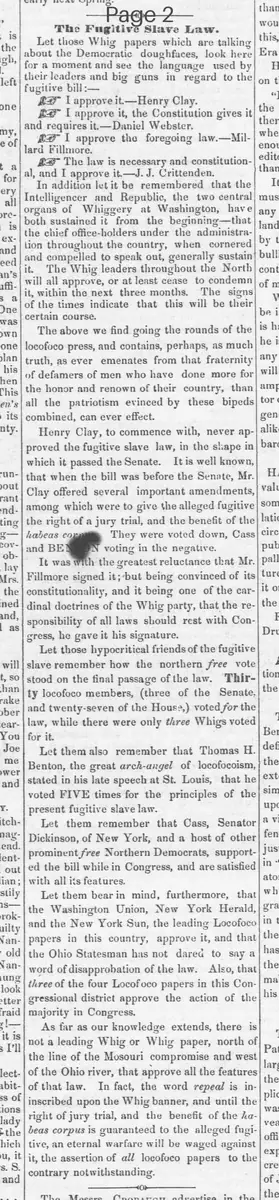
The Fugitive Slave Law.
Let those Whig papers which are talking about the Democratic doughfaces, look here for a moment and see the language used by their leaders and big guns in regard to the fugitive bill:-
I approve it.—Henry Clay.
I approve it, the Constitution gives it and requires it.—Daniel Webster.
I approve the foregoing law.—Millard Fillmore.
The law is necessary and constitutional, and I approve it.—J. J. Crittenden.
In addition let it be remembered that the Intelligencer and Republic, the two central organs of Whiggery at Washington, have both sustained it from the beginning—that the chief office-holders under the administration throughout the country, when cornered and compelled to speak out, generally sustain it. The Whig leaders throughout the North will all approve, or at least cease to condemn it, within the next three months. The signs of the times indicate that this will be their certain course.
The above we find going the rounds of the locofoco press, and contains, perhaps, as much truth, as ever emanates from that fraternity of defamers of men who have done more for the honor and renown of their country, than all the patriotism evinced by these bipeds combined, can ever effect
Henry Clay, to commence with, never approved the fugitive slave law, in the shape in which it passed the Senate. It is well known that when the bill was before the Senate, Mr. Clay offered several important amendments, among which were to give the alleged fugitive the right of a jury trial, and the benefit of the habeas corpus. They were voted down, Cass and Benton voting in the negative.
It was with the greatest reluctance that Mr. Fillmore signed it; but being convinced of its constitutionality, and it being one of the cardinal doctrines of the Whig party, that the responsibility of all laws should rest with Congress, he gave it his signature.
Let those hypocritical friends of the fugitive slave remember how the northern free vote stood on the final passage of the law. Thirty locofoco members, (three of the Senate, and twenty-seven of the House,) voted for the law, while there were only three Whigs voted for it.
Let them also remember that Thomas H Benton, the great arch-angel of locofocoism stated in his late speech at St. Louis, that he voted FIVE times for the principles of the present fugitive slave law.
Let them remember that Cass, Senator Dickinson, of New York, and a host of other prominent free Northern Democrats, supported the bill while in Congress, and are satisfied with all its features
Let them bear in mind, furthermore, that the Washington Union, New York Herald, and the New York Sun, the leading Locofoco papers in this country, approve it, and that the Ohio Statesman has not dared to say a word of disapprobation of the law. Also, that three of the four Locofoco papers in this Congressional district approve the action of the majority in Congress.
As far as our knowledge extends, there is not a leading Whig or Whig paper, north of the line of the Missouri compromise and west of the Ohio river, that approve all the features of that law. In fact, the word repeal is inscribed upon the Whig banner, and until the right of jury trial, and the benefit of the habeas corpus is guaranteed to the alleged fugitive, an eternal warfare will be waged against it, the assertion of all locofoco papers to the contrary notwithstanding
Let those Whig papers which are talking about the Democratic doughfaces, look here for a moment and see the language used by their leaders and big guns in regard to the fugitive bill:-
I approve it.—Henry Clay.
I approve it, the Constitution gives it and requires it.—Daniel Webster.
I approve the foregoing law.—Millard Fillmore.
The law is necessary and constitutional, and I approve it.—J. J. Crittenden.
In addition let it be remembered that the Intelligencer and Republic, the two central organs of Whiggery at Washington, have both sustained it from the beginning—that the chief office-holders under the administration throughout the country, when cornered and compelled to speak out, generally sustain it. The Whig leaders throughout the North will all approve, or at least cease to condemn it, within the next three months. The signs of the times indicate that this will be their certain course.
The above we find going the rounds of the locofoco press, and contains, perhaps, as much truth, as ever emanates from that fraternity of defamers of men who have done more for the honor and renown of their country, than all the patriotism evinced by these bipeds combined, can ever effect
Henry Clay, to commence with, never approved the fugitive slave law, in the shape in which it passed the Senate. It is well known that when the bill was before the Senate, Mr. Clay offered several important amendments, among which were to give the alleged fugitive the right of a jury trial, and the benefit of the habeas corpus. They were voted down, Cass and Benton voting in the negative.
It was with the greatest reluctance that Mr. Fillmore signed it; but being convinced of its constitutionality, and it being one of the cardinal doctrines of the Whig party, that the responsibility of all laws should rest with Congress, he gave it his signature.
Let those hypocritical friends of the fugitive slave remember how the northern free vote stood on the final passage of the law. Thirty locofoco members, (three of the Senate, and twenty-seven of the House,) voted for the law, while there were only three Whigs voted for it.
Let them also remember that Thomas H Benton, the great arch-angel of locofocoism stated in his late speech at St. Louis, that he voted FIVE times for the principles of the present fugitive slave law.
Let them remember that Cass, Senator Dickinson, of New York, and a host of other prominent free Northern Democrats, supported the bill while in Congress, and are satisfied with all its features
Let them bear in mind, furthermore, that the Washington Union, New York Herald, and the New York Sun, the leading Locofoco papers in this country, approve it, and that the Ohio Statesman has not dared to say a word of disapprobation of the law. Also, that three of the four Locofoco papers in this Congressional district approve the action of the majority in Congress.
As far as our knowledge extends, there is not a leading Whig or Whig paper, north of the line of the Missouri compromise and west of the Ohio river, that approve all the features of that law. In fact, the word repeal is inscribed upon the Whig banner, and until the right of jury trial, and the benefit of the habeas corpus is guaranteed to the alleged fugitive, an eternal warfare will be waged against it, the assertion of all locofoco papers to the contrary notwithstanding
What sub-type of article is it?
Slavery Abolition
Partisan Politics
Constitutional
What keywords are associated?
Fugitive Slave Law
Whig Defense
Democratic Support
Jury Trial
Habeas Corpus
Partisan Debate
Constitutional Amendments
What entities or persons were involved?
Henry Clay
Daniel Webster
Millard Fillmore
J. J. Crittenden
Thomas H. Benton
Lewis Cass
Senator Dickinson
Whig Party
Democratic Party
Washington Intelligencer
Washington Republic
Washington Union
New York Herald
New York Sun
Ohio Statesman
Editorial Details
Primary Topic
Defense Of Whig Reservations On Fugitive Slave Law
Stance / Tone
Defensive Of Whigs, Accusatory Toward Democrats
Key Figures
Henry Clay
Daniel Webster
Millard Fillmore
J. J. Crittenden
Thomas H. Benton
Lewis Cass
Senator Dickinson
Whig Party
Democratic Party
Washington Intelligencer
Washington Republic
Washington Union
New York Herald
New York Sun
Ohio Statesman
Key Arguments
Clay Offered Amendments For Jury Trial And Habeas Corpus, Voted Down By Cass And Benton
Fillmore Signed Reluctantly Due To Constitutionality And Whig Doctrine On Congressional Responsibility
30 Democrats Voted For The Law Vs. Only 3 Whigs In Northern Free Vote
Benton Voted Five Times For Principles Of The Law
Prominent Northern Democrats Like Cass And Dickinson Supported The Bill
Leading Democratic Papers Approve The Law
No Leading Northern Whig Papers Approve All Features; Whigs Call For Repeal Without Protections