Thank you for visiting SNEWPapers!
Sign up free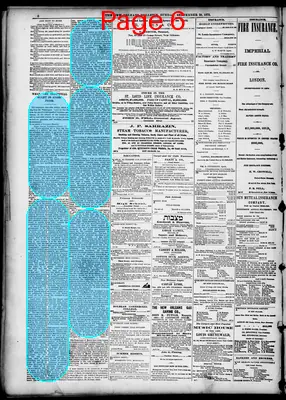
Editorial
September 26, 1875
The New Orleans Bulletin
New Orleans, Orleans County, Louisiana
What is this article about?
A Southern correspondent critiques a Scribner's Monthly article urging Southern participation in the 1876 Philadelphia Centennial for reconciliation, arguing that punitive post-Civil War laws like the iron-clad oath and flawed claims processes must be repealed first to restore true sectional harmony.
Clipping
OCR Quality
96%
Excellent
Full Text
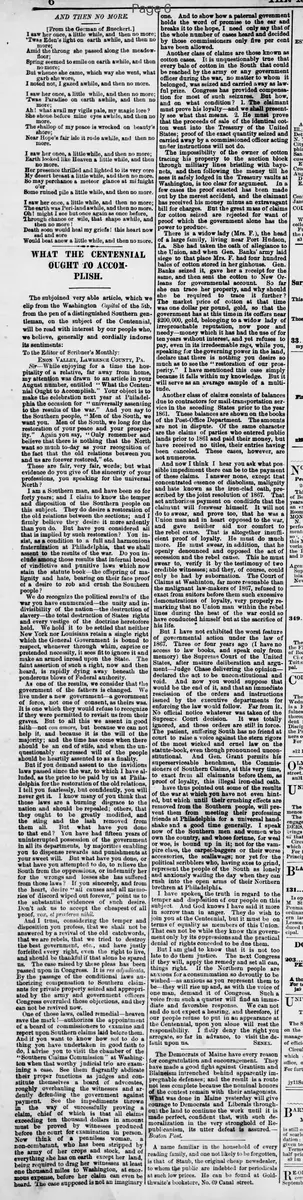
WHAT THE CENTENNIAL OUGHT TO ACCOMPLISH.
The subjoined very able article, which we clip from the Washington Capital of the 5th, from the pen of a distinguished Southern gentleman, on the subject of the Centennial will be read with interest by our people who, we believe, generally and cordially indorse its sentiments:
To the Editor of Scribner's Monthly:
Enon Valley, Lawrence County, Pa.
Sir—While enjoying for a time the hospitality of a relative, far away from home, my attention was drawn to an article in your August number, entitled "What the Centennial Ought to Accomplish." Your object is to make the celebration next year at Philadelphia the occasion for "universally assenting to the results of the war." And you say to the Southern people, "Men of the South, we want you. Men of the South, we long for the restoration of your peace and your prosperity." Again you say, "Only remember and believe that there is nothing that the North want so much to-day as your recognition of the fact that the old relations between you and us are forever restored," etc.
These are fair, very fair, words; but what evidence do you give of the sincerity of your professions, you speaking for the universal North?
I am a Southern man, and have been so for forty years; and I claim to know the temper and disposition of the Southern people on this subject. They do desire a restoration of the old relations between the sections; and I firmly believe they desire it more ardently than you do. But have you considered all that is implied by such restoration? You insist, as a condition to a full and harmonious fraternization at Philadelphia, that we shall assent to the results of the war. Do you include among those results that infernal brood of vindictive and punitive laws which now stain the statute book—the offspring of malignity and hate, bearing on their face proof of a desire to rob and crush the Southern people?
We do recognize the political results of the war you have enumerated—the unity and indivisibility of the nation—the destruction of slavery—the total destruction of States rights and every vestige of the doctrine heretofore held. We hold it to be settled that neither New York nor Louisiana retain a single right which the General Government is bound to respect, whenever through whim, caprice or pretended necessity, it sees fit to ignore it and make an armed inroad upon the State. The faint assertion of such a right, now and then heard, is rapidly dying away beneath the ponderous blows of Federal authority.
As one of the results, we consider that the government of the fathers is changed. We live under a new government—a government of force, not one of consent, as theirs was. It is one which they would refuse to recognize if they were permitted to revisit us from their graves. But to all this we assent in good faith—not con amore, but because we can not help it, and because it is the will of the majority; and the time has come when there should be an end of strife, and when the unquestionably expressed will of the people should be heartily assented to as a finality.
But if you demand assent to the invidious laws passed since the war, to which I have alluded, as the price to be paid by us at Philadelphia for the restoration of the old relations, I tell you fearlessly, but confidently, you will never get it. I know many of you think that those laws are a burning disgrace to the nation and should be repealed; others, that they ought to be greatly modified, and the sting and the lash removed from them all. But what have you done to that end? You have had fifteen years of uninterrupted possession of the government in all its departments, by majorities enabling you to dispense rewards and punishments at your sweet will. But what have you done, or what have you attempted to do, to relieve the South from the oppressions, or indemnify her for the wrongs and losses she has suffered from those laws? If you sincerely, and from the heart, desire "all causes and all memories of discord wiped out forever," point us to the substantial evidences of such desire. Don't ask us to accept the cheapest of all proof, vox, et praeterea nihil.
And I trust, considering the temper and disposition you profess, that we shall not be answered by a revival of the old catchwords, that we are rebels, that we tried to destroy the best government, etc., and have justly forfeited every right, even the right to live, and should be thankful if that alone be spared us. The case raised by these pleas has been passed upon in Congress. It is res adjudicata. By the passage of the conditional laws authorizing compensation to Southern claimants for private property seized and appropriated by the army and government officers Congress overruled those objections, and they can not be revived now.
One of those laws, called remedial—heaven save the mark!—authorizes the appointment of a board of commissioners to examine and report upon Southern claims laid before them. And if you want to know how not to do a thing you have undertaken in good faith to do, I advise you to visit the chamber of the "Southern Claims Commission" at Washington when that worthy judicial trio are examining a case. See them flagrantly abdicate their proper functions as judges and constitute themselves a board of advocates, roughly overhauling the witnesses and ardently defending the government against payment. See the impediments thrown in the way of successfully proving a claim, chief of which is that all claims exceeding ten thousand dollars in amount must be proved by witnesses produced before the court for examination in person.
Now think of a penniless woman, a non-combatant, who has been stripped by the army of her crops and stock, and of everything she has on earth except her land, being required to drag her witnesses at least one thousand miles to Washington, at enormous expense, before her claim can even be heard. The case supposed is not an imaginary one. And to show how a paternal government holds the word of promise to the ear and breaks it to the hope, I need only say that of the whole number of cases heard and decided by those commissioners only five per cent have been allowed.
Another class of claims are those known as cotton cases. It is unquestionably true that every bale of cotton in the South that could be reached by the army or any government officer during the war, no matter to whom it belonged, was seized and carried away as lawful prize. Congress has provided compensation for most of such seizures. But how, and on what condition? 1. The claimant must prove his loyalty—and we shall presently see what that means. 2. He must prove that the proceeds of sale of the identical cotton went into the Treasury of the United States; proof of the exact quantity seized and carried away by a commissioned officer acting under instructions will not do.
The impossibility of the owner of cotton tracing his property to the auction block through military lines bristling with bayonets, and then following the money till he sees it safely lodged in the Treasury vaults at Washington, is too clear for argument. In a few cases the proof exacted has been made out by the merest accident, and the claimant has received his money minus an extravagant bill for charges. But the great mass of claims for cotton seized are rejected for want of proof which the government alone has the power to produce.
There is a widow lady (Mrs. F.), the head of a large family, living near Port Hudson, La. She had taken the oath of allegiance to the Union, and when Gen. Banks' army laid siege to that place Mrs. F. had four hundred bales of cotton stored in her ginhouse. Gen. Banks seized it, gave her a receipt for the same, and then sent the cotton to New Orleans for governmental account. So far she can trace her property, and why should she be required to trace it further?
The market price of cotton at that time was one dollar per pound, gold, so that the government has at this time in its coffers near $200,000, gold, belonging to a widow lady of irreproachable reputation, now poor and needy—money which it has had the use of for ten years without interest, and yet refuses to pay, even in its irredeemable rags, while you, speaking for the governing power in the land, declare that there is nothing you desire so much as to see the "restoration of our prosperity." I have mentioned this case simply because it falls within my knowledge. But it will serve as an average sample of a multitude.
Another class of claims consists of balances due to contractors for mail-transportation service in the seceding States prior to the year 1861. These balances are shown on the books of the Post-Office Department. The amounts are not in dispute. Of the same character are the claims of parties who entered public lands prior to 1861 and paid their money, but have received no titles, their entries having been canceled. These cases, however, are not numerous.
And now I think I hear you ask what possible impediment there can be to the payment of these claims. I answer none, except that concentrated essence of diabolism, malignity and hate known as the iron-clad oath, prescribed by the joint resolution of 1867. That act authorizes payment on condition that the claimant will forswear himself. It will not do to swear, and prove too, that he was a Union man and in heart opposed to the war, and gave neither aid nor comfort to the rebel cause. That is altogether insufficient proof of loyalty. He must do much more. He must swear, in addition, that he openly denounced and opposed the act of secession and the rebel cause. This he must swear to, verify it by the testimony of two credible witnesses; and they, of course, could only be had by subornation. The Court of Claims at Washington, far more reasonable than the malignant law-makers of 1867, refused to exact from suitors before them such excessive demonstrations of loyalty, very properly remarking that no Union man within the rebel lines during the heat of the war could so have conducted himself but at the sacrifice of his life.
But I have not exhibited the worst feature of governmental action under the law of 1867. Three or four years ago (I have no access to law books, and speak only from memory) the Supreme Court of the United States, after mature deliberation and argument—Judge Chase delivering the opinion—declared the act to be unconstitutional and void. And now you would suppose that would be the end of it, and that an immediate rescission of the orders and instructions issued by the executive departments for enforcing the law would follow. Far from it. No official notice whatever was taken of the Supreme Court decision. It was totally ignored, and those orders are still in force. The patient, suffering South has no friend at court to raise a voice against the stern rigors of the most wicked and cruel law on the statute-book, even though pronounced unconstitutional. And Gen. Grant permits his superserviceable henchmen, the Commissioners of Southern Claims, at this very time, to exact from all claimants before them, as proof of loyalty, this illegal iron-clad oath.
I have thus pointed out some of the results of the war at which you have not even hinted, but which until their crushing effects are removed from the Southern people, will prevent them from meeting their professing friends at Philadelphia for a universal hand-shake and a good time generally. I speak now of the Southern men and women who own the country, and whose fortune, for weal or woe, is bound up in it: not for the vampire class, the carpet-baggers or their worse accessories, the scallawags; nor yet for the political scribblers who, having axes to grind, represent the people of the South as lonely and anxiously waiting the day when they can rush into the open arms of their Northern brethren at Philadelphia.
I have spoken the truth in regard to the temper and disposition of our people on this subject. And God knows I have said it more in sorrow than in anger. They do wish to join you at the Centennial, but it must be on terms of equality as members of this Union. That can not be while they know this government only by its oppressions and the practical denial of rights conceded to be due them.
But I am glad to know that it is not too late to do them justice. The next Congress if they will, can apply the remedy and set all things right. If the Northern people are anxious for a consummation so devoutly to be wished—as anxious as you represent them to be—they will rise up and, as with the voice of one man, demand it of Congress. Such a voice from such a quarter will find an immediate and favorable response. We can not and do not expect a hearing, and therefore, if our people refuse to put in an appearance at the Centennial, upon you alone will rest the responsibility. I flatly deny the right you arrogate, so far in advance, to visit the default upon us.
SENEX.
The subjoined very able article, which we clip from the Washington Capital of the 5th, from the pen of a distinguished Southern gentleman, on the subject of the Centennial will be read with interest by our people who, we believe, generally and cordially indorse its sentiments:
To the Editor of Scribner's Monthly:
Enon Valley, Lawrence County, Pa.
Sir—While enjoying for a time the hospitality of a relative, far away from home, my attention was drawn to an article in your August number, entitled "What the Centennial Ought to Accomplish." Your object is to make the celebration next year at Philadelphia the occasion for "universally assenting to the results of the war." And you say to the Southern people, "Men of the South, we want you. Men of the South, we long for the restoration of your peace and your prosperity." Again you say, "Only remember and believe that there is nothing that the North want so much to-day as your recognition of the fact that the old relations between you and us are forever restored," etc.
These are fair, very fair, words; but what evidence do you give of the sincerity of your professions, you speaking for the universal North?
I am a Southern man, and have been so for forty years; and I claim to know the temper and disposition of the Southern people on this subject. They do desire a restoration of the old relations between the sections; and I firmly believe they desire it more ardently than you do. But have you considered all that is implied by such restoration? You insist, as a condition to a full and harmonious fraternization at Philadelphia, that we shall assent to the results of the war. Do you include among those results that infernal brood of vindictive and punitive laws which now stain the statute book—the offspring of malignity and hate, bearing on their face proof of a desire to rob and crush the Southern people?
We do recognize the political results of the war you have enumerated—the unity and indivisibility of the nation—the destruction of slavery—the total destruction of States rights and every vestige of the doctrine heretofore held. We hold it to be settled that neither New York nor Louisiana retain a single right which the General Government is bound to respect, whenever through whim, caprice or pretended necessity, it sees fit to ignore it and make an armed inroad upon the State. The faint assertion of such a right, now and then heard, is rapidly dying away beneath the ponderous blows of Federal authority.
As one of the results, we consider that the government of the fathers is changed. We live under a new government—a government of force, not one of consent, as theirs was. It is one which they would refuse to recognize if they were permitted to revisit us from their graves. But to all this we assent in good faith—not con amore, but because we can not help it, and because it is the will of the majority; and the time has come when there should be an end of strife, and when the unquestionably expressed will of the people should be heartily assented to as a finality.
But if you demand assent to the invidious laws passed since the war, to which I have alluded, as the price to be paid by us at Philadelphia for the restoration of the old relations, I tell you fearlessly, but confidently, you will never get it. I know many of you think that those laws are a burning disgrace to the nation and should be repealed; others, that they ought to be greatly modified, and the sting and the lash removed from them all. But what have you done to that end? You have had fifteen years of uninterrupted possession of the government in all its departments, by majorities enabling you to dispense rewards and punishments at your sweet will. But what have you done, or what have you attempted to do, to relieve the South from the oppressions, or indemnify her for the wrongs and losses she has suffered from those laws? If you sincerely, and from the heart, desire "all causes and all memories of discord wiped out forever," point us to the substantial evidences of such desire. Don't ask us to accept the cheapest of all proof, vox, et praeterea nihil.
And I trust, considering the temper and disposition you profess, that we shall not be answered by a revival of the old catchwords, that we are rebels, that we tried to destroy the best government, etc., and have justly forfeited every right, even the right to live, and should be thankful if that alone be spared us. The case raised by these pleas has been passed upon in Congress. It is res adjudicata. By the passage of the conditional laws authorizing compensation to Southern claimants for private property seized and appropriated by the army and government officers Congress overruled those objections, and they can not be revived now.
One of those laws, called remedial—heaven save the mark!—authorizes the appointment of a board of commissioners to examine and report upon Southern claims laid before them. And if you want to know how not to do a thing you have undertaken in good faith to do, I advise you to visit the chamber of the "Southern Claims Commission" at Washington when that worthy judicial trio are examining a case. See them flagrantly abdicate their proper functions as judges and constitute themselves a board of advocates, roughly overhauling the witnesses and ardently defending the government against payment. See the impediments thrown in the way of successfully proving a claim, chief of which is that all claims exceeding ten thousand dollars in amount must be proved by witnesses produced before the court for examination in person.
Now think of a penniless woman, a non-combatant, who has been stripped by the army of her crops and stock, and of everything she has on earth except her land, being required to drag her witnesses at least one thousand miles to Washington, at enormous expense, before her claim can even be heard. The case supposed is not an imaginary one. And to show how a paternal government holds the word of promise to the ear and breaks it to the hope, I need only say that of the whole number of cases heard and decided by those commissioners only five per cent have been allowed.
Another class of claims are those known as cotton cases. It is unquestionably true that every bale of cotton in the South that could be reached by the army or any government officer during the war, no matter to whom it belonged, was seized and carried away as lawful prize. Congress has provided compensation for most of such seizures. But how, and on what condition? 1. The claimant must prove his loyalty—and we shall presently see what that means. 2. He must prove that the proceeds of sale of the identical cotton went into the Treasury of the United States; proof of the exact quantity seized and carried away by a commissioned officer acting under instructions will not do.
The impossibility of the owner of cotton tracing his property to the auction block through military lines bristling with bayonets, and then following the money till he sees it safely lodged in the Treasury vaults at Washington, is too clear for argument. In a few cases the proof exacted has been made out by the merest accident, and the claimant has received his money minus an extravagant bill for charges. But the great mass of claims for cotton seized are rejected for want of proof which the government alone has the power to produce.
There is a widow lady (Mrs. F.), the head of a large family, living near Port Hudson, La. She had taken the oath of allegiance to the Union, and when Gen. Banks' army laid siege to that place Mrs. F. had four hundred bales of cotton stored in her ginhouse. Gen. Banks seized it, gave her a receipt for the same, and then sent the cotton to New Orleans for governmental account. So far she can trace her property, and why should she be required to trace it further?
The market price of cotton at that time was one dollar per pound, gold, so that the government has at this time in its coffers near $200,000, gold, belonging to a widow lady of irreproachable reputation, now poor and needy—money which it has had the use of for ten years without interest, and yet refuses to pay, even in its irredeemable rags, while you, speaking for the governing power in the land, declare that there is nothing you desire so much as to see the "restoration of our prosperity." I have mentioned this case simply because it falls within my knowledge. But it will serve as an average sample of a multitude.
Another class of claims consists of balances due to contractors for mail-transportation service in the seceding States prior to the year 1861. These balances are shown on the books of the Post-Office Department. The amounts are not in dispute. Of the same character are the claims of parties who entered public lands prior to 1861 and paid their money, but have received no titles, their entries having been canceled. These cases, however, are not numerous.
And now I think I hear you ask what possible impediment there can be to the payment of these claims. I answer none, except that concentrated essence of diabolism, malignity and hate known as the iron-clad oath, prescribed by the joint resolution of 1867. That act authorizes payment on condition that the claimant will forswear himself. It will not do to swear, and prove too, that he was a Union man and in heart opposed to the war, and gave neither aid nor comfort to the rebel cause. That is altogether insufficient proof of loyalty. He must do much more. He must swear, in addition, that he openly denounced and opposed the act of secession and the rebel cause. This he must swear to, verify it by the testimony of two credible witnesses; and they, of course, could only be had by subornation. The Court of Claims at Washington, far more reasonable than the malignant law-makers of 1867, refused to exact from suitors before them such excessive demonstrations of loyalty, very properly remarking that no Union man within the rebel lines during the heat of the war could so have conducted himself but at the sacrifice of his life.
But I have not exhibited the worst feature of governmental action under the law of 1867. Three or four years ago (I have no access to law books, and speak only from memory) the Supreme Court of the United States, after mature deliberation and argument—Judge Chase delivering the opinion—declared the act to be unconstitutional and void. And now you would suppose that would be the end of it, and that an immediate rescission of the orders and instructions issued by the executive departments for enforcing the law would follow. Far from it. No official notice whatever was taken of the Supreme Court decision. It was totally ignored, and those orders are still in force. The patient, suffering South has no friend at court to raise a voice against the stern rigors of the most wicked and cruel law on the statute-book, even though pronounced unconstitutional. And Gen. Grant permits his superserviceable henchmen, the Commissioners of Southern Claims, at this very time, to exact from all claimants before them, as proof of loyalty, this illegal iron-clad oath.
I have thus pointed out some of the results of the war at which you have not even hinted, but which until their crushing effects are removed from the Southern people, will prevent them from meeting their professing friends at Philadelphia for a universal hand-shake and a good time generally. I speak now of the Southern men and women who own the country, and whose fortune, for weal or woe, is bound up in it: not for the vampire class, the carpet-baggers or their worse accessories, the scallawags; nor yet for the political scribblers who, having axes to grind, represent the people of the South as lonely and anxiously waiting the day when they can rush into the open arms of their Northern brethren at Philadelphia.
I have spoken the truth in regard to the temper and disposition of our people on this subject. And God knows I have said it more in sorrow than in anger. They do wish to join you at the Centennial, but it must be on terms of equality as members of this Union. That can not be while they know this government only by its oppressions and the practical denial of rights conceded to be due them.
But I am glad to know that it is not too late to do them justice. The next Congress if they will, can apply the remedy and set all things right. If the Northern people are anxious for a consummation so devoutly to be wished—as anxious as you represent them to be—they will rise up and, as with the voice of one man, demand it of Congress. Such a voice from such a quarter will find an immediate and favorable response. We can not and do not expect a hearing, and therefore, if our people refuse to put in an appearance at the Centennial, upon you alone will rest the responsibility. I flatly deny the right you arrogate, so far in advance, to visit the default upon us.
SENEX.
What sub-type of article is it?
War Or Peace
Constitutional
Partisan Politics
What keywords are associated?
Centennial Celebration
Post War Reconciliation
Southern Claims
Iron Clad Oath
Punitive Laws
Cotton Seizures
Loyalty Proof
Reconstruction Grievances
Sectional Harmony
What entities or persons were involved?
Scribner's Monthly
Southern People
Northern People
Congress
Supreme Court
Gen. Grant
Southern Claims Commission
Gen. Banks
Mrs. F.
Judge Chase
Editorial Details
Primary Topic
Southern Demands For Repeal Of Punitive Post War Laws To Enable Reconciliation At The Centennial
Stance / Tone
Critical Of Northern Insincerity And Governmental Oppression, Sorrowful Yet Firm In Demanding Justice
Key Figures
Scribner's Monthly
Southern People
Northern People
Congress
Supreme Court
Gen. Grant
Southern Claims Commission
Gen. Banks
Mrs. F.
Judge Chase
Key Arguments
Southerners Desire Restoration Of Sectional Relations More Than Northerners But Require Repeal Of Vindictive Post War Laws
Assent To Political Results Of War Like National Unity And End Of Slavery, But Not To Punitive Statutes
Southern Claims Commission Hinders Just Compensation Through Biased Procedures And Requirements
Cotton Seizure Claims Rejected Due To Impossible Proof Standards Despite Government Possession Of Proceeds
Iron Clad Oath Of 1867 Demands Perjury For Loyalty Proof, Unconstitutional Per Supreme Court But Still Enforced
Examples Like Mrs. F.'S $200,000 Claim Illustrate Governmental Injustice To Loyal Southerners
Mail And Land Entry Claims Undisputed But Blocked By Loyalty Oaths
Northern Control Of Government For 15 Years Has Failed To Relieve Southern Oppressions
True Reconciliation Requires Northern Demand For Congress To Repeal Oppressive Laws
Southern Participation In Centennial Conditional On Equality And Justice, Not Onus On South Alone